Back to the Jurassic

Posted on behalf of Henry Gee

Jurassic World

{credit}Universal studios and Amblin Entertainment Inc.{/credit}

If you have not seen Jurassic Park yet, I envy you. One of the greatest creature features of all time, Steven Spielberg’s tale of human hubris and a dinosaur theme park going horribly wrong is right up there with the original 1933 film King Kong, directed by Merian Cooper. I still remember seeing Jurassic Park for the first time — amazingly, 22 years ago — after which I reviewed it glowingly in Books and Arts.

 I saw Colin Trevorrow’s Jurassic World, the fourth in the franchise, at the very same theatre, only this time in IMAX and in 3D, and with an audience raised in a digital age and with higher expectations. They will not have had the unrepeatable experience of having first looked without preamble on Jurassic Park.

I shall not keep you in suspense: Jurassic World is a winner.

I won’t be spoiling anything to say that the plot is, in essence, the same as the franchise’s first three: Jurassic Park, The Lost World and Jurassic Park III. People travel to an island and meet dinosaurs. Some people are eaten by dinosaurs. Some of the dinosaurs eat one another. The rest of the people escape. Seen one, seen ’em all. Where Jurassic World succeeds is by upping the tooth count while at the same time nodding affectionately to the original in countless ways, large and small, all of which I shall leave it to you to discover.

Saurian resurrection

A reminder: Jurassic Park was set on the fictional Isla Nublar, off Costa Rica, which a wealthy entrepreneur has stocked with genetically engineered dinosaurs. They were brought back from extinction by mining ancient DNA, stitching the DNA together with DNA from modern animals, and, by dint of science-fictional macguffins and machines that go beep, resurrecting Tyrannosaurus rex, Velociraptor and their dentally advantaged chums — which then go on a killing spree. The action of the next two is set on a different island, Isla Sorna, where the spare dinosaurs were kept.

Jurassic World returns us to Isla Nublar. Here, the original Jurassic Park theme park has been revived and is a raging success. This gives the movie an instant lift, as it features the interaction between dinosaurs and a lot more people than the plots of films 2 and 3 allowed. Indeed, the second in the series had to have an ill-fitting appendix in which a transplanted T. rex goes on the rampage, Godzilla-style, in San Diego.

In Jurassic World, though, the dinosaurs are tame. Thousands of tourists see them close up, go canoeing down rivers accompanied by kindly stegosaurs and sauropods, queue for sanitised rides among the emasculated monsters, and watch a Sea World-style display with a leaping mosasaur. There is even a petting zoo — and not even an EVIL petting zoo — where small children can stroke baby dinosaurs that look like refugees from The Land Before Time.

It’s no surprise, then, that the park’s marketing department is on the lookout for more thrills to pique the public’s jaded palate. Dinosaurs are old hat, so they brief the lab to come up with something bigger, fiercer, and with more teeth. And so the lab combines tongue of dog, wool of bat, blindworm’s sting and several other proprietary ingredients to make a wholly invented beast, Indominus rex. It’s important, says marketing, that it has a name that can be pronounced by any four-year-old. Of course it is this creature that is the park’s nemesis.

Firmly featherless

There has been much talk on the dino-web about the antiquated look of the dinosaurs in Jurassic World. When the franchise kicked off in 1993, there was as yet no inkling that many dinosaurs, theropods in particular, had feathers. A modern recreation of a Velociraptor, for example, would have carried more or less abundant plumage. The dinosaurs in Jurassic World, though, remain firmly featherless, as if the discoveries of the past two decades had never been. And that’s exactly as it should be — for three reasons.

First, as palaeontologist and series adviser Jack Horner notes in his recent Q&A, to clothe the dinosaurs in feathers now would break the artistic continuity of the series. In the Jurassic Park ‘universe’, the dinosaurs are 1990s dinosaurs. For dinosaurs to be feathered we’d need a whole new franchise.

Second, nobody is going to thrill at somebody being brutally savaged by enraged poultry.

Third, the dinosaurs in these films aren’t really dinosaurs, but man-made recreations, sewn together with genetic material from other animals to suit human tastes, and whose relationship with the real dinosaurs of the Mesozoic is uncertain. This point is hammered home in an impassioned scene featuring the chief scientist Henry Wu (B. D. Wong) — perhaps significantly, the only character in Jurassic World to have survived from the very first film. These are not dinosaurs. They are dragons, designed to pique the same primal fear of the Worm that storytellers from the ancient Norse to J.R.R.Tolkien to George R. R. Martin know lurks in us all.

Henry Gee is a senior editor at Nature. His latest book is The Accidental Species. He blogs at https://cromercrox.blogspot.co.uk. Listen in to Gee, Nature reporter Ewen Callaway and features editor Rich Monastersky on a Backchat podcast here


For Nature’s full coverage of science in culture, visit www.nature.com/news/booksandarts.
Rediscovering Pluto on film

Posted on behalf of Alexandra Witze

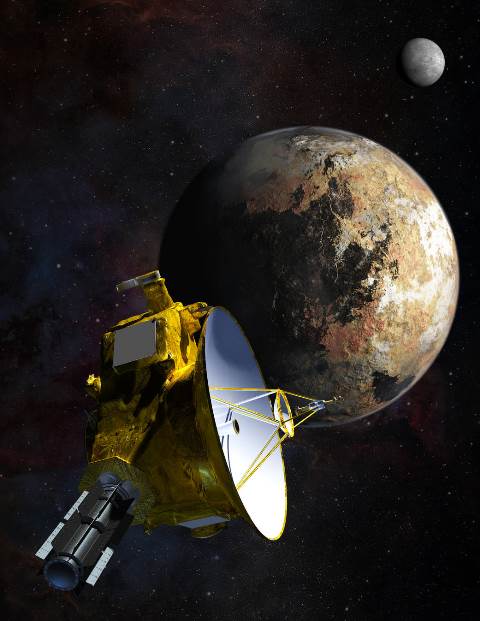
New Horzon approaching Pluto (artist's concept).

New Horizons approaching Pluto (artist’s concept).{credit}NASA{/credit}

There’s less than a month to get up to speed on all things Pluto, before NASA’s New Horizons spacecraft whizzes past the dwarf planet on 14 July.

Your best guide (aside from Nature’s Pluto special, of course) might just be the hour-long documentary The Year of Pluto. It will be out of date in a couple of weeks, but until then it serves as an excellent primer on the New Horizons mission and on what to expect during our first-ever close look at Pluto. Filmmaker Geoffrey Haines-Stiles has been producing science videos since Carl Sagan’s original 1980 Cosmos, and his experience shows in the film’s professionalism and focus.

The Year of Pluto begins with the 1930 discovery of Pluto by Clyde Tombaugh,  the Kansas farm boy-turned-astronomer at Lowell Observatory in Flagstaff, Arizona. The film then steps through the major discoveries involving Pluto, from the ices that coat its surface to its giant moon Charon.

Those breakthroughs came from astronomers using telescopes on the ground. Seeing Pluto in greater detail would take a planetary mission, a voyage that began in 1989 when Alan Stern asked NASA’s planetary chief Geoff Briggs why there was no mission to Pluto in the works. Stern and other young researchers soon coalesced as the “Pluto underground” to push for a spacecraft there, and 26 years later he is the principal investigator of New Horizons on the eve of its arrival.

The Year of Pluto explores the community of Pluto researchers — so expect a lot of footage of people sitting around at science team meetings, looking intently at computer screens. Faces that were fresh in the early 1990s are now lined, and a second generation is emerging to experience the thrill of the 14 July flyby.

Refreshingly, the film skips the debate about whether Pluto should be a planet, and focuses on the wider context of how it fits into the realm of icy bodies on the solar system’s fringe, known as the Kuiper Belt. Illustrations of eerie ice balls such as Haumea, Makemake and Eris offer a welcome perspective. No one knows what Pluto might look like, but worlds such as Neptune’s moon Triton, festooned with icy geysers, may give a clue.

Other essential Pluto reading includes Alan Boyle’s The Case for Pluto, a journalistic account of the battle over planetary nomenclature; Tombaugh’s own account of his discovery, Out of the Darkness; and Stern’s overview written with Jacqueline Mitton, Pluto and Charon.

If you haven’t the time for all these books, stick with The Year of Pluto. But watch it now — before it becomes obsolete.

Alexandra Witze is a correspondent for Nature in Boulder, Colorado. She tweets all things Pluto, and more, at @alexwitze.


For Nature’s full coverage of science in culture, visit www.nature.com/news/booksandarts.

The operatic Turing

Posted on behalf of Jo Baker

Alan Turing in 1951.

Alan Turing in 1951.{credit}Bocconi University, Wikimedia Commons. {/credit}

Music and language are codes. And Sentences, a new 30-minute work for chamber orchestra and voice by eclectic New York-based composer Nico Muhly, is a moving dialogue on abstraction and emotion in the life of British mathematician and wartime code-breaker Alan Turing. Turing is often portrayed as a binary individual – celebrated wartime hero and troubled genius, thought to have taken his own life in 1954. Even the title has a double meaning. Turing was sentenced to chemical castration in 1952 when homosexuality was illegal in the UK (he was posthumously ‘pardoned’ in 2013).

I was dazzled by the world premiere of Sentences at London’s Barbican Hall. The playing, by the inventive Britten Sinfonia with Muhly conducting, and the soaring otherworldly voice of countertenor Iestyn Davies, melded into a smart and unexpectedly moving speculation on the man behind the myth.

Turing’s tragic tale could have spawned a morose movie-soundtrack score, but Muhly’s influences are diverse. He has assisted minimalist composer Philip Glass (Q&A’d here), collaborated with pop original Björk (Q&A’d here), written film scores and operas. The depth of his music is matched by that of the libretto, from Adam Gopnik, the essayist and New Yorker regular. Gopnik wrangles with vexed questions: why do we project emotions onto machines; how can we infer the state of another; how do we extract meaning from a string of 0s and 1s?

Composer Nico Muhly.

Composer Nico Muhly.{credit}Barbican Centre, London{/credit}

The seven-part piece has a tightly structured rhythm, kicking off with a jittery edge. Alternating bass notes are enriched by trombones, violins and cor anglais. “Sentiments are sentences,” Davis sings. A broken bicycle wheel – link snapping every unlucky 13th turn – becomes the motif in part 2, backed by clacking knitting needles. Davis uses electronic loops to sing beguiling harmonies: “The weak link of the chain is the one that’s most revealing.” Flutes, xylophone, bells and piccolo bring an ethereal tone to Part 3, where Turing mourns the loss of his youthful lover Christopher Morcom to tuberculosis. “I’m glad the stars were shining.”

The orchestra gets busy in the passages on Turing’s computer work. Muhly employs a typewriter to elicit the sounds of Bletchley Park, where Turing worked during the war, deciphering German military messages. Binary codes are evoked in part 4 through oscillating sequences of notes and exotic percussion. “A zero, a one and the soul’s left behind.” Part 5muses on the mundane openings of secret messages, such as references to the weather.

Discord and unease mount in the final section.  “We read structure into chaos; meaning into nonsense; purpose into sounds”. Piercing tension, gongs and more knitting needles announce Turing’s death  by poisoned apple.  The sounds soften and dissipate: “The sentence ends.”

Muhly says his fascination with Turing began when he came across Steve Reich’s Three Tales (2002), a video opera on the march of technology that references cloning and artificial intelligence and asks what is and is not real, man-made or divine. Gopnik’s mother was a computer linguist who idolized Turing. The pair embarked on this commission — by the Barbican Centre, the Britten Sinfonia, Köln Musik GmbH and Festival de Saint-Denis — with some trepidation, given the spate of Turing vehicles such as the recent film The Imitation Game (reviewed here). But they set out to convey what may have been inside the great mathematician’s heart as well as his mind. They have succeeded.

Jo Baker is senior Comment editor at Nature.

Sentences plays next in Cologne on 21 June. Savour Philip Ball’s review of the opera Oppenheimer here, and a review of John Adams’s opera Doctor Atomic by Nature editor-in-chief Philip Campbell here.

 Correction: The Turing film reviewed was The Imitation Game, not Enigma.


For Nature’s full coverage of science in culture, visit www.nature.com/news/booksandarts.

A new chapter in scholarly impact

Posted on behalf of Jean Liu

use this Bookmetrix

{credit}© Springer/iStock [m]{/credit}

Imagine this: you’ve had a clinical research article published in a prominent medical journal, and you want to get the word out online. You post about your article on social media, then watch for any blog and media attention, scholarly citations, or references in public policy.

On the way to public engagement, scholarly influence, or policy impact, there are many useful signals and indicators to track. Since 2012, Altmetric has been collecting many of these possible signals of impact for journal articles. But can such services be extended to uncover the routes to impact for academic books?

Measuring and reporting on the impact of books can be a challenge. So the possibility of obtaining more data, such as any online mentions of books in news, public policy, social media and other sources, is an exciting prospect. This is an avenue we are currently exploring at Altmetric, and as part of a fruitful collaboration with Springer (who have now merged with our sister company, Macmillan Science & Education), we recently developed an innovative book-level metrics platform, Bookmetrix.

Launched last month, the pilot of Bookmetrix provides a comprehensive view of the citations, online mentions (including all sources tracked by Altmetric), reference manager readers, downloads, and reviews of Springer’s impressive output of over 194,000 academic books. That encompasses disciplines from science, engineering, and mathematics to the arts, humanities, and social sciences.

Every Springer book in the database has its own free, public-facing Bookmetrix details page, featuring any available metrics, raw data and visualisations for an individual Springer book or chapter.

Bookmetrix measures impact in a number of ways, including metrics by chapter.

Bookmetrix measures impact in a number of ways, including metrics by chapter.{credit}Altmetrics/Springer{/credit}

Those who will benefit the most from the Bookmetrix platform are Springer authors, who can, for the first time, monitor reader usage and engagement with their books and chapters immediately following publication. And along with universities and funding bodies, authors can potentially use Bookmetrix data within internal or external impact reporting. The Bookmetrix details pages help authors get credit for their work, and could be especially useful for researchers who publish mostly in book form, such as those working in the arts and humanities.

For publishers, the ability to view, compare and analyse various metrics for books in one place is also highly beneficial. A commissioning editor could identify books with particularly high numbers of online mentions, downloads, or citations, then infer whether there is a “trending” topic that deserves further exploration in a new book. “We need to be able to show authors and readers exactly how well our books and chapters have performed,” an editor told me during one of our user research focus groups.

Of course, how well a book has performed can be measured in many different ways. Bookmetrix isn’t the first comprehensive book database by any means – other innovative products, such as Thomson Reuters’ Book Citation Index or Nielsen BookScan have been useful in providing detailed citation data and retail sales figures, respectively. Even though Bookmetrix currently only shows data for Springer books, it is the first product of its kind to aggregate online mentions as well as various performance indicators, including downloads and citations.

There’s still much more to be done to expand new book-level metrics such as those seen in Bookmetrix, and it will be important to demonstrate their value to the wider scholarly community. At Altmetric, we are developing more advanced functionality around the tracking of online attention for books. The continued growth of book-level metrics will be a boon for research disciplines that primarily publish in book form, as these authors will finally have more powerful ways to trace the routes to impact of their works through the web and beyond.

Jean Liu is product development manager at Altmetric.


For Nature’s full coverage of science in culture, visit www.nature.com/news/booksandarts.