Inside Inside Out

Posted on behalf of Kerri Smith
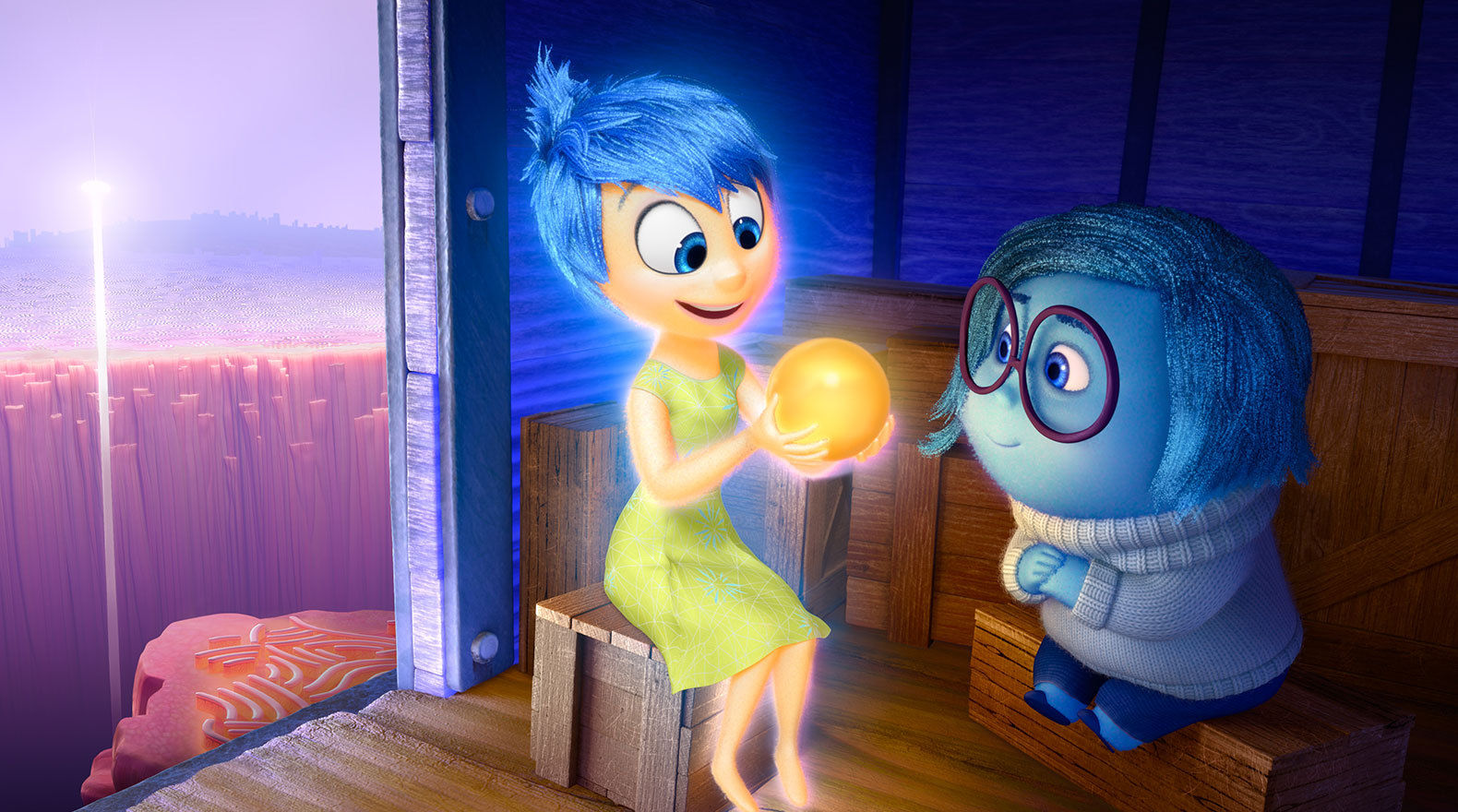
Joy and Sadness, two of the personified emotions in Pixar's Inside Out.

Joy and Sadness, two of the personified emotions in Pixar’s Inside Out.{credit}Disney/Pixar{/credit}

Moving emotional journeys are the stock-in-trade of animation studio Pixar. In their Toy Story trilogy, released in 1995, 1999 and 2010, little Andy’s toys compete for his affections as his family move, threatening to leave them behind. In the 2009 Up, even the opening sequence — a poignant recap of the elderly protagonist’s life story – had audiences blubbing.

In Inside Out, now on general release, it is the emotions – personified – that themselves go on a journey. The feelings of 11-year-old Riley are characters (Joy, Sadness, Anger, Disgust and Fear) lodged in a neuroscientifically improbable ‘Headquarters’ reminiscent of Rene Descartes’ pineal gland — the brain area where he imagined mind governed body. This volatile crew rev into action when Riley’s parents move the family from Minnesota to San Francisco, where she faces the first big challenges of an easy life: finding new friends, getting used to a new home and school.

As Riley navigates these changes, the narrative is driven by the interplay between her emotions – particularly Joy and Sadness — and their adventures in the wild kingdom of Riley’s psyche. Joy had had the upper hand in Riley’s life to date; the central message is of the crucial role of Sadness in forming Riley’s character as she makes the bitter-sweet transition from child to teen and beyond. The adventures of Joy and Sadness form a counterpoint to Riley’s as each navigates a thrilling narrative of lost and found.

The colours of emotions drench this film: golden for Joy and green for Disgust, for instance. They tint Riley’s experiences, which are delivered to HQ like bowling balls, and thence dispatched to be enshrined in memory or forever forgotten. Many travel along tubes to long-term storage, a maze of high shelves resembling the folds of cortex when seen from above. “Let’s get those memories down to long-term!” trumpets Joy, as Riley falls asleep at the end of a happy day. I found this a compelling portrayal of memory processing: neuroscientists know that memories spend a little time in the hippocampus, where they are made, before some are shuttled to the cortex for long-term storage.

Memory in the mind’s eye

Likewise, when Riley recalls one positive memory and it is projected onto a ‘mind’s eye’ screen for her emotions in HQ to see, Sadness reaches up to re-colour it. It is well-established that memories can be rendered malleable by being recalled, and then altered by new experience before being stored again.

A handful of experiences become core memories, each powering a different aspect of Riley’s personality. Others tumble to a dark chasm where they dissolve in wisps of dust. Forgetting isn’t always this passive – remembering competing facts can cause other related information to be forgotten, for instance, and forgetting can be beneficial, freeing up processing power for new memories.

Five emotions are quite enough for Inside Out’s writers to be getting on with, but there is some debate in psychology over how many we really have. American psychologist Paul Ekman, one of the film’s scientific consultants, would have liked to see upwards of 20; others argue that there can be no more than 4. I would have been interested in seeing Surprise and Embarrassment, but perhaps the latter will play a greater part in Inside Out 2: The Teenage Years.

The physical appearance of the emotions was unsurprising: Anger is a bright-red cube, Sadness a blue blob with a frumpy jumper, and Joy an elfin figure who left little particles of yellow glitter floating in her wake. But each had their own emotional range. Joy was sometimes sad, and often worried about Riley. Was this Pixar giving us a lesson on how our own emotions can blend, or could they not make the narrative work with relentlessly one-note characters? 

There are some witty asides aimed at adults. While travelling on the Train of Thought, for instance, Joy knocks over two boxes and spills their contents. “All these Facts and Opinions look the same!” she cries, trying to shovel them back in.

The brain’s fleshy chasms and labyrinthine neuronal libraries are an inspired choice for a filmic landscape. In Pixar’s treatment, brain are transformed into psychedelic fairgrounds (‘Imaginationland’) and dark, terrifying gulfs (the ‘Unconscious’). But even with this stiff competition, our three-pound lumps of squidgy pinkness are still more exotic, surprising and mysterious. As we learn more about how we processes and react to the complexities of our world, there will surely be plenty more to inspire Pixar.  

 Kerri Smith is Nature’s podcast editor. She tweets @minikerri.


For Nature’s full coverage of science in culture, visit www.nature.com/news/booksandarts.

Graphene structures at the cutting edge

Posted on behalf of Shamini Bundell

{credit}jannoon028/Pond5.com {/credit}

Did you ever make paper snowflakes as a kid? The kind where you fold a circle of paper several times, cut shapes out, then unfold it to reveal a beautifully symmetrical pattern? This is kirigami, the ancient Japanese art of paper cutting. Now physicist Melina Blees has applied the same technique to the ‘supermaterial’ graphene — strong sheets of carbon a single atom thick.

Blees, who works in Paul McEuen’s group at Cornell University in Ithaca, New York, has a background in the visual arts and so was used to getting to grips with the potential of a new material. What she didn’t realise was that this experience would help her turn graphene into tiny mechanical components for future nano-machines.

The Cornell team were working on a big sheet of graphene. One of the first things they did was start to physically explore its properties, like a child with a new toy. “We were sort of playing with these large sheets of graphene and it was crumpling and un-crumpling,” recalls Blees. They realised that it had the same kind of stiffness and flexibility as a sheet of paper. It was then that they thought of cutting it.

The team turned to kirigami (from kiru, meaning ‘to cut’, and kami, meaning ‘paper’), in which intricate three-dimensional shapes are formed from folding and cutting a sheet of paper. They picked up a children’s book on the technique and chose some of the simplest shapes.
 

Melina Blees talks about the kirigami shapes the Cornell team has made from graphene

Melina and her colleagues found themselves “sitting in a high tech lab with scotch tape and paper and scissors”. Their low-tech experimentation led to discoveries with amazing potential. One of the first was a method for turning a single sheet of graphene into a stretchable spring using just a few cuts.

 The group played around with different kinds of mechanical structures — pyramids, cantilevers and hinges — just a few tens of micrometres across. These basic components herald a day when physicists might make entire machines on minute scales.

Melina hopes to create tiny weighing scales from graphene springs, for instance, or to design nets that could lie over a living cell and measure electrical signals. Going smaller still, such approaches could one day allow the creation of nanoscale robots.

It’s difficult to imagine how things work at the micrometre scale with attendant differences in forces and properties. Scientists are usually one step removed from microscopic materials such as graphene, and have to use microscopes and robots to see and manipulate them. But Melina found that just poking at a sheet of graphene to see what happened was key to understanding its potential.

Kirigami graphene also shows what scientists can learn from art — and from going back to basics. High-tech experiments are all very well, but there’s a lot to be said for just messing about with materials. Now who wants to make a graphene snowflake?

Read the original Nature paper here. Shamini Bundell is a science communicator and multimedia editor at Nature. She tweets at @SBundell.


For Nature’s full coverage of science in culture, visit www.nature.com/news/booksandarts.
Neuroscience-tinged kids’ app put to the test

Posted on behalf of Hysell Oviedo and Siboney Oviedo-Gray

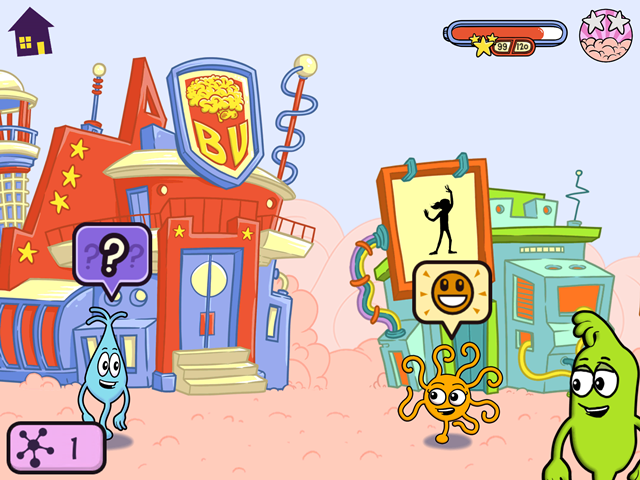
'Brain Street' in Kizoom's gamified neuroscience learning app, Brainventures.

‘Brain Street’ in Kizoom’s gamified neuroscience learning app, Brainventures.{credit}Kizoom{/credit}

I have two criteria for a game app for my daughter: it must assuage my guilty conscience when I’m not able to play with her, and contain no ads. Ideally I would want her to learn calculus while we wait at the airport security line (or to discover that lingering boredom can lead to creativity and observation). Realistically, I at least want her to learn something useful.

What that something is varies widely, from the physics puzzles starring candy-eating monster Om Nom in Cut the Rope (ZeptoLab) to the ruthless war strategizing in Supercell’s Clash of Clans, to good old-fashioned addition and spelling. A newish trend is apps that gamify learning, which taps into our reward and motivation systems to incentivize explicit learning (of world history, for example).

One such app is Brainventures from Kizoom, which my seven-and-a-half-year-old, Siboney, was excited to try. She played Kizoom’s Brain Jump when younger, and enjoyed a read-along vignette about neurons from the developers (the founder is a neuroscientist). Like Brain Jump, Brainventures draws heavily on classic psychophysical tasks: reaction time, memory, visual acuity. It connects Brain Jump’s star Ned the Neuron with many friends — including the competitive Pepper, dopey Big Rick, and Ada the focused.  

These neurons mainly teach us about the brain in quirky interactions via speech bubbles (such as,  Here in the brain we are just as busy when Sophie is sleeping,” says Buster. “Brain party all night!” responds another neuron). These speech bubbles risk being skipped by kids eager to get to the games. To illustrate the function of different neurons, the app gets kids to choose virtual children who need help from their neurons in their daily routine: “I like that we do stuff for Sophie,” said Siboney. That “stuff” includes turning cartwheels in a tricky timing task called Move It, catching the most nutritious food in Fuel Up, and Sort and Store.

Memories are made of this

Every task has increasing levels of difficulty. My favourite is Focus Pocus, the hide-and-seek version of a visual working memory task where kids have to remember objects presented briefly and track them in a fishbowl full of distractors. This demands sustained memory and attention, a rare feature in game apps.

Overall, the app makes it clear that neurons have to work together to do “stuff”, but that’s where the level of complexity stops. As a neuroscientist, I would have liked to see the game makers exploit more our vast knowledge of the marvelous anatomical differences between brain areas that perform different functions.

It’s arguable whether the game achieves the cognitive claims stated on Kizoom’s website (such as, “Take on quests to help the child grow brain power”). But the app does introduce the basic idea that an integrated network of neurons that perform different functions powers the brain. The psychophysical games are also well designed: it’s clear what to do but at the same time, they are challenging.

Brainventures satisfies one of the cardinal rules of a kids’ app: they can do it largely without parental help. The downside was that Siboney blasted through the app in about an hour, then started re-doing the levels. She played the game enthusiastically for about a week; then her interest waned. I surmise that Brainventures lacks some key elements of gamification — such as a virtual currency, missions and rewards — which reinforce a kid’s excitement and engagement, drive the desire for mastery and achievement, and hopefully, increase the potential for learning. But my biggest request to the game makers? Please add a pause button. 

Hysell Oviedo is a professor of neuroscience at The City College of New York, and the biology-neuroscience subprogramme at the CUNY Graduate Center. She studies the neural basis of animal communication. Her favourite science outreach project is leading a BioAnimation team of visual arts and biology students who make movies about how the brain works. She tweets at @hysell.

Siboney Oviedo-Gray’s favourite subjects are maths and grammar, her favorite city is Madrid, and she likes drawing, and cooking with mom.


For Nature’s full coverage of science in culture, visit www.nature.com/news/booksandarts.

Of mud pies, muscle and science education

digitalmedia.fws.gov

{credit}Steve Hildebrand, US Fish and Wildlife Service{/credit}

What really prepares the young for a life in science? This week a joint Nature and Scientific American special on STEM education attacks that question on a number of fronts. In Books and Arts, design practitioners Stephen Kellert and Günter Beltzig argue that young children need the complexity of natural environments and intelligently designed playspaces to learn the joys of discovery, teamwork and materials nous necessary for a life at the bench.

‘Old school’ physicality can also counterbalance the screen-based experiences in which many babies and toddlers are now immersed. As Nicholas Carr has noted in The Glass Cage: Automation and Us (reviewed by Silicon Valley insider Jaron Lanier here), the ease of clicking and swiping can actually hinder the exploratory urge per se, while an inability to navigate in the real world might ultimately affect memory.

Very twenty-first-century concerns, you’d have thought. Except that at the dawn of modern automation in the depths of the twentieth century, other original thinkers were coming to similar conclusions about science pedagogy in Nature.

H.G. Wells is now seen primarily as a pioneer of modern science fiction. In 1937, he was also serving as president of the section of the British Association on Educational Science, and his address to it (published in Nature on Wells’s centenary, in 1966) is as breezily contemporary as his SF was often technologically prescient. Discussing elementary education, he notes:

I see no need at this stage to afflict the growing mind with dates and dynastic particulars….we ought to make the weather and the mud pie our introduction to what Huxley christened long ago as Elementary Physiography. We ought to build up simple and clear ideas from natural experience.

H. G. Wells in 1920, by George Charles Beresford.

H. G. Wells in 1920, by George Charles Beresford.{credit}George Charles Beresford{/credit}

T.H. Huxley, ‘Darwin’s bulldog’, had instructed Wells in biology and zoology at the Normal School of Science in South Kensington, London, in the 1880s. Lower-middle-class and poor, Wells trained for a science teaching career, and founded the Science Schools Journal. He was, however, soon catapulted into writing — landmark SF, autobiographical novels and encyclopaedic factual works, including the 1929 biology tome The Science of Life (cowritten with evolutionist Julian Huxley and Wells’s son, marine biologist G.P. Wells).

Noting that children hunger to understand wild animals — “what their real excitements are, how they are sometimes timid” — he added, “I doubt if, in itself, vegetation can hold the attention of the young. But directly we begin to deal with plants as hiding-places, homes and food for birds and beasts, the little boy or girl lights up and learns.”

Over a quarter of a century later in 1964 the biologist and educator Cyril Bibby — known as “T.H. Huxley’s bulldog”  — published the pungent essay ‘Science as an instrument of culture’. In it, Bibby (who, like Julian Huxley among other biologists of the time, was a sometime contributor to The Eugenics Review) responded to C.P. Snow’s much-cited ‘two cultures’ lecture of 1959. He proposed an alternative dichotomy: scientists and creative artists on one side, and “purely verbal” scholars on the other.

The scientist and the artist day by day explore the properties of the stuff of the universe…for each the thing is primary and the word secondary; neither can get far without the involvement of the whole personality — mind and muscle, sensuous response to sensual stimuli, persistence and experimentation, reason and imagination.

Bibby inveighs against conformist pedagogy that fails to frame science as an “adventure of inquiry”. He bemoans how the “close, naked, natural” language of the Royal Society founders had given way to “an almost universal phobia of illuminating imagery, an endemic tendency to verbal flatulence”.  Science teaching, he argued, should regain both the “sensuous richness” of the arts, and the “verbal finesse” of literature. And it should tackle real-world issues at all scales — from public health and resource use, to experiencing “the force of magnetic attraction by the actual muscular effort of moving powerful magnets”.

Bibby admitted that his was “an unlikely vision…for a society wedded to verbalism, dominated by examinations, apparently determined at every educational level to spend more time and energy on measuring children’s achievement than on fostering it”. Just as Wells, back in 1937, fretted that at a time of rocketing innovation in military technologies, “our schools are drooling along much as they were drooling along 37 years ago”.

As we navigate our own high-tech rapids, such critiques sound strangely familiar. Have we got anything to lose by bringing mud pies and muscle back into science teaching for the young?


For Nature’s full coverage of science in culture, visit www.nature.com/news/booksandarts.


Sculpting deep time

Cloud Fire Head

Cloud Fire Head, caramel onyx, by Emily Young.{credit}The Fine Art Society, London{/credit}

Human culture is bedded in stone — from the 3.3-million-year-old rock tools dug up near Kenya’s Lake Turkana to China’s Great Wall. Spewed out by volcanoes, folded and transformed by pressure and heat, laid down by patient tides and currents, the stone in habitations, palaces, bridges and objects represents an intimate relationship between civilisation and deep time.

But even as the tactile nature of shaped stone still draws us, the historic technique of free carving is dying out with the advent of 3D printing and sculpting media that can range from polyamide to frozen blood.

 I was therefore intrigued to note concurrent London shows by two devotees of direct carving — Emily Young, and the late multimedia modernist icon Barbara Hepworth — a stone’s throw from each other.

Young (whose grandmother was the sculptor Kathleen Bruce, pupil of Auguste Rodin and widow of Scott of the Antarctic) is noted for bravura pieces such as colossal heads that can weigh several tonnes. Call and Response, her new exhibition at the Fine Art Society in London, features more heads, but at an intimate scale.

Emily Young working.

Emily Young at work.{credit}The Fine Art Society, London{/credit}

As I pass their ranks I am struck by the dazzling variety, mineral and textural. The veined and striated marbles, malachite, onyx and quartzite are saturated with powerful earthy hues or ethereally pale. Polished faces with Zen-like expressions emerge by degrees from rock left raw or deliberately roughened — like phases of the moon set in stone. In Cloud Fire Head, a profile juts from a translucent chunk of caramel onyx, swirled with an admixture of other minerals. The back of a dreaming head in montorsaio, a dolomitic limestone, is sheared at an angle like a boiled egg.

It got off lightly. “A lot of montorsaio is now smashed for gravel,” Young tells me, “along with the red marble rouge de vitrolle, once much used in Roman temples and palaces.” Young laments overextraction, and sources her raw material ethically. “What I like is unwanted, ‘unuseable’ stone. I have found amazing old blocks of it in defunct Italian quarries.”

Montorsaio Moon Head, Quartzite Head of a Woman 1, White Onyx Head of a Woman, Verdite Forest Head (all, Emily Young).

Montorsaio Moon Head, Quartzite Head of a Woman 1, White Onyx Head of a Woman, Verdite Forest Head (all, Emily Young).{credit}The Fine Art Society, London{/credit}

She shapes it experimentally, working with natural flaws and patterns to discover what to work and what to leave alone. “I respond to the stone. I try to do as little as possible: the material guides the work.” Insights into the behaviour of materials emerge from that process. She tells me how Zimbabwean verdite, a fuchsite-based, chromium-rich rock used for her Forest Head, shoots out molten globules rather than dust under the diamond drill.

Young’s ethos and practice are rooted in an understanding of the processes that create stone over millions or billions of years. “Stone tells us of the origins of the planet, as geological pioneer Charles Lyell found. And as a medium it will endure. Today’s environmental problems are based on short-term thinking. I’m taking the long view, making something based on the pragmatic realities of matter and energy, and trying to remind people that this is our physical heritage — a piece of our mindboggling Universe.”

Barbara Hepworth with the 1953 limestone Monolith (Empyrean) at her Whitechapel retrospective in 1954. (The sculpture is now sited at Kenwood House, London.)

Barbara Hepworth with the 1953 limestone Monolith (Empyrean) at her Whitechapel retrospective in 1954. (The sculpture is now sited at Kenwood House, London.){credit}The Hepworth Estate{/credit}

Across town at Tate Britain, Hepworth’s evocative pieces in stone shaped by chisel and mallet reveal different tensions. Many of her abstract forms are pierced, allowing interplay between space and mass and offering an exploration of inner form — as well as a window on new perceptions. As she wrote in the 1952 Barbara Hepworth: Carvings and Drawings: “I had felt the most intense pleasure in piercing the stone in order to make an abstract form and space; quite a different sensation from that of doing it for the purpose of realism.”

In this illuminating retrospective — the first in nearly 50 years — most of the stone sculptures on show are early and small-scale. Some are figurative, such as the beautiful Doves from 1927.

Doves (Group), Parian marble, 1927, by Barbara Hepworth.

Doves (Group), Parian marble, 1927, by Barbara Hepworth.{credit}© Manchester City Galleries{/credit}

Others are ‘biomorphic’, rounded organic abstractions that hint at the influence of mathematical biologist D’Arcy Thompson’s seminal treatise On Growth and Form (reviewed here) on Hepworth and fellow sculptors including Henry Moore. The monumental stoneworks Hepworth created at St Ives in Cornwall appear solely in a fascinating 1953 documentary film by Dudley Shaw Ashton, Figures in a Landscape.

The purity of form in Hepworth’s stone abstractions is one with the pristine marbles she often chose. She pursued another kind of harmony in dynamic relationships. In Two Forms of 1937, the negative space between the pair of tapering standing stones in Serravezza marble seems charged with meaning. Hepworth wrote of being gripped by “the unconscious grouping of people when they are working together, producing a spatial movement which approximates to the structure of spirals in shells or rhythms in crystal structure; the meaning of the spaces between forms, or the shape of the displacement of forms in space, which in themselves have a most precise significance.”

Double exposure of Two Forms, 1937, by Barbara Hepworth (photograph, gelatin silver print on paper).

Double exposure of Two Forms, 1937, by Barbara Hepworth (photograph, gelatin silver print on paper).
{credit}© The Hepworth Photograph Collection{/credit}

Ashton’s film underlines another relationship — between Hepworth’s works and the environment, specifically the Cornish landscape that inspired so much of her work. Eidos, a stone ovoid with concentric concavities, is shown lodged on a beach like some wave-washed boulder. Tall marble slabs with perforated edges echo lighthouses and megaliths.

The footage of Hepworth chipping away at the 3-metre limestone Monolith (Empyrean) of 1953 with equally monolithic patience calls to mind another passage in Barbara Hepworth: “it was not dominance which one had to attain over material, but an understanding, almost a kind of persuasion”. It is an approach Young would recognise. There is something profoundly meditative and inquiring about the work of these two material women. By piercing form, Hepworth allows a glimpse of its inner life. By finding where to let the raw rock speak for itself, Young allows a glimpse of deep time.  

Barbara Hepworth: Sculpture for a Modern World is at Tate Britain, London, to 25 October 2015, and features a number of large works in African hardwood and bronze not discussed here. Emily Young’s exhibition Call and Response is at the Fine Art Society, London, to 27 August; and the Madonna dell’Orto, Venice, Italy, to 22 November, as part of the Venice Biennale.


For Nature’s full coverage of science in culture, visit www.nature.com/news/booksandarts.

The bio-imaging artist

3Q: Louise Hughes

Coloured scanning electron microscope image of an ant spiracle.

Coloured scanning electron microscope image of an ant spiracle.{credit}Louise Hughes{/credit}

Biologist Louise Hughes heads the bio-imaging unit at Oxford Brookes University in the UK. Also a multimedia artist, she makes labwork-inspired jewellery — including gold pieces based on structures such as the hepatitis virus. Here she talks electron microscopy, centrioles and chromosome earrings.

How do you see the relationship of scientific images and art?

Bio-imager and multimedia artist Louise Hughes.

Bio-imager and multimedia artist Louise Hughes.

I have always considered microscopy images and data to be beautiful. During my master’s degree in biological electron microscopy, I learned how to take images using negative plates and film — the use of modern digital cameras in an electron microscope is relatively recent. I see electron microscopy as another form of photography, just using a rather complicated camera. Art and science are both ways of looking at the world. How we use images and produce the graphics that explain our interpretation of the information we receive differs between the two disciplines, but there is a process that is similar.

But there are differences in how you approach making art and science imaging?

Human karyotype rings.

Human karyotype rings.{credit}Louise Hughes.{/credit}

Both, for me, require clarity and I take a lot of care to ensure that the images or final pieces accurately convey the message I am attempting to get across. My approach to art is very emotional. It is therapeutic, a form of personal meditation. Science, of course, is generally approached at a far more objective level. There are specific questions that I attempt to address using microscopy and this often links into the functionality of the biological structures I am observing, including cells, organelles, molecules and viruses. It is not enough to simply capture descriptive data; it must be informative, focused on the research issue and is often published in collaboration with other forms of evidence — biochemistry, genetics or molecular biology, for example.

You make 3D objects based on microscopic images for research and outreach, and also as jewellery?

Adenovirus model.

Adenovirus model.{credit}Louise Hughes{/credit}

I use a combination of techniques, including microscopy, digital modelling and 3D printing, and make adjustments until I have created the item I want. For outreach I generally make large plastic printed models, as close a replica of the 3D data as I can manage. For jewellery, I print the model in wax using a 3D printer (for the ‘lost wax’ casting method), which ensures a high level of detail. At the moment my favourite metal to work with is bronze: I feel the colour and weight create really striking items. I use microscopic structures in jewellery because they are aesthetically satisfying, and also universally human: at the cellular/organelle level there is no difference in race, sexual orientation, religion, country, wealth. We all have the same cellular components. Viruses can infect any one of us. My personal favourites are centrioles and axonemes — micro-tube structures found in cells. These beautiful, fascinating, endlessly complex biological structures apply across a wide range of organisms and kingdoms. I am now expanding the range to incorporate structures such as organelles and macromolecules. My awe at this amazing miniature architecture is not going to diminish any time soon.

 Interview by Daniel Cressey, a reporter for Nature in London. He tweets at @DPCressey.


 For Nature’s full coverage of science in culture, visit www.nature.com/news/booksandarts.