Getting Brainy in Boston: Neuroscience news and Twitter, Facebook. Meetup lists

Lots of recent neuronews out of Boston so we’ve put together a Boston Neuroscience Twitter list, including local players, with a few national Tweeps of interest.

Summary: MIT’s Picower Institute for Learning and Memory prepares for its upcoming conference on, “New Insights on Early Life Stress and Mental Health” and two neuroscience imaging papers of note came out of Boston this week.

You are currently viewing a placeholder content from YouTube. To access the actual content, click the button below. Please note that doing so will share data with third-party providers.

More Information

NPR compared the images to a map of Manhattan, while here at Nature, we likened it to a scaffold.

The researchers imaged cubes of the brain a couple of millimeters across in living humans and half a millimeter across in dead animals from four other primate species. They used a technique called diffusion spectrum magnetic resonance imaging, which traces the path of axons by analyzing the flow of water through the brain.

  • MGH radiologists also contributed to another neuroscience imaging paper – like the first, published in Science – this one compared their imaging results to, “a human brain atlas based solely on genetically informative data….” Using a data-driven, fuzzy clustering technique with magnetic resonance imaging data from 406 twins, they parceled cortical surface area into genetic subdivisions, creating a human brain atlas based solely on genetic information.

Jérémie Cabessa  of the Umass Computer Science Department, writes in the journal Neural Computation. A Umass press release quotes her saying that her  a computing system is “modeled on the brain.” Here’s the abstract:

In classical computation, rational- and real-weighted recurrent neural networks were shown to be respectively equivalent to and strictly more powerful than the standard Turing machine model. Here, we study the computational power of recurrent neural networks in a more biologically oriented computational framework, capturing the aspects of sequential interactivity and persistence of memory. In this context, we prove that so-called interactive rational- and real-weighted neural networks show the same computational powers as interactive Turing machines and interactive Turing machines with advice, respectively. A mathematical characterization of each of these computational powers is also provided. It follows from these results that interactive real-weighted neural networks can perform uncountably many more translations of information than interactive Turing machines, making them capable of super-Turing capabilities.

For more on neuroscience in Boston we have listed the latest seminars below:

  •  Harvard
  • Tufts The Department of Neuroscience coordinates neuroscience educational and research programs within the Sackler School of Biomedical Sciences and the Tufts University School of Medicine
  • The Boston Action Club “presents a forum of interactive meetings on movement neuroscience for researchers in the Boston area. The series of talks is interdisciplinary bringing together presenters and audience from such disparate fields as Biology, Mechanical and Electrical Engineering, Physical Therapy and Rehabilitation Science, Psychology and Cognitive Science, Physics, and Kinesiology. The presentations are held in a highly interactive style, followed by more interactions in social gatherings.”

On Facebook:

On Yahoo; Neurotalks

Meetups: Link here for the list or go straight to the  “Neurosceince and Ssociety “ meetup page.
 

Fear of the Light

fear-of-the-light**PLEASE SEE UPDATES BELOW**

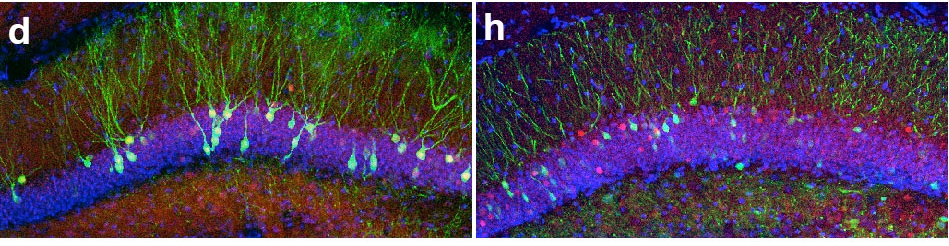
It is commonly believed that distinct mini-networks of neurons, firing together, may be the means by which memories and other conceptual encoding requirements are handled in the brain. However, it is only recently that we have had the tools available to directly test the sufficiency of such a mechanism. Today, a new study in Nature from the lab of Susumu Tonegawa documents the ability to use light as a means to activate distinct subsets of neurons responsible for the encoding of fear memories.

Continue reading

Parietal decision sequences – and more of mice and monkeys

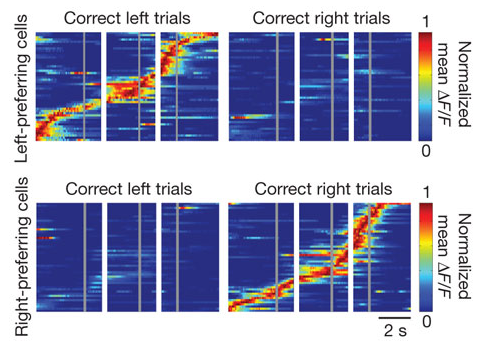
From Figure 2 of Harvey et al

Back in the 1990’s, one of the most intense battlegrounds in systems neuroscience was in monkey posterior parietal cortex. Labs competed to claim what a little strip of cortex called lateral intraparietal area (LIP) really does – decision, movement planning, attention, reward, or all of the above – mostly using single cell recording in behaving monkey. The experiments were (and still are) tough: standard operating procedure requires a well-trained monkey who will perform hundreds if not thousands of trials a day and then isolating neurons one at a time to find ones that respond during some interesting part of the trial. And then lots and lots of repetition so that you can average over many neurons. All things considered, it’s remarkable how much the field has been able to learn with this toolbox.

Fast forward to present day, there’s a new kid on the block. As I discussed a few weeks ago, rodent behavior and physiology is booming. People are taking on questions previously studied mainly in primates and are taking full advantage of the recent storm of new techniques. This is typified by today’s paper by Chris Harvey, Philip Coen, and David Tank, which goes back to the question – what does posterior parietal cortex do during a decision task?  They imaged populations of neurons while mice used visual cues to navigate a virtual maze. Just like in primates, individual neurons were selective for different choices that the mouse made. But unlike in primate parietal cortex, where neurons tend to have sustained responses leading up to the time of decision, individual neurons responded transiently in different portions of the trial. So as a population, different choices were represented by distinct sequences of neuronal activity. This kind of sequential firing has been seen in other parts of the rodent brain such as hippocampus, but not in posterior parietal cortex.  Continue reading

The Fine Architecture of Learning and Joint Publication

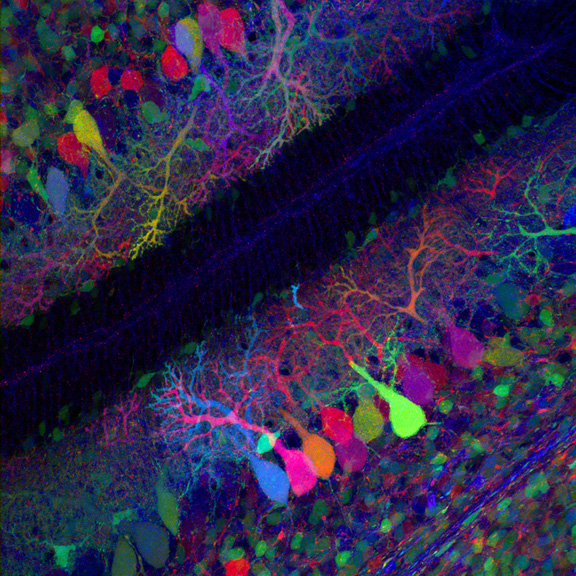
(image courtesy of Svoboda lab, https://openwiki.janelia.org/wiki/display/SvobodaLab/Research)

You warily walk into a dark compartment, wondering if there is food inside. Suddenly there is a loud tone and you feel an uncomfortable surge of electricity through your feet. This goes without saying, but it won’t take long before you will learn to be afraid of that tone. However, over time, you hear the tone without the shock, and slowly (foolishly??) accept that the previous connection may no longer hold.

Or perhaps you are extremely motivated to work for food, given that in your home area, nutrition has been sparse and hard to come by. You see millet seeds seemingly just within the reach of your fore-limb. Though not a typical movement for you, you reach for it. In another instance, you find a different type of food that is difficult to handle. However, it is nourishment nonetheless, so you will learn the required motor skills.

SPOILER ALERT: In each of the above cases, you were a mouse the whole time (I know!) But this is a neuroscience blog, not M.Night Shyamalan’s IMDB page, so perhaps we should focus on what was taking place in the brain as each scenario played out. In both of the cases above, learning was occurring, with new information stored away within the appropriate neural connections of particular brain areas. These situations are on display in a pair of new(ish) papers out in Nature, exploring the structural substrates of such learning and identifying patterns underlying the observed structural changes as learning occurred. Continue reading

Layer magic and monkey business

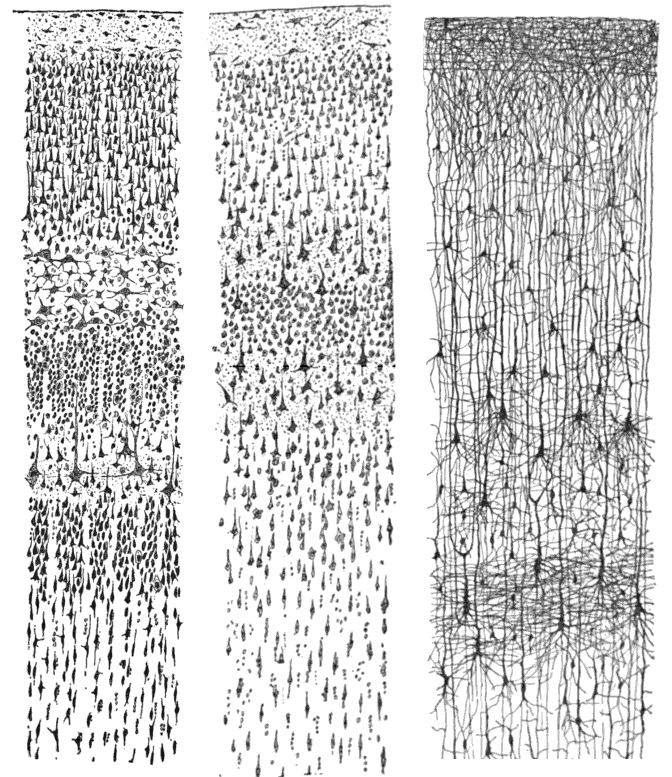
Layers of human cortex drawn by Ramon y Cajal. Image from Wikimedia Commons

We’ve known for over a century that sensory cortex is arranged in distinct layers, each containing a different make up of neuronal types and projection patterns, but we don’t actually know that much about the actual computations performed in each layer.  Today a paper from Massimo Scanziani’s lab takes a big step towards cracking the function of the bottom layer (layer 6) in mice. Layer 6 neurons project both to upper cortical layers and to the lateral geniculate nucleus in the thalamus, which itself is the primary input to cortex, and so are primed to play a large modulatory role. Using a monumental combination of optogenetics, intracellular recording, and behavioral testing, the paper convincingly makes the case that layer 6 controls the gain of visual responses of upper layer neurons (i.e. changes the size of their responses without altering their selectivity). Gain control is a fundamental computation in cortex, and has been invoked as a mechanism for attention, perception, spatial processing, and more. The cellular mechanism here is worked out in primary visual cortex, but it could potentially operate throughout layered cortex.

Continue reading

Telepathy? I think not

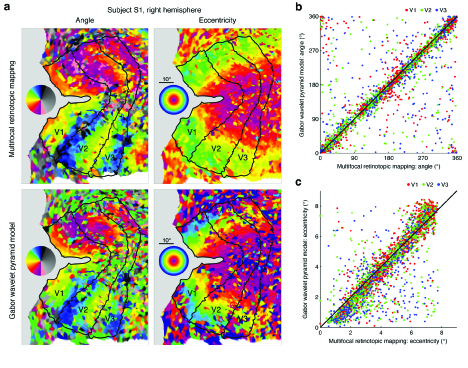
From Supp Fig 10 of Kay et al.

There is just something about neural decoding that captures the imagination. Scientists “reading out brain activity” to infer what someone was seeing or doing sounds like the stuff of science fiction. But in practice, with the right dataset and right computer algorithm, it can be done – providing the question you are trying to query the brain is simple enough. But no matter how simple the question, with every paper comes an orgy of stories in the mainstream press about how scientists can eavesdrop on your thoughts or even engage in electronic telepathy. Thereby infuriating scientists and science journalists in droves, sometimes detracting from some very cool work.

Today I’m going back a few years to a paper that typifies this effect, a study from Jack Gallant‘s lab about a model for decoding natural images from fMRI activity in early visual cortex.

Continue reading

AstraZeneca to cut 2,200 R&D jobs

As part of a major restructuring programme, pharmaceutical company AstraZeneca announced yesterday it would be cutting 2,200 jobs from its research and development (R&D) workforce.

The bulk of job losses will affect employees in its neuroscience arm as the company looks to outsource more of its R&D via external collaborations. It will set up a ‘virtual’ neuroscience research unit comprising 40 to 50 AstraZeneca scientists working with partners in academia and industry, such as the Karolinska Institute in Sweden. The unit will be based in Boston, United States, and Cambridge, United Kingdom, while R&D activities will cease at two sites that are focused on neuroscience: Södertälje in Sweden and Montreal in Canada.

In a statement, AstraZeneca’s president of R&D, Martin Mackay, said: “We’ve made an active choice to stay in neuroscience though we will work very differently to share cost, risk and reward with partners in this especially challenging but important field of medical research.”

Awakening dormant genes with cancer drugs

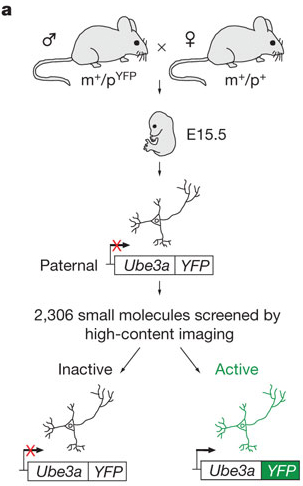
From Figure 1 of Huang et al.

Here’s one that first appeared online at the end of last year by Benjamin Philpot, Bryan Roth and Mark Zylka about a finding that could lead to a therapy for Angelman Syndrome. Angelman syndrome is a rare neurodevelopmental disorder affecting 1 in 15,000 live births and is characterized by developmental delay, lack of speech, seizures, and motor difficulties. There are no therapies available for core symptoms and individuals generally require care throughout life. Autism is often diagnosed in Angelman Syndrome individuals, and the same genomic region has been fingered as a culprit in both disorders. Angelman Syndrome is most commonly caused by deletion of a region on the maternal copy of chromosome 15 containing the gene UBE3A, conversely, some forms of autism may also be caused by duplication of this region.

Although we all possess two copies of UBE3A, only the one inherited from the mother is active. Normally, the paternal copy is epigenetically silenced. This means that in Angelman Syndrome there is no functioning copy at all, which has consequences for multiple signaling pathways and brain circuits. The authors of this paper set out to find a workaround: something that could activate the intact, but dormant, paternal copy of UBE3A.  They made a reporter assay from neurons of mice expressing fluorescent paternal UBE3A protein, and performed a large-scale drug screen, testing over 2000 compounds for ones that would activate paternal Ube3A. None of the most likely suspects worked, but an unlikely class of drugs, topoisomerase inhibitors, did so reliably. Even better,  one of the best (topotecan) is already an FDA-approved cancer drug.

Continue reading

Patients help bring the study of Alzheimer’s to the dish

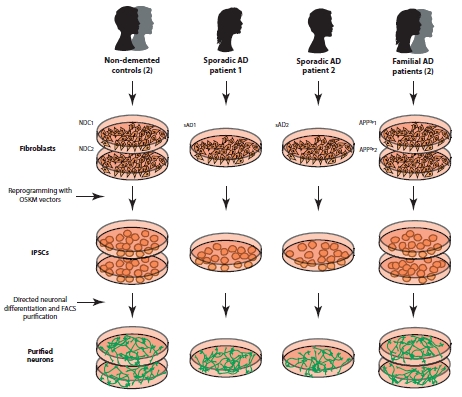
Israel et al. Supp Fig1: Experimental design.

Alzheimer’s disease (AD) is a devastating neurodegenerative disease that could become an even more massive public health problem than it already is, if current projections hold. Some predict that by 2050, 1 in 85 individuals will be affected by the disease. Currently, there is no cure, but there are neurotransmitter-enhancement-based strategies to slow down the cognitive deficits [the loss of cholinergic neurons is implicated in some of the memory problems associated with AD so therefore, pharmacological enhancement of brain acetylcholine concentration can partially alleviate some memory-based symptoms.] However, as with many neurodegenerative diseases, these stop-gap treatments only work for so long, until the cells responding to neurotransmitter supplementation treatments die off completely. Therefore, diverse strategies designed to cure or at least slow down AD are imperative.

While a number of AD transgenic mouse models have been created, based on the various mutations identified in patients, the trouble is that these models still utilize the cross-species approach of studying “diseased” mouse neurons expressing mutated human genes. And perhaps an even bigger problem with many mouse models, genetically-inherited forms of AD represent only ~0.1% of cases, with the remainder being “sporadic” (although there are genetic risk factors influencing the emergence of sporadic AD.)

Continue reading

Timely inhibition

Image: Tamily Weissman

This week’s paper is by Abigail Person and Indira Raman and is about information transmission between two cell populations in the cerebellum – purkinje cells in the cortex and their targets in the deep nuclei. Purkinje cells are justifiably famous for their spectacular anatomy  which enables integration of thousands of inputs. This paper, however, is about their output and how these exclusively GABAergic cells control the activity of downstream neurons. Conventional wisdom holds that there should be a straightforward inverse relationship between the firing rate of the two populations, but this has not always been observed. Person and Raman present a new solution based on spike timing – when purkinje cells spike asynchronously, their targets are inhibited (as expected), but when they spike synchronously, nuclear neurons can spike during the gaps in inhibition and end up time locking their activity to their inputs.

This is an intriguing proposal for how information is transmitted in the cerebellum that could have implications for how this brain structure controls movement, but it’s just the first step. The proposal is built from in vitro experiments, deduction, and some supporting in vivo data, but several crucial unknowns have to be resolved before we’ll know whether it’s relevant to actual behavior. There was plenty of spirited discussion during the review process about the strength of some of the authors’ assumptions. There were deeply divided views on whether the authors had made sufficiently strong a case for how the cerebellum IS operating, as opposed to just proposing how it COULD be. We had to decide whether to publish a paper that everyone agreed was interesting, but one that contained some pieces of indirect evidence and some good (but by no means universally agreed-upon) assumptions.

Continue reading