Beyond the Antikythera mechanism

Posted on behalf of Jo Marchant

'The Wrestler', a marble sculpture from the Antikythera shipwreck showing wear on the side not buried in sand.

One of the first-century BC marble sculptures from the Antikythera shipwreck, showing wear on the side not buried in sand.{credit}Copyright: Jo Marchant{/credit}

The sea has great destructive power, but it can also preserve. A new exhibition of 2,000-year-old artefacts retrieved in 1900 from a shipwreck near the Greek island of Antikythera includes some breathtakingly pristine treasures — such as a bowl made of delicate coils of turquoise, yellow and purple glass, and a miniature golden figure of Eros hanging from an earring set with garnets, an emerald and 20 tiny pearls.

The ancient ship is famous for having contained a geared astronomical device from the first century BC, dubbed the Antikythera mechanism.  What’s less well known, however, is that the rest of its cargo is hugely important too: a dizzying collection of items from statues to ships’ nails that provide a unique insight into first-century-BC seafaring and trade.

The exhibition, called “The Sunken Treasure: The Antikythera Shipwreck”, includes hundreds of items on loan from Athens’ National Archaeological Museum – the first time they have been permitted to leave Greece – and runs at the Basel Museum of Ancient Art and Ludwig Collection in Switzerland until 27 March 2016.

The journey down

Curator Esaù Dozio and Paris-based exhibition designers Studio Adeline Rispal clearly want to take visitors on a journey. To enter the exhibition, we descend into a black-walled room with elegantly placed bronze and marble statues set against the ocean displayed on a 16-metre-wide screen. According to the notes, we’re in a Roman seaside villa. Around 70 BC, when the Antikythera ship sailed, wealthy Romans loved to decorate their homes with Greek artworks, and commissioned thousands of ships to deliver them from territories in the eastern Mediterranean.

The Exosuit

Photo of the Exosuit, a US$1-million wearable submarine used at Antikythera in 2014, with marble finds from the wreck.{credit}Copyright: Jo Marchant{/credit}

Then we take a voyage, filing past a model of a Roman cargo vessel, and ship components retrieved from the Antikythera wreck itself, including a bilge pipe, hull planking, bronze nails and rigging rings. Next come cooking pots and oil lamps used on board, and what may have been the belongings of an aristocratic passenger – gold jewellery, and silver coins from Pergamum and Ephesus on the Asia Minor coast. Found near female skeletal remains, these items have sparked stories of a royal bride travelling to Rome with her dowry.

We descend a ramp to the sound of whistling wind and emerge on the seabed, another black room with marble statues from the shipwreck artistically arranged on piles of white-painted pebbles. The effect is beautiful yet ghostly. The torso of a horse – one of four that may have formed a chariot group – lies stranded on the stones. Crouching nearby is a naked boy. His head and half of his body (presumably protected over the millennia by being buried in sand) are exquisitely preserved, while his other arm and leg are rough, pitted stumps eaten away by the sea.

These marbles date from the first century BC, made of stone from the Aegean island of Paros. Meanwhile bronze statues, held in glass cases against the walls, are thought to date from the second and third centuries BC, already antiques when loaded onto the ship. These are mostly in pieces, including the arm of a boxer with a bandage-wrapped hand, and a philosopher’s head with piercing glass eyes and tousled hair. The missing parts are presumably still buried below the seabed.

Mosaic bowl.

Patterned ‘mosaic’ bowl.{credit}Copyright: Jo Marchant{/credit}

Other items provide a snapshot of thriving Mediterranean trade: there’s glassware from Alexandria; fragments of a wood-and-bronze couch, probably from the island of Delos; and wine jars from Kos and Rhodes. A small room dedicated to the Antikythera mechanism doesn’t contain the surviving fragments (these are too fragile to leave Athens) but does feature several models – of the mechanism itself and other ancient geared devices, including the “sphere of Archimedes” described by the Roman writer Cicero.

Technological shifts

The exhibition also nods to the changing technology used to explore the wreck. On the “seabed”, we see a canvas diving suit like the one used by sponge divers to salvage the 55-metre-deep site in 1900; a model of the boat used by marine researcher Jacques Cousteau when he investigated the wreck in 1976; and a giant photograph of the Exosuit, a US$1-million wearable submarine deployed at Antikythera in 2014.

That latest project, directed by Brendan Foley of Woods Hole Oceanographic Institute in Massachusetts with archaeologists from the Greek Ephorate of Underwater Antiquities, aims to discover whether any of the ship’s cargo remains buried on the seabed. In September 2015, divers retrieved items including a blue game pawn, sections of a bone flute and pieces of mosaic glass. They hope future excavations might yield more statues, or even another mechanism, to add to the items on display.

But the Antikythera collection is opening up in another way too. As well as excavating the wreck site, Foley says he is determined to carry out as many scientific tests as possible, not just on new discoveries but on the existing artefacts. For example, lead isotope analysis on the ship’s hull sheeting should show where it was built, while DNA analysis on the contents of ceramic jugs and jars may reveal the contents of the foodstuffs, medicines and perfumes they held.

Bronze statuette discovered by researcher Jacques Cousteau in the 1970s. Its base may have rotated when a key was inserted.

Bronze statuette discovered by researcher Jacques Cousteau in the 1970s. Its base may have rotated when a key was inserted.{credit}Copyright: Jo Marchant{/credit}

Other possibilities include fracture analysis on the bronze statue pieces to investigate how and when they broke, and X-ray imaging. A prime candidate for X-ray analysis is a bronze statuette discovered by Cousteau’s team in 1976. It stands on a circular base with what looks like a broken-off key on the front. According to the exhibition notes, a mechanical device inside the base rotated the statue when this key was turned. Yet this idea has never been investigated or confirmed. The statue dates from the second century BC, so if X-ray imaging does reveal an internal mechanism, this statuette would trump the Antikythera mechanism as the world’s oldest known geared device.

The Basel exhibition is truly stunning, but for me, the most exciting thing about this collection is the paradigm shift now being driven by Foley and his team. Since 1900, these objects have been beautiful but static, seen merely as artworks to be admired and conserved. The introduction of a scientific approach promises to transform them into a dynamic, rich source of new information about this fascinating period of ancient history.

Jo Marchant is author of a book about the Antikythera mechanism called Decoding the Heavens: Solving the Mystery of the World’s Computer. Her next book, Cure: A Journey into the Science of Mind over Body, will be published by Canongate in February 2016.

For Nature Video’s film Building the Sphere of Archimedes, see here. For Nature’s full coverage of science in culture, visit www.nature.com/news/booksandarts.

Hunger games: food security on stage and screen

Metta Theatre's production of Lydia Adetunji's play Bread on the Table, Trafalgar Studios, London.

Metta Theatre’s production of Lydia Adetunji’s Bread on the Table juxtaposes food commodity trading and starvation in poorer countries.{credit}Richard Davenport{/credit}

A Nigerian farmer feeds her last cow to a man who pays with his life. A biologist in an agribusiness-dominated dictatorship risks death by growing potatoes. An official in a world of water wars tortures a man dehumanised by thirst.

Mouthful, a set of six playlets at London’s Trafalgar Studios, offers pungent glimpses — some bleakly comic, some harrowing — of food crises real and potential. It joins a spate of films — including the documentaries 10 Billion and Land Grabbing — and books re-examining the issues to ask how and why hunger still haunts us, after decades of humanitarian and scientific effort, and enshrinement in the Millennium Development Goals.

Some 795 million people remain malnourished, according to the UN Food and Agriculture Organization. But globally, the complexities of food production, distribution and consumption create another kind of havoc. The World Health Organization notes that over 600 million adults are obese. Humanity’s relationship with food has become intractably tangled in tandem with population growth, globalisation, economic inequities, and technological changes such as factory farming and food processing. We swim in a bouillabaisse of biotech agribusiness, threatened crop biodiversity, rising food prices, and a vast tonnage of wasted food.

Alisha Bailey of Metta Theatre in Neil LaBute's drought-ridden dystopia 16 Pounds.

Alisha Bailey of Metta Theatre in Neil LaBute’s drought-ridden dystopia 16 Pounds.{credit}Richard Davenport{/credit}

Six scientists steeped in the issues collaborated with the six playwrights behind Mouthful. Thus Tim Benton,  champion of the UK Global Food Security programme, teamed up with renowned film director and writer Neil LaBute for his drought-bound dystopia 16 Pounds (Benton also helped hammer out issues explored by all the plays). Lydia Adetunji, whose trenchant Bread on the Table picks at the link between food commodification and the Middle East food riots, worked with plant breeder Molly Jahn. The researchers were sounding boards and fact checkers, ensuring assertions were evidence-based, and suggesting real-world concerns as dramatic inspiration.

These joint ventures are a world away from Duncan Macmillan’s recent 2071. Essentially a lecture on climate change by climate scientist Chris Rapley, that play drew fire from many critics for its bald didacticism. Mouthful gets its multiple messages across via the expressive skill of the Metta Theatre ensemble (whose four members play all the roles) and director Poppy Burton-Morgan. Interludes by artistic director William Reynolds deliver quantification — projections of data and brief videos — but at so rapid a pace it was hard to get more than an impression of the facts.

And that made me wonder how someone new to them might experience Mouthful. Where the drama in 2071 is meant to emanate from the science alone, here theatrical skill is the weight-bearing element. Certainly, the performances are superb, particularly Doña Croll’s as, in turn, a commodity broker’s client, a Fulani farmer and a biodiversity activist, and Robert Hands’s as a starving Tunisian — and a giant insect in the interval revue Try Me, a paean to entomophagy.

Mouthful is best at taking humanity’s botched attempts to feed itself to their logical conclusions, and at showing with some subtlety the interlinkages between conflict, corporate greed and hunger. It is politicised, but that is inevitable given the economic inequalities that are the worm at the core of this unwieldy problem.

Feeding the billions

10 Billion covers much of the same territory as Mouthful. But the film’s dramatic tension is sparked by the friction between extremes — top-down, lab-bound, big-money solutions alternating with bottom-up experiments and experiences. While the dichotomy and development paradigms are familiar, the director — environmental journalist Valentin Thurn — gives us a mindboggling range of responses to the food crisis.

The film opens on Thurn munching a deep-fried grasshopper, intoning that apropos of food, “It may not be long before we can’t afford to be picky any more”. It’s a taster for a sometimes queasy tour taking in a Mozambican farmer ejected from her land by soy growers, a panoply of organic farmers, the scientific advisor to a high-tech Japanese lettuce factory, the director of a vast industrial chicken production business in India, Canadian researchers genetically modifying salmon, “in vitro meat” engineer Mark Post and many others. These individuals become unique windows on the often baffling world of ‘global food’.

Thurn makes no secret of his disdain for agribusiness. This is muckraking of a serious type, and that some of his interviewees are hoist with their own petard is in the nature of documentary-making. Thurn does, however, milk the visual contrast between the researchers and farmers. The technicians in lab coats under artificial light seem shot with a slo-mo surreality, giving their work an alien, claustrophobic feel in stark contrast to that of the farmers in sunny fields full of scurrying livestock.

B. Soundararajan of Indian company Suguna Poutry Farm, featured in 10 Billion.

B. Soundararajan of Indian company Suguna Poutry Farm, featured in 10 Billion.{credit}Prokino 2015{/credit}

Again like Mouthful, 10 Billion is strongest in its revelations of interconnections and tradeoffs. Thurn shows how vast multitudes of factory-farmed chickens mean more soy fields in Africa to feed them, and how food commodities speculation in Chicago can cause the price of staple crops to fluctuate in scores of poor countries. He is unimpressed by the idea — propounded by Jim Rogers, founder of the Rogers International Commodity Index — that high food prices benefit farmers, arguing that profits often circulate solely within the commodities market.

His point that small farmers can, by becoming self-sufficient, opt out of the global system entirely is hardly novel, but the case studies are salutary. Malawian Fanny Nanjiwa, for instance, intercrops pigeon peas, cabbage and cassava to keep her food supply resilient. Across the world in Wisconsin, basketball veteran Will Allen boosts urban community food security through Growing Power. The venture features intensive vermicomposting and ‘aquaponics’, a closed system neatly meshing fish farming with food cropping.

A highlight is Thurn’s look at Indian landraces. Many of these indigenous crop varieties, having evolved under highly variable local conditions, are very hardy; and there is a resurgence of interest in them. We see Kusrum Misra, an ebullient Balasore-based seed collector, touring conservation fields preserving over 700 varieties of rice resistant to salt, flooding and drought.

Small farmers in Cambodia who were forced off the land, featured in Land Grabbing.

Small farmers in Cambodia who were forced off the land, featured in Land Grabbing.{credit}Wolfgang Thaler{/credit}

One wonders what Misra would make of Jes Tarp. Chairman of a company called Asian Global Management, he is shown gazing proudly over a rippling monoculture soy field saying, “two years ago, this looked like that” as he points to a nearby forest. Tarp, however, is not pushing people off the land — a now worldwide phenomenon. The Austrian documentary Land Grabbing by Kurt Langbain and Christian Brüser graphically reveals the cost of this practice in Cambodia, Romania, Sierra Leone and Ethiopia.

And it is high. Western demand for the crops fuelling our lifestyle — sugarcane for sugar and ethanol, oil palms for the saturated vegetable oil used increasingly in everything from lipstick to sweets — is met in part by companies operating in poverty-stricken countries. Land Grabbing explores that relationship in depth, and clarifies the extent of savannah and rainforest clearances that make way for vast plantations, and the siphoning off of water supplies. As entire villages can be burnt, bulldozed or simply divested of cropland in the process, social stability can be lost along with biodiversity and scarce resources.

Land Grabbing is a film less orchestrated than 10 Billion, and the better for it. Martin Hausling — a German farmer-turned-MEP in the European Parliament for the Greens  — does provide some context, notably on the links between European Union subsidies and evictions of hundreds of thousands of small farmers in Cambodia, which have been amply reported elsewhere. But on the whole we parse for ourselves the pronouncements of an agribusiness consultant fired up by palm-oil profits (a hefty $40 million per 10,000 hectares a year), World Bank advisors thrilled by opportunities for agricultural entrepreneurship in Africa, ethanol producers — and farmers traumatised by the grabs.

Vegetable picker Alemgema Alemayoh, featured in Land Grabbing.

Vegetable picker Alemgema Alemayoh, featured in Land Grabbing.{credit}Wolfgang Thaler{/credit}

And it is the people working the land who speak loudest. I was struck by two of the Ethiopians interviewed. One, Alemgema Alemayoh, picks peppers and tomatoes in a vast, foreign-run greenhouse whose produce is airlifted to five-star restaurants in Saudi Arabia. (The Ethiopian government, we are told, offers investors the lease of 3.6 million hectares of land at 5 euros a hectare per year.) She has never tasted these vegetables; she and her six children live on maize.

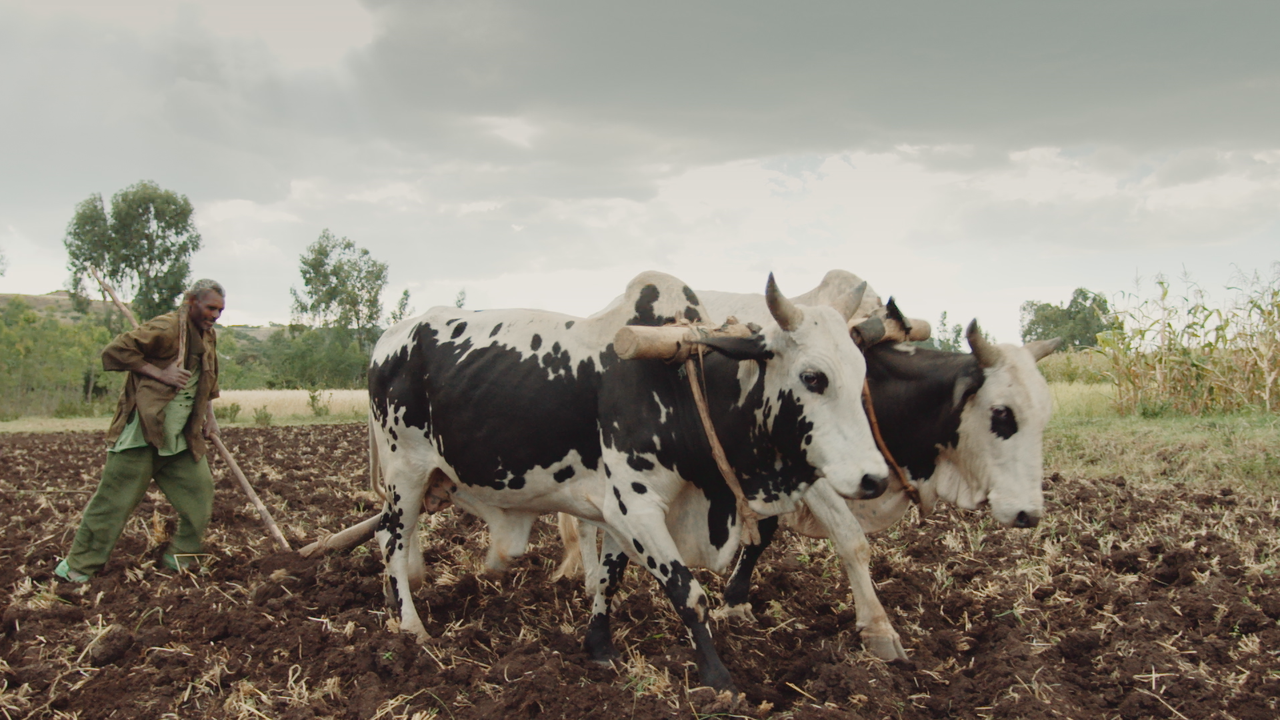
The other is Gebreyesus Tesfay. Under a government project helping small farmers improve soils, compost, intercrop and row-plant the grain teff, Tesfay is shown cultivating his land with a magnificent brace of oxen and a formidable handmade plough. Before, he says, they starved. Now they plant vegetables three times a year and are secure, although it is obviously still a tough life. As with Nanjiwa and Allen, self-sufficiency enlightened by the best of tradition and of small-scale science can work, if bad governance and skewed economics are held at bay.

Gebreyesus Tesfay on his farm in Ethiopia, featured in Land Grabbing.

Gebreyesus Tesfay on his farm in Ethiopia, featured in Land Grabbing.{credit}Wolfgang Thaler{/credit}

Globally, small farms number half a billion and support an estimated 2.5 billion people. They are, as these plays and films reveal, vulnerable; but they are centrally important as bulwarks against hunger. Meanwhile, the West’s demand for crammed supermarket aisles seems largely decoupled from a full understanding of the human dramas behind all that bounty. If tackling hunger is a ‘war’, it’s fought on many fronts; and it is winnable only if, in addition to appropriate technologies and sustainable innovation, richer societies fully grasp the politics that complicate this fraught issue.


See here for a Nature Podcast on Mouthful. For Nature’s full coverage of science in culture, visit www.nature.com/news/booksandarts.

The undisciplinarian

3Q: Harvey Graff

Comparative social historian Harvey Graff.

Comparative social historian Harvey Graff.

In Undisciplining Knowledge, Harvey Graff  examines the ideals and practice of interdisciplinary research through 12 case studies, from genetic biology in the late nineteenth and early twentieth centuries to nanotechnology and cultural studies in the twenty-first. Here, the Ohio Eminent Scholar in Literacy Studies and professor of English and history at The Ohio State University talks about the myth that interdisciplinarity demands the integration of entire disciplines.

Why did you write this book?

It goes back partly to the 1960s, when, as a history major with a minor in sociology, I was encouraged to cross fields and pursue questions widely. I’ve been fortunate since then to have colleagues across all parts of the university: I sit across history and English, but spend a lot of time talking with researchers in law, science and medicine. The tightrope I walk is being a strong believer in interdisciplinarity – but also a critic of what is promoted or pretends to pass as interdisciplinary research. I find an amazing similarity between the platitudes of some promoters of the term and the opinions of some of the anti-interdisciplinary camp. Both spend very little time talking about the complexities of how researchers can best work together across fields. The standard version of interdisciplinary research from research funders (such as this account from the National Institutes of Health), is a conflict-free, romanticized account neatly unconstrained by time, place and historical context. It also emphasizes stereotypical, now possibly outmoded notions of well-funded “big science.” But looking in detail at the history of efforts at interdisciplinary research – not just in the sciences, but also in the social sciences, humanities, arts and professions – I see that the social and political-economic contexts matter enormously. So do stages of disciplinary and subdisciplinary development and interrelationships. Major personalities, institutional advantages, and sheer good luck are central elements – from the unusual wartime circumstances that propelled the Manhattan Project, to the failed attempt to create a field called “social relations” (a quasi-department at Harvard in the 1940s and 50s, which disbanded after a decade).

What are the biggest myths or misunderstandings about interdisciplinarity?

I define interdisciplinary research as what emerges from the effort to develop new answers to questions (or approaches to problems) that require elements from different disciplines, subdisciplines and fields. The questions and problems are central. So, one myth is that interdisciplinarity is based on the “integration” of disciplines or requires “mastery” of multiple disciplines. Another is that there is one path toward interdisciplinarity – a large group and expensive science. As the case studies in my book demonstrate, there is no one formula that has a higher chance for success. Nor is interdisciplinarity new. It is part of the history of the modern research university and the development of disciplines from the late nineteenth century on. Too often we frame the disciplines and interdisciplinarity as opposed; the reality is that one depends upon the other. Finally, it has become common to oversell and inflate the promise of interdisciplinary research. It’s declared that all-out attacks on medical and social problems, such as the “war on poverty”, must be interdisciplinary. Yet often the research being done is not, and large claims – made to raise cash and bolster institutions and careers – are inappropriate or wasteful for the state of knowledge in certain areas.

What is your advice on building multidisciplinary partnerships?

Researchers, institutions and funding agencies need to be more honest and modest. Forsake endless typologies (trans-disciplinary, meta-disciplinary) and focus instead on specific questions and problems. Also, consider the physical and social organization of research. Universities I see as successful tend to use the model of “centres” or “institutes” that draw together practitioners in various fields. They link elements between fields rather than create new departments or impose “themes” or “initiatives”.  Interdisciplinary efforts do put much greater demands on the quality of communication. In this context, problems of field-specific jargon are often mentioned, but I find them less an obstacle than more fundamental aspects of organizational and interpersonal communication, intellectual and authority relationships, institutional locations, and clarity in planning and conduct of research. Interdisciplinarity is hard to do well, but worth the effort, even when the results are not the “breakthrough” too often over-optimistically promised.

Interview by Richard Van Noorden, Nature‘s deputy news editor. He tweets at @RichVN.


For Nature‘s interdisciplinary special, see here. For Nature’s full coverage of science in culture, visit www.nature.com/news/booksandarts.

The arboricultural explorer

3Q: Thomas Pakenham

Thomas Pakenham at the top of Mount Maenam, Sikkim, hunting rhododendron seeds, 2013.

Thomas Pakenham at the top of Mount Maenam, Sikkim, hunting rhododendrons, 2013.{credit}Thomas Pakenham{/credit}

Thomas Pakenham is a historian and arboriculturalist whose books include the bestselling Meetings with Remarkable Trees (2003). His new book, The Company of Trees, chronicles his efforts to establish an arboretum at Tullynally, Ireland, intertwining moments in the history of botany, such as the exploits of Victorian plant hunter Joseph Hooker. His quest for rare trees and other plants took him to Patagonia to view the last vast monkey puzzle trees, to the Himalayas to find the rare Magnolia campbelli alba and beyond. Ahead of his appearance at Write on Kew, the Royal Botanical Garden’s inaugural literary festival, Pakenham talks about the slippery concept of ‘alien’ species, getting lost in a blizzard in Tibet, and pathogens that travel in packing cases.

What compelled you to plant the arboretum, and what drew you to the exotics you chose?

There was no plan. It started as a shelterbelt, as I already had some exceptionally tall beeches and oaks. I planted a new grove — a collection of incongruities that came to include Japanese maples and the South American giant Alerce. This became the arboretum. After a bit, aesthetics took over and we introduced spring bulbs. I also brought in a plant-hunting theme, harking back to the great Victorian and early twentieth-century botanic expeditions: history is woven in, which is one of the things that drew me on. As for ‘exotic ‘ vs ‘native’, to a degree that’s an academic distinction. I recall that the late David Allardice Webb, the great field botanist at Trinity College Dublin, noted that he sometimes thought his colleagues called a species ‘alien’ when they didn’t like it.

Pakenham holding a Chilean plum yew (Prumnopitys andina), 2012.

Pakenham holding a Chilean plum yew (Prumnopitys andina), 2012.

What was your most memorable plant hunt?

Tibet is close to my heart; it is not for nothing that we think of it as a magical, end-of-the-world place. In search of species such as the Tibetan cowslip Primula florindae and the blue poppy Mecanopsis baileyi, I travelled to parts of the Himalayas explored in the twentieth century by the botanist Frank Kingdon-Ward — the remote valleys of Pemako and Rongchu. It was late in the season and at one point a blizzard blew up in a mountain pass. I had to sit it out near a boulder until the others reemerged. Later on that trip, my companions left our camp for an arduous 10-mile journey in search of blue poppies. I stayed behind. Washing my feet in a stream, I sprang up: I had sat on a clump of them. 

 At a time when forests are at risk from climate change and more, what do you see as the greatest threat?

Tree diseases are a huge problem. The bacterium Pseudomonas syringae pv aesculi has been causing bleeding canker in the horse chestnut for about a decade. It can kill an old tree in a year. Microscopic pathogens can travel in all sorts of ways — some Asian tree diseases have arrived in wooden packing cases carried on container ships, for instance. One way to stop them from wreaking havoc is to plant trees that have co-evolved with the disease, such as the Himalayan horse chestnut and the Chinese elm. The British Isles’ relatively small group of natives, however, are world-beaters.

Write on Kew is at the Royal Botanical Gardens at Kew from 24 to 27 September. Thomas Pakenham will be speaking on 26 September. For information on booking, see www.kew.org/writeonkew.

For silvologist Gabriel Hemery‘s retrospective review of John Evelyn’s classic book on arboriculture, Sylva, see here. For Nature’s full coverage of science in culture, visit www.nature.com/news/booksandarts.

Oliver Sacks: an appreciation

Posted on behalf of Philip Ball

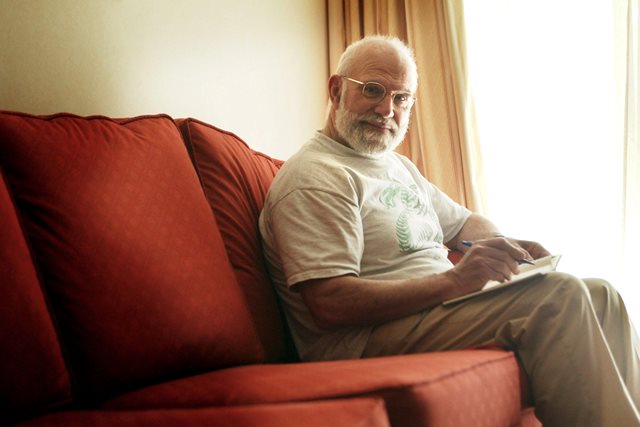
Oliver Sacks in 2002.

Oliver Sacks in 2002.{credit}Rex Shutterstock{/credit}

“Not quite salve et vale yet,” Oliver Sacks signed off a letter to me at the end of June, expressing the hope that he’d visit London again in the time he had left. The treatment he received earlier in the year had, he said, done “a very good job clearing out the majority of the metastasis in my liver”, and I allowed myself to be optimistic about seeing this remarkable, terminally ill man once more.

That’s not how it worked out. With his death at the end of August I – and many others – lost a friend whose generosity and sympathy of spirit were constantly inspiring. That Oliver would find the time to write at all when his remaining days were clearly so few, and when he had “case histories, essays etc, short and long” – and apparently several books too – still to complete will not surprise anyone fortunate enough to have felt his kindness. That his comments would stroll from the virtues of the Japanese “actor-magician” Yoshi Oida to Shakespeare’s belief that the fern can confer invisibility typifies his boundless curiosity. But who else wielded such breadth this lightly? Who, while afforded tremendous acclaim, was ever so devoid of ego?

This was one of the qualities that lifted Oliver’s writing to canonical status, and not just within the confines of “science writing” (he was rightly uncomfortable with being labeled thus). His subject was that of novelists, philosophers, poets, humanists of all descriptions: what is often rather grandly called “the human condition”. But in Oliver’s books and essays, the humanity was immediate and intimate, coming not from sweeping generalizations or lofty pronouncements but from deep within the grain of individual experiences. His concern was not “humanity” as such; it was people.

In all of the extraordinary, sometimes bizarre and baffling case histories that he described, he sought out what they revealed about our own fragile existence and what was unique and valuable in the lives of these people who often faced unimaginable challenges. To do this without mawkishness or sentimentality, yet with enormous empathy and even affection, required not just a rare talent with words but exquisite sensitivity. It is a fittingly Sacksian question to wonder (without expecting answers) how all this came about. Oliver’s account of his early life, in the first volume of his autobiography, Uncle Tungsten (2001), tells of his affluent, intellectual Jewish family in north London, whose scientific inclinations – his father was a general practitioner – might have been expected to launch him on just the kind of path it did: into neurochemistry and then consulting neurology. It offers no real clues about what would turn him into a writer with a unique ability to translate the clinical work of a neurologist into insights both beautifully lucid and movingly profound.

It does, however, hint at the beginnings of the loneliness that seemed to me to linger in the background even while Oliver was among friends and colleagues who shared a great deal of mutual affection. He writes in his second autobiographical volume, On the Move (2015), of “the habits of a lifetime’s solitude, and a sort of implicit selfishness and self-absorption”. Well, maybe; you might guess the former, not the latter. I was delighted, then, that Oliver found love again in 2009 at the age of 77.

It was Oliver’s passion for chemistry, revealed in Uncle Tungsten, that brought us into contact, when I discovered to my surprise and delight that he had read the books I’d written on the subject. His friends, the chemists Roald Hoffmann and Bassam Shakhashiri, rightly file Uncle Tungsten alongside Primo Levi’s The Periodic Table as one of the “great chemistry classics of all time”: two books that put chemistry on the required reading list. These books are not “about science” but simply and undemonstratively let science assume its place in culture. Like Levi, Oliver was a great writer whose subjects often happened to be scientific.

The first time I met him, in the harsh New York winter of 2003, I witnessed the irresistible strength of his chemical enthusiasms, undiminished since the days he tossed lumps of sodium into Highgate Pond in north London with his boyhood friend, the polymath Jonathan Miller. With barely a word of introduction but with eyes sparkling, he beckoned me eagerly into his kitchen, where next to the bowls of nuts he had laid out as much of the periodic table as he possessed (which was most of it), encouraging me to listen to the “cry of tin” and to handle the round ball of mildly toxic cadmium.

I do not envy anyone the necessary task of sorting through Oliver’s unpublished writings – which, he admitted, “spreads onto the backs of envelopes, menus, whatever scraps of paper are at hand”. The correspondence alone will be enormous – he kept it all. It should also be delicious. “I enjoy writing and receiving letters,” he wrote. “It is an intercourse with other people, particular others.” That concern with the particulars of others is what makes all his writings so bountiful; I see now that is why he wrote – and with generous and life-affirming energy – in June.

Several writers have written about coming to terms with terminal illness, and many accomplish it with grace and courage. I’m not sure, though, that any of these accounts has been as uplifting as what indeed proved to be Oliver’s salve et vale in The New York Times in February. “It is up to me now to choose how to live out the months that remain to me”, he wrote. “I have to live in the richest, deepest, most productive way I can… I have been a sentient being, a thinking animal, on this beautiful planet, and that in itself has been an enormous privilege and adventure.” It has been an enormous privilege that he has shared the adventure with us.

Philip Ball is a writer based in London.

See Nature‘s Special on Oliver Sacks here. For Nature’s full coverage of science in culture, visit www.nature.com/news/booksandarts.

On the road with Star Men

Posted on behalf of Carolin Crawford

Roger Griffin, Wal Sargent, Donald Lynden-Bell, Nick Woolf and John Hazlehurst at Meteor Crater, Arizona.

Roger Griffin, Wal Sargent, Donald Lynden-Bell, Neville (Nick) Woolf and John Hazlehurst having Christmas dinner at the bottom of Meteor Crater, Arizona, in 1960.

Fifty years ago, four young men with newly minted PhDs left England for the California Institute of Technology. They were embarking on what turned out to be long and successful lives in astronomy. California afforded Donald Lynden-Bell, Roger GriffinWal Sargent and Neville Woolf opportunities — to probe the heavens, through access to the world’s best telescopes at Mount Wilson and Mount Palomar, and to explore the astonishing landscapes of the western United States on the road.

Star Men, a documentary film on the four astronomers by Alison E. Rose, premiers on 3 September at the 35th Cambridge Film Festival. For the film, Rose joined them as they reunited for a final road trip, along with the Union Jack flag that features in many photos from their original forays. (The fifth original member, John Hazlehurst, was unable to make the reunion.) Their journey is partly a nostalgic return to the giant telescopes, and a chance to repeat the ‘best’ hike they undertook, through arid, dusty canyons to Rainbow Bridge National Monument in Utah. More, it is a rare chance to reflect on the changes the years have wrought, on the men and their science.

Very Large Array radio telescopes, New Mexico.

Very Large Array radio telescopes, New Mexico.{credit}Malcolm Park{/credit}

The 1960s marked the start of modern astronomy. Game-changing observations, theory and technological advances then and in subsequent decades would begin to transform the face of the field. Quasars, the cosmic microwave background and pulsars were all discovered serendipitously; structure on the largest scales was traced around the voids of space; new generations of giant, segmented mirror telescopes began to scan the skies; spectrometric techniques started to reveal the presence of planets beyond our Solar System; new astronomies conquered invisible wavebands. Lynden-Bell, Griffin, Sargent and Woolf each played a significant part in this game of progress – in their separate roles as theorist, instrumentalist, observer and telescope visionary, respectively.

In the film, the four reminisce about their shared experiences, such as the joy of riding the prime focus cage to guide the motion of the 200-inch Hale Telescope  at the Palomar Observatory for hours at a time, with only the stars and classical music for company. It is fascinating to hear Sargent, director of Mount Palomar from 1997 to 2000, express how he originally suffered from impostor syndrome. He confesses on screen to having been scared of the telescope for several years, doubting at first that his science was “good enough for such a grand machine”.

Spurred into science

This is not a film about the science or how science is done, although it discusses and describes of a range of astronomical phenomena, and is illustrated by sumptuous time-lapse sequences showing the Milky Way in all its glory crossing the night sky. Instead, it reveals how scientists live and breathe for their work. I was particularly entranced by what the four had to say about what triggered their youthful enthusiasm: books brought home by a mother in lieu of her salary as a cleaner; the unfettered view of the heavens afforded by wartime blackouts; an affinity for pondering mathematical problems when words were not easy to read; listening to Fred Hoyle’s radio lectures.

Roger Griffin, Donald Lynden-Bell, filmmaker Alison Rose and Nick Woolf at Rainbow Bridge National Monument, Arizona.

Roger Griffin, Donald Lynden-Bell, filmmaker Alison Rose and Nick Woolf at Rainbow Bridge National Monument, Utah, for the reunion.

Necessarily, the film also exposes the consequences of ageing, as the four confront physical frailty, terminal illness, and the limitations and stark vulnerability of a body in its eighth decade. (Sargent died at 77 in 2012, seven months after the reunion.) There are brief but poignant musings on a range of subjects, from the worth of human spaceflight to religion, extra-terrestrial life and mortality. Yet their good humour and enthusiasm remain undimmed. I was humbled by their expressions of amazement, gratitude and joy at having spent a lifetime observing the Universe. They have enough of the boy still at their core – we witness brief glimpses of petulance, teasing and competitive behaviour – to continue asking the big questions. On their overnight camping trip, an opportunity for observing afforded by the dark suggests that the astronomers are still far better able to navigate their way around the sky than on the ground.

Star Men is, however, very much of its time – a privileged time, when astronomy could be a much more individualistic pursuit than it is now. Young, bright researchers of the late twentieth century century had comparatively easy access to some of the best telescopes, and pondered their science at a more considered pace than in today’s world of large collaborations, intense competition, giant facilities, satellites, sky surveys and data mining. What changes and discoveries will today’s more mixed generation of 25-year-old astronomers reflect on 50 years hence, I wonder?

Carolin Crawford is a communicator of science, astrophysicist researcher, lecturer and public astronomer based at the Institute of Astronomy and Emmanuel College, University of Cambridge.  The 2015 Cambridge Film Festival runs from 3 to 13 September.


For Nature’s full coverage of science in culture, visit www.nature.com/news/booksandarts.