Top 20 books: discovering worlds

Artist's conception of a hypothetical planet covered in water around the binary star system of Kepler-35A and B.

Artist’s conception of a hypothetical planet covered in water around the binary star system of Kepler-35A and B.{credit}NASA/JPL-Caltech{/credit}

In terms of job satisfaction, discovering worlds must take the Sachertorte. Sibling astronomers William and Caroline Herschel, for instance, rejoiced in a haul that included Uranus, eight comets and several moons gleaned from what William called the “luxuriant garden” of the skies. Their final tally of deep-sky objects, with that of William’s gifted son John, numbered in the thousands. I’m sure their minds would be boggled by today’s exoplaneteering exploits — such as the TRAPPIST-1 system of seven Earth-like planets that fully emerged this year.

In my way, I’m in the business of discovering — and rediscovering — worlds. That they’re between two covers and on sale in your local bookshop is neither here nor there. And the 2017 harvest has been rich. We revisited Jonathan Swift’s 1726 Gulliver’s Travels, for instance — which, Greg Lynall noted in his eye-opening essay, is a journey across an unfamiliar Earth that even features Swift’s accurate prediction of the moons of Mars, 150 years before their detection. (The terra incognita flavour of this year’s events gave all that particular resonance.)

As for the new books sifted from the non-stop stream, as always I entered their portals with the open mind of an explorer. Thus, through Caspar Henderson’s A New Map of Wonders we scope the known cosmos with new eyes. In Hetty Saunders’s My House of Sky we sift the psyche of reclusive nature writer J.A. Baker. And in Jonathan Silvertown’s Dinner with Darwin, we see a plateful of food transformed into a repository of dazzling evolutionary stories.

It has, in short, been an astounding year for those of us engaged in tracking literary planets across the publishing firmament. Here’s my sky survey.

Improbable Destinies, Jonathan Losos. Riverhead. In a “deep, broad, brilliant” study, the biologist explores how evolutionary solutions, morphological to molecular, repeatedly emerge. (Reviewed here.)

A Crack in Creation, Jennifer A. Doudna and Samuel H. Sternberg. Houghton Mifflin. A pivotal player in the CRISPR saga delivers her dispatch from the genome-editing frontline. (Reviewed here.)

Collecting the World, James Delbourgo. Allen Lane. A life of Hans Sloane — medic, Royal Society president, ‘wondermonger’ and collector extraordinaire — is limned by an accomplished historian. (Reviewed here.)

The Death Gap, David Ansell. University of Chicago Press. The social epidemiologist lays bare how ‘structural violence’ in US healthcare fosters disparities in life expectancy. (Reviewed here.)

The Great Leveller, Walter Scheidel. Princeton University Press.  In a magisterial socio-political chronicle, the historian untangles the deeper roots of inequality. (Reviewed here.)

The Imagineers of War, Sharon Weinberger. Knopf.  The defence writer delves into the shadowy history of DARPA, the US agency that forecasts “imagined weapons of the future”. (Reviewed here.)

Miracle Cure, William Rosen. Viking. The accomplished writer’s swansong superbly captures the rise of antibiotics, from the discovery of penicillin on a mouldy cantaloupe to the war on resistance. (Reviewed here.)

The Vaccine Race, Meredith Wadman. Viking. A former Nature journalist tells the convoluted story of human fetal cell line WI-38, still deployed in vaccine research. (Reviewed here.)

Deep Thinking, Garry Kasparov. PublicAffairs. The chess titan revisits his 1997 match against computer Deep Blue in an “impressively researched” history of AI. (Reviewed here.)

The Songs of Trees, David George Haskell. Viking. In a sensory tour de force, a biologist documents the exquisite interconnections of arboreal life. (Reviewed here.)

Rigor Mortis, Richard F. Harris. Basic Books. The science journalist jumps into the deep end of biomedicine’s reproducibility crisis. (Reviewed here.)

Dawn of the New Everything, Jaron Lanier. Bodley Head. The virtual-reality pioneer traces the unconventional trajectory of an extraordinary career. (Reviewed here.)

The Origins of Creativity, E.O. Wilson. Liveright. In exploring the wellsprings of creativity, the ecologist calls for a “third enlightenment” meshing science with the humanities. (Reviewed here.)

Outside the Asylum, Lynn Jones. Weidenfeld & Nicolson. A psychiatrist working in war and disaster zones elucidates both policy implications and the uncommon courage of survivors. (Reviewed here.)

The Quantum Labyrinth, Paul Halpern. Basic Books. A physicist unpicks the intertwined lives of consummate theoreticians and chums Richard Feynman and John Wheeler. (Reviewed here.)

Life 3.0, Max Tegmark. Knopf. The cosmologist peered into possible risks and benefits of evolving AI, from an autonomous-weapons arms race to quark-powered ‘sphalerizers’. (Reviewed here.)

A Mind at Play, Jimmy Soni and Rob Goodman. Simon & Schuster. A journalist and a political theorist vividly portray information theorist — and rocket-powered-Frisbee inventor — Claude Shannon. (Reviewed here.)

Stalin’s Meteorologist, Olivier Rolin. Harvill & Secker. A harrowing account of a Soviet researcher exiled to the Gulag testifies to the endurance of science in the midst of political chaos. (Reviewed here.)

The Darkening Web, Alexander Klimburg. Penguin. The policy expert reports on the new cold war between ‘free Internet’ and ‘cybersovereignty’ forces. (Reviewed here.)

The Seabird’s Cry, Adam Nicolson. William Collins. The environmental writer’s inspired survey of 10 seabird species — albatross to shearwater — is a paean to life at the edge. (Reviewed here.)


For Nature’s full coverage of science in culture, visit www.nature.com/news/booksandarts.
Crowdfunding an online tree of life

3Q: James Rosindell and Yan Wong

A branch on the OneZoom online tree of life.

OneZoom lets people sponsor animals and plants on an online tree of life.{credit}OneZoom{/credit}

Putting all living things, from kingdom to species level, onto a single, easy-to-explore ‘tree of life’ is an ambitious project. But a newly formed charity has just gone a long way towards that by releasing the website www.onezoom.org. To crowdfund the new ‘OneZoom’ tree, biodiversity theorist James Rosindell and evolutionary biologist Yan Wong are asking the public to sponsor their favourite animals and plants. Here Rosindell and Wong talk about OneZoom, and why graphics from it have made their way into a fully revised edition of The Ancestor’s Tale – the 2004 classic Wong co-authored with Richard Dawkins.

What is OneZoom?

The fully revised, reissued edition of the 2004 classic by Richard Dawkins and Yan Wong.

The fully revised, reissued edition of the 2004 classic by Richard Dawkins and Yan Wong.

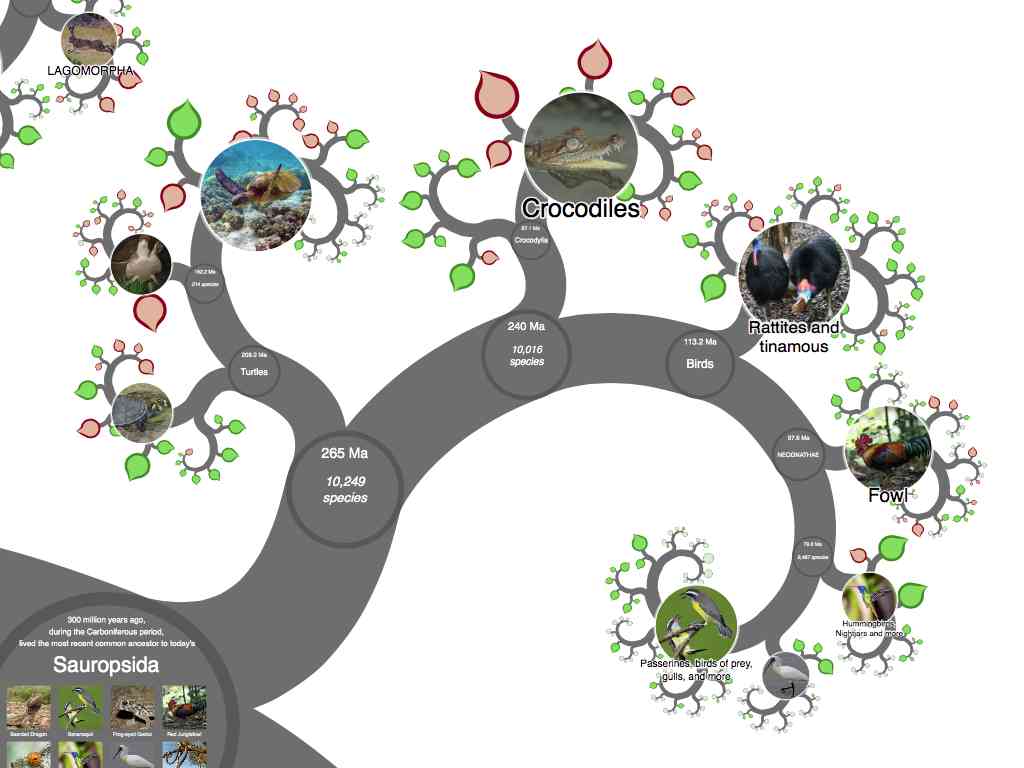
JR: It’s a way of visualizing large evolutionary trees as a branching fractal. Mindboggling quantities of data can be accessed easily and intuitively by panning and zooming in. With this technology we’re aiming to do for the living world what online mapping software like Google Earth has done for the physical world. Just as you might zoom from a map of the globe into a town, you could navigate into vertebrates and then, say, bats on the tree of life. Think of it as a digital natural history museum, aquarium, zoo and botanical gardens rolled into one.

YW: When James first mentioned OneZoom to me, I was in the middle of revising The Ancestor’s Tale. It became clear that the visual attractiveness and potential coverage of the entire tree of life meant OneZoom trees would be a great addition to the book, which attempts to distil the evolution of all life on earth. I looked in detail at around 100 phylogenetic studies that concern the lineage leading from humans back to the origin of life. Synthesising these studies into a single tree was necessary to give rigour to the ‘pilgrimage to the dawn of life’ that we undergo in The Ancestor’s Tale, and formed the backbone for the tree currently used in OneZoom.

What are you hoping to do now with crowdfunding?

Both: thanks largely to projects like the Open Tree of Life, we’ve now got the entire tree of life with over 2.1 million species — practically all known complex lifeforms — in our database. We’ve also developed visualization methods that allow seamless navigation. What we don’t have yet is a software engine capable of dealing with all those species on a normal PC, let alone a mobile phone. So our website currently only reveals a fraction of what is on our database. Our priority is improving the software core that runs behind the tree view so that we can handle all 2.1 million species.

JR: We chose a crowdfunding model where visitors to the site can feel a sense of ownership of the OneZoom tree of life by stamping their name on a leaf of the tree. The species you choose to sponsor is quite personal and that enhances the community feeling without detracting from the underlying scientific core of the project. Some leaves are sponsored by visitors to the website, others have been engraved as gifts from users to people they know, but there are also many wonderful species still available to choose from.

How will your tree stay up-to-date with shifts in the science?

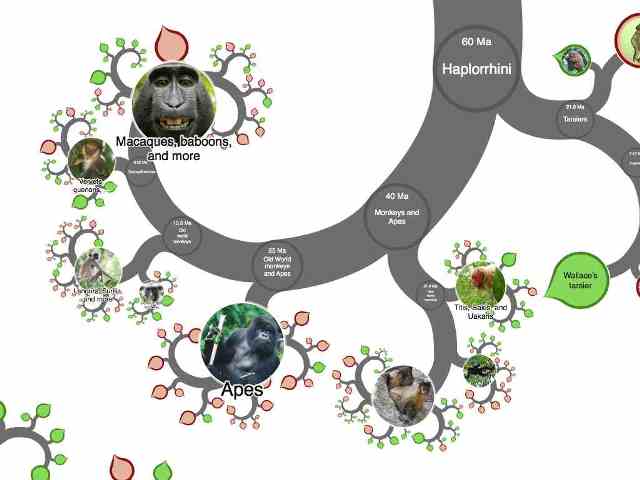
Simiiformes on OneZoom.

A branch on this section is our own family line.{credit}OneZoom{/credit}

JR: The disadvantage of human-drawn illustrations is that they can only be made for small trees and everything needs redrawing when the science is updated. Software that’s built to visualize trees tends to produce outputs more like graphs: simple to update, but lacking in visual design and only comfortable to read for an expert. The OneZoom viewer is unique because although it is easy to explore and visually appealing, it is also automatically generated.

YW: As for the topology of the tree — the order of branching and so forth — we have semi-automated pipelines in place to keep our tree up to date. They tie together several pre-existing, constantly maintained resources. For example, the Open Tree of Life release 5 came out on 7 April, and our pipeline was able to incorporate it and produce a new tree in time for our release less than a month later. However, some important areas of the tree still require hand curation: the main backbone of the tree and popular chunks. This is done as new studies are released. Another automated feature of the tree is our ‘popularity’ measure, based on visits and edits to Wikipedia pages. If there is a sustained increase in interest about a particular taxa on Wikipedia, this influences the prominence (and sponsorship price) of that leaf in the crowdfunding part of OneZoom.

Interview by Daniel Cressey, a reporter for Nature in London. He tweets at @DPCressey.

The fully revised edition of The Ancestor’s Tale was published on 28 April 2016. For further information about it, see www.ancestorstale.net. For more on OneZoom, see www.onezoom.org.


For Nature’s full coverage of science in culture, visit www.nature.com/news/booksandarts.
Darwin Day: a poem on the Sandwalk

Posted on behalf of Philip Parker

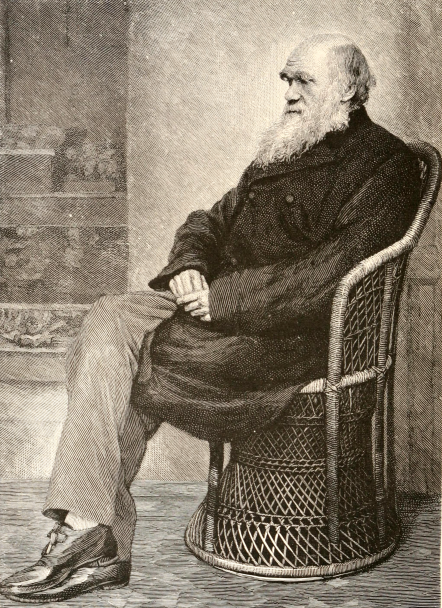
Charles Darwin (engraving adapted from photograph, in Francis Darwin (ed.), Life and Letters of Charles Darwin, 1891).

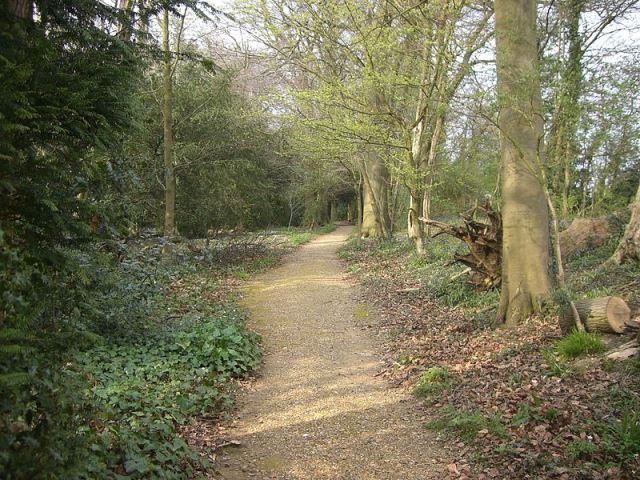
Charles Darwin famously built a circular path in the grounds of Down House near Orpington, Kent, soon after he moved there in 1842. It became known as the Sandwalk, a gravel-lined oval walk around the trees and bushes he planted. He called this his ‘thinking path’ and walked it morning and afternoon, often with his fox terrier Polly, observing seasonal changes, while mulling over his most difficult problems.

The Sandwalk has inspired me too. To celebrate Darwin Day — which marks the evolutionary biologist’s stunning achievements on his birthday, 12 February, each year — I wrote a sestude (a piece of 62 words) as part of 26 Postcodes. This project of not-for-profit UK organisation ‘26’ paired 26 writers each with a different postcode, which we visited literally, and in our imagination, to spark a piece of writing. I wrote ‘Last Circuit of the Sandwalk’ (below) after visiting Darwin’s house at BR6 7JT.

The Sandwalk at Darwin's home, Down House near Orpington, Kent.

The Sandwalk at Darwin’s home Down House near Orpington, Kent.{credit}Tedgrant at English Wikipedia.{/credit}

I knew from the outset that I wanted to reflect Darwin’s humanity, as well as the scope of his achievement, and that the piece would be in two parts. The first part attempts to present Darwin as a person, not an icon. Down House was his home for the last 40 years of his life, where he brought up his children and wrote his masterwork On the Origin of Species by Means of Natural Selection (1859). His favourite child was Annie. She died at the age of ten and Darwin nursed her in her final weeks and wrote movingly of the loss. His writing indicates that he most likely became agnostic.

Down House was also Darwin’s laboratory. He was a practical scientist using garden and greenhouse for experiments, or laying out skeletons of birds on his billiards table, or indeed dissecting barnacles (his pioneering classification of barnacles made his reputation as a natural historian).

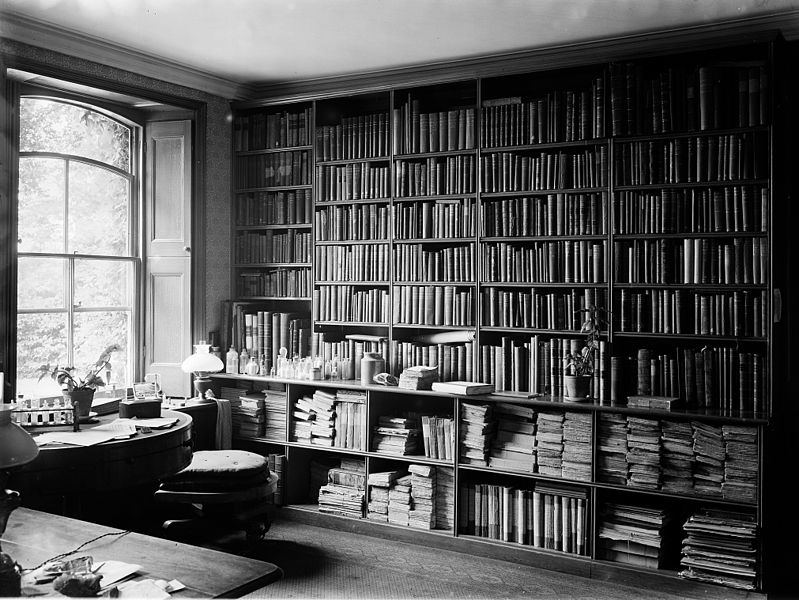
Visitors to Down can walk into his study, where his furniture has been returned including his wheeled armchair, and see what remains of the garden experiments. And you can tour the Sandwalk. While early drafts of the sestude concerned the house, my research on the Sandwalk was the ‘way in’. I saw Darwin, a venerable old man, standing on the gravel path looking back on his life, his journey.

Interior of Darwin's study at Down House in 1932.

Interior of Darwin’s study at Down House in 1932. {credit}Wellcome Images, images@wellcome.ac.uk, Wellcome Library, London. {/credit}

The letters of his children recollect how they played on the Sandwalk. At least 15,000 of Darwin’s own letters survive and have been diligently digitised by Cambridge University. The Victorian post was the internet of its day. A letter could be written and posted after breakfast, and a reply delivered back to the sender by teatime. In this way Darwin discussed his ideas and requested evidence and information from hundreds of colleagues worldwide, as well as eloquently replying to his critics.

These letters were most important to me. They show the man. He robustly defends his ideas, but also shows immense consideration for the feelings of his peers and family, reiterating his friendship. In them, he appears to me to be the most self-effacing and kind of souls.

The second half of my piece conveys his evidence-gathering and crystallising into the coherent theory he so elegantly described in what he refers to as Origin. It was because he had the most unusually broad but detailed knowledge of geology, botany and zoology that he could assemble the tens of thousands of pieces of evidence and begin to work out the mechanism of evolution, his specimens going back to his voyage aboard the HMS Beagle in the 1830s, finches’ beaks included.

Darwin’s many journeys culminated in the book, arguably one of the most influential of all time.


LAST CIRCUIT OF THE SANDWALK

Your kind, lined face peers into the thinking path. Fifty years, concentrating on millions.

Annie’s ghost dances round the birch you planted. Faith interred with her.

A closing correspondence. Evidence encircling the Earth, reaching kin, collaborators, critics. Your crystal mind the core.

Charting immense horizons of Beagle, beaks, barnacles. Focused to a final orbit of the Sandwalk. Tracing the elongated ‘O’. Origin.


Philip Parker is strategy manager for Royal Mail Stamps. The opinions expressed in this article are his own. He tweets at @parkerpj01. Find 26 Postcodes on Facebook and Twitter, and join the discussion at #26postcodes.

For Nature’s full coverage of science in culture, visit  www.nature.com/news/booksandarts.
Menageries of the mind

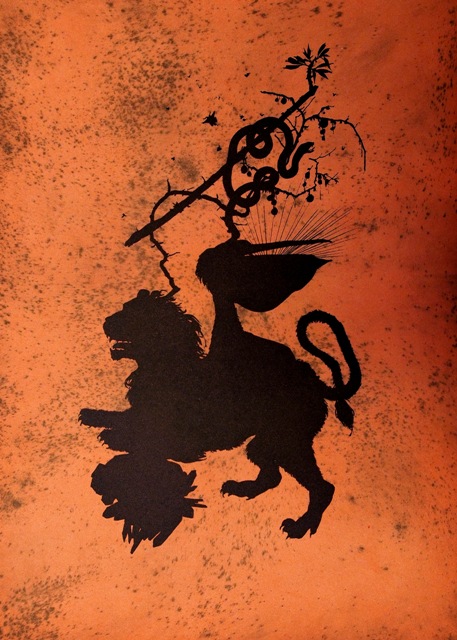
Aquatint etching from Doty and Waterston's A Swarm, A Flock, A Host

From Doty and Waterston’s A Swarm, A Flock, A Host (aquatint etching, 2013){credit}Courtesy of the artist and DC Moore Gallery, New York{/credit}

Whatever ‘being human’ means, it seems irrevocably tied to the bestial. In real life we tame, avoid or study animals (think pigs, grizzlies, lab mice). In stories, we freight them with characteristics human, mystical or approximately their own (think the White Rabbit, Moby-Dick, Mrs Tiggywinkle). Beasts are burdened indeed — by human needs, questionings, hopes, dreams, morals and fantasies.

Reflecting that obsession, a small, beautifully curated exhibition at the British Library showcases a trove of illustrated books and audio from its holdings. Animal Tales abounds with children’s volumes from the seventeenth century on. But this is definitely a show for all ages, and one too that scatters science amid the cultural offerings.

A random sampling turns up a letter recording observations of summer birds of passage by Gilbert White (author of The Natural History of Selbourne, 1789); poems by Mark Doty (“Snail exudes a silver avenue”); cartoonist Art Spiegelman discussing his Holocaust cat-and-mouse saga Maus on tape; an eighteenth-century woodblock print of China’s picaresque hero Monkey battling a demon king; and an 1875 edition of the Grimm brothers’ Little Red Riding Hood showing slavering wolf and unfazed child against the proverbial dark wood.

Organised around themes such as animal allegories and metamorphoses, the show, curated by Matthew Shaw, reminds early on that Darwin and Freud expanded our view of animal nature — Darwin, by revealing our common descent, Freud by locating the wildness within the human psyche. (Multitudes of key findings in science are, of course, predicated on animals, from Darwin’s finches and Pavlov’s dogs to Julian Huxley’s great crested grebes.)

‘Very real, and very close’

On that front, I was moved by White’s mention of the ‘grasshopper lark’ (or warbler) — now on the IUCN Red List. I asked Shaw what, in an age of biodiversity drain, cloning and CRISPR, he feels stories hinging on animals have to tell us.

From Johannes Comenius's Orbis Sensualium Pictus (, 1659 edition)

From Johann Comenius’s Orbis Sensualium Pictus (The Visual World in Pictures, 1659 edition) {credit}The British Library{/credit}

Shaw said that, as a parent, he had noted how the state of childhood and of animals has been closely associated in culture, prompting him to wonder “how this has played out historically and culturally. In general, the stories in Animal Tales speak to a time when animals were very real, and very close.  We are now beyond that, and live away from animals in the main, yet have a greater imaginative link to them.”

To trace the dynamic progress of that association in this show is to step into multiple cultural streams. Philosopher Michel de Montaigne‘s famous question in his 1580 Essays (“When I play with my cat, how do I know that she is not amusing herself with me more than I with her?”), for instance, gets a mischievous gloss from Dutch painter Pieter van Veen in his 1602 edition — a charming sketch of cat and man in the margin.

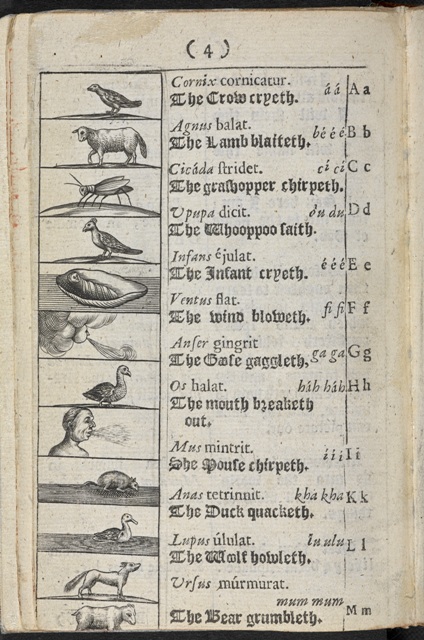
I was mesmerised by a minuscule volume from 1659. Orbis Sensualium Pictus (The Visual World in Pictures) by trailblazing Czech educational theorist Johann Comenius is one of the first children’s picture books. Comenius  taught Latin using ‘nature’s way’ — through things, not grammar — and in the book employs the calls of various animals (juxtaposed with exquisitely whimsical engravings) to teach the language. Thus, the bleat of a lamb teaches the sound ‘b’, while the chirping, quacking and hooting of various species are described in both Latin and English, as:  “Ursus múrmurat: The bear grumbleth”.

Harnessing the bestial

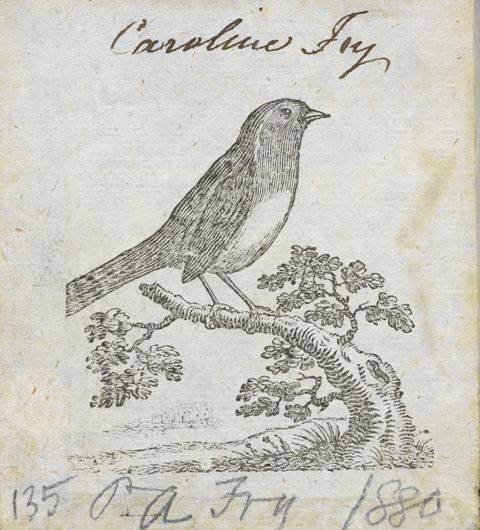
Sarah Trimmer’s 1793 History of the Red-Breast Family also harnessed the bestial to enrich learning. A noted educational reformer in the tradition of Anna Barbauld, Trimmer used the tale (also known as Fabulous Histories) to teach children respect for animals which, she presciently argued, would help develop ‘universal benevolence’ later in life.

Sarah Trimmer's 1793 History of the Red-breast Family

Sarah Trimmer’s 1793 History of the Red-breast Family{credit}The British Library{/credit}

Twentieth-century offerings reveal animals of a fiercer cast, in keeping with a century of war. In novelist Chinua Achebe’s 1976 How the Leopard Got His Claws, Adrienne Kennaway’s illustration of the beast is a study in violence — made not long after Nigeria’s civil war. British poet Ted Hughes’s 1973 Crow, a collaboration with American multimedia artist Leonard Baskin, is stark and unsettling. In ‘Crow and Mama’, Baskin’s bird is darkness visible, save for its huge reptilian feet. It broods next to the lines, “He tried a step, then a step, and again a step — /Every one scarred her face for ever.”

There is more — from the stunning Bestiary by Pablo Neruda and woodcut master Antonio Frasconi, to Judith Kerr’s  disruptive tiger, Beatrix Potter’s Peter Rabbit and David Garnett’s Lady Into Fox. You can listen in to gems such as Noël Coward reading Ogden Nash’s poem Elephant. The final thematic area, ‘Call of the Wild’, features the work of writers who have engaged “with animals as animals”, Shaw noted. Here among masterpieces by Jack London and Herman Melville are Doty’s evocative poems from his collaboration with artist Darren Waterston, the modern bestiary A Swarm, A Flock, A Host.

As I left Animal Tales for that clogged artery, the Euston Road, I harked back to the thought that we are drawn to animals not least because we are increasingly alienated from them. We are a long way from the painted mammoths of Chauvet Cave, riding out what many call the sixth great extinction. Yet fauna retain their dominion over our imagination. Animal Tales is a way into that menagerie — or Serengeti — of the mind.

Animal Tales runs through 1 November at the British Library, Euston Road, London.


For Nature’s full coverage of science in culture, visit www.nature.com/news/booksandarts.