Double Shift: schooling Syria’s child refugees

xxx

Jordanian and Syrian pupils in Al-Arqam school’s double-shift programme declare their ambitions, from doctor and ship’s engineer to teacher, swimmer and professor.{credit}Paula Ellguth, Marjam Fels{/credit}

Imagine this. You’re 12 years old. Half your family has been killed in conflict, and you find yourself in a country where every other word is a mystery. You’re desperate for stability — not least, school enrolment.

This is reality for many of the 8 million children who make up half the world’s refugees. Education is one of the biggest hurdles they face: only half have access to primary schooling. Potentially, they are a lost generation, at risk from abuse, trafficking and criminalisation, disenfranchised in ways and magnitudes unimaginable to many. A country’s loss of intellectual capital is tragic: how much more so, losing the intellectual future its children represent.

Now, a rich multimedia web documentary is revealing how Jordan — a nation hosting 657,000 registered Syrian refugees — is lighting a candle in the murk. Called Double Shift, the video, audio and text showcase the findings of an innovative social-science research project looking at how the “double shift” educational system, in which different groups are taught morning and evening, is working in the country. Already deployed for decades in Jordan and in other nations from Uganda to the United States, the system is being rolled out anew to accommodate children fleeing the war: Lebanon has adopted it, and Jordan, as Double Shift documents, is following suit to serve 160,000 school-aged Syrian refugees.
xxx

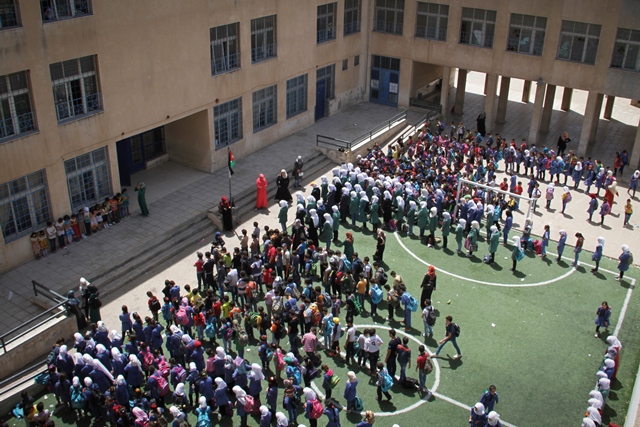
The noon switchover from the Jordanian to the Syrian cohort allows few close encounters. A football club and Saturday centre bridge the gap.{credit}Paula Ellguth, Marjam Fels{/credit}

Double Shift is a joint effort by the WZB Berlin Social Science Center and the European Bank for Reconstruction and Development. Its team of social scientists and visual designers used a variety of methods to capture data from Syrian refugee children in a Jordanian school, from “cultural probe” — giving students digital cameras to document their daily lives — to participatory workshops.

The findings reflect the day-to-day complexities child refugees cope with, notes Steffen Huck, director of WZB research unit Economics of Change. “Some showed the traumatic effects of the war in Syria,” he says. A questionnaire given to 88 Jordanian and Syrian students at Al-Arqam school in Sahab, southeast of Amman, is a case in point. It suggests overwhelming positivity about the school, with 90% reporting approval and more than half finding the classroom clean and safe. A subjective assessment hints at different insights.

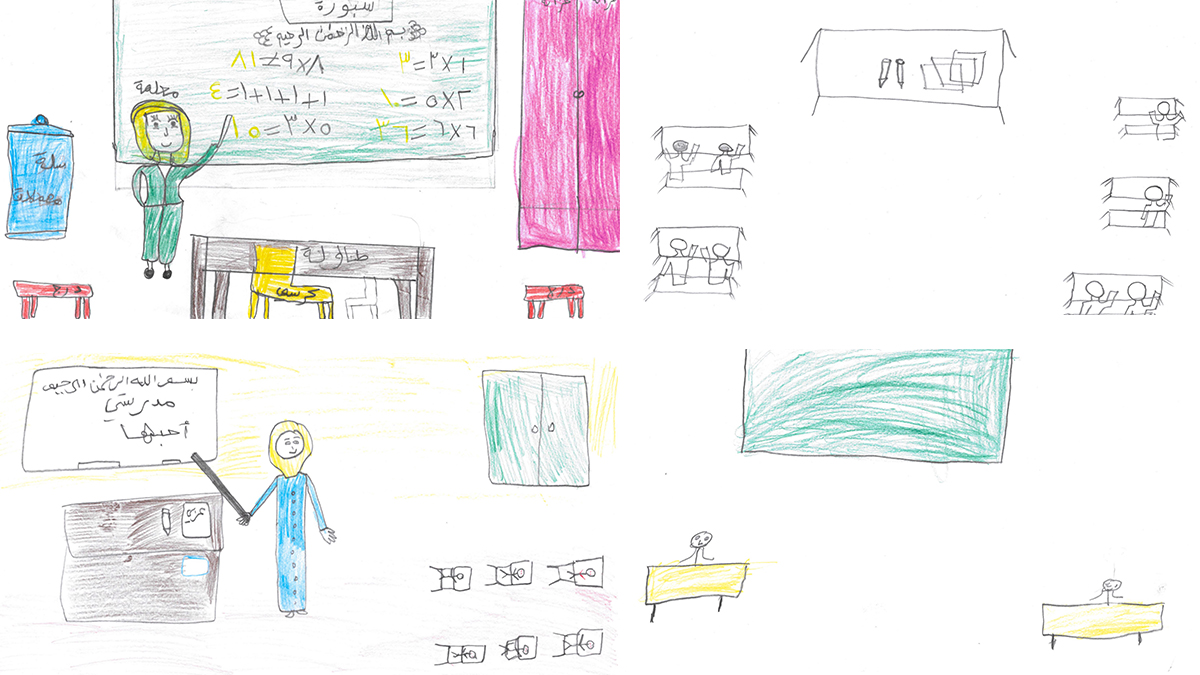
Each student was supplied with five colours and a pen and asked to draw their classroom. “The Jordanian children used significantly more colours than the Syrian,” Huck said. “They also painted in a larger portion of the sheet of paper.” Huck speculates that these differences could indicate relatively withdrawn psychological states among the Syrian children.
xxx

At Al-Arqam school, the differences in coverage and colour use between the Jordanian children’s drawings (left) and those of the Syrian child refugees were marked.{credit}Paula Ellguth, Marjam Fels{/credit}

Jordan’s public schools are already under strain, with teachers, classrooms, water, cooling and heating all in short supply. Class sizes can number 45. The pressures on both teachers and pupils are clear, and the separate shifts (Jordanian children in the morning, Syrian in the afternoon) risk entrenching difference. Yet as Double Shift documents, Al-Arqam is building bridges through a mixed soccer club and Saturday centre for study and play.

Meanwhile, Huck and colleagues have done the maths on another gain: US$167,552,165.00. That is their figure for the total net benefit to the country’s economy of enrolling 50,000 Syrian child refugees in Jordanian schools. As it happens, a new cohort of that size is poised to enter the educational system, thanks  to international funding and support from agencies such as UNICEF.

“As the Syrian civil war drags on with no end in sight,” Huck says, “Jordan’s efforts do not only set a humanitarian example but become more and more an investment in its own future.”
xxx

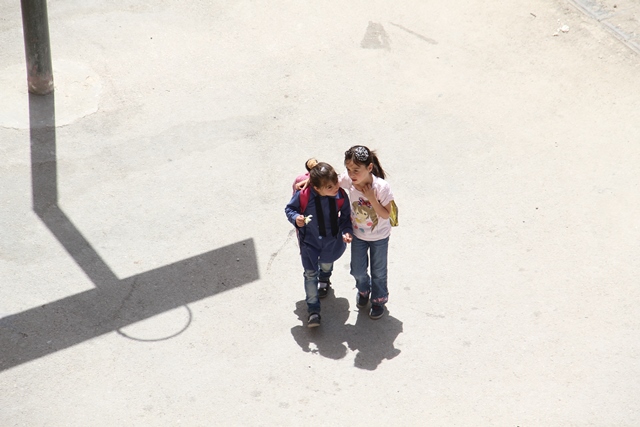
A rare meeting during the midday double-shift switchover.{credit}Paula Ellguth, Marjam Fels{/credit}

Double Shift offers a balanced examination of one school and the headteachers, parents and children who make up its community. It pans out, too, to the wider picture, where other factors come into focus.

Sarah Dryden-Peterson, who researches the nexus of education and social stability, has reported on serious issues with Lebanon’s double-shift programme on the non-profit Brookings Institute website. She reveals that Syrian children may be bullied, and that teachers may be exhausted and poorly trained to cope with their pupils’ psychological trauma. But solutions to fast-moving, critical situations often are partial or quasi-experimental.

If a ‘war child’ is to become an engineer, a surgeon, a pilot — as so many of the children interviewed by Double Shift passionately wish — it’s bedrock we need, not sand. As Dryden-Peterson has noted:

The average length of exile for refugees is 17 years. That’s the equivalent of a child’s whole shot at education, from birth to high school graduation… Syrian refugees do not need temporary education programs. They need access to a complete education.

Currently, debates over STEM teaching and anxieties over science in a politically chaotic world proliferate. Yet the fate of this traumatised, uprooted generation seems an afterthought to governments, who increasingly de-prioritize education in aid portfolios. Policymakers and pundits forget, perhaps, that it was refugees in flight from another appalling war who built American science and technology.


For Nature’s full coverage of science in culture, visit www.nature.com/news/booksandarts.

Revisiting Feynman on physical law

Posted on behalf of Andrea Taroni

9780262533416

Physics, along with jurisprudence, is principally known for its laws. And physical laws are amazing: they can predict almost anything, from the effects of gravity to why the Sun shines. Explaining them is surprisingly hard, however. Anybody first encountering them in the classroom, typically as mathematical formulae applied to abstract problems, can attest to that. The result is countless hours spent by teachers, educators and popularisers of science devising ways to make physics (and its laws) ‘more interesting’.

Richard Feynman’s The Character of Physical Law – published in 1965 and now newly reissued by MIT with a foreword by Frank Wilczek – stands out as an early example of a successful attempt towards this end. The book is based on a series of lectures the iconic physicist had delivered the previous year at Cornell University. But it’s a layered work, and clearly shows Feynman also drawing from another set of lectures, delivered at the California Institute of Technology from 1961 and 1963. Those would go on to become his most famous work: The Feynman Lectures in Physics (reviewed here).

However, whereas The Feynman Lectures were an attempt to reinvigorate the pedagogical approach to ‘freshman’ physics, The Character of Physical Law is, in Wilczek’s words, far more than an exposition of facts and ideas. It is also a character study of Feynman himself.

By physical law, Feynman is quick to explain that he means “the rhythm and pattern of phenomena of nature which is not apparent to the eye, but only to the eye of analysis”. In other words, the very phenomena we uncover through painstaking empirical observation, and tend to ultimately write down as mathematical equations. But the topic of the lectures is broader still. They focus on the characteristics common to all the laws: “that is another level, if you will, a higher generality over the laws themselves”.

The big picture

What is really striking about The Character of Physical Law is Feynman’s ease in covering broad areas of physics — for instance, the law of gravitation, the relationship between physics and mathematics, the role of symmetry in physical laws. But crucially, he is equally adept at discussing the history of these topics and their relevance to everyday life, and lucidly articulating the reasons why one might be curious about them. It is this combination of skills that allows him to avoid excessive abstraction and philosophising, a common pitfall when looking at the big picture of things.

For instance, Feynman kicks off by discussing the law of gravitation. In plain words, this describes how a particle is attracted to every other particle through a force directly proportional to the product of their masses, and inversely proportional to their distance. Though acknowledging that it is a discovery of the Enlightenment, he argues that by “describing its history and methods, the character of its discovery, its quality”, he recontextualises it for the present.

In the space of a few pages, the reader learns the way mathematician and astronomer Johannes Kepler established how the planets orbit around the sun. And they are provided with a clear description of the Newtonian mechanics that explain what makes them go around — including, of course, a brief explanation that, eventually, even Newton’s laws are found wanting and Einstein’s relativity takes over. At the next level of generality, Feynman also considers other instances in which inverse-square laws appear in nature — for example, to describe the interaction between electrical charges. The reader is invited to think deeper as each layer of description is peeled away, while at the same time keeping in mind the common threads that bind them together. Yet Feynman isn’t afraid to admit when even the boundaries of his knowledge are reached: “instead of having the ability to tell you what the law of physics is, I have to talk about the things that are in common to the various laws; we do not understand the connection between them”.

This approach certainly demonstrates an unusual depth of physics understanding. It also reveals Feynman’s humanity. Feynman was of course famously charming and charismatic — and, arguably, flawed, perhaps propagating the myth of his stage persona a little too enthusiastically. But ultimately he was, in my view, a man driven by a playful, down-to-earth spirit of curiosity, not the dry and abstract reasoning of a detached academic.

Rules of the game

As Wilczek notes in the foreword, a lot has happened in physics since 1965; yet The Character of Physical Law holds up extremely well today. My favourite chapter is the one on symmetry in physics. Feynman starts off by noting that symmetry appears to fascinate the human mind, if only for aesthetic reasons. But he chooses to emphasise the symmetry within the laws of physics themselves. Certain laws can be symmetric with respect to time and space, for example, but not necessarily under changes of scale. The implications of these symmetries are more obvious in some cases than others. But the key point is that by focusing on these underlying rules of the game, one gains an appreciation for the character of the physical laws they apply to.

To underline that, he masterfully explicates the far-reaching implications of charge-parity violation in the weak nuclear force. In his own words, “it is as if 99.99% of nature is indistinguishable right from left, but that there is one little piece which is completely different”. This ultimately explains the preponderance of right-handed molecules, such as proteins, that play a central role in the biochemistry of life. Feynman’s genius as a communicator lies in his ability to explain this connection in a manner that is accessible, fascinating and accurate in equal part.

Ultimately, I wouldn’t go quite as far as Wilczek by describing The Character of the Physical Law as the single best introduction to modern physics. Somehow, I suspect there is a reason why the more incremental approach espoused in The Feynman Lectures in Physics has gained traction with a wider readership over the years. But for the interested reader looking for more, this book offers enlightenment to those exploring its facets.

Andrea Taroni is chief editor of Nature Physics. He tweets at @TaroniAndrea. 


For Nature’s full coverage of science in culture, visit www.nature.com/news/booksandarts.
From tin men to Terminator: Robots reviewed

Posted on behalf of Celeste Biever

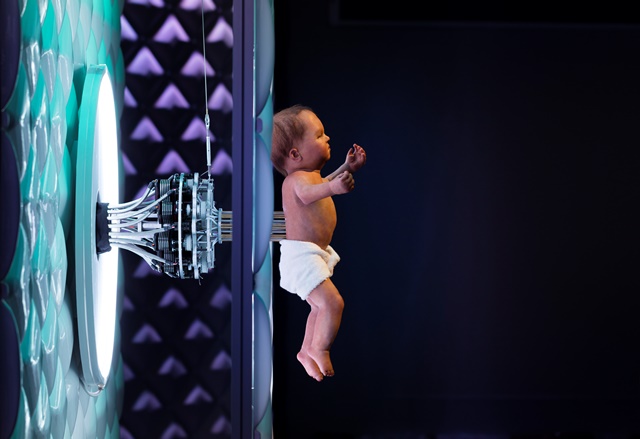
Animatronic baby, John Nolan Studio

Animatronic baby, John Nolan Studio.{credit}Plastiques Photography, courtesy of the Science Museum{/credit}

The baby’s skin looks soft and its hair downy as it blinks and stretches out its arms. Then I spot the plug and mass of wires protruding from its back.

Brainchild of London-based John Nolan Studio, the animatronic infant is a fitting start to the blockbuster Robots exhibition at London’s Science Museum. Its impressively comprehensive array of automatons is a reminder both of machine-like qualities in people, and of the challenges of imitating humans in mechanical form.

Historical automata crowd the first section, ‘Marvel’. A small, hand-carved mechanical monk from the 1560s was crafted to walk and beat its breast in contrition. Is this really a robot? Yes, says chief curator Ben Russell, who has long pondered this question: “A robot is a machine that looks life-like or behaves in life-like ways.” This summary proved a tough but useful curatorial filter, he says.

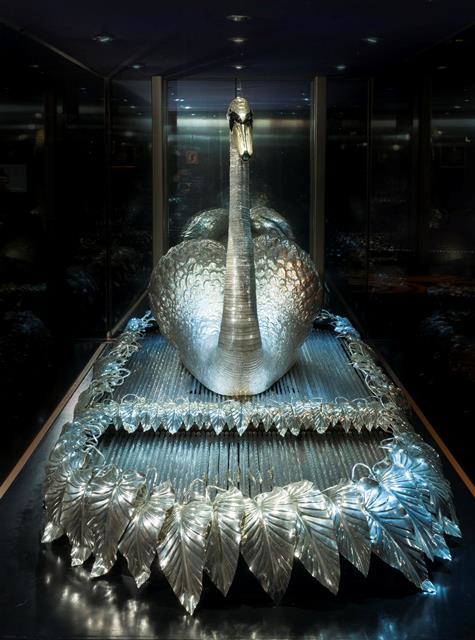
Clockwork 'Silver Swan', John Joseph Merlin, 1773.

Clockwork ‘Silver Swan’, John Joseph Merlin, 1773.{credit}The Board of Trustees of the Science Museum{/credit}

Another highlight here is the Silver Swan, a life-sized clockwork bird on a glass pool crafted in 1773 by Belgian inventor and instrument-maker John Joseph Merlin, whose work inspired Charles Babbage. (The automaton is on loan from the Bowes Museum in county Durham, northern England.) In his 1869 travelogue The Innocents Abroad, American writer Mark Twain noted the avian wonder ‘swimming’ as “comfortably and unconcernedly as if he had been born in a morass instead of a jeweller’s shop”. The lifelike movements of its serpentine neck still impress – but visitors beware: to preserve the delicate machine, it will only play at certain times.

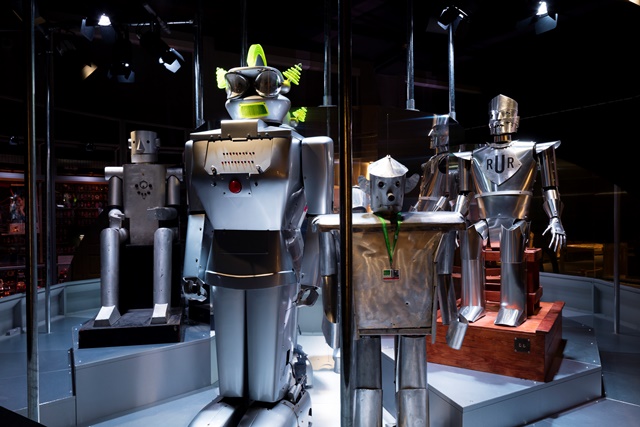
Classic twentieth-century robots Sitting Robot, Cygan, George and Eric (left to right).

Classic twentieth-century robots Sitting Robot, Cygan, George and Eric (left to right).{credit}Plastiques Photography, courtesy of the Science Museum.{/credit}

A clutch of robots classiques includes an impressive collection of dumb but engaging tin-giants dating back to the 1920s. Eric is arguably the star. The replica we see was commissioned for the exhibition and paid for by a Kickstarter campaign. Amateur engineer William Richards and mechanic Alan Reffell built the original Eric in 1928 for the annual Society of Model Engineers exhibition in London, where it a gave a speech as a stand-in for the Duke of York. Its feet bolted to a 12-volt electric motor, Eric could also stand, sit down and move its arms.

As I gaze at a Terminator from 2009 film Terminator Salvation, I’m reminded of how popular culture, as well as science and engineering, shaped the modern concept of a robot. The intimidating android “had to be there”, says Russell. “This is what people think a robot is like.”  Another delight for aficionados is a 1923 first-edition copy of Czech writer Karel Čapek’s play R.U.R. (Rossum’s Universal Robots), which coined the word ‘robot’.

ECCEROBOT, Rob Knight and Owen Holland, 2004-2011.

ECCEROBOT, Rob Knight and Owen Holland, 2004-2011.{credit}Plastiques Photography, courtesy of the Science Museum.{/credit}

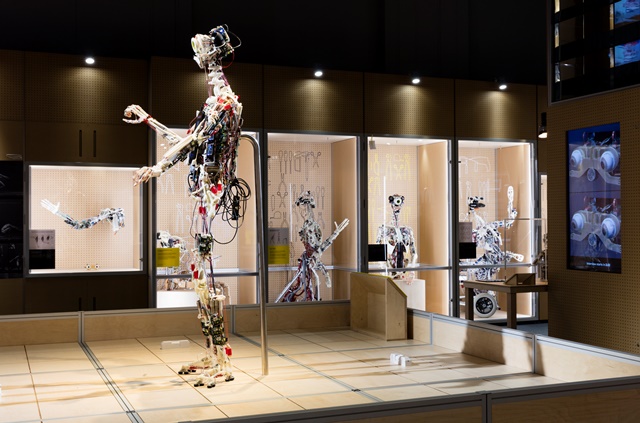
It’s one thing to dream, quite another to construct. The reality check is a gaggle of bots from a range of top labs — experiments shedding light on what it means to be human. Here are multiple versions of the life-sized ECCEROBOT (Embodied Cognition in a Compliantly Engineered Robot), each a skeletal display of tendons and bones. Built by robotics engineer Rob Knight, cognitive roboticist Owen Holland and the ECCEROBOT Consortium between 2004 and 2011, the series explores embodied cognition: how the structure of the human body shapes the evolution of intelligence and consciousness.

Juxtaposing several attempts at creating bipeds, this section also showcases the joy of tinkering. Honda’s well-resourced P2, unveiled in 1996, was the first full-bodied robot to walk on two legs. It stands next to the Shadow Biped — a pair of legs snaked through with wires and gauges, developed by inventor Richard Greenhill and other members of the Shadow Robot Project Group in a London attic from 1987 to 1997. (It managed a few wobbling steps.) The group evolved into the Shadow Robot Company, makers of the dexterous robotic hand on display.

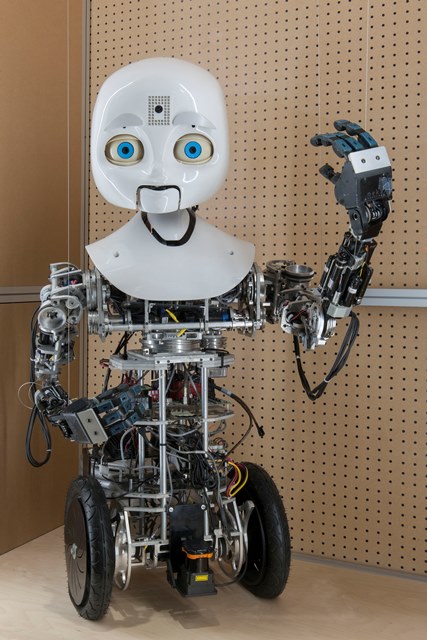
Nexi, Cynthia Breazeal, 2008.

Nexi, Cynthia Breazeal, 2008.{credit}The Board of Trustees of the Science Museum.{/credit}

The show’s research chops are also evident in the inclusion of Cog, the Massachusetts Institute of Technology project led by robotics pioneer Rodney Brooks that ended in 2003. The exhibit only features Cog’s head – a mess of wires and metal. While it’s not visually arresting, I was thrilled to see Cog: it was built to address the fascinating, once radical, question of whether human level intelligence could emerge from physical interactions with the environment, without any higher-level programming.

The emerging field of human-robot interaction gets a look-in with Inkha, built by Matthew Walker and Peter Longyear at King’s College London. A pair of bulbous eyes and rubbery lips attached to a metal frame, it served as a receptionist at King’s between 2003 and 2014. And the freakish, blue-eyed Nexi was built in 2008 by human-robot interaction pioneer Cynthia Breazeal of MIT. Through its ability to carefully control movements such as face-touching, Nexi was used to study the role of non-verbal communication.

Robot child Kodomoroid, Hiroshi Ishiguro Laboratories.

Robot child Kodomoroid, Hiroshi Ishiguro Laboratories.{credit}Plastiques Photography, courtesy of the Science Museum.{/credit}

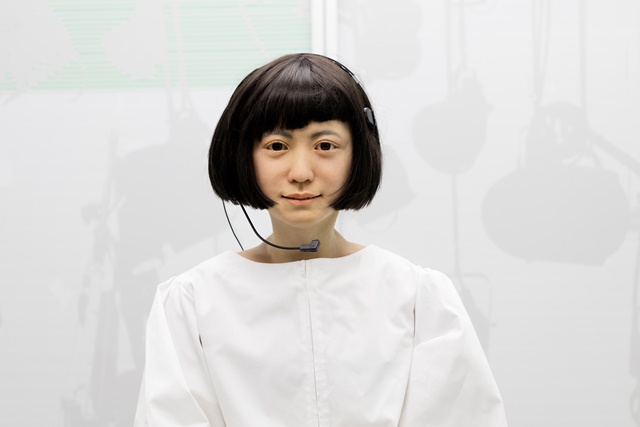
Today, of course, robots have escaped the lab, showing up in factories, homes and even clinics.  As I trek through the last room, a corridor lined with a range of humanoids already out in the real world, I ponder how robots will evolve next. Will they become ever more realistic, like the alarmingly life-like robot child Kodomoroid? Its creators at Hiroshi Ishiguro Laboratories in Japan have used such ‘geminoids’ — android ‘twins’ of real individuals — to monitor reactions when compared with the human originals. Robo-toddler Kaspar, by contrast, makes a virtue of robotic limitations. Its creators at the University of Hertfordshire are examining how children with autism,  who can be overwhelmed by diverse facial expressions, react to Kaspar’s much simpler, carefully controlled mannerisms.

This is a timely show, in a society now grappling with the implications of the robot invasion, enabled by speedily evolving, hyper-sophisticated machines. It does a beautiful job of demonstrating robotics’ embarrassment of riches and how humanity got here, powered at first by belief, then dreams and most recently hardcore research and engineering. The question that scientists, engineers, consumers and industry now have to answer is: where do we point this formidable engine?

Celeste Biever is Nature’s chief news and features editor. She tweets at @celestebiever.

Robots runs at London’s Science Museum from 8 February to 3 September.


For Nature’s full coverage of science in culture, visit www.nature.com/news/booksandarts.
Lunar balloonist

3Q: Luke Jerram

Artist's impression of Museum of the Moon as it will look in a park setting.

Artist’s impression of Museum of the Moon as it will look on its travels.{credit}Luke Jerram{/credit}

Multi-media artist and researcher Luke Jerram experiments with sound, movement and materials in a dazzling array of installations. He has created monumental blown-glass sculptures of bacteria and viruses (Glass Microbiology), the acoustic wind pavilion Aeolus, and Retinal Memory Volume, an interactive sculpture using the mechanisms of eyesight. Here Jerram talks about his new Museum of the Moon, a vast globe that will premier at the Bristol International Balloon Fiesta in August.

How did you make Museum of the Moon and what will it involve?

It is a balloon 7 metres across, made of urethane-coated ripstop material, lit from the inside. The surface is printed with an image of the Moon’s surface taken by a NASA satellite carrying the Lunar Reconnaisance Orbiter Camera, and created by the US Geological Survey’s Astrogeology Science Center. Each centimetre on the balloon represents 5 kilometres on the lunar surface. During the Bristol balloon festival it will be presented as part of their ‘night glow’, allowing the public to bathe in moonlight and listen to a Moon-inspired surround-sound composition by award-winning composer Dan Jones. The artwork will tour for several days; it will float through darkened streets and also be suspended a metre and a half above a local swimming pool, allowing people to swim out to view it close up. As it tours, astrophysicists from the University of Bristol will offer lectures. The balloon will then travel for up to 10 years around the world, collecting people’s ways of thinking about the Moon — from mythology to science — via questionnaires, online, on paper and on video. It’s likely to be interpreted differently in every country we go to; for example, in the United States people may think about the Apollo mission, while in China the Moon is very much celebrated during their Mid-Autumn Festival.

The lunar balloon under construction.

The lunar balloon under construction.{credit}Luke Jerram, with the kind support of Cameron Balloons. {/credit}

Why focus on the Moon?

Over millennia, the Moon has acted as a sort of cultural mirror, used as the basis for a calendar or for night-time navigation, and has been worshipped as a deity. Once it was the only night-time source of light. Now, many people see it surrounded by skyscrapers. Through this project I hope to restore a sense of wonder, to help people to ask questions and hopefully to reconnect with the night sky. I’m also fascinated in the latest lunar science. Recent space missions have detected water ice at the Moon’s poles, and the Moon is being considered as a staging post for a future mission to Mars. It was only in 1959 that the Soviet Union’s Luna 3 probe photographed the far side of the Moon, which looks completely different from the side we see: there are no dark patches, for instance. So the Museum of the Moon will be the first time most members of the public will see the far side. Here in Bristol we have the second highest tidal range in Europe: there is a 13-metre gap between high and low tide. So I think about the Moon’s influence every time I cycle to work over the River Severn each day.

Luke Jerram with blown-glass swine flu virus from his Glass Microbiology series.

Luke Jerram with blown-glass swine flu virus from his Glass Microbiology series.{credit}Luke Jerram{/credit}

Are there personal reasons for your choosing this project?

My colour-blindness has given me an interest in perception. There are a number of optical oddities linked to the Moon — for instance, the illusion that it seems larger when closer to the horizon. And when you see a close-up of the lunar surface, you realise it is very dark and grey, yet it can appear incredibly bright in the night sky due to the Gelb effect. I am fascinated by how things work. I nearly studied engineering, and still use maths and engineering as a part of my arts practice, to solve problems and design artworks. Both scientists and artists can ask similar questions, and interrogate, question and explore phenomena in different ways, which lead to very different sets of answers. I’m also fascinated by the communication of science, and am often asked by scientists to help them disseminate their research through art, and achieve that balance between accuracy, accessibility and inspiration.

Interview by Elena Bozhkova, a freelance journalist in London. She tweets at @elena_bozhkova.

The Bristol International Balloon Fiesta runs from 11 to 14 August at Ashton Court Estate, Bristol, UK. Museum of the Moon  is scheduled to tour UK festivals Lakes Alive (Kendal), the Norwich & Norfolk Festival, Brighton Festival and Greenwich+Docklands Festival, as well as Lieux Publics, Marseilles, France, and OORtredens Festival, Belgium.


For Nature’s full coverage of science in culture, visit www.nature.com/news/booksandarts.
Lab Wars: a game of scientific sabotage

Posted on behalf of Richard Van Noorden

3d box a

{credit}© “LAB WARS” BY CAEZAR AL-JASSAR AND KULY HEER; GRAPHIC DESIGN BY CRIMZON STUDIO, ILLUSTRATIONS BY NIZAR ILMAN{/credit}


In the race for discovery and recognition, researchers have sometimes cheated, lied, colluded, suppressed evidence and even sabotaged others to get what they want — as Michael Brooks documented in his 2012 book Free Radicals: The Secret Anarchy of Science.

Two researchers today launch a game that captures this anarchic spirit. Board-game fans Caezar Al-Jassar, a postdoc at the Laboratory of Molecular Biology in Cambridge, UK, and Kuly Heer, a clinical psychologist, have designed the card game Lab Wars to represent the scientific rat race, with extra sabotage.

“It’s a very exaggerated form of science,” admits Al-Jassar. Most testers wanted even more power to disrupt, he adds.

Competitors play lab archetypes, ranging from ‘PhD student’ to ‘emeritus professor’. They collect equipment such as electron microscopes and centrifuges, generate results, and acquire papers, books, and, most valuable of all, Nobel prizes. Characters interfere with each other’s productivity: a principal investigator derails a PhD student by dictating their experimental time; a PhD student annoys a post-doc by necessitating extra equipment costs; and so on.

The game is at its most cut-throat when players mess up other laboratories. They can steal papers or lab equipment, gain favours from peer reviewers, or sabotage other labs with radioactive materials and computer viruses. If all that sounds unlikely, Al-Jassar says that all the sabotage cards are based on real or rumoured events.

promo cards

{credit}{credit}© “LAB WARS” BY CAEZAR AL-JASSAR AND KULY HEER; GRAPHIC DESIGN BY CRIMZON STUDIO, ILLUSTRATIONS BY NIZAR ILMAN{/credit}{/credit}

Some games based around science mingle education with entertainment: there’s a card deck of women in science, for example, Cell Trumps, and various efforts at representing evolution in board game format.

There’s an element of the didactic in Lab Wars, with some explanation of the lab equipment involved. The cards’ designs contain knowing winks: astrophysicist Neil de Grasse Tyson’s face is cast on the Nobel medal, rather than Alfred Nobel’s; players compete for papers in the fictional journal Nurture. Al-Jassar says he hopes to add famous historical scientists with their lab equipment to the deck if there is enough enthusiasm. (As is the way for specialist products, LabWars’ Kickstarter page doubles as a purchase point for the basic game and as a fundraising campaign site for future interest; it will only be funded if the developers raise £5,000.)

But in the main, Lab Wars is for fun. Borrowing elements from established favourites such as Citadels and Dominion, the game is a fairly complex tactical battle that will take less than an hour to complete with three players; it is aimed at older children and adults, scientists and non-scientists alike.

And some testers, Al-Jassar says, have enthused about using the game to show others what science is really like. After all, for many a hard-pressed post-doc, research can feel like a game where the cards are stacked against them.

Richard Van Noorden is senior news editor at Nature. He tweets at @Richvn.


For Nature’s full coverage of science in culture, visit www.nature.com/news/booksandarts.
Neuroscience-tinged kids’ app put to the test

Posted on behalf of Hysell Oviedo and Siboney Oviedo-Gray

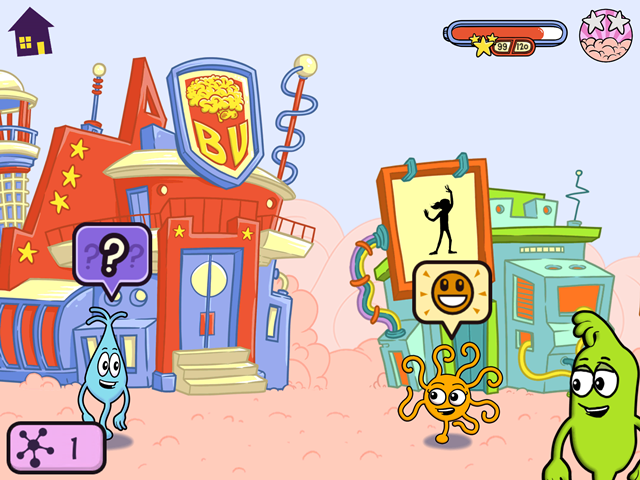
'Brain Street' in Kizoom's gamified neuroscience learning app, Brainventures.

‘Brain Street’ in Kizoom’s gamified neuroscience learning app, Brainventures.{credit}Kizoom{/credit}

I have two criteria for a game app for my daughter: it must assuage my guilty conscience when I’m not able to play with her, and contain no ads. Ideally I would want her to learn calculus while we wait at the airport security line (or to discover that lingering boredom can lead to creativity and observation). Realistically, I at least want her to learn something useful.

What that something is varies widely, from the physics puzzles starring candy-eating monster Om Nom in Cut the Rope (ZeptoLab) to the ruthless war strategizing in Supercell’s Clash of Clans, to good old-fashioned addition and spelling. A newish trend is apps that gamify learning, which taps into our reward and motivation systems to incentivize explicit learning (of world history, for example).

One such app is Brainventures from Kizoom, which my seven-and-a-half-year-old, Siboney, was excited to try. She played Kizoom’s Brain Jump when younger, and enjoyed a read-along vignette about neurons from the developers (the founder is a neuroscientist). Like Brain Jump, Brainventures draws heavily on classic psychophysical tasks: reaction time, memory, visual acuity. It connects Brain Jump’s star Ned the Neuron with many friends — including the competitive Pepper, dopey Big Rick, and Ada the focused.  

These neurons mainly teach us about the brain in quirky interactions via speech bubbles (such as,  Here in the brain we are just as busy when Sophie is sleeping,” says Buster. “Brain party all night!” responds another neuron). These speech bubbles risk being skipped by kids eager to get to the games. To illustrate the function of different neurons, the app gets kids to choose virtual children who need help from their neurons in their daily routine: “I like that we do stuff for Sophie,” said Siboney. That “stuff” includes turning cartwheels in a tricky timing task called Move It, catching the most nutritious food in Fuel Up, and Sort and Store.

Memories are made of this

Every task has increasing levels of difficulty. My favourite is Focus Pocus, the hide-and-seek version of a visual working memory task where kids have to remember objects presented briefly and track them in a fishbowl full of distractors. This demands sustained memory and attention, a rare feature in game apps.

Overall, the app makes it clear that neurons have to work together to do “stuff”, but that’s where the level of complexity stops. As a neuroscientist, I would have liked to see the game makers exploit more our vast knowledge of the marvelous anatomical differences between brain areas that perform different functions.

It’s arguable whether the game achieves the cognitive claims stated on Kizoom’s website (such as, “Take on quests to help the child grow brain power”). But the app does introduce the basic idea that an integrated network of neurons that perform different functions powers the brain. The psychophysical games are also well designed: it’s clear what to do but at the same time, they are challenging.

Brainventures satisfies one of the cardinal rules of a kids’ app: they can do it largely without parental help. The downside was that Siboney blasted through the app in about an hour, then started re-doing the levels. She played the game enthusiastically for about a week; then her interest waned. I surmise that Brainventures lacks some key elements of gamification — such as a virtual currency, missions and rewards — which reinforce a kid’s excitement and engagement, drive the desire for mastery and achievement, and hopefully, increase the potential for learning. But my biggest request to the game makers? Please add a pause button. 

Hysell Oviedo is a professor of neuroscience at The City College of New York, and the biology-neuroscience subprogramme at the CUNY Graduate Center. She studies the neural basis of animal communication. Her favourite science outreach project is leading a BioAnimation team of visual arts and biology students who make movies about how the brain works. She tweets at @hysell.

Siboney Oviedo-Gray’s favourite subjects are maths and grammar, her favorite city is Madrid, and she likes drawing, and cooking with mom.


For Nature’s full coverage of science in culture, visit www.nature.com/news/booksandarts.
Of mud pies, muscle and science education

digitalmedia.fws.gov

{credit}Steve Hildebrand, US Fish and Wildlife Service{/credit}

What really prepares the young for a life in science? This week a joint Nature and Scientific American special on STEM education attacks that question on a number of fronts. In Books and Arts, design practitioners Stephen Kellert and Günter Beltzig argue that young children need the complexity of natural environments and intelligently designed playspaces to learn the joys of discovery, teamwork and materials nous necessary for a life at the bench.

‘Old school’ physicality can also counterbalance the screen-based experiences in which many babies and toddlers are now immersed. As Nicholas Carr has noted in The Glass Cage: Automation and Us (reviewed by Silicon Valley insider Jaron Lanier here), the ease of clicking and swiping can actually hinder the exploratory urge per se, while an inability to navigate in the real world might ultimately affect memory.

Very twenty-first-century concerns, you’d have thought. Except that at the dawn of modern automation in the depths of the twentieth century, other original thinkers were coming to similar conclusions about science pedagogy in Nature.

H.G. Wells is now seen primarily as a pioneer of modern science fiction. In 1937, he was also serving as president of the section of the British Association on Educational Science, and his address to it (published in Nature on Wells’s centenary, in 1966) is as breezily contemporary as his SF was often technologically prescient. Discussing elementary education, he notes:

I see no need at this stage to afflict the growing mind with dates and dynastic particulars….we ought to make the weather and the mud pie our introduction to what Huxley christened long ago as Elementary Physiography. We ought to build up simple and clear ideas from natural experience.

H. G. Wells in 1920, by George Charles Beresford.

H. G. Wells in 1920, by George Charles Beresford.{credit}George Charles Beresford{/credit}

T.H. Huxley, ‘Darwin’s bulldog’, had instructed Wells in biology and zoology at the Normal School of Science in South Kensington, London, in the 1880s. Lower-middle-class and poor, Wells trained for a science teaching career, and founded the Science Schools Journal. He was, however, soon catapulted into writing — landmark SF, autobiographical novels and encyclopaedic factual works, including the 1929 biology tome The Science of Life (cowritten with evolutionist Julian Huxley and Wells’s son, marine biologist G.P. Wells).

Noting that children hunger to understand wild animals — “what their real excitements are, how they are sometimes timid” — he added, “I doubt if, in itself, vegetation can hold the attention of the young. But directly we begin to deal with plants as hiding-places, homes and food for birds and beasts, the little boy or girl lights up and learns.”

Over a quarter of a century later in 1964 the biologist and educator Cyril Bibby — known as “T.H. Huxley’s bulldog”  — published the pungent essay ‘Science as an instrument of culture’. In it, Bibby (who, like Julian Huxley among other biologists of the time, was a sometime contributor to The Eugenics Review) responded to C.P. Snow’s much-cited ‘two cultures’ lecture of 1959. He proposed an alternative dichotomy: scientists and creative artists on one side, and “purely verbal” scholars on the other.

The scientist and the artist day by day explore the properties of the stuff of the universe…for each the thing is primary and the word secondary; neither can get far without the involvement of the whole personality — mind and muscle, sensuous response to sensual stimuli, persistence and experimentation, reason and imagination.

Bibby inveighs against conformist pedagogy that fails to frame science as an “adventure of inquiry”. He bemoans how the “close, naked, natural” language of the Royal Society founders had given way to “an almost universal phobia of illuminating imagery, an endemic tendency to verbal flatulence”.  Science teaching, he argued, should regain both the “sensuous richness” of the arts, and the “verbal finesse” of literature. And it should tackle real-world issues at all scales — from public health and resource use, to experiencing “the force of magnetic attraction by the actual muscular effort of moving powerful magnets”.

Bibby admitted that his was “an unlikely vision…for a society wedded to verbalism, dominated by examinations, apparently determined at every educational level to spend more time and energy on measuring children’s achievement than on fostering it”. Just as Wells, back in 1937, fretted that at a time of rocketing innovation in military technologies, “our schools are drooling along much as they were drooling along 37 years ago”.

As we navigate our own high-tech rapids, such critiques sound strangely familiar. Have we got anything to lose by bringing mud pies and muscle back into science teaching for the young?


For Nature’s full coverage of science in culture, visit www.nature.com/news/booksandarts.