Successful vs. effective research presentations

In a disturbing trend, biomedical researchers can achieve a degree of career success despite an inability to effectively communicate scientific information, say David Rubenson and Paul Salvaterra.


“I have only made this letter longer because I have not had the time to make it shorter.”

– Blaise Pascal, The Provincial Letters, 1657

It goes without saying that every biomedical researcher wants to give effective presentations. Or does it? Is a presentation effective if it merely wows the audience with dense data, causes minimal objections, but fails to convey true scientific understanding? While such presentations may provide a degree of career success, they rarely inspire systematic or creative thinking. Scientists are wasting significant time listening to presentations that fail to effectively communicate information.
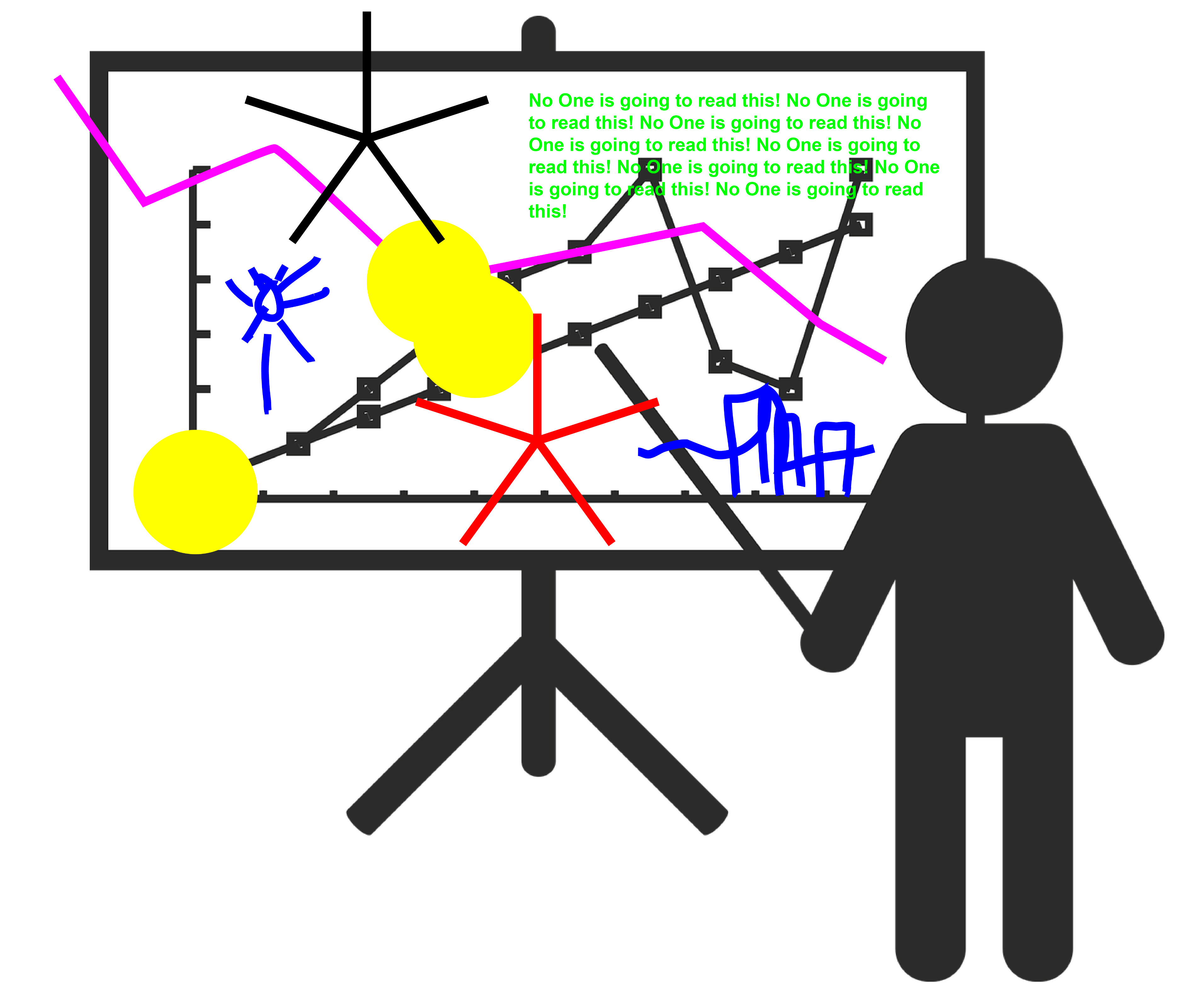

messy-cropped Continue reading →

Is a picture worth a thousand words?

To communicate science is to tell a story. And the best stories come with pictures, says Thaís Moraes.

Translating the results of a research project into a 10-minute presentation or article can be a difficult task. It must be informative but also succinct and appealing. It has to tell an interesting story. It has to entertain. And you shouldn’t have too much text.

2014-06-29 15-smaller

Thais Moraes

Continue reading →

You’re a designer — act like one

To communicate effectively, scientists have to start thinking like designers: know your audience, follow the rules of human perception, and tell your story in many layers.

Naturejobs journalism competition winner Lev Tankelevitch

This past August, I visited the Naturejobs career expo in London. As I chatted with exhibitors, I was ready to decline the typical set of leaflets they give away at these things. To my surprise, I was given a USB stick loaded with all of the information that I’d otherwise be carrying home in a canvas bag. This small but much appreciated gesture highlighted for me the significance of effective communication.

pexels-photo-196646 Continue reading →

Make a (sketch)note of Science!

Raise your hand if you doodle while taking notes.

Taking notes is a time consuming – and occasionally boring – process, but doodling and using symbols can make it easier, more fun – and could be better for your studies, says Marianna Ricci.

https://youtu.be/qp3kdN58SD0

Personally I’ve always liked to draw and I think of myself as a “visual person”: I’m sensitive to paintings and photos as well as nice color combinations or a cool pattern.

When I need to study something, the easiest way for me is to write it down and draw a diagram. Especially in my veterinary medicine studies, I used mathematical symbols and diagrams as well as colour codes and eye-catching drawings while taking notes and summarizing the lessons. Continue reading →

No such animal

Nobel Laureate Dan Shechtman describes the structure of quasi-crystals, the discovery of which won him the scorn of colleagues in the 1980’s and then the Nobel Prize in chemistry in 2011.

You are currently viewing a placeholder content from YouTube. To access the actual content, click the button below. Please note that doing so will share data with third-party providers.

More Information


Suggested posts

Tick tock cold cold clock

Big box small box light-filled box

Aint no stopping them now

Ain’t no stopping them now

Unstoppable by lead, undetectable above ground, undividable by modern physics; neutrinos are messengers from the very centre of the sun. Art McDonald, co-recipient of the 2015 Nobel Prize in physics, describes the puzzle of detecting neutrinos and the discovery that they change flavour on their journey to earth.

You are currently viewing a placeholder content from YouTube. To access the actual content, click the button below. Please note that doing so will share data with third-party providers.

More Information


Suggested posts

Tick tock cold cold clock

No such animal

Big box small box light-filled box