Rocket woman

xxxx

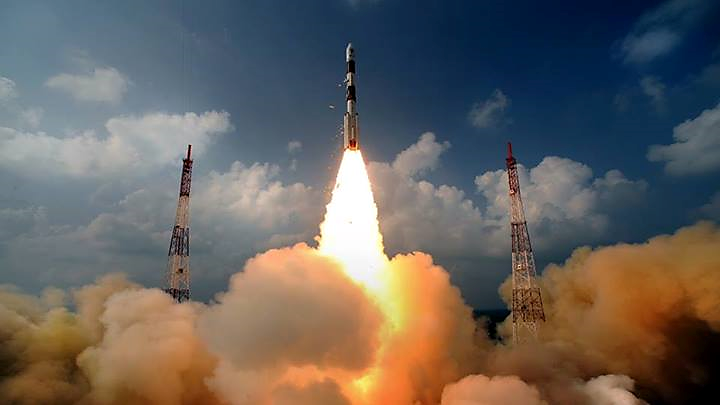
The Polar Satellite Launch Vehicle of the Indian Space Research Organisation, which carried the Mars Orbiter Mission satellite Mangalyaan. The payload included instruments developed by Dutta and her team.{credit}ISRO{/credit}

3Q: Moumita Dutta

A physicist at the Indian Space Research Organisation’s Space Applications Centre, Moumita Dutta was part of the team that put a probe into Mars orbit in 2014. The instruments they designed for the Mangalyaan are still beaming back data. Now India is gearing up for its third planetary mission in 2018 — Chandrayaan-2, a return to the Moon. As Dutta prepares to take part in the London Science Museum’s Illuminating India events, she talks about the lure of optics, the challenge of crafting super-light sensors, and the rise in Indian women entering space science.  

Tell me about your work with the Indian Space Research Organisation (ISRO).

Moumitta Dutta.

Moumitta Dutta.

In my childhood I had dreamed about space, aliens, the Universe, the stars – particularly the aliens! But I didn’t think I would be involved in space science. I became interested in physics when I saw the magnificent colours coming out of a prism in an experiment at school. I ended up doing a master’s in applied physics, specialising in optics. Then one morning in 2004 I read in the local newspaper that India was preparing for its first lunar mission, and I thought ‘What a phenomenal thing’. From that moment on I wanted to join the ISRO. A year and a half later, I did, ending up working on two sensors that would fly on the Chandrayaan-1 project [India’s first lunar mission, which launched in 2008 and found evidence of water before losing contact with Earth.] My base is the Space Applications Centre in Ahmedabad, mainly working on optical sensors for studying Earth and for planetary missions. For India’s 2018 lunar mission, Chandrayaan-2, we will use advanced versions of the sensors flown in the last mission, carrying out a very detailed study of the lunar surface and mineralogical mapping. There will be an orbiter, a lander and a rover, with mounted instruments to carry out experiments on the surface.

Mangalyaan launched just 18 months from its conception, costing a relatively low US$75 million.  What challenges did you face in building its sensors? 

All the sensors were designed in India: a colour camera, an infrared spectrometer generating a thermal map of the Martian surface and a methane sensor. We had 15 months or so to develop them. The main challenge was to make them very compact, lightweight and low-power, because the mission was to be launched with minimum fuel. We fought for every gram. The sensors were all first of a kind, and to develop them quickly we had to use off-the-shelf — rather than space-qualified — components, then test each under extreme conditions. The team of almost 500 engineers working  across the centres on the mission worked day and night. I feel like people worked from their heart and no one cared about the clock. The mindset was that they were working for our country, and the mission had to be successful. When we received the first signal after the spacecraft was captured into Mars orbit, a wave of joy spread across the country. The project team members became the superstars of India, with people even holding their pictures on placards, like film stars. Eagerness about Indian space research has rocketed. Three years on, the orbiter still transmits data from all the sensors, which we are analysing today.
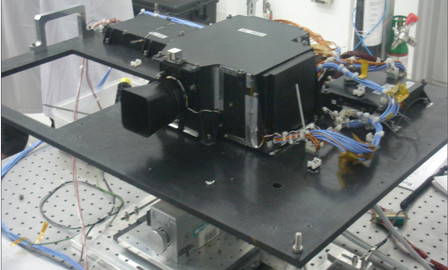
Methane sensor for Mars.

Methane sensor for Mangalyaan.{credit}Space Application Centre, ISRO{/credit}
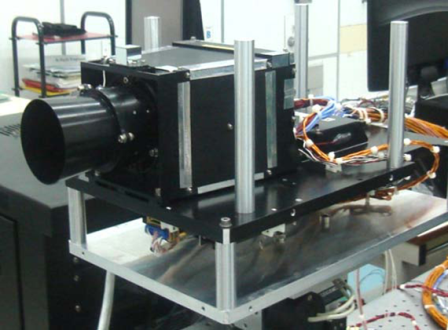
Mars colour camera.

Colour camera for Mangalyaan.{credit}Space Application Centre, ISRO{/credit}

Is space science in India welcoming women?

In the past few years we have seen a significant increase in the number of women joining Indian space science: right now, they constitute 20% or 25% of ISRO. The organisation is always ready to welcome women. As a government body, we get a minimum of six months’ maternity leave, for example, and women are given equal responsibilities. I feel like it’s not about whether someone is a man or woman, it is all about how they can handle the challenges. Now, whenever I give a talk and a small girl comes up to me and says, “I want to work for ISRO, I want to be an astronaut,” I feel wonderful. Women scientists of ISRO have also featured in the media, including Vogue India; and when our work is recognised, we represent the contributions of all the women involved.  That is the best part of it.

Interview by Elizabeth Gibney, a senior reporter for Nature based in London. This interview was edited for brevity and clarity.

Dutta will be appear in conversation with space scientist Maggie Aderin-Pocock at the London Science Museum’s Lates: Illuminating India on 29 November.


For Nature’s full coverage of science in culture, visit www.nature.com/news/booksandarts.
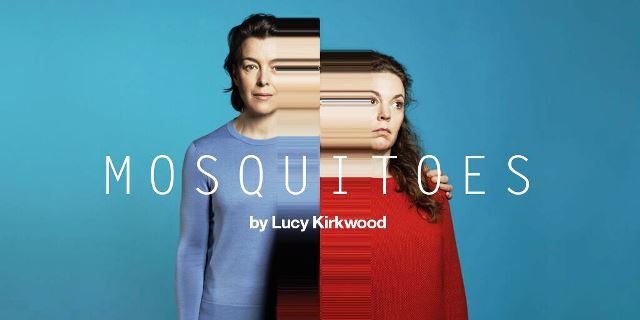
When physics and family collide

Posted on behalf of Elizabeth Gibney

NTGDS_Mosquitoes_Twitter_1024x512TT_Photography (Olivia Williams and Olivia Colman) by David Stewart. Design by National TheatLucy Kirkwood’s new play Mosquitoes is such a sparkling showcase for physics that it might as well have been commissioned by CERN, Europe’s particle physics laboratory. But this tragicomedy is most successful in its portrayal of heartbreak, trust and the tug of family ties.

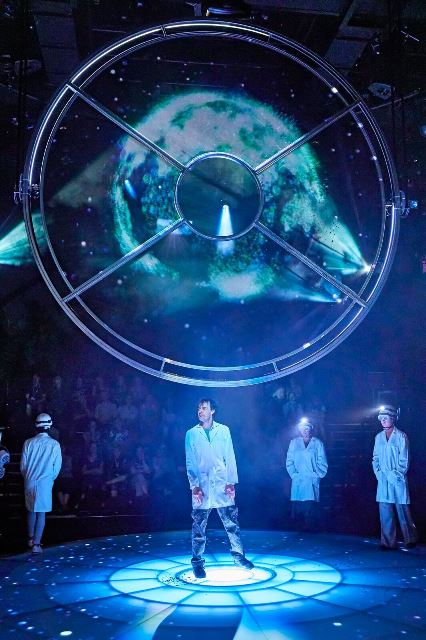
The science begins with the play’s name, a reference to a phenomenon at the heart of CERN’s Large Hadron Collider (LHC): that incredible things emerge when particles collide with the force of just two mosquitoes. The action takes place during the LHC’s startup in 2008. Women scientists from two generations feature — condensed-matter physicist Karen (Amanda Boxer) and her daughter, particle physicist Alice (Olivia Williams). There is even a humanised boson called, naturally, The Boson. Played by Paul Hilton, the personified particle segues into grand monologues about the creation and demise of the Universe, set to spectacles of light and sound in Rufus Norris’s slick, minimalist production. (The ghostly character doubles up as Alice’s missing husband, who is as elusive as the long-searched-for Higgs.) But it is the very human story enacted by Williams and Olivia Colman, as Alice’s disgruntled, underachieving sister Jenny, that completely steals the show.

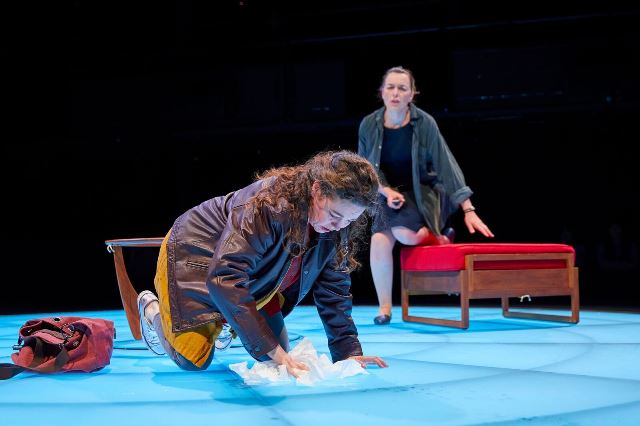
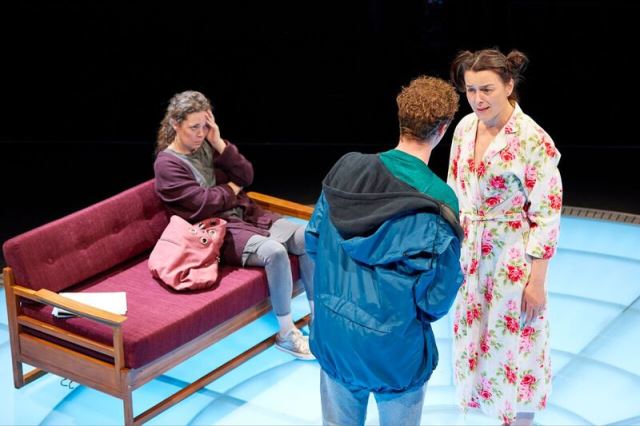
Olivia Williams (on bench) and Olivia Colman as Alice and Jenny.{credit}BrinkhoffMogenburg{/credit}

A tragedy prompts Jenny and their mother Karen, who is coping with the early stages of dementia, to visit Alice just as she is about to embark on the most exciting years of her career at the LHC. During their stay, Alice’s orderly life is jolted by events unfolding around her guests and her socially awkward teenage son Luke (Joseph Quinn). Each faces a personal issue — guilt, loss of control, work or teenage angst — that can stop them from seeing the bigger picture.

Colman is electric as Jenny. Witheringly witty, she’s also boozy and reckless, a fan of horoscopes and holidays “somewhere hot that serves English food”. Williams has less to work with but is excellent as even-tempered Alice, who struggles to understand her son and gently patronises her frequently deluded sister. Their relationship is very believable, not least in drawing on each other’s diverse qualities at times of need; it steadies the whirlwind of ideas Kirkwood plays with, from mental health to cosmology. The pacy dialogue meanwhile zings with humour.

xxx

Paul Hilton (centre) as The Boson.{credit}Brinkhoff Mogenburg{/credit}

Science here is most successful as a backdrop. The play perfectly captures the fervid atmosphere of the LHC’s switch-on day, with physicists jumping for joy at screens that seem, to an outsider, to show nothing. Boxer is effervescent as Karen, describing the highs and lows of her scientific work – for which, she often reminds her daughters, she should have won a Nobel. (Kirkwood also neatly skewers journalists who sought to ham up the possibility of the LHC causing Earth to be sucked into a black hole.) Jenny meanwhile becomes an anti-science mouthpiece, at one point masterfully comparing the quest for the Higgs boson to complete the Standard Model to the claim “my marriage isn’t working because we don’t have a cappuccino machine”. Her views are generally so ludicrous that such comments come off as praise.

The science setpieces are eerie and gripping — notably The Boson’s description of the Universe’s first 300,000 years as a real “pea-souper” while twinkling visuals appear on a screen above. But the relevance of these moments to the rest isn’t entirely clear. Are they meant to highlight the importance of Alice’s work? Are they a counterweight to the minutiae of human stories?

A more successful theme is the link between power and trust. Though the play celebrates the triumph of reason over pseudoscience, it also subtly makes the point that scientific pronouncements are taken on trust by everyone except those who directly work on them. Mosquitoes equates science with power, and shows that working in the two sisters. Jenny feels left behind by her scientific family, and that relates to her reactionary attitude and mistrust of doctors who tell her that vaccines and ultrasounds are safe. Meanwhile, the harder Alice’s life gets, the more she leans on superstition, faith and the blind acceptance of family.

Colman, Paul Quinn and Williams.

Colman, Paul Quinn (as Luke) and Williams.{credit}Brinkhoff Mogenburg{/credit}

Kirkwood’s decision to intertwine this intense relationship and each character’s personal struggles with a barrage of science makes for a slightly disjointed but profoundly emotional, immersive and compelling experience. I was irked only by the fact that the play does little to dispel the myth that science is only for the select few. (In a great comic line, Luke’s would-be girlfriend earnestly proclaims that, as she’s not clever enough to become a scientist, she’ll probably just be a doctor or lawyer. It’s a joke that’s close to the bone.) The audience is unlikely to leave Mosquitoes with a radically better understanding of cosmic mysteries, but they will be stung by its insights into the power of family relationships long after the curtains close.

Elizabeth Gibney is a senior reporter on physics for Nature based in London. She tweets at @LizzieGibney. 

Mosquitoes is on at the National Theatre, London, until 28 September.


For Nature’s full coverage of science in culture, visit www.nature.com/news/booksandarts.
The artist as astronaut

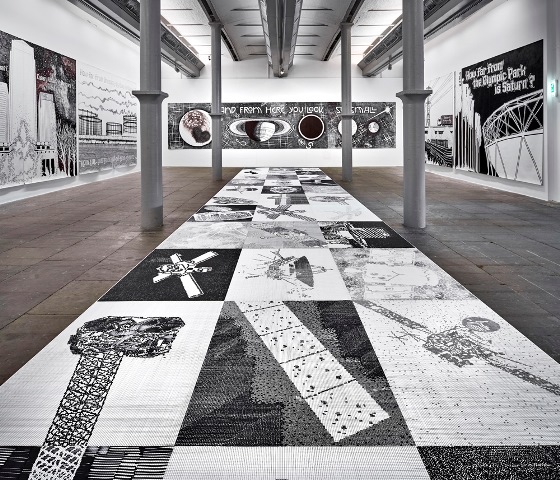
Probes is an inventory of space probes, which examines how the aesthetic of such craft has changed over time, as well as how functionality of design intersects with its cultural underpinnings. Mir views space probes as substitutes for human explorers, romantically searching for connection in the Solar System.

Artist Aleksandra Mir views space probes as substitutes for human explorers, romantically searching for connection in the Solar System. Her piece Probes (on floor) — part of her major work Space Tapestry — is an inventory of these craft, examining how their aesthetic has changed over time, as well as how the functionality of design intersects with its cultural underpinnings. {credit}Tate Liverpool{/credit}


3Q: Aleksandra Mir

 In 2014, Aleksandra Mir began a journey into the unknown. The London-based artist started talking with scientists and engineers about space — a realm in which she was a complete novice. The result of Mir’s dive into the cosmos is Space Tapestry, a vast wall hanging 3 by 200 metres, hand-drawn — in collaboration with 25 young artists — with fibre-tipped pens on synthetic canvas. Inspired in part by the eleventh-century depiction of Halley’s Comet on the Bayeux Tapestry, the work unfolds like a giant graphic novel to explore the unfathomable distances of space, the quest for extra-terrestrial life, and the impact of space technology on humans – from observing Earth to the politics of space. As the piece goes on show at Tate Liverpool, UK, Mir talks about her quest to get under the skin of science.

Why did you choose this format for Space Tapestry?

xxx

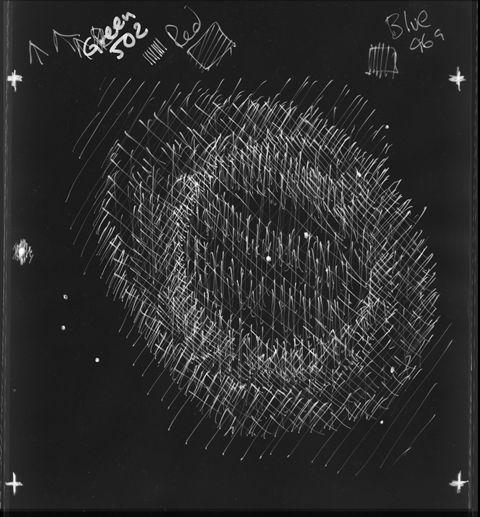
Mir’s work Ring Nebula emerged from conversations with Jayanne English, an astronomer involved in creating Hubble telescope images. To move beyond the “ice-cream” coloured swirls that Mir views as “trashy”, they experimented with capturing the same information in a black-and-white sketch in which the angle of cross-hatching represents different phenomena.{credit}Aleksandra Mir{/credit}

I wanted to create an immersive environment, almost like a stage set. And I wanted to introduce a new aesthetic. Whenever you see a science illustration you get what I call the “sleazy aesthetic”: supposed to convey fact but made to seduce with their slickness, intense colours and airbrushed surfaces. There are other ways of picturing phenomena that can be as realistic. And some phenomena beyond our technologies or perception can also be portrayed poetically. This is where art becomes relevant to science. My original inspiration for the project was the 1066 Bayeux Tapestry. It features a very early portrayal of Halley’s Comet: you have this little group of characters staring out in horror and fascination, and there’s this simple line drawing of the comet. What was interesting to me is that it doesn’t look anything like an actual comet, but conveys a tremendous amount of scientific information – it has a direction, a velocity and luminosity – which makes it valuable for contemporary scientists. So this became the key to my ‘tapestry’: images with validity for the science community, but also treated in a very poetic, freestyle, emotive and personal way.

You’ve explored many issues over your 25-year career. Why space, and why now?

Space has been a strand of my work for a very long time. My family watched the Moon landing in 1969 in Poland (which was then behind the Iron Curtain), and this left a powerful mark on me. My best-known work is First Woman on the Moon, the transformation of a beach in the Netherlands into a lunar surface in 1999, in response to the 30th anniversary of Apollo 11’s feat. The video of this event has been touring for 17 years now. And I recently realised that while the gist of the work is still valid – no woman has yet set foot on the Moon – I needed to catch up on the achievements of today’s space industry. I attended my first space conference in 2014 and was sold on a world that for me was like an alien planet. I had to learn a new language. I spoke to a lot of scientists about their daily lives. And once you start looking at that from my perspective as an artist and anthropologist, a natural philosophy and sort of magic embedded in these practices reveals itself. I was never interested in science fiction. Science has everything of interest to me. I think that the whole scientific project is a romantic project, the chasing for a connection, the yearning for depth, taking on a challenge, risking everything for a passion, the struggle.

xxxx

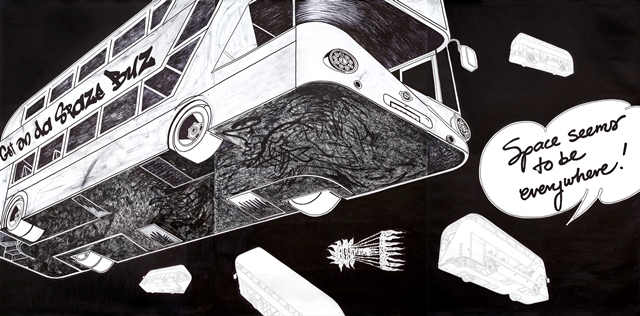
Get on Da Spaze Buz – a detail in Mir’s Space Tapestry: Earth Observation & Human Spaceflight.{credit}Modern Art Oxford{/credit}

What did you learn about scientists and science?

Working on the Space Tapestry project has given me access to some extraordinary scientists, locations and visuals. Among those I interviewed was Jan Woerner, director-general of the European Space Agency. Marek Kukula from the Royal Observatory Greenwich has been one of my main advisors, and molecular astrophysicist Clara-Sousa Silva has been a huge inspiration. I visited high-security sites such as Airbus Defence and Space in Stevenage, UK; and saw the network control centres at Inmarsat and the Satellite Applications Catapult, both depicted in my drawings. I was allowed to ask tons of naïve questions, be critical, playful and absurd at times, which has connected and educated me in a big way. I can now hold a conversation in this realm, and in 2015 I was invited as a speaker at the UK Space Conference myself.

Solar system

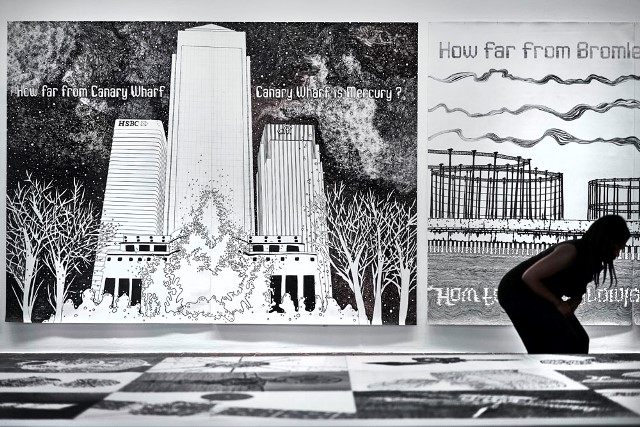
The Solar System series, part of Space Tapestry: Faraway Missions, aims to help viewers find more poetic and metaphorical ways to think about distances that are impossible for the human brain to grasp.{credit}Tate Liverpool{/credit}

There is a newfound dialogue with scientists who are reaching the understanding that they also have been working in isolation.  I have also realised that the sophistication of their projects, the enormous budgets and the long timespans can in no way ever be comparable to what I, as one artist, can do. So, if anything, I have gained a greater respect for science. One conversation I’ve had with scientists, though, is that you don’t always have to be heroic and successful to garner respect. To struggle, fail, be tired and dirty is part of our nature and a fundamental part of all human exploration. Artists know how to draw power from it and I think my project both humanizes and makes science more credible.

Mr's piece First Woman on the Moon (video, 1999).

Mir’s piece First Woman on the Moon (video, 1999).{credit}Aleksandra Mir{/credit}

Interview by Elizabeth Gibney, a reporter on physics for Nature based in London. She tweets at @lizziegibney.

This interview has been edited for length and clarity. 

Space Tapestry is on display in two parts: Faraway Missions will be at Tate Liverpool until 15 October; Earth Observation & Human Spaceflight will be on display at Modern Art Oxford until 12 November. An accompanying book forming part of the Space Tapestry project, We Can’t Stop Thinking About the Future, is also available, and includes 16 interviews with space professionals.


For Nature’s full coverage of science in culture, visit www.nature.com/news/booksandarts.
An immortal life: Henrietta Lacks on film

Posted on behalf of Ewen Callaway

p12871796_p_v8_aa

In the HBO film based on Rebecca Skloot’s book of the same name, Oprah Winfrey plays Henrietta Lacks’ daughter Deborah Lacks.

The idea that people should have a say over how their cells are used in research isn’t revolutionary, but it flies in the face of research practices over the past century. That it nearly became law is due in no small part to Rebecca Skloot’s 2010 bestseller The Immortal Life of Henrietta Lacks, the story of the African-American woman living in Baltimore, Maryland, whose fatal tumour – taken by scientists at Johns Hopkins Hospital in 1951 without the knowledge or permission of Lacks or her family — gave rise to the first immortal human cell line, HeLa.

The book fuelled a much-needed conversation about scientists’ moral obligations to research participants and their families. Now a powerful film adaptation of the same name, starring Oprah Winfrey as Lacks’ youngest daughter Deborah, looks set to amplify that.

Skloot’s book covered a lot of ground, and the film’s director George C. Wolfe (best known for directing and producing Broadway hits such as Tony Kushner’s Angels in America) does an admirable job cramming in details about how HeLa cells were established and their ongoing impact on research. But the movie, broadcast on 22 April on premium US television network HBO, largely covers the decade it took for Skloot to report and publish her book. It focuses in particular on her efforts to gain the trust of Lacks’ family and build an emotional bond with Deborah Lacks.

Their relationship can feel overly dramatized, although Wolfe should not be faulted for taking some dramatic licence with Skloot’s book in what is, after all, a dramatisation (she also served as an executive producer). But much of the film rings true. A scene in which Deborah Lacks questions Skloot’s financial motives and grabs her arm is exactly as described in the book.

Deborah Lacks.

Deborah Lacks.{credit}Rebecca Skloot{/credit}

By omitting some key aspects of the book — the science and history of cell culture and large swathes of Lacks’ biography — the film can feel meta. It is, after all, a film based on a book about a journalist trying to write a book. But it should encourage more people to read the story and absorb its powerful message of social injustice institutionalized by science.

US National Institutes of Health (NIH) director Francis Collins and then-deputy Kathy Hudson have noted that Lacks’ story inspired policy changes in the rules that govern research on human subjects (officially known as the Federal Policy for the Protection of Human Subjects, but widely known as the Common Rule). “The people who are participating in research and providing pieces of themselves should be providing permission as well,” Hudson told Nature in 2015, when the government floated a proposal that would have required them to get approval to reuse discarded samples of blood, urine and other specimens for studies beyond those the subject initially agreed to. But the proposal caused consternation among many scientists. They breathed a sigh of relief this year, when the  final version. of the Common Rule largely maintained the status quo. As long as a participant’s name is removed from the sample, scientists needn’t obtain new consent.

Henrietta Lacks.

Henrietta Lacks.{credit}Courtesy of the Lacks family{/credit}

That may seem like a setback in a quest for justice the Lacks family is all too familiar with. But other developments suggest that the Lacks’ story has changed how research participants are treated by scientists.

Currently, a movement for “dynamic consent” — focused on the establishment of a lasting relationship between researchers and study participants — is growing. It was pioneered by professor of health, law and policy Jane Kaye, while elements of it are being used in Australia. Participants or their relatives (in cases where they are no longer alive) are kept up to date on how their samples are used in research, and they can opt out of particular studies or remove their sample entirely.

The Lacks are finally gaining some control over HeLa cells, if not the remuneration many members have in the past and some still seek. In 2013, after researchers funded by the NIH sequenced the HeLa cell genome without the knowledge or consent of the Lacks family, Collins helped broker a deal with the family to limit access to the data. Now, all NIH-funded scientists and others who want the best quality HeLa genome must explain their research to a committee that includes a Lacks family member. It’s enough for a sequel.

Ewen Callaway is a senior reporter for Nature based in London. He tweets at @ewencallaway. 


For Nature’s full coverage of science in culture, visit www.nature.com/news/booksandarts.

Ancient DNA and the rise of ‘celebrity science’

Elizabeth Jones.

Science historian Elizabeth Jones.

3Q: Elizabeth Jones

Whether it’s about Neanderthal-human interbreeding or the prospect of resurrecting woolly mammoths, the public cannot seem to hear enough about ancient-DNA research. For science historian Elizabeth Jones, ancient DNA offered an opportunity to study the development of a field in the crucible of intense public interest. She defines the phenomenon as “celebrity science”, in which scientists harness attention to generate interest in their work and capture future funding.

What led you to the definition of celebrity science?

As a historian, I used traditional research methods, like looking at professional and popular literature. I’ve gone back to conferences and archives. But one of the main reasons I’ve come up with the idea of celebrity science is from my conversations with scientists working in ancient DNA themselves. Many of them are alive so I can talk to them, but it’s also dangerous territory because their careers could be impacted by what I write. Meanwhile, if you go back to the 1970s and 80s, you see that the interest in ancient DNA was there from the very beginning. My speculation is that this comes from a long history of popularizing certain public-facing fields, such as palaeontology, archaeology and molecular biology. Our fascination with dinosaurs, human history and genetics and DNA as the code of life is documented. When you get these things together, the interest is just explosive.

Jurassic_Park_logo

The Jurassic Park franchise enabled a visual image of what using ancient DNA to bring back extinct species might mean.

How important do you think the Jurassic Park films are to the field?

Steven Spielberg’s 1993 film Jurassic Park had, for the first time, this visual image of what it would mean to use DNA to do something like bring back dinosaurs. That image was used by both researchers and reporters to talk to the public – ‘I’m doing this ancient-DNA research, and it’s kind of like this but not really’. It created a lot of momentum and it influenced press interest. There are some arguments that it influenced publication timing in journals like Nature. Did it influence research? One good example has to do with funding in the United States. Jack Horner, who is a palaeontologist but was also the scientific consultant to the Jurassic Park films, applied to the National Science Foundation in 1993 for money to try to extract DNA from dinosaur bones. Interviewees I talked to who were involved in the project feel the funding was awarded in part because of the public interest in the film at the time. Some researchers think this close connection between science and science fiction was damaging to press and publication expectations about what their research could really do. But a lot of the researchers who work in this field are very attuned to news value. They understand that you have to sell science. That means packaging it in such a way that the consumer wants to read it or learn more about it. They understand that Jurassic Park was an easy entry for communicating to the public what their research can and can’t do.

What changes have you seen in the field since?

Ancient-DNA researchers agree that they have achieved a great sense of credibility in the field of evolutionary biology. You can look at a lot of the work with ancient humans like the Neanderthal genome, for example, that’s really shown the power of ancient DNA. But even the Neanderthal genome was still very much a celebrity kind of study. Svante Pääbo was really active in designing it that way, by issuing press releases, putting a strict deadline on his lab and telling the rest of the world “we’ll sequence the genome in two years’ time”. It’s very much still science in the spotlight, but one that has demonstrated that they can do rigorous research. Next-generation sequencing has allowed researchers to get some high coverage genomes from extinct organisms. There are a few researchers in the ancient-DNA community who are not necessarily pursuing de-extinction, but they’re involved in these conversations. Because they’re respected scientists, they have lent a sense of credibility to the idea that de-extinction might happen. I think researchers in the ancient-DNA community are starting to pay attention to this pursuit in a way they wouldn’t have 15 years ago. As for my own work, I worry that scientists will think I’m saying celebrity science is a sell-out kind of science. Of course there are tensions between science and the spotlight. But ancient-DNA research is a great example of how really rigorous work can coincide with press and public interest.

Interview by Ewen Callaway, a senior reporter for Nature based in London. He tweets at @ewencallaway. 

This interview has been edited for length and clarity.


For Nature’s full coverage of science in culture, visit www.nature.com/news/booksandarts.

Waltzing for science

Posted on behalf of Quirin Schiermeier

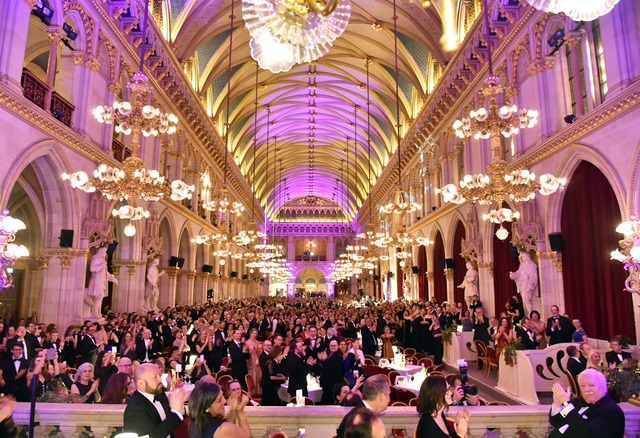
The Vienna Science Ball 2017, in the city's Town Hall.

The Vienna Ball of Sciences 2017, in the City Hall.{credit}©PID/Christian Jobst{/credit}

Around midnight on 28 January, hundreds of couples lined up in the splendid ballroom of the Vienna City Hall for the quadrilles — and the Vienna Ball of Sciences became tangibly interdisciplinary. Students, scientists and scholars of myriad fields whose paths would scarcely cross in daily academic life moved gracefully to the waltzes of the younger Johann Strauss. Laughter filled the air as rows of elegantly clad dancers performed (in reasonably perfect composure) the bows and figures of the traditional courtly dance.

Balls are the very hallmark of Vienna’s social life and an essential part of its cultural identity. Some 450 take place during January and February. Many trades and professions – from hunters to physicians – proudly hold their own in splendid venues such as the Hofburg, Vienna’s imperial palace. However, the city’s growing and increasingly international research community, currently numbering about 220,000 people, had long been standing aloof from the parallel world of its ball society.

That changed in 2015 when Oliver Lehmann and Alexander Van der Bellen launched an annual Vienna science ball. “We wanted to set a counterpoint to ultra-conservative student corps and the academic ball they organize,” says Van der Bellen, the former Green politician and economist who last week took office as Austria’s new president. “Vienna’s liberal science community absolutely deserves a wonderful ball of their own, we thought.”

Promoting diversity

Lehmann, a public relation expert with the Institute of Science and Technology (IST Austria) in Klosterneuburg near Vienna, says that Vienna’s balls tend to be high-level political affairs that have in the past drawn violent protests from some on the extreme left, who deem them elitist. But the science ball promotes diversity, reaching out to students and researchers from all academic disciplines and institutions. Like Berlin’s Falling Walls conference, held every November to commemorate the divided German city’s 1989 reunification, it is a clever attempt to associate a big city’s science base with its most distinguished cultural characteristics.

And the sold-out event was ample proof that the organizers had hit a nerve. The 3,000-strong crowd happily waltzed, tangoed and foxtrotted the night away in environs that subtly alluded to science. Light-emitting diodes illuminated dancers’ moves to stunning effect; tables were decorated with supposedly aphrodisiac plants (pomegranate, celery, orchids) selected by botanists at the University of Vienna’s department of pharmacognosy; and young artists with Vienna’s Academy of Fine Arts had covered the walls with expressive paintings.

Bundespräsident Van der Bellen, Bürgermeister Häupl und Stadtrat Mailath-Pokorny eröffnen den Ball der Wiener Wissenschaft

Austrian president Alexander Van der Bellen opens the Vienna science Ball. In the background are Oliver Lehmann of the Institute of Science and Technology (right), and Wolfgang Ortner, the conductor of the ball’s orchestra (left).{credit}©PID/Christian Jobst{/credit}

Those more inclined to test the laws of probability theory were offered a chance to do so at two roulette wheels. On large screens, researchers with the Ludwig Boltzmann Institute of Archaeological Prospection and Virtual Archaeology displayed the results of their geomagnetic prospection and ground-penetrating radar measurements of Stonehenge. And at the tables, animated discussions ranged over science and the arts. How often does it happen in academe that a pensive researcher on African cultural identity exchanges ideas with a tipsy quantum physicist about Arthur Schopenhauer’s philosophy of pessimism?

Computer scientist Thomas Henzinger, director of IST Austria and a member of the ball’s honorary committee, is not someone inclined to indulge in rambling sophism. He says he doesn’t even care much for ballroom entertainment, but he does agree that the ball raises Vienna’s profile as a cosmopolitan city of science. Vienna and Austria, he says, benefit a lot from the influx of talent from Eastern Europe and other countries. At the IST, launched in 2009, less than a fifth of 600 staff — and only 5% of postdocs — are Austrian, he says.

Isn’t a ball a bit jingoistic for such a global profession? “Nationalism is the very last thing I support,” Van der Bellen told me, speculating that Europe could soon become a haven for US scientists and intellectuals escaping the Trump administration. “I do appeal to all young scientists, here and around the world, to resist chauvinism and stand up for liberal values.”

As the scientists had a ball, anxiety about world politics became distant concerns — for a few hours. Some had travelled from as far as China to join the fun; many pledged to come again. Tickets for next year’s Science Ball go on sale on 15 November.

 Quirin Schiermeier is senior reporter for Nature in Munich. He tweets at @tomboy180463.


For Nature’s full coverage of science in culture, visit www.nature.com/news/booksandarts.

Lab Wars: a game of scientific sabotage

Posted on behalf of Richard Van Noorden

3d box a

{credit}© “LAB WARS” BY CAEZAR AL-JASSAR AND KULY HEER; GRAPHIC DESIGN BY CRIMZON STUDIO, ILLUSTRATIONS BY NIZAR ILMAN{/credit}


In the race for discovery and recognition, researchers have sometimes cheated, lied, colluded, suppressed evidence and even sabotaged others to get what they want — as Michael Brooks documented in his 2012 book Free Radicals: The Secret Anarchy of Science.

Two researchers today launch a game that captures this anarchic spirit. Board-game fans Caezar Al-Jassar, a postdoc at the Laboratory of Molecular Biology in Cambridge, UK, and Kuly Heer, a clinical psychologist, have designed the card game Lab Wars to represent the scientific rat race, with extra sabotage.

“It’s a very exaggerated form of science,” admits Al-Jassar. Most testers wanted even more power to disrupt, he adds.

Competitors play lab archetypes, ranging from ‘PhD student’ to ‘emeritus professor’. They collect equipment such as electron microscopes and centrifuges, generate results, and acquire papers, books, and, most valuable of all, Nobel prizes. Characters interfere with each other’s productivity: a principal investigator derails a PhD student by dictating their experimental time; a PhD student annoys a post-doc by necessitating extra equipment costs; and so on.

The game is at its most cut-throat when players mess up other laboratories. They can steal papers or lab equipment, gain favours from peer reviewers, or sabotage other labs with radioactive materials and computer viruses. If all that sounds unlikely, Al-Jassar says that all the sabotage cards are based on real or rumoured events.

promo cards

{credit}{credit}© “LAB WARS” BY CAEZAR AL-JASSAR AND KULY HEER; GRAPHIC DESIGN BY CRIMZON STUDIO, ILLUSTRATIONS BY NIZAR ILMAN{/credit}{/credit}

Some games based around science mingle education with entertainment: there’s a card deck of women in science, for example, Cell Trumps, and various efforts at representing evolution in board game format.

There’s an element of the didactic in Lab Wars, with some explanation of the lab equipment involved. The cards’ designs contain knowing winks: astrophysicist Neil de Grasse Tyson’s face is cast on the Nobel medal, rather than Alfred Nobel’s; players compete for papers in the fictional journal Nurture. Al-Jassar says he hopes to add famous historical scientists with their lab equipment to the deck if there is enough enthusiasm. (As is the way for specialist products, LabWars’ Kickstarter page doubles as a purchase point for the basic game and as a fundraising campaign site for future interest; it will only be funded if the developers raise £5,000.)

But in the main, Lab Wars is for fun. Borrowing elements from established favourites such as Citadels and Dominion, the game is a fairly complex tactical battle that will take less than an hour to complete with three players; it is aimed at older children and adults, scientists and non-scientists alike.

And some testers, Al-Jassar says, have enthused about using the game to show others what science is really like. After all, for many a hard-pressed post-doc, research can feel like a game where the cards are stacked against them.

Richard Van Noorden is senior news editor at Nature. He tweets at @Richvn.


For Nature’s full coverage of science in culture, visit www.nature.com/news/booksandarts.

Finding the art in research

3Q: Rich Johnston

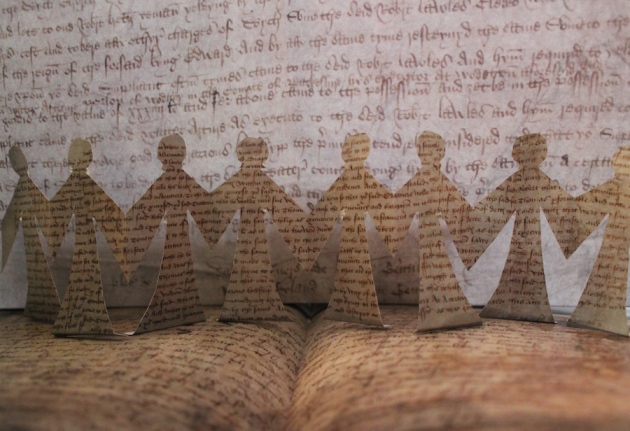
Rising from the page: bringing medieval women to life/Sparkey Booker and Deborah Young. Winner of the 2015 Research as Art competition.

Rising from the Page: Bringing Medieval Women to Life. Sparky Booker and Deborah Youngs. (Winner of the 2015 Research as Art competition.) {credit}Sparky Booker and Deborah Youngs{/credit}


For scientists used to describing experiments in scientific papers, distilling their research down to one picture and a 150-word description presents a challenge. But this is what the ‘Research as Art’ competition demands. With the 2015 entries on display at the Royal Institution in London until 2 March, materials scientist Rich Johnston, co-director of Swansea University’s Advanced Imaging of Materials facility, told Nature about the competition, which he founded in 2009.

What is the purpose of Research as Art, and how does it differ from other science-photography competitions?

Research as Art is less about the stunning picture, and more about the story. It’s about what goes on behind the research; what it means to be a researcher. The most compelling submissions aren’t an image that was lying unappreciated on a lab hard drive for years, or a beautiful false-coloured electron microscopy image. They are the submissions that describe the years of failure in the laboratory, the imposter-syndrome and the way you question yourself daily. Submissions can be very personal. For 2015, I received an acrylic painting, Nearly Not Dusk, from geographer Jennifer Stanford. It was her view from the deck of a research vessel in the Norwegian Sea. She described the cold isolation of seeing neither darkness nor land for weeks on end. I’ve never been on a research ship in the Arctic Circle, but reading the text and looking at the painting, I was transported to that spot, to her viewpoint, to her life.

Nearly Not Dusk: A view from the deck of a research vessel in the Arctic/Jennifer Stanford.

Nearly Not Dusk. Jennifer Stanford. {credit}Jennifer Stanford{/credit}

Conventional research output doesn’t provide an avenue for the creativity and emotion that underpins research. The conventions of publication mean that the human is stripped from the final product — the research paper. Researchers are creative. They develop exciting hypotheses and they are creative in their proposals for funding.

Do you have a favourite image from the competition?

This year was the first time the wonderful judging panel selected my favourite as the overall winner: Rising from the Page: Bringing Medieval Women to Life (pictured, top) by Sparky Booker and Deborah Youngs. They are historians, working primarily with medieval legal texts. Perhaps not the easiest subject matter in this context, but they created a submission that represented their research, their process, the challenges they face in lifting these experiences from incomplete text and presenting a rounded view of medieval women. And they did it in a unique and clever way, with a paperchain of women, cut from a manuscript, literally rising from the page.

My favourite from the early years of Research as Art helped develop the project in a new direction, revealing the humanity behind research. This was by Suzy Moody, entitled Scrutiny. When I first saw this entry in 2011, I remember being amazed that someone had so perfectly captured their research process, and what it means to them, and how our identity as humans can be shaped by the research we do.

Scrutiny/Suzy Moody. An entry to the 2011 Research as Art competition.

Scrutiny. Suzy Moody.{credit}Suzy Moody{/credit}

I have another favourite too. Matt Carnie works on photovoltaics, or solar cells. He teamed up with his wife Jay Doyle to represent failure in research with Graveyard of Ambition. They arranged lots of small solar cells in rows, like gravestones. These cells were all failures. Failed attempts at improving on previous research, which are a part of Matt’s past, but also shape his future, as he learns from each one. They are as much a part of his research as the one cell that does yield a higher efficiency, which makes it into his academic paper.

Graveyard of Ambition/Matt Carnie and Jay Doyle.

Graveyard of Ambition. Matt Carnie.{credit}Matt Carnie{/credit}


Do you produce art in your own research?

I lead an imaging research group where we X-ray all manner of interesting things, and find even more interesting and otherworldly shapes when we peer inside them at the micro-scale. So we produce striking images and 3D animations in the lab daily. But, I don’t really consider these to be our art. We can spend a lot of time working on huge X-ray data sets to make them beautiful, and they may be considered SciArt, but I see them as a gateway to the research story.

A Sand Dollar/Rich Johnston.

A Sand Dollar. Rich Johnston.{credit}Rich Johnston{/credit}

I have put submissions into the exhibition when it tours different places, but I wouldn’t want to influence potential contributors too much. I began Research as Art, but the researchers who’ve engaged with the project and given a glimpse into their process are far better at Research as Art than I am, and have had a huge impact on how it’s developed. They have found a platform to explore their creativity and convey their emotion and humanity. Their submissions astound me every year. I’m blown away by their ability to reveal part of their soul … in just an image and 150 words or less.

Rich Johnston was a 2013 British Science Association media fellow at Nature. Interview by Daniel Cressey, a reporter for Nature in London. He tweets at @DPCressey.

For Nature’s full coverage of science in culture, visit www.nature.com/news/booksandarts.

On the road with Star Men

Posted on behalf of Carolin Crawford

Roger Griffin, Wal Sargent, Donald Lynden-Bell, Nick Woolf and John Hazlehurst at Meteor Crater, Arizona.

Roger Griffin, Wal Sargent, Donald Lynden-Bell, Neville (Nick) Woolf and John Hazlehurst having Christmas dinner at the bottom of Meteor Crater, Arizona, in 1960.

Fifty years ago, four young men with newly minted PhDs left England for the California Institute of Technology. They were embarking on what turned out to be long and successful lives in astronomy. California afforded Donald Lynden-Bell, Roger GriffinWal Sargent and Neville Woolf opportunities — to probe the heavens, through access to the world’s best telescopes at Mount Wilson and Mount Palomar, and to explore the astonishing landscapes of the western United States on the road.

Star Men, a documentary film on the four astronomers by Alison E. Rose, premiers on 3 September at the 35th Cambridge Film Festival. For the film, Rose joined them as they reunited for a final road trip, along with the Union Jack flag that features in many photos from their original forays. (The fifth original member, John Hazlehurst, was unable to make the reunion.) Their journey is partly a nostalgic return to the giant telescopes, and a chance to repeat the ‘best’ hike they undertook, through arid, dusty canyons to Rainbow Bridge National Monument in Utah. More, it is a rare chance to reflect on the changes the years have wrought, on the men and their science.

Very Large Array radio telescopes, New Mexico.

Very Large Array radio telescopes, New Mexico.{credit}Malcolm Park{/credit}

The 1960s marked the start of modern astronomy. Game-changing observations, theory and technological advances then and in subsequent decades would begin to transform the face of the field. Quasars, the cosmic microwave background and pulsars were all discovered serendipitously; structure on the largest scales was traced around the voids of space; new generations of giant, segmented mirror telescopes began to scan the skies; spectrometric techniques started to reveal the presence of planets beyond our Solar System; new astronomies conquered invisible wavebands. Lynden-Bell, Griffin, Sargent and Woolf each played a significant part in this game of progress – in their separate roles as theorist, instrumentalist, observer and telescope visionary, respectively.

In the film, the four reminisce about their shared experiences, such as the joy of riding the prime focus cage to guide the motion of the 200-inch Hale Telescope  at the Palomar Observatory for hours at a time, with only the stars and classical music for company. It is fascinating to hear Sargent, director of Mount Palomar from 1997 to 2000, express how he originally suffered from impostor syndrome. He confesses on screen to having been scared of the telescope for several years, doubting at first that his science was “good enough for such a grand machine”.

Spurred into science

This is not a film about the science or how science is done, although it discusses and describes of a range of astronomical phenomena, and is illustrated by sumptuous time-lapse sequences showing the Milky Way in all its glory crossing the night sky. Instead, it reveals how scientists live and breathe for their work. I was particularly entranced by what the four had to say about what triggered their youthful enthusiasm: books brought home by a mother in lieu of her salary as a cleaner; the unfettered view of the heavens afforded by wartime blackouts; an affinity for pondering mathematical problems when words were not easy to read; listening to Fred Hoyle’s radio lectures.

Roger Griffin, Donald Lynden-Bell, filmmaker Alison Rose and Nick Woolf at Rainbow Bridge National Monument, Arizona.

Roger Griffin, Donald Lynden-Bell, filmmaker Alison Rose and Nick Woolf at Rainbow Bridge National Monument, Utah, for the reunion.

Necessarily, the film also exposes the consequences of ageing, as the four confront physical frailty, terminal illness, and the limitations and stark vulnerability of a body in its eighth decade. (Sargent died at 77 in 2012, seven months after the reunion.) There are brief but poignant musings on a range of subjects, from the worth of human spaceflight to religion, extra-terrestrial life and mortality. Yet their good humour and enthusiasm remain undimmed. I was humbled by their expressions of amazement, gratitude and joy at having spent a lifetime observing the Universe. They have enough of the boy still at their core – we witness brief glimpses of petulance, teasing and competitive behaviour – to continue asking the big questions. On their overnight camping trip, an opportunity for observing afforded by the dark suggests that the astronomers are still far better able to navigate their way around the sky than on the ground.

Star Men is, however, very much of its time – a privileged time, when astronomy could be a much more individualistic pursuit than it is now. Young, bright researchers of the late twentieth century century had comparatively easy access to some of the best telescopes, and pondered their science at a more considered pace than in today’s world of large collaborations, intense competition, giant facilities, satellites, sky surveys and data mining. What changes and discoveries will today’s more mixed generation of 25-year-old astronomers reflect on 50 years hence, I wonder?

Carolin Crawford is a communicator of science, astrophysicist researcher, lecturer and public astronomer based at the Institute of Astronomy and Emmanuel College, University of Cambridge.  The 2015 Cambridge Film Festival runs from 3 to 13 September.


For Nature’s full coverage of science in culture, visit www.nature.com/news/booksandarts.
Science guns the engine

A Harley-Davidson.

A Harley-Davidson.{credit}Hartmann Linge, Wikimedia Commons.{/credit}

What is it about scientists and motorcycles? Is the idea of caning it helmet-free down the highway an antidote to the close analysis and hunched precision of the lab? Does the love of Harley-Davidsons on an open road somehow spring out of the exploratory dynamism of the scientific enterprise? Or is the boffin-bike nexus just down to the deep groove Easy Rider cut in our collective psyche?

It was Tim Radford’s stirring review of neuroscientist Oliver Sacks’s On the Move that kickstarted my thinking about the connection. In it, Sacks recounts his youthful immersion in 1960s America, notably the revved-up cultures of the East and West coasts. Here he took to motorcycles (and musclebuilding), as the cover photo of a young Sacks on a BMW in Greenwich Village — looking somehow both vulnerable and physically at ease — neatly reveals.

Sacks was then already a veteran of the road, and multiple biking accidents. As he tells in On the Move, he motored through several models as a London teenager — a BSA Bantam, a 250cc Norton, and finally a 600cc Norton Dominator. On this he managed both to ‘do the ton’ (hit 100 mph) and zip to Stratford-on-Avon to see the latest Shakespeare play. That restlessness, he notes, has also propelled him through his phenomenal career.

Francis Collins of the NIH on his Harley.

Francis Collins of the NIH on his Harley.{credit}K. Wolf/Nature{/credit}

So perhaps the link between driven scientist and big bike isn’t so hard to parse. Certainly, two eminent geneticists — Francis Collins, US National Institutes of Health director, and Paul Nurse, Royal Society president and Francis Crick Institute director — are devotees. (Collins’s is a Harley-Davidson Road King Classic, while Nurse famously bought a bigger Kawasaki when he won the 2001 Nobel Prize for Medicine or Physiology.) Experimental physicist Charles Falco owns over a dozen (and co-curated the New York Guggenheim’s blockbuster 1998 show,  The Art of the Motorcycle). And IBM’s lead architect for cloud solutions, Lysa Banks, is no stranger to sprockets and kickstands.

Aside from such exalted hobbyists, there are scientists who gun the engines on work time. Giovanni  Savino of Australia’s Monash University , for instance, has devoted his career to studying the physics of motorcycles. His unique interactive physics lab in Bologna’s historic Ducati motorcycle factory, Fisica in Moto, allows local high-school students to see physical principles in action.

Bikes have even infiltrated community healthcare. In April 2013, Nature reporter Ewen Callaway joined and filmed epidemiologists in northern Nigeria working on polio eradication under a programme run by the Nigerian government and the US Centers for Disease Control and Prevention.

One of the dirt bikes used by a polio-eradication team in northern Nigeria.

One of the dirt bikes used by a polio-eradication team in northern Nigeria.{credit}Ewen Callaway{/credit}

Using off-road motorbikes on the rough terrain, the team search for nomadic Fulani communities and check whether the children are vaccinated — mapping tens of thousands of settlements as they go.

Whether for escape or discovery — or both — the nexus of road and motorcycle seems to inhabit a key niche in scientists’ mental ecology. In a world where many opt for a desk toy or a run to spur original thinking, straddling a bike might look a little extreme. But as Sacks has wonderfully shown, it suits the supercharged mind.

Sample Nature Podcast’s Oliver Sacks special here.


For Nature’s full coverage of science in culture, visit www.nature.com/news/booksandarts.