Back to the thesis

We share Nature’s back to the thesis videos, and some of our favorite #threewordthesis tweets

Last week, Nature visited a few prominent scientists to take them back to their theses.

First up was Francis Collins, director of the NIH, with Semiclassical theory of vibrationally inelastic scattering, with application to H+ and H2 (1974). This is how it went.

Continue reading

Jobs of the Future: What will a science career look like in 2030?

Scientists should be the ones designing the jobs of the future, say Michael Fischer and Mandë Holford. The Jobs of the Future initiative enables them to do so.


The modern growth in cross- and multidisciplinary research in academia has already had huge impact on the world around us, and is set to reshape the jobs market for scientists globally. With this in mind, the UN recently announced their 2030 Sustainable Development Goals (SDGs), which includes the goal to create jobs with competitive salaries that lead to sustainable economic growth. We believe young scientists should be the ones establishing the new fields and areas of employment for the future, to address the 2030 SDGs.


JOF-2

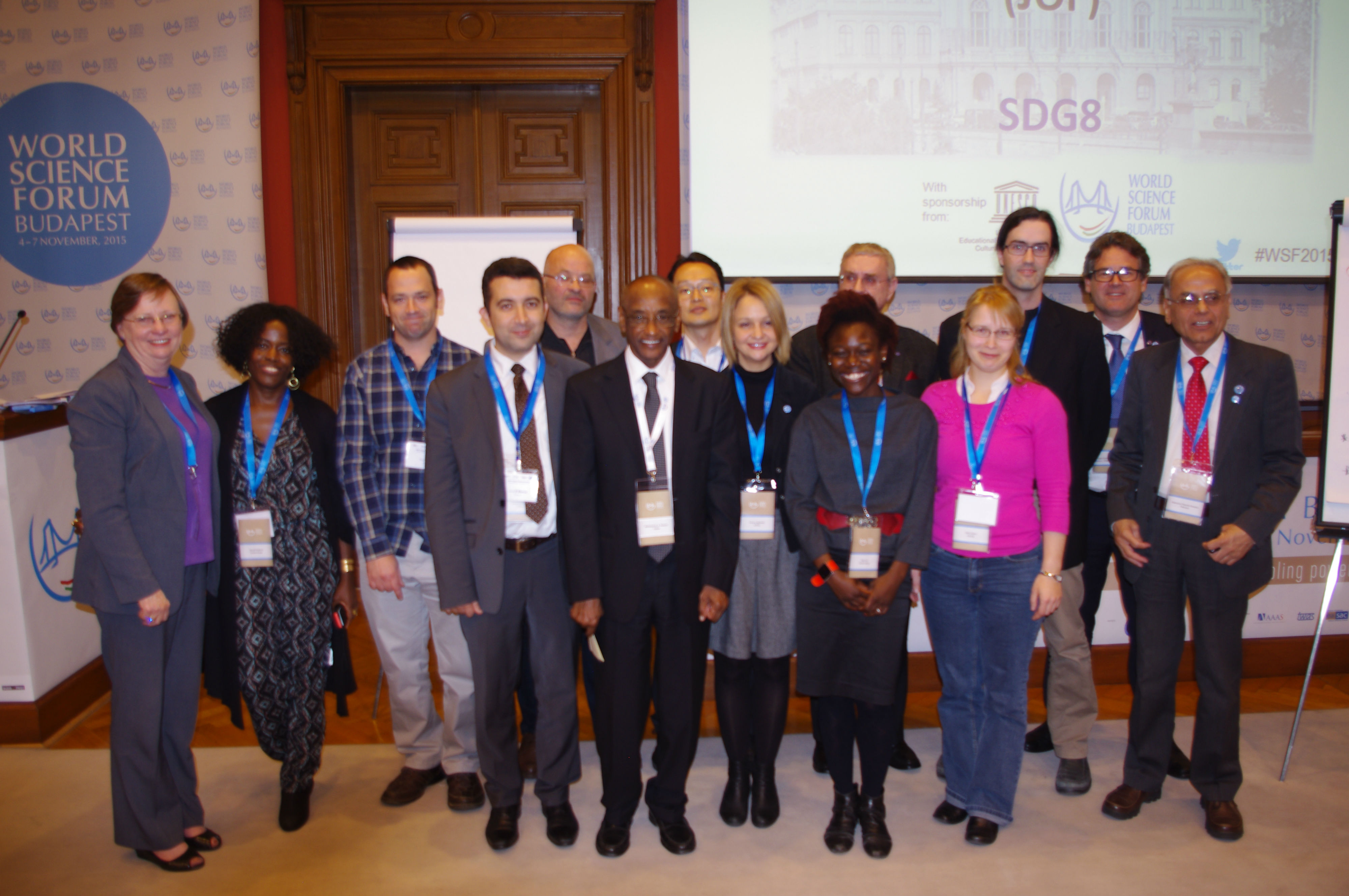
The JOF team

The Jobs of the Future (JOF) initiative will provide a platform to do just that – it’s a that allows young scientists and engineers to describe their dream job of the future.


To answer this call, a group of early career scientists and engineers at the 2015 World Science Forum pitched ideas on tangible ways to address the SDGs to a panel of international judges composed of high profile decision makers from UNESCO, InterAcademy Panel, and The Academy of Science of South Africa. The winning pitch, made by a team including the authors, was the JOF initiative.


Continue reading

Science communication: How to deal with articles that misrepresent science

Robert Dawson from Cancer Research UK explains how they deliver engaging but accurate content based on their research.

Robert Dawson, communications manager at Cancer Research UK, was one of four speakers on the careers in science communication panel at the 2015 London Naturejobs Career Expo.

Media outlets are giving information in a variety of ways, whether in list formats like those on Buzzfeed, or long feature articles.

But often, with the shorter, and often faster production times of the content, the science can be misleading and incorrect. So, Cancer Research UK works with organisations to do myth-busting: where the media has misrepresented science and needs correcting. The NHS has a section on their website called Behind the Headlines, which does a similar thing.

His advice is to give the audience articles in the form that they want, whether in Facebook posts or Buzzfeed articles, but make sure that the content is accurate.

Further reading:

Science communication: Whose responsibility is it?

Science communication: Sculpting your role

Careers in industry: How to transition into a new field

Keeping an eye on the bigger picture in your field of research will enable you to see potential new avenues for research. If they line up with a company’s mission, then there’s nothing stopping you from pursuing them.

In the Careers in Industry panel at the 2015 London Naturejobs Career Expo, Steve Martin from GSK says that big pharma hires people with deep specialisms all the time, but after five or so years, many have moved into fields they haven’t experienced before. Simon Mosey from the University of Nottingham has made a living in moving between departments, and his advice is to keep an eye on the bigger picture.

In industry, as long as you keep the main vision of the company in mind, then there is a considerable amount of latitude to move fields within a company.

Top tips:

1) Express interest as soon as you come across an idea that is interesting.

2) Keep an eye on the bigger picture.

3) Network: You might meet someone who can be a great collaborator.

4) Find out if a company offers secondments to try a different area.

Further reading:

Careers in industry: The options.

Careers in academia: Frances Ashcroft and how she published her work

In the face of failed experiments, Frances Ashcroft turned to collaborations to get her work published.

At the 2015 London Naturejobs Career Expo, Frances Ashcroft, physiology professor at the University of Oxford, told the story of how, despite experimental disasters, she still managed to get her work published in Science and Nature. In this Q&A, as part of the Careers in Academia panel, Ashcroft shares how she managed to make this happen.

Top tips:

  1. Create collaborations with other scientists so that you can benefit from each other’s strengths and expertise.
  2. Find your own funding. This will bring a level of independence to your research, so you can move to and from labs if you don’t like the research being done there.

Further reading: 

Writing for international journals: Tips and tricks

Careers in academia: The different options

Careers in academia: How to get a PhD position

Careers in academia: How to avoid getting pigeon-holed

Careers in academia: How to get a senior staff scientist position


Careers in academia: How to manage work-life balance with families

If having a family is something you are considering, then chose an employer that will accommodate your needs.

Frances Aschroft, physiology professor at the University of Oxford, James Hadfield, manager of the genomics core facility at the University of Cambridge, Cancer Research UK Cambridge Institute and Lisa Fox, senior trials manager at the Institute of Cancer Research (who has recently returned to work after having children), tackle the question of how to manage work-life balance whilst having families.

Top tips:

  1. Pick the right employer.
  2. Manage your time wisely.
  3. Financial support.
  4. Plan ahead when considering your career.

Further reading:

Women in science: A returner’s perspective

Careers in academia: The different options

Careers in academia: How to get a PhD position

Careers in academia: How to avoid getting pigeon-holed


Careers in academia: How to avoid getting pigeon-holed

Developing experimental techniques that can be applied to multiple projects will help broaden your scientific experiences.

At the 2015 London Naturejobs Career Expo, Frances Aschroft, physiology professor at the University of Oxford, and James Hadfield, manager of the genomics core facility at the University of Cambridge, Cancer Research UK Cambridge Institute, gave advice on how to develop skills that will avoid you getting pigeon-holed into one field of research.

Top tips:

  1. Follow your passions and interests. If you succeed, it won’t be a problem. Determination, application and patience will help.
  2. Learn experimental techniques that can be applied in different situations.
  3. If you want to set up a lab, long term, you need to be able to adapt.
  4. Find the question you want to answer, then find the technology to help you do so.
  5. Don’t spend all your time working on one research question. Find time to stay up to date with research on the fringes of your field.

Further reading:

Careers in academia: The different options

Careers in academia: How to get a PhD position

Careers in academia: How to get a PhD position

Regular, targeted applications and demonstrating how you can benefit a lab will go a long way to securing a PhD position.

Frances Aschroft, physiology professor at the University of Oxford, and James Hadfield, manager of the genomics core facility at the University of Cambridge, Cancer Research UK Cambridge Institute, tackle the question of how to get selected onto a PhD programme, as part of the 2015 London Naturejobs Career Expo panel on careers in academia.

Top tips:

  1. Look for advertised, four-year, PhD programmes offered by departments
  2. Look for PhD positions that aren’t part of larger programmes. Some principle investigators won’t have access to an official PhD programme, but will have funding for individual students.
  3. Write to the lab leaders whose work you’re really interested in. They might not be advertising a position, but they might have some funding available for enthusiastic students.
  4. Whilst looking, write to people who working on a subject you’re interested in, and ask if you can work for them on a short-term (six months – one year) basis. Labs might not have funding for a whole PhD, but they might for a little bit. This would allow you to build up work experience, and develop skills in a field that you want to be in during the long term, and who knows what other doors it might open in the future.
  5. Justify to your potential supervisor why you think you would be a good hire, whether for a full PhD or just for a short-term project. Even if you are volunteering, you are a cost to the supervisor in terms of time and effort they put in. If you can demonstrate what you can bring to the table that would benefit them, you’re in a much better position to get hired.

Further reading:

Careers in academia: The different options