Marc Kuchner is the author of Marketing for Scientists, an astrophysicist at NASA’s Goddard Space Flight Center and a country songwriter. He is the co-inventor of the band-limited coronagraph, a tool for finding planets around other stars that will be part of the James Webb Space Telescope. He is also known for his work on planets with exotic chemistries: ocean planets, helium planets, and carbon planets. Kuchner received his bachelor’s degree in physics from Harvard and his Ph.D. in astronomy from Caltech. He was awarded the 2009 SPIE early career achievement award for his work on planet hunting. He has contributed to more than 100 research papers and published articles in journals including the Astrophysical Journal, Nature, and Astrobiology. He appears as an expert commentator in the Emmy nominated National Geographic television show “Alien Earths” and frequently writes articles in Astronomy Magazine. For more career tips for scientists, go to www.marketingforscientists.com. You can also follow Marc on Twitter @marckuchner.
You’re cuddled up with your loved ones, recounting your favorite moments of the year. To amplify your joy, let me share with you this list of my six top science marketing successes of 2012, compiled with help from the Marketing for Scientists Facebook group. Click here to compare them with last year’s top five list.
It was a good year for us with celebrities like pop singer Bjork’s sticking up for science, the continued success of television’s Big Bang Theory, and rappers, hipsters and pop stars around the world sporting dark plastic glasses. But these events below combined marketing techniques with the substance of science, educating us even as they drew us in. Continue reading →
Gwen Pearson is Network Manager for the Organization of Biological Field Stations, and an online strategy consultant for nature centers and researchers. She formerly was Asst. Director for Education and Outreach at Kellogg Biological Station.
When I talk to Field Station Managers or Researchers about promoting their work with social media, the first thing they say is, “Oh great, MORE stuff I have to do.”
Certainly, social media can be overwhelming; there are thousands of choices about ways to create content, engage the community, and advertise your research and outreach programs. Unfortunately, print isn’t dead yet, nor is email. There are a lot of rumors about email’s demise, but about 92% of online adults use email; 61% use it daily. Just because you are online and being social, that doesn’t mean you can stop doing all the other things you are doing.
The world of social media is just like the print and email worlds: billions of messages are competing for attention. How do you break through all that competition, and get the attention of the public? How can you mobilize and engage people to create a community of supporters (and possibly donors)?
Before you start picking out your Facebook cover photo, stop and assess what you are doing already in terms of your communication efforts. Continue reading →
Professor David Adams’ clinical interests are transplant hepatology and autoimmune liver disease. Laboratory research interests are focused on mechanisms of immune-mediated liver disease. After initial training in hepatology in Birmingham he continued his immunology training at the Experimental Immunology Branch of the National Cancer Institute, Bethesda, USA, before being appointed to the Chair of Hepatology in Birmingham in 1997. He served on the scientific committee and governing board of the European Association for Study of the Liver between 2004-2007 and currently sits on its Ethics committee. He was a councillor for the European Society for Organ Transplantation between 2004-2008. He was made a Fellow of the Academy of Medical Sciences in 2000, sits on the Academy’s Council and Chairs the Academy’s Mentoring Advisory Group.
You can follow the Academy of Medical Sciences mentoring team on Twitter – search for@AMSMentoring.
Mentoring has a vital role to play in developing the next generation of medical researchers, enabling them to fulfill their potential and make the most of the outstanding opportunities the UK affords for medical research.
A clinical academic’s career path, whilst potentially hugely rewarding, also presents significant challenges. There are numerous decisions to be made which can have major impacts on the individual’s long term career trajectory. Medical researchers, whether clinically trained or not, have always benefited from informal advice and encouragement from peers and senior colleagues. This advice – whether it’s a chance conversation with a colleague in a departmental common room, discussion with attendees at a conference or through a phone call to a former supervisor – can be instrumental in developing and shaping the direction of an academic career.
However, although informal advice is great, it is easily tinged with personal preferences and I believe there is a need for formal mentoring. There is increasing evidence that formal mentoring is helping to produce a generation of researchers who are more confident in their own abilities, and who value and draw on diverse personal support networks. It also develops in individuals the ability to ask the right questions, challenge assumptions and explore options. I believe that the establishment of formal mentoring schemes is starting to create a ‘mentoring culture’ in which researchers receive high quality mentoring and support as well as the informal advice of peers and colleagues which has always been available.
My first experience of a formal mentoring scheme came through the Academy of Medical Sciences. The Academy’s mentoring scheme provides an excellent model of best practice in this area. Funded by NIHR and the devolved administrations, the scheme is open to postdoctoral clinical academic trainees throughout theUK, specifically Clinical Lecturers and Clinician Scientist Fellows. Mentors are drawn from the Academy’s 1000-strong Fellowship. Mentors and mentees are encouraged to develop their mentoring skills through workshops with dedicated Academy staff available to answer questions about mentoring and to administer the pairing process. I am both a mentor on the Academy’s scheme and also chair a group which assists the Academy in developing the scheme.
As well as providing high quality mentoring to a specific cohort of clinical academic trainees, the Academy’s scheme is seeding mentoring in other institutions. Professor Charles Pusey FMedSci at Imperial College London started a mentoring scheme for Imperial’s Academic Clinical Fellows, clinical PhD students and Clinical Lecturers based on the Academy’s scheme. This scheme is now an integral part of postgraduate medical training at Imperial. Career development support is clearly valuable at every stage of training. I’m delighted that Imperial have taken our model and adapted it to support all their trainees.
Our scheme has developed a lot over the past 10 years and the Academy has collated some principles we’ve learned the hard way into a booklet and a series of short films, which we hope will be useful to others looking to support young researchers. As well as Imperial, other groups and organisations are already learning from the Academy’s experiences and designing their own support schemes.
One size certainly doesn’t fit all and a great example of a tailored scheme is the establishment of a forum for dental academic trainees which was launched at a NIHR event this year. This is part mentoring scheme and part peer support network – tailored to fit the needs of this diverse group. The forum includes a large group of dentists at every stage of academic training. They are planning to meet regularly and connect via LinkedIn during the interim periods. The group aims to provide the benefits of informal mentoring (a diverse network of willing advisors and a chance for one-off mentoring conversations to happen) without the administrative burden of a more formal scheme.
The Academy’s mentoring scheme continues to develop and our staff are always happy to speak about it, or to give advice about mentoring in general. If you are eligible for an Academy mentor I strongly encourage you to take advantage of this excellent opportunity. For my part, aside from my involvement in the Academy’s scheme, I’m trying to set up mentoring within my clinical specialty, as Chair of the British Society of Gastroenterology’s Academic Advisory Committee. How are you contributing to a mentoring culture?
Sandeep C. Pingle has a PhD in Pharmacology and is a clinically trained physician. He is currently working as a postdoctoral scholar at Moores Cancer Center, UC San Diego. His research focuses on signaling pathways in cancer and treatment-associated neurotoxicity. In addition, Sandeep is San Diego Editor for the blog Roundtable Review by Oxbridge Biotech Roundtable. You can follow him on Twitter.
The 2012 election season in the US that ended a few weeks ago witnessed a never-before-seen barrage of “targeted” television advertisements, phone calls and door knocks. The use of “big data” by campaigns to effectively micro-target voter groups was particularly striking. Data companies gathered over 500 attributes from individual records including voting histories, demographics, hobbies, income etc. These data points were plugged into sophisticated algorithms on computer models to generate scores that identified undecided voters most likely to “swing”. The “persuasion scores” thus obtained drove campaign strategies to target these swing voters. Research shows that such voter targeting likely yields huge successes in terms of persuading unconvinced voters. Another layer to political campaigning was the use of transactional data to evaluate how opinions would change after interactions with campaign volunteers. Together, big data and an efficient use of technology have radically changed the nature of campaigning. It is remarkable how similar this approach is to that of personalized cancer medicine. Or at least to how an ideal personalized medicine approach should be for cancer management. Continue reading →

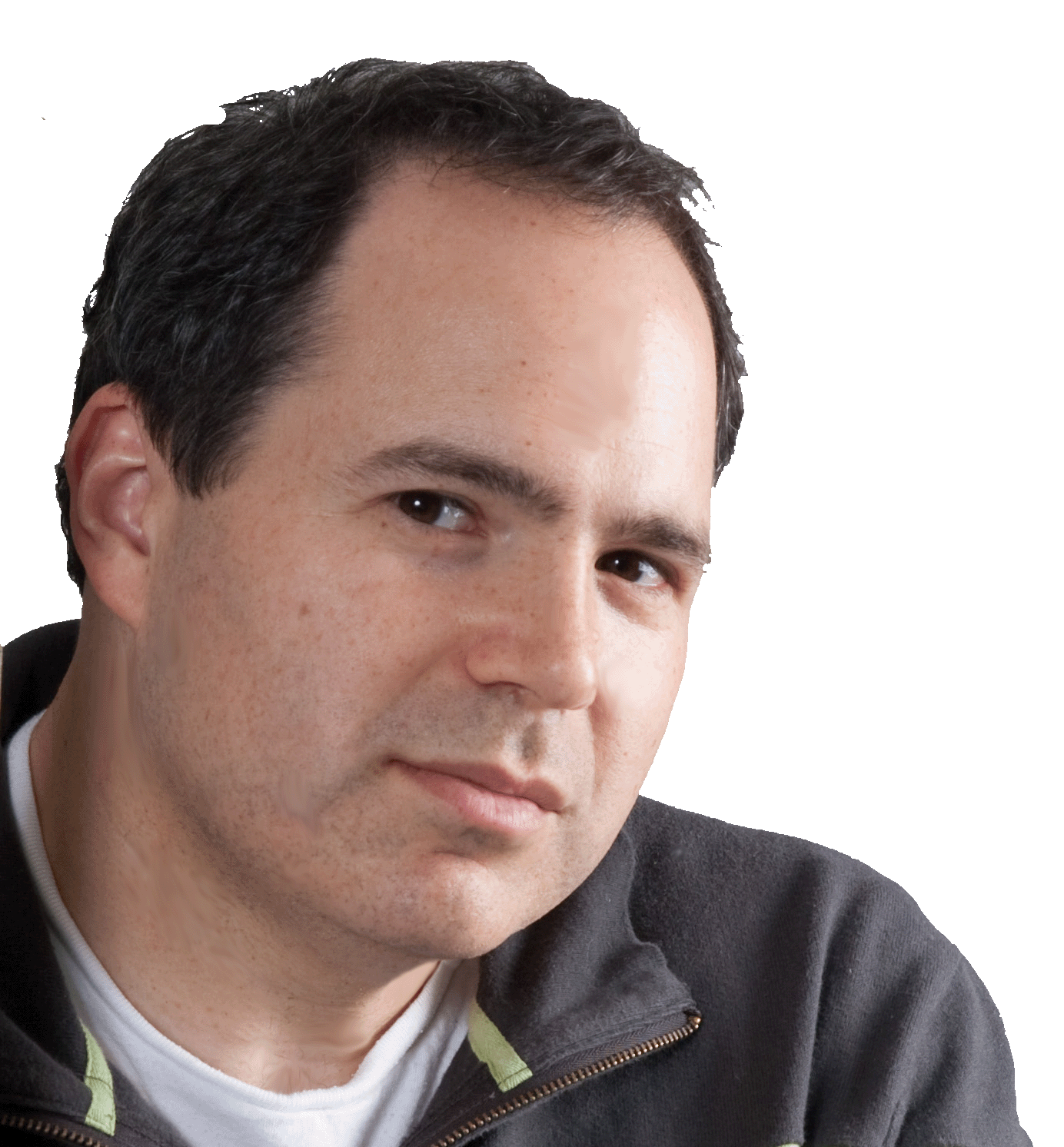 Marc Kuchner is the author of Marketing for Scientists, an astrophysicist at NASA’s Goddard Space Flight Center and a country songwriter. He is the co-inventor of the band-limited coronagraph, a tool for finding planets around other stars that will be part of the James Webb Space Telescope. He is also known for his work on planets with exotic chemistries: ocean planets, helium planets, and carbon planets. Kuchner received his bachelor’s degree in physics from Harvard and his Ph.D. in astronomy from Caltech. He was awarded the 2009 SPIE early career achievement award for his work on planet hunting. He has contributed to more than 100 research papers and published articles in journals including the Astrophysical Journal, Nature, and Astrobiology. He appears as an expert commentator in the Emmy nominated National Geographic television show “Alien Earths” and frequently writes articles in Astronomy Magazine. For more career tips for scientists, go to www.marketingforscientists.com. You can also follow Marc on Twitter @marckuchner.

 Sandeep C. Pingle has a PhD in Pharmacology and is a clinically trained physician. He is currently working as a postdoctoral scholar at Moores Cancer Center, UC San Diego. His research focuses on signaling pathways in cancer and treatment-associated neurotoxicity. In addition, Sandeep is San Diego Editor for the blog