This article was written by Zuleyka Zevallos, Buddhini Samarasinghe and Rajini Rao.
Dr. Zuleyka Zevallos is a research and social media consultant with a PhD in Sociology. Dr. Buddhini Samarasinghe is a molecular biologist specialising in cancer research. Professor Rajini Rao is a research scientist and graduate program director at Johns Hopkins University. Together they manage STEM Women, a website dedicated to highlighting the issues facing women in STEM. Follow them on Twitter and Google+.
In a New England pub after a conference, our male academic colleagues shrug their collective shoulders at the gender imbalance; in their opinion, women drop out of science because their hormones make them “different”. As women in science know all too well, similar examples of bias abound in academia. We read with familiar dismay, therefore, the arguments that girls find science “boring,” that attempts to bridge the gender divide “deny human biology and nature,” and that efforts to achieve gender equality in the Science, Technology, Engineering and Mathematics (STEM) fields are doomed. Attributing the gender gap to biology misses the obvious contribution of societal and institutional biases.
The “girls are not interested in STEM” mantra is itself an example. Knowledge of a prejudicial stereotype can lead to enough anxiety that it becomes a self-fulfilling prophecy. Although initially applied to racial bias in IQ tests, ‘stereotype threat’ can be extended to gender as well. Negative stereotypes are transmitted from parents and teachers to girls. Reminding girls that they are girls just before a math test can impede their performance. This effect can be seen in children as young as age five. The key point is that as adults, we are able to view stereotypes as generalisations about a group. Unfortunately, young children are more accepting of stereotypes, and may implicitly believe that girls are indeed poor at STEM subjects. As girls grow up, these stereotypes affect their identities as STEM professionals. So how do these stereotypes take shape?
The Draw a Scientist Test (DAST) shows that science stereotypes are socialised from an early age. The test has its origins in a pilot study from 1957, in which high school students were asked to describe their image of a scientist. Subsequent research from the 1960s onwards has examined a timeline of when this image is cemented. This research finds that children in kindergarten and the first grade are less likely to draw a stereotypical scientist; that is, a White man with facial hair, who wears a lab coat and glasses, and who is surrounded by lab equipment, formulae and books, making a “Eureka!” style exclamation. By the second grade, however, “the stereotype has began to take root,” due to a combination of how science is taught at school as well as through media images and social ideas and expectations that children pick up from parents, teachers and other influences. By the fifth grade, the stereotype is overwhelmingly fixed. A review study of 50 years worth of international research on the DAST demonstrates that, across cultures, “the stereotype of scientists being male has largely endured since 1957.” More specifically, the research shows that in Western cultures, this image is of a White male, even amongst minority students. However, children exposed to female scientists, via a combination of visits by women scientists in the classroom and by talks and readings about women’s contribution to science and their careers, are more likely to draw both women and men as scientists. Studies demonstrate that teachers themselves can contribute to these stereotypes, by giving boys more attention in class, and by rating their abilities higher than girls, even when girls get the same test scores as boys. Conversely, “intervention programs” for teachers, including career information and weekly visits by women researchers to the classroom, as well as short courses with follow-up visits, are subsequently less likely to result in stereotypical DAST results amongst students. This is because the teacher’s bias has been actively addressed, leading to the reinforcement of diversity in their teaching.
Despite the fact that people are socialised into believing that girls can’t do science, popular culture blames the individual; young girls are often chastised Don’t get your dress dirty, or Be careful, why don’t you hand that to your brother, as a recent viral video reminded us. If only girls were more confident. If only girls spoke up and asked more questions in class. If only they actively looked for mentors. Then they could easily overcome this stereotype threat and perform just as well as boys in STEM subjects. Unfortunately this “leaning in” viewpoint is naive because it ignores the institutional disadvantages contributing to the academic exclusion of women and minorities.
Sexual harassment is widespread in academic fieldwork. Women trainees are the primary targets with the perpetrators being predominantly senior professional males. Female undergraduates in male dominated fields report higher levels of sex discrimination, and are more likely to consider changing majors. Another study showed that high-achieving male biologists train fewer women than men in their laboratories, and that these men predominantly fill Assistant Professor slots in academia. In the same study, biomedical science male postdocs are 90% more likely than women to have an adviser who is a Nobel laureate. Not only is there a ‘leaky pipeline’ problem, the plumbing itself is broken.
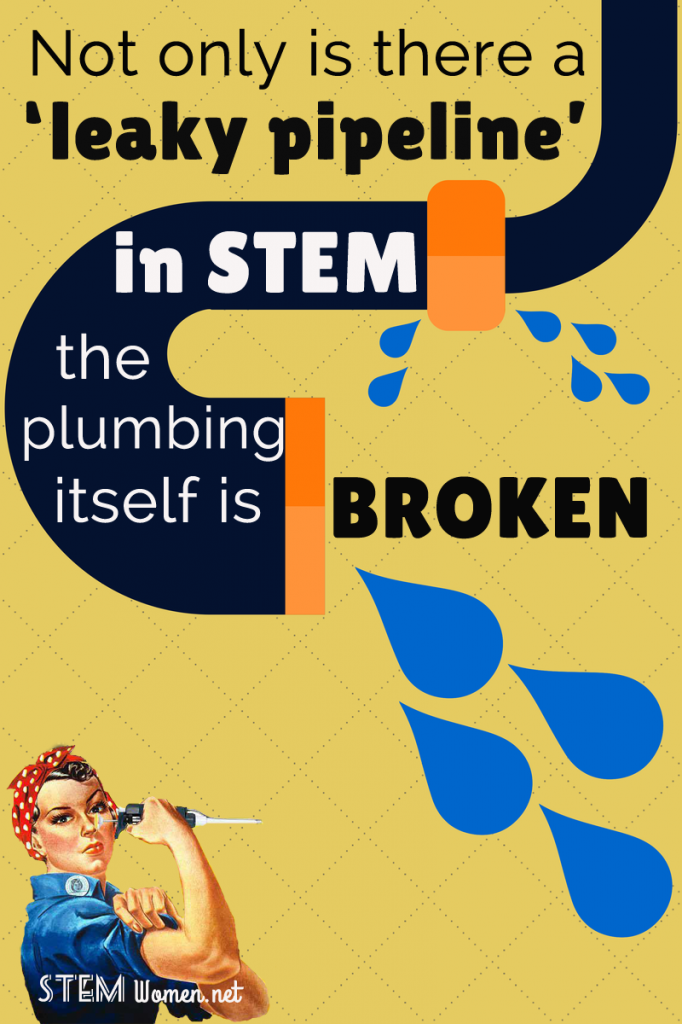
Image Courtesy of www.stemwomen.net
Continue reading →