Finding an audience with social media: whether they “like” it or not

Josh

{credit}Photo Credit: Russ Creech (All Rights Reserved, Used with Permission){/credit}

Josh Witten co-founded and manages the group science blog The Finch & Pea and works as an independent life sciences & communications consultant in Hartsville, SC. He has a PhD in molecular cell biology from Washington University in St. Louis and worked on RNA splicing regulation at the Laboratory of Molecular Biology in Cambridge, UK. In previous lives, he has been a rugby player, a whale-rider, and a magician’s assistant.

One of the iconic scenes in The Blues Brothers (1980), has Elwood Blues (Dan Aykroyd) keeping rhythm with a bullwhip while his brother, “Joliet” Jake E. Blues, sings “Rawhide” to an angry crowd at Bob’s Country Bunker. Did I mention that the stage was shielded by chicken wire to protect them from flying beer bottles? Our philosophical approach to using social media for science communication can learn from the experience of the Blues Brothers.

The Blues Brothers “are on a mission from God”. They need to raise $5000 dollars to save St. Helen of the Blessed Shroud, the Roman Catholic boarding school that raised them. We science communicators are also on a mission, but our mission is not always as clearly defined as Jake and Elwood’s. “Science communication” can mean many things, including education about the principles of the scientific method, explanation of the results of current research, reinforcing the community of science fans, and facilitating communication between scientists. Continue reading

Caregiver or Hero—Which One Are You? The Archetypal Roles of Women in Science and Academia

Marc Kuchner is the author of Marketing for Scientists, an astrophysicist at NASA’s Goddard Space Flight Center and a country songwriter. He is the co-inventor of the band-limited coronagraph, a tool for finding planets around other stars that will be part of the James Webb Space Telescope. He is also known for his work on planets with exotic chemistries: ocean planets, helium planets, and carbon planets. Kuchner received his bachelor’s degree in physics from Harvard and his Ph.D. in astronomy from Caltech. He was awarded the 2009 SPIE early career achievement award for his work on planet hunting. He has contributed to more than 100 research papers and published articles in journals including the Astrophysical Journal, Nature, and Astrobiology. He appears as an expert commentator in the Emmy nominated National Geographic television show “Alien Earths” and frequently writes articles in Astronomy Magazine. For more career tips for scientists, go to www.marketingforscientists.com. You can also follow Marc on Twitter @marckuchner.

The hero, the outlaw, the caregiver—which one of these roles do you play when you’re at work? The theory of archetypes, originated by Carl Jung, fascinates me as a way to understand works of fiction, marketing campaigns, and also the roles we play in the academic workplace.

The theory explains how a short list of roughly twelve staple characters appears over and over in movies, novels, songs, and so on. These characters, like the hero, the outlaw, the sage, and the wizard, are so common that there must be something permanent about them; the characters live in our minds, waiting for an author to evoke them with a slight gesture or prop. Place a wand in the character’s hand, and he becomes a magician. Place a crown on his head, and he becomes a ruler.

The same thing can happen while you’re at work. Place a coffee pot in a woman’s hand and in the eyes of some beholders, she can become a caregiver. Trade that for pinstripes, and she becomes a ruler. When you’re watching a movie or reading a novel, the archetypes in your mind help you understand the writer’s shorthand and identify with the characters in the story. But the natural tendency of humans to see certain kinds of characters in everyone we meet affects many aspects of our daily lives. Continue reading

Research 2.0.3: The future of research communication

Elizabeth Iorns headshot (portrait)Elizabeth Iorns is a breast cancer scientist and the Co-Founder & CEO of Science Exchange, an online marketplace for science experiments. 

This week Elizabeth is hosting a three part series all about the research cycle. Do share your thoughts in the comment thread.

In the first post of this series, I described the changes that are coming for the way scientific research is funded in the digital age.  In the second part, I explored the ways in which the process of research itself is destined to undergo dramatic changes. In the final part I look at the future of research communication, exploring the impact of digital tools on scientific reputation.

Nowhere in science has the disruptive power of digital technologies been more apparent than in research communication.  Traditional journals with subscription-based models and lengthy, anonymous pre-publication peer-review have been challenged by pre-print servers, post-publication evaluation and open access. Scientific news outlets now co-exist with blogs, often written by practicing scientists.  The threat of gatekeepers stultifying the scientific process is replaced by the need for new ways to extract knowledge from the threat of information overload.

The continued move towards open access

The Open Access movement to free published research from subscription barriers has led to major research funding agencies in the U.S., U.K. and the EU mandating that the research they fund be made openly available on-line within 12 months of publication.  This in turn has led to a shift in publishing business models away from subscriptions and towards publication fees, as evidenced by the prominent rise of new OA journals such as PeerJ and eLife to join the more established BioMed Central, PLOS, and Frontiers journals. Continue reading

Research 2.0.2: How research is conducted

Elizabeth Iorns headshot (portrait)

Elizabeth Iorns is a breast cancer scientist and the Co-Founder & CEO of Science Exchange, an online marketplace for science experiments. 

This week Elizabeth is hosting a three part series all about the research cycle. Do share your thoughts in the comment thread.

In the first post of this series, I described the changes that are coming for the way scientific research is funded in the digital age.  In the second part, I’ll explore the ways in which the process of research itself is also destined to undergo dramatic changes.

Traditionally, research was conducted by a single scientist or a small team of scientists within a single laboratory. The scientist(s) would conduct the majority of required experiments themselves, even if they did not initially have the necessary expertise or equipment. If they could not conduct an experiment themselves, they would attempt to find a collaborator in another lab to help them by using a barter system. This barter system essentially involves one scientist asking for a favor from another scientist, with the potential upside being co-authorship on any publications that are produced by the work. This type of collaborative arrangement depends heavily on personal networks developed by scientists. Continue reading

Research 2.0.1: The future of research funding

Elizabeth Iorns headshot (portrait)
Elizabeth Iorns is
 a breast cancer scientist and the Co-Founder & CEO of Science Exchange, an online marketplace for science experiments. 

This week Elizabeth is hosting a three part series all about the research cycle. Do share your thoughts in the comment thread.

Just as they have transformed many societal domains, digital tools are having a profound impact on the scientific process. As the co-founder and CEO of a company (Science Exchange) that is based on using digital tools to improve science, I am investing my livelihood and my passion in the belief that the next five years will see an unprecedented amount of change in the research landscape as the technology that connects and empowers scientists improves and as research institutions more fully embrace these digital advances.

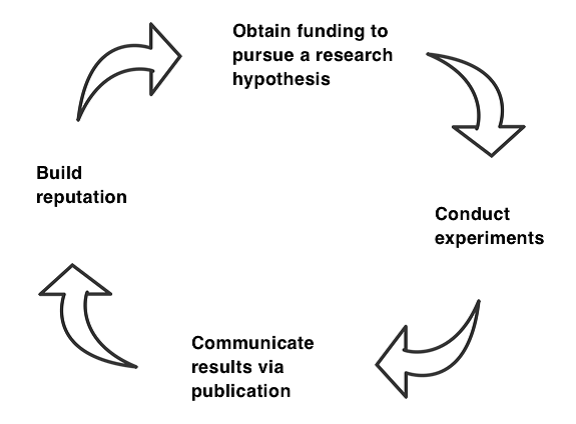
aThe modern scientific enterprise is a cyclical process. In most cases, it begins with a scientist obtaining funding to pursue a particular hypothesis – i.e., a grant, often from the federal government or a research foundation. The scientist then conducts the necessary observations, experiments or theoretical calculations, either directly or with the help of other scientists, technicians or clinicians. Once the scientist has completed a body of work that represents a novel finding, the results are communicated to the broader scientific community through conference presentations and journal publications, and in some cases to the general public through mainstream media. Scientists are mainly evaluated on the basis of the quality and quantity of publications they author; in particular, their publication record determines whether they will be funded to conduct further research. Continue reading

How To Grow A Garden On Mars

Louisa Preston is a Postdoctoral Research Associate at The Open University and TED Fellow. She is currently designing a Mars Gardening Interactive exhibit to showcase the features and issues raised in this blog. Follow her on Twitter @LouisaJPreston.

I grew up surrounded by science fiction; in books, in films, and on the television. Every scene showed humans travelling around in spaceships visiting aliens that lived on other planets, living their day to day lives in the vacuum of space and setting up new cities on foreign worlds. I never questioned this; it was, after all, fiction. However, for our generation and the one quickly following behind us, science fiction is becoming a reality on a daily basis. We have witnessed the discovery of the Higgs Boson, watched rovers wander across the surface of Mars and have discovered planets orbiting other stars. But we might be only decades away from discovering life on another planet and even observe humans leave Earth and inhabit another world during our lifetime. As I said, this is all science fiction isn’t it? Well not anymore… Continue reading