Language and Advertising – What do we really know?

Julie Sedivy is a cognitive scientist with an indomitable interest in language. She is a former faculty member of Brown University, and is currently an adjunct professor at the University of Calgary. She now devotes much of her time to writing about language for a general audience. She is the lead author of Sold on Language: How Advertisers Talk To You and What This Says About You. She blogs regularly for Language Log, Psychology Today and Discover, and tweets as @soldonlanguage.

One of the undergraduate courses that I most enjoy teaching is called Language and Advertising. Each year, I start off by presenting a particular scenario to students:

Imagine that the beef industry has joined forces with a company that makes a cola drink, and has worked out a deal to have a specific chemical that induces cravings for beef dissolved in the cola. The chemical is perfectly safe, and is listed among the ingredients; anyone is free to research its beef-craving properties.

Is this an ethical form of persuasion?

Most students say no. When pressed for an explanation, they typically say things like this: The companies are taking advantage of the fact that most consumers will be unaware of the effects of the chemical. Using techniques that are outside of the awareness of consumers is sneaky and dishonest. It undermines their freedom of choice, because consumers don’t know what is driving that choice.

I then ask them:

Do you think it’s ethical for a company to use language in its advertising as a means of persuasion?

As you might imagine, this question gets some strange looks. But the reality is that much of what happens in our minds as a result of language is just as hidden from our conscious awareness as the effects of fictional beef-craving chemicals. But while most people take it for granted that a great deal of their brain chemistry does its thing outside of their conscious knowledge or volitional control, they don’t have the same beliefs about language. This leads to a strange illusion about language: not only is much of what our minds do with it hidden from us, but the fact that so much is hidden is hidden from us.

Perhaps this is why a great deal of how language is discussed—whether it’s about linguistic pedagogy, language policy, language and persuasion, literary aesthetics, or language and culture—occurs without consideration of what is actually scientifically known about language. Authority figures, including members of the Académie Française, or literary luminaries such as George Orwell, have often made pronouncements about language which are readily accepted as intuitively obvious, but which make contemporary language scientists wince.

To me, the great fascination in studying language has been the discovery of its iceberg-like qualities, how some of its most intriguing properties lie well below the surface, accessible only through meticulous observation or ingenious experimentation. Scientific work on language has revealed that humans possess a truly staggering linguistic intelligence, a body of knowledge which is mostly made up of things we don’t know we know.

For example: Most English speakers, if asked, would report that the last sound in the word cleared and the first sound in the word dice are the same. But in fact, they are pronounced slightly differently. Your conscious mind may not be aware of this, but actually, your less conscious mind can put that information to good use as a perceptual clue about where words begin and end. This, it turns out, came in especially handy when you were an infant; before you actually knew many words, human speech sounded like an uninterrupted string of sounds rather than a series of words, much as a foreign language that you don’t know might sound to you now. But, as discovered by researchers Sven Mattys and Peter Jusczyk, infants younger than nine months can leverage the subtle differences in d sounds to make smart hypotheses about how a continuous stream of speech might be carved up into words. So even without knowing the words, they can guess at the word boundary in the phrase cleared ice versus throw dice.

In my own lab-based research, I’ve looked mainly at how people manage to cope with the  ambiguity inherent in language, how they make rapid-fire decisions in interpreting a chunk of language which could be consistent with several interpretations. What we’ve seen from this work is that humans are able to very quickly integrate a number of different streams of information, ranging from statistical expectations about various linguistic structures to inferences about a particular speaker’s probable communicative intent or capabilities. And again, most of these decisions are happening completely outside of people’s awareness. To tap into them, you can’t simply ask people what they were thinking while processing a sentence. Often, we have to look at more reflexive behaviors as a clue, such as tracking their eye movements while they listen to language.

Once you start to dig around seriously in the guts of how language really works, though, it can change how you look at everyday language around you. While I was still a graduate student, my research meetings with my advisor, Greg Carlson, would often devolve into observations about how TV advertisements we’d seen had exploited this or that aspect of linguistic knowledge or language processing. These lingering conversations were the seeds for the book we eventually wrote together, titled Sold on Language: How Advertisers Talk To You and What This Says About You.

In the end, my reason for encouraging my students to compare language with beef-craving chemicals is not so much to raise alarms about nefarious mind-controlling practices by advertisers. Rather, it’s to point out that most of the information-processing that we humans do—including language—hums along at a fairly automatic level outside of our deliberate control. This means that in order to understand how we respond to language, how it might influence our thoughts and our behaviors, we have to move beyond intuition. We have to get a little bit intimate with the science.

A New Era of Science Funding – Part 4: Speaking up in support of federally funded research

Over the years science funding has changed significantly. In the past, funding would have been obtained through private benefaction or from wealthy individuals. Today, researchers are usually funded by a mixture of grants from government agencies, non-profit foundations and institutions. However, with the increasing popularity of social media and the internet, methods used to obtain money may be undergoing a shift. New routes linking funding sources with scientists are being increasingly explored. Tighter budgets and struggling economies are driving a need for new ways of funding and social media is proving to be invaluable in raising awareness of projects and linking like-minded people more effectively.

In this special Soapbox Science series, we focus on the new ways in which science groups and individuals are obtaining funding and how projects such as Petridish, Tekla LabsKickstarter and the #scifundchallenge may change the future of scientific research.

Dr. Thon holds joint appointments within the hematology division at Brigham and Women’s Hospital, and Harvard Medical School in Boston, and is an American Society of Hematology Scholar. Dr. Thon received his doctorate from the University of British Columbia, Canada, under Dr. Dana Devine where he worked closely with Canadian Blood Services for the improvement of the processing and storage of blood platelets. As a post-doctoral fellow in Dr. Joseph Italiano’s lab, Dr. Thon’s research now focuses on the cytoskeletal mechanics and signaling pathways leading to platelet formation. This research has set the groundwork for the development of biological model systems that will be used to (1) study the process of platelet release under physiologically relevant conditions, (2) develop bio-mimetic systems to generate useable numbers of clinically viable platelets for infusion, and (3) establish representative ex vivo models of human bone marrow and surrounding blood vessels to test drugs and develop treatments for thrombocytopenia.

The day-to-day rigors of academic biomedical research are difficult to appreciate, and it is necessary that scientists share their perspective of the knowledge market with politicians and government representatives who are burdened with making difficult decisions on our behalf. Unlike the airline industry which also does research and development (R&D) to create safer, lighter and more efficient airplanes, academic medicine does not build R&D into the pricing of its services. This is because biomedical research is a surprisingly random process which depends on chance observations, unexpected results and seemingly unrelated outcomes. As a result, downstream applications of research are almost impossible to predict at the outset and necessitate an altogether different model of cost recovery. To subsidize national biomedical research endeavors, projected costs are spread among citizens in the form of taxes, and distributed to multiple academic institutes as operating grants. Investments in research lead to licensed technologies which create jobs and revenues far in excess of the grants that support them, with every dollar invested in academic biomedical research generating two dollars in economic growth (Murphy K., Topel, R. The economic value of medical research, 1999).

A country’s biomedical advancement and innovation is thus tied to its investment in academic research. Funding of research comes entirely from government and private donors, and is as value-based, bottom-up and pork- and crony-free as it gets. In North America approximately two-thirds of academic biomedical research is supported through federal funding agencies such as the National Institute of Health (NIH) and the Canadian Institute of Health Research (CIHR). The mainstays of NIH/CIHR support are grants made to individual investigators for reasonably broad research projects, and researchers compete for these funds through a rigorous process of peer review. Nevertheless, the lack of sustained growth for both the NIH and CIHR has forced success rates for primary operating grants to drop significantly over the last decade to approximately 12% (NIH, R01) and 15% (CIHR Operating Grant); Fiscal Year 2011. This means that only a very small percentage of outstanding applications for research projects are being actively supported to tackle the multitude of health needs in these countries. As a result, a majority of highly-rated research proposals will not be funded, opening the field for countries like Germany, India and China which are boasting funding rates of 47% and higher to take the lead.

Relatively flat funding rates in North America have meant that universities, hospitals and research institutes have been forced to implement hiring freezes of PhDs into faculty positions, effectively stranding their scientists in temporary, low-paying jobs with limited prospects of advancement. Not only does this risk exporting our scientists abroad, but private industry’s reliance on biomedical research, both in terms of scientific innovation and the researchers they help train, means industry will follow suit. Canadians call this the ‘brain drain.’

Indeed, 80% of PhDs in North America will not become professors (Fuhrmann et al., Improving graduate education to support a branching career pipeline: Recommendations based on a survey of doctoral students in the basic biomedical sciences, 2011). For the majority of these scientific investigators, the inability to secure a faculty position has meant that they must languish in a series of post-doctoral positions supported by grant-funded professors who are finding themselves increasingly with limited resources. The average age of independence in research is now in the mid-40s, a testament to the bleak prospects facing young scientists. Given the state of academic funding, it is not surprising that many investigators have chosen to transition into more secure professions like teaching, medicine or law. The loss hurts our competitiveness in biomedical research and forces industry abroad.

Given our current economy, it is imperative that efforts to improve the nation’s fiscal stability be grounded in the long-term competitiveness of industries we currently head, and that we leverage our expertise in medical science and capacity to do high-tech research. This does not need to come from increased government spending alone. Whereas academic medicine cannot build R&D into the pricing of its services, universities profit directly from tuition fees, patents and personal endowments. Since these revenues are derived from faculty teaching loads, the scientific success of their investigators, and established reputation of their research program, faculty support must be factored into departmental operating budgets. For American institutions, the Canadian system represents a more sustainable model in this regard, and universities on both sides of the border should be required to assume greater responsibility for investigator salaries and administrative support, freeing up tax dollars to directly support research innovation. Likewise, tax breaks for private donations to federal funding agencies would reduce their dependence on tax-payer dollars and incentivize industry investment in national research programs. Finally, limiting the number of federal awards issued per investigator (most of which are held by senior faculty) would open up more funding opportunities to help support young investigators and significantly lower the age of independence.

Science is a marathon, and if we fall behind now, while we lead health innovation in the world, the cost of recovering our position, in light of emerging economies with which we compete, will become progressively more expensive. Sustained increases in NIH/CIHR funding are critical to maintain North America’s innovation engines at a crucial time for research and the economy, and most importantly, improve the health and well-being of our nations. Now is the time for scientists to advocate most strongly for national investment in biomedical research. Senators, congressmen, and members of parliament are the decision-makers you elect to represent you – write to them. You can go here and enter your zip code (in the United States), or here and enter your postal code (in Canada), to access your representative.

While the argument for the government to prioritize an industry where the number of clinical advances, drug developments and cures is proportional to total research investment is not a difficult case to make – make it. Addressing these concerns forces the issue to light, and commits politicians to publicly defensible positions for which they can subsequently be held accountable. Government agencies cannot lobby for themselves and policy makers do not share your unique perspective. Our health, economy, and the future of scientific progress are at stake.

To find out more about science funding you can read this special Nature News feature,  Finding philanthropy: Like it? Pay for it.

A New Era of Science Funding – Part 3: Crowdfunding via Petridish

Over the years science funding has changed significantly. In the past, funding would have been obtained through private benefaction from wealthy individuals. Today, researchers are usually funded by a mixture of grants from government agencies, non-profit foundations and institutions. However, with the increasing popularity of social media and the internet, methods used to obtain money may be undergoing a shift. New routes linking funding sources with scientists are being increasingly explored. Tighter budgets and struggling economies are driving a need for new ways of funding and social media is proving to be invaluable in raising awareness of projects and linking like-minded people more effectively.

In this special Soapbox Science series, we focus on the new ways in which science groups and individuals are obtaining funding and how projects such as Tekla LabsKickstarter and the #scifundchallenge may change the future of scientific research.

In this post we will hear from three different groups who are using a new website, Petridish.org, to help fund their research. 

Geoff Gallice grew up in the suburbs of Baltimore, where he spent every available minute searching nearby fields and small forest patches for insects. At the University of Maryland, he quickly chose biology as his major and since making his first trip to the tropics during his third year, he has been unequivocally devoted to tropical ecology and conservation. He is currently a graduate student at the University of Florida’s McGuire Center.

After watching a documentary about the Amazon when I was child, I wanted desperately to visit. I finally got my chance just a few years ago, and the rainforest that I encountered both met and exceeded all of my expectations – I decided right then and there, without vacillation, that I would study tropical biology. Today, I am a graduate student at the University of Florida’s McGuire Center for Lepidoptera and Biodiversity, a leading center for tropical Lepidoptera research. I’m interested primarily in the large scale relationship between species abundance and distribution, as well as its underlying causes, using Neotropical butterflies as a model system.

A clearwing butterfly, Ithomia salapia, from Moyobamba, Peru

I’m planning a trip to Peru beginning in late 2012, where I will gather butterfly abundance and other ecological information to test this relationship, as well as potential underlying causes, including breadth of host-plant use. I’ve prepared thoroughly for the trip, first by conducting a similar brief project in Ecuador for my Master’s, and currently by teaching myself everything I can about ithomiine host-plants. I feel very well-equipped to see the project through – the only gaping hole in my plan at this moment is funding, and securing the relatively small amount of cash that I need to conduct my field study in Peru has indeed been a struggle.

Peruvian rainforest, Cordillera Escalera, near Tarapoto

Apart from a few comparatively well-studied groups, even the basic biology of nearly every species of tropical plant and animal remains almost completely unknown. Certainly a large number of causes are to blame for this situation, but two in particular stand out. First, most of the world’s biologists are trained, and therefore conduct research close to home in the temperate regions of Western Europe and North America. Second, and perhaps more importantly, there is an abysmal lack of funding for research in the tropics. But a ground-breaking new website, Petridish.org, aims to change that. The folks at Petridish recently launched their first round of projects and anyone is free to donate to a project that they wish to see completed.

This crowdfunding approach accomplishes two things simultaneously. It helps scientists raise funds by tapping a previously neglected resource, the interested public, while engaging said public in science from its incipient stage. Given both the scarcity of science funding and an alarming disconnect between science and the general public, the application of crowdfunding to science is a welcomed new approach. I’m excited to be part of the initial launch of Petridish.org, and not just because I envision a real chance to raise the funds needed for my research. I simply love the crowdfunding model and I hope to see Petridish usher in a new era of funding for tropical biology, and indeed science in general.

Credit: Marcelo Rotundo.

Morgan Gustison is a doctoral graduate student in the Psychology Department at the University of Michigan – Ann Arbor. She is a member of the University of Michigan Gelada Research Project, a team of researchers who have studied the behavior and biology of Ethiopian gelada monkeys in the Simien Mountains since 2005. Morgan studies the complexity of gelada monkey vocal communication.

There are two common questions I get when telling my friends, family and new acquaintances about what I do for a living. The first is, “Wait… why would you willingly go back to school for 5-7 years in order to study monkey behavior?” The second is, “Do you actually get paid for that?

“Wait… why would you willingly go back to school for 5-7 years in order to study monkey behavior?”

It’s always fun to answer the first question – I start by reliving some of my experiences as a cage-cleaner at the  Wisconsin Primate Research Center. At first, the rhesus macaques gave me lots of dirty looks, just as they would any newbie. After working there for several months, however, I began noticing a shift in their behavior – they started grooming each other. One monkey would sprawl out like a dog wanting a belly scratch and its partner would furiously weave through his or her hair to find items that only they can see. This affiliative social behavior was endearing and their trust in one another eerily ‘human-like’. I wondered whether primate behavior was like this in the wild. So, I sought out a series of experiences to learn more about naturalistic primate behavior, including following around owl monkeys in Formosa, Argentina.

Credit: Clay Wilton

Being a ‘field’ researcher is rewarding. We collect data on events that no one else is ever likely to see, like the hostile reactions of a family group to another family group on territory boundaries (think of the Jets and the Sharks from West Side Story), or the sexy calls of a solitary animal to locate potential mates. After observing our non-human primate relatives in the wild, it’s extremely difficult not to be hooked on wanting to know more about their similarities and differences with humans.  For instance, humans have language at our our disposal, but what about our primate relatives? This is the question driving my current research directions. Perhaps surprisingly, the wealth of research on primate communication suggests that overall, non-human primates have relatively simple ways of communicating vocally – using small repertoires of sounds and rarely combining these sounds into complex sequences. Preliminary observations and analysis carried out by my academic supervisor at the University of Michigan, Dr. Thore Bergman, collaborator Dr. Aliza le Roux and I suggest that gelada monkeys are one of the rare species that produce a large repertoire of vocalizations and express the special ability to combine these vocalizations. Gelada monkeys, a primate endemic to the highlands of Ethiopia, are particularly interesting because they  produce and combine together several unique vocalizations that do not have homologous versions produced by closely related monkey species.

“Do you actually get paid for that?”

To answer this question, I explain that funding for research comes from two sides: the first side is to cover your living expenses, or salary, and the second is to cover the research itself. Both types of funding have their own unique challenges to a budding scientist in the world of primate behaviour. Main sources of funding for U.S. graduate students to carry out research on primate behavior come from dissertation grants from the National Science Foundation, Fulbright, and the Leakey Foundation. As with most funding sources, these organizations were hit hard by the recession. With no choice but to restrict budgets, this means that researchers have to “apply for anything and everything” with the hope that at least 10% of their grant applications will succeed in the heightened competition from their peers’ applications. In a sense, the scene is becoming much more like individual-biased sport, with a greater and greater weaning of athlete scientists from the arena over time. Yet, science isn’t an individualistic sport, right? Shouldn’t we be working together as a team to enhance our understanding of the natural world?

This funding competition is what has driven some researchers to locate novel ways to fund their work. Recently, I have run into an idea called ‘crowdfunding’ – this basically means that you seek out sponsorship from the public. I just began advertising my proposed gelada monkey communication research on a newly launched crowdfunding website called Petridish.org.  Several of my colleagues and I are excited about Petridish because its benefits are two-fold. Not only is it a potential source for funding for projects that would be unaffordable otherwise, we also have the opportunity to interact directly with the public. This ‘outreach’ phase in science often happens after your projects are said and done, and Petridish gives us the chance to excite people one-on-one about our research right at the very beginning. It’s great that people can now be a part of scientific discovery from start to finish.

Already, 42 people have decided to back my project and I have reached 50% of my funding goal. There are still 4 weeks to go before my time is up and I leave for a 2-month field season in Ethiopia (to be followed by another 4-5 months next January). Seeing the enthusiasm from my backers on Petridish has only boosted my excitement about my upcoming fieldwork. It’s comforting to know that several people will be looking forward to email updates on the project when I am in the field and when I am back in the USA analyzing my data. I hope that this website is a success so that it can be a resource for future scientists to interact with the public and find support for their research. I encourage readers to check out the website and spread the news to friends and colleagues.

Often found hip-deep in Madagascar mud, Dr. Brian Fisher is a modern day explorer who has devoted his life to the study and conservation of ants and biodiversity around the world. He is Curator of Entomology at CAS and adjunct professor at UCB and SFSU.  He created the annual Ant Course in 2001, AntWeb in 2002, and the Madagascar Biodiversity Center in 2004. He has published over 90 articles on ants, and trains dozens of international graduate students in the taxonomy and natural history of ants, skills enabling them to use ants as an important indicator of biodiversity across the globe.

In the past, scientists could depend on just a few government sources such as NSF or NIH to support our programs. But as funding opportunities there have decreased, we have had no option but to develop alternative sources to keep our research programs moving forward as we wait for the next NSF grant. One way to deal with the current funding environment in science is to act more like an entrepreneur and cultivate a portfolio of investors to support research programs. Because I am often locked up in my office looking at ants, it was not apparent how I could meet potential donors. A recently launched site, Petridish, provides just the service I’d been looking for. It matches research ideas with interested members of the public willing to invest in projects.  Crowdsourcing, as such matchmaking services are called, could help locate patrons to support science activities. If the Medicis, who helped support Leonardo da Vinci, represent the patronage of the 1%, Petridish offers patronage to the 99%. When I first learned about Petridish, I realized this concept could be very helpful to those studying primates or maybe elephants. I was less certain the average person would be interested in supporting my research into organisms which most people consider “invisible” or see only as a kitchen pest.

Monormorium worker ant caring brood. Photo credit Brian L Fisher

My research on ant taxonomy and evolution starts with very simple question: what species exist and where? My goal is to place ants on equal footing with birds in ecological and conservation studies across the world. With only an estimated 15% of life  on Earth described, it’s clear that we need a renewed investment in species discovery and description to reach this vision. Convincing the general public to support this research is quite different than writing a proposal to colleagues at NSF. The challenge is to find a way to make them investment partners in the research. Some might be convinced once they realize that ants are the glue that holds ecosystems together. Others might care because species discovery improves our understanding of the history and evolution of life on this planet. Still others may be moved by the adventure of discovery (if you have any doubt that species discovery is one of the greatest adventures left on earth, check out these photos and images of Madagascar after cyclone Irina hit the island in early March of this year).

I recently gave Petridish.org a try and put together a request for backers for an expedition to discover new ant species in a remote region of Madagascar. The project is now almost completely funded and demonstrates that crowdsourcing has real potential to support my research program. For an NSF grant, we are used to devoting three weeks of writing aimed at other experts in the field to prepare the proposal. With crowdsourcing, we need to get used to developing text and video aimed at a much wider audience.  For me, this was not easy – I needed to figure out how to make a video and create and develop a compelling project description.

At a time when there is growing public concern about the role and importance of basic science, we need scientists who can also act as advocates. No longer can we afford to work in isolation without engaging the broader public in our endeavors. The public must understand the importance of funding science and the role of science in society.  Crowdsourcing, in addition to funding science, offers a great way for scientists to connect directly with the public. In the long run, methods that invite the community to take part will hopefully help to keep science funded.

To find out more about science funding you can read this special Nature News feature,  Finding philanthropy: Like it? Pay for it.

A New Era of Science Funding – Part 2: Kickstarter Success and #IamScience

Over the years science funding has changed significantly. In the past, funding would have been obtained through private benefaction from wealthy individuals. Today, researchers are usually funded by a mixture of grants from government agencies, non-profit foundations and institutions. However, with the increasing popularity of social media and the internet, methods used to obtain money may be undergoing a shift. New routes linking funding sources with scientists are being increasingly explored. Tighter budgets and struggling economies are driving a need for new ways of funding and social media is proving to be invaluable in raising awareness of projects and linking like-minded people more effectively.

In this special Soapbox Science series, we focus on the new ways in which science groups and individuals are obtaining funding and how projects such as Petridish, Tekla LabsKickstarter and the #scifundchallenge may change the future of scientific research.

Jessica Morrison earned her B.S. in geology from Middle Tennessee State University, and she is currently an actinide geochemistry Ph.D. candidate at the University of Notre Dame. She is a frequent contributor to the Scientific American guest blog, an editorial board member for Frontiers in Energy Research, and an accomplished Mario Kart player. She blogs with appreciation for creativity, communication, yoga, and uranium at I Heart the Road. Jessica can be found on Google+ and Twitter as @ihearttheroad.

The traditional image of a scientist is changing. No longer will the boring, white-coated stereotype represent a diverse population—at least not if Kevin Zelnio has his way. The independent scientist and communications strategist knows a lot about being non-traditional and since mid-January he’s used the Twitter hashtag #IamScience to spread the word that those who struggle are not alone; like wildfire, #IamScience jumped from Twitter to blogs to Tumblr.

The next step for Zelnio is a free e-book curating the stories—an endeavor he’ll pay for using Kickstarter, the largest online crowdfunding tool for creative projects.

Kickstarter has been around since 2008 and it works like this: an idea is born, a proposal is written and, with any luck, generous backers contribute to fund the idea. Kickstarter campaigns, however, are all or nothing, which means that a funding goal must be met by the proposed deadline or the project loses all backing. These campaigns are typically in the realm of creative endeavor and the most successful have funded a video game, an iPod dock and a webcomic re-print. These projects all have one thing in common: an engaged community of would-be backers.

The #IamScience Kickstarter campaign ends on Thursday and it has already exceeded its goal of $3500 by more than $2000. The campaign couldn’t have come at a better time to pull in community support. It kicked off in the month following ScienceOnline2012 —an un-conference which generated more than 30,000 tweets using the Twitter hashtag #scio12.

“This is a community effort and I’m just the one harnessing the energy,” says Kevin Zelnio. “While I’m the one taking charge of the project, it wouldn’t be anything without the contributions from everyone else involved.”

While the original goal was a free e-book weaving together #IamScience submissions, Kevin Zelnio is now planning a print-run to get books into the hands of high school students. The intention is to inspire them to become more involved in science and to show that anyone can become a scientist, regardless of background.

“There are people in high school who think that a career in science is out of their reach because they are a certain way—a punk rocker getting off drugs or an average person not doing well in a science course,” says Kevin Zelnio. “If you don’t do well in science at the high school level, there’s very little chance you’re going to stay interested or find a renewed interest later on in life.”

In a similar vein  and with like-minded goals to the #IamScience Kickstarter campaign,  another creative science project, Citizen Science Quarterly, also saw success in its launch. Jacob Shiach, a bioinformatics-trained advocate of independent science research, dreamed up Citizen Science Quarterly, a magazine dedicated to spreading the idea that anyone can do science.  He launched a Kickstarter campaign to fund the magazine and the campaign overshot its goal of $2500 by more than $5000—a good thing says Jacob Shiach.

“I grossly underestimated the cost,” says Jacob Shiach. “By having 300 percent, we had just enough money to cover all the prizes and print the magazine.”

Jacob Shiach raises an interesting point about Kickstarter, explaining that one of the ways to attract backers is to offer rewards at specific funding levels. Common rewards include bumper stickers, t-shirts, free products or the backer’s name listed as a sponsor. The rewards can be an expensive part of a Kickstarter campaign if they are not well thought out.

Kevin Zelnio’s top reward for backing #IamScience is a custom written and performed song that he’ll produce himself. Similarly, Jacob Shiach offered an original piece of cover artwork, a year-long subscription to Citizen Science Quarterly, a couple of t-shirts, merit badges and the backer’s name printed on the back cover of the magazine.

“I think a lot of people underestimate the cost of doing Kickstarter,” says Jacob Shiach. “Since it’s all or nothing, you really shouldn’t underestimate your costs.”

The first issue of Citizen Science Quarterly was funded by Kickstarter, but subsequent campaigns for the magazine have been less successful—failing for issues two, three and four. The magazine’s campaign seems to be missing the necessary community component.

“We haven’t really made the magazine as available as we would like. We aren’t doing advertisement and we depend on people to buy the magazine to produce the next issue,” says Jacob Shiach. “To get people excited about the magazine, they have to actually read it. It’s been a catch-22.”

While Jacob Shiach raises concerns about crowdfunding for science endeavors, Kevin Zelnio is hopeful.

“The speed at which crowdfunding works can be astonishing really. Kickstarter is a great model for small-scale science projects, but the problem is finding your audience,” says Kevin Zelnio. “I have the luxury of being a part of the ScienceOnline community. If you can get one or two major donors to bump up your funding it seems to create a pull-effect where the more people donate, more people want to donate.”

You can see some of the #IamScience tweets in the video below:

I Am Science from Mindy Weisberger on Vimeo.

The success of these endeavors is echoed in Kevin Zelnio’s words:

“Magical things can happen when you enthusiastically open your mouth on the internet.”

To find out more about science funding you can read this special Nature News feature,  Finding philanthropy: Like it? Pay for it.

A new era of Science Funding – Part 1: Individual Scientists as Active Global Citizens.

Over the years science funding has changed significantly. In the past, funding would have been obtained through private benefaction from wealthy individuals. Today, researchers are usually funded by a mixture of grants from government agencies, non-profit foundations and institutions. However, with the increasing popularity of social media and the internet, methods used to obtain money may be undergoing a shift. New routes linking funding sources with scientists are being increasingly explored. Tighter budgets and struggling economies are driving a need for new ways of funding and social media is proving to be invaluable in raising awareness of projects and linking like-minded people more effectively.

In this special Soapbox Science series, we focus on the new ways in which science groups and individuals are obtaining funding and how projects such as Petridish, Tekla LabsKickstarter and the #scifundchallenge may change the future of scientific research.

Lina Nilsson is a postdoctoral researcher at the University of California Berkeley, where she works on the development and evaluation of CellScope, a portable smartphone-based microscope that can be used to diagnose infectious diseases in low-resource rural settings worldwide. She is also the co-founder of Tekla Labs, an initiative to increase access to laboratory infrastructure globally. Tekla Labs is a community of researchers that creates easy-to-follow instructions for how to build research-grade laboratory equipment using locally available supplies.

To take part in Tekla Labs’ 3D printing for science competition, visit us at teklalabs.org. General comments, equipment building instructions and ideas for future initiatives are also welcome.

Individual Scientists as Active Global Citizens.

Meeting global challenges in health, environment and development will require breakthroughs from the entire global scientific community, not just a selected set of industrialized countries. Today, the potential of many scientists in developing countries is not being efficiently harnessed because they lack adequate hands-on training as well as the infrastructure to advance research in their own labs. These international capacity-gaps are generally tackled on the level of governments, NGOs and large institutions. In reality, to address the pressing global challenges, we do not have the luxury of time or money to rely solely on these conventional measures for capacity building. I argue here that the scientific community should also step up to address international inequities in science research by engaging individual scientists on a grassroots level. With crowd-based initiatives that allow many individuals to contribute in small and easy ways, scientists can become active members of a global science community.

My organization, Tekla Labs, is one small example of such a grassroots initiative. We provide a community platform where academic researchers, DIY enthusiasts and others can share their detailed in-house solutions to building standard laboratory equipment. These DIY solutions can range from the most basic (e.g. a kitchen blender adapted into a multi-speed benchtop centrifuge) to the more sophisticated (LED-light spectrophotometer). However, Tekla Labs is only one example of how individual researchers can help lift the global scientific research base.  Scientists are a creative and engaged group, and we should create a multitude of infrastructure options to channel some of this energy to support research in emerging-science regions of the world.  To start the dialogue, I propose ideas for three projects with a low energy-barrier for entry that could engage individuals to improve scientific research worldwide:

  • Kickstarter for Science. Online crowdfunding platforms like Kickstarter allow artists to solicit funding from individuals for creative projects in areas such as film and music. What if there was a similarly well-visited and well-supported site for scientific research projects, where researchers worldwide could pitch their research projects, large and small? Instead of having to convince a small set of expert reviewers (who tend to favor established scientists from well-known institutions and generally are limited to in-country solicitations), the proposals would be written to a larger online community of people interested in scientific inquiry. With a ‘Kickstarter for Science,’ individuals – whether academic researchers, company scientists or lay enthusiasts – could pool their donations (in money, expertise or time) to support research projects internationally in areas such as education, health and sustainability. A successful “Kickstarter for Science” could be an easy opportunity for individuals to support fellow researchers globally on specific, defined projects in areas that we care passionately about as scientists.
  • Buy Your Consumables, Sponsor a Lab. What if every time you bought basic supplies, like pipette tips or falcon tubes, a small donation was made by the supply company to a ‘sponsored’ laboratory in a developing country? Last year, Kate Lovero at Tekla Labs ran a small pilot program with the help of the local representative of one of the major laboratory supply companies.  The set up was simple: Based on a given percentage of the value of the purchases from our group of laboratories, the supply company allowed a partner laboratory in Peru to order reagents free of charge. In the U.S., companies that sell lab consumables often offer small incentives for university research groups, such as free coffee, pizza, or ‘buy 10 get 1 free’ promotions.  We get plenty of free pizza opportunities at our university as is, and one could say that we basically replaced the standard incentive system with an international donation program that was based on our purchases. I propose that some version of this sponsorship program should be more widely offered by laboratory supply companies. Many of us are scientists because we want to in some way have positive impact on the world, and this could be one small but easy way to do so as part of the every-day running of our laboratories.
  • PRINTmyLAB: 3D-printing for science. My organization, Tekla Labs, addresses the lack of laboratory infrastructure across the world by creating DIY blueprints for building your own equipment. Other organizations have extensive donation programs for used or new equipment.  For my last project proposal, I give you something more radical: PRINTmyLAB. What basic repairs, supplies and equipment could be made locally using a 3D printer? NASA is exploring 3D printing as a flexible approach for replacing spare parts in space on the principle that if you can simply bring the machine that makes the parts, then you bring all the different replacement parts you could possibly need? Not too long ago, even basic-functionality 3D printers cost tens of thousands of dollars. Today, the cheapest versions are well under $1000, and prices are continually dropping for all model levels. In PRINTmyLAB, a competition that Tekla Labs is currently running, we ask what science supplies could be printed on location in labs around the globe? Until April 30th, we are challenging researchers to submit their favorite 3D printer designs.  There are two categories: 1) alternatives to commercial options and 2) novel DIY designs. To learn more about rules, prizes and to submit designs, go to teklalabs.org/3Dprinting.

This article is a call for individual scientists to become more active global citizens and to work together to improve scientific research and education for all. While for some, this is a calling that defines their career, it does not have to be one’s main focus to be valuable. I want to show here that there are also small yet impactful ways in which we could all contribute to the global science community.  What we are missing are the platforms to enable simple and straightforward scientist-to-scientist sharing of resources, expertise and ideas.

Thanks go out to Tekla Labs’ members Kevin Lance, Kate Lovero, Bertram Koelsch, Javier Rosa, Todd Duncombe and Naomi Kort for their awesome work on Tekla Labs in general and the initiatives ‘PRINTmyLAB’ and ‘Buy Your Consumables, Sponsor a Lab’ in particular.

To find out more about science funding you can read this special Nature News feature,  Finding philanthropy: Like it? Pay for it.

Scientists and journalists need different things from science – Response 3: Science blogging in the New Zealand media

Grant Jacobs, Ph.D., is an established computational biologist contracting to research groups, organisations and companies offering his background in molecular biology / genetics and computer science locally and internationally through his consultancy, BioinfoTools. He has wide personal research interests, including epigenetic and chromatin-level control of gene expression, the three-dimensional organisation of genomes, structural biology and development of new algorithms. Outside of work he is a fan of travel, tramping (hiking), good books and, more recently, writing. He is the author of Code for life and tweets under @BioinfoTools.

During a recent Royal Institution debate (written up here by the nature.com Communities team), Fiona Fox, head of the UK Science Media Centre (SMC), was quoted as stating that “blogs [are] fantastic but no journalists go to them to look for full stories.”

This has not been the experience of those writing at the Sciblogs, New Zealand ’s largest on-line science writing collective. One element to this may be that the New Zealand SMC not only links journalists with scientists, and vice versa, but also promotes to the media the scientists’ causes as presented through articles on blogs. It likely helps that the NZ SMC runs Sciblogs and are in touch with the writers there daily. The SMC imprimatur may give journalists more confidence to use this source for material. An additional factor may be thatNew Zealand lacks science columnists for print and television (a notable exception is Radio NewZealand who have a long-running regular science feature). As a consequence of these factors, it may be that the media are turning to those scientists who make a direct effort to address a general audience.

Peter Griffin, who heads the NZ SMC, reports that he regularly receives requests based on material initially seen on Sciblogs. Where some articles result from interaction facilitated through the NZ SMC, others arise from direct contact between the media and the scientist. In some cases blog articles are re-worked to be run as columns in local newspapers.

Scientists writing blogs at Sciblogs have been called up to radio and television appearances, quoted in newspaper articles, or had their work presented as articles in newspapers. In addition, the NZ Herald opts-in to present blogs on their website, usually opinion pieces or backgrounders to current issues (see Appendix at the end of the article for specific examples).

Below the work of a few writers are presented as representative of the relationship between science blogging and the media inNew Zealand. These examples span three broad areas:

i) Public health issues, such as disease outbreaks and prevention

ii) Science education issues and evaluating risk

iii) Science of topical public concern e.g. the recent earthquakes

It is worth bearing in mind that a wider range of articles (and authors) have been associated with the media than the examples presented here, for example covering technology, climate change science and policy, and so forth – a limitation of the brief coverage here.

Public health issues

Microbiologist Siouxsie Wiles has found herself on radio, in newspapers and television:

– An article on using bees to diagnose tuberculosis (TB) led to an interview on Breakfast with Spanky (RDU 98.5 fm, 31st October 2011) as did an article on ’ferret’ flu (9th February 2012), which also featured on ABC Radio Australia (Connect Asia, 22nd December 2011) and was quoted in various Australian print media (The Australian, Sydney Morning Herald and the HeraldSun).

– Tilting against ’quantum-homeopathic-biophotonic flea-control pendants’ was quoted in Sunday Star Times (Charles Anderson, 22nd Jan 2012) in Scientist gets hot under the collar over flea remedy.

– An article on HPV vaccination was reworked as an op-ed piece for The Dominion Post (Offering HPV vaccination to boys the logical, ethical thing to do, 15 Dec 2011) via an university communication team member inviting her to rewrite the piece.

– The German E. coli outbreak of June last year found Siouxsie on current affairs television (TVNZ Close Up, 3rd June 2011) and radio (Radio Live Drive Time, 3rd June 2011) explaining the story to the public.

Science education issues

– Alison Campbell, whose interests lie with how science is taught, has been on radio, with several of articles from her blog re-worked for newspapers and periodicals. (Changing the culture of science education. New Zealand Herald. 27 January 2011; Predicting earthquakes: hedging your bets – National Business Review, 04 March 2011; Resistance to science. Skeptical Intelligencer. 14: 26-27 (2011); Oxygenated food for the brain Skeptical Intelligencer 13: 23-24 (2010).)

– Michael Edmond, a chemist, has taken part in a panel on radio covering the chemistry of food, sex and ageing. He feels that the presence of the blog made it clear that he was interested in science communication, which led to the opportunity.

Science of topical concern

– Our coverage of the disasters in New Zealandhas been cited in a number of articles, for example in the NZ Herald.

– One of the better-known cases is David Winter’s post examining the statistical meaningfulness of astrologer Ken Ring’s ’forecasts’ of further earthquakes in the Canterbury region following the damaging earthquakes there. Mr Ring’s ’forecasts’ raised considerable pubic debate and concern. David’s article led to an appearance in a prime-time current affairs presentation to relay the gist of his article to a wider audience; his articles was quoted and referred to in prominent print media inNew Zealand.

Colleagues have noted that they are typically introduced as scientists in these presentations, particularly when on radio or television, and the blog is not mentioned. However, it is clear that it was the blog article that led to their media invitations.

With this (and much more) evidence of the interaction of mainstream media with science blogs, perhaps there is a case for science media centres elsewhere to be more active in promoting the role of science bloggers and it should be more widely recognised that, given the opportunity, scientists who regularly address the general public have a lot to offer to improve public engagement with, and understanding of, scientific news.

Less evidenced is a perceived shift by some media venues and publications towards more science coverage. There may be no ready way to quantitate this, but one would hope that in part this is a consequence of exposure of science writing withinNew Zealand. The author’s impression has been that blog articles can act as leads to science-related stories in an indirect fashion. Finally, it’s worth noting that the traditional focus on journalists as the sole source of public information has changed. People can now access information ’straight from the source’ or via (perceived) informed comments on social media sites and blogs.

Footnote: I would like to thank my science blogging colleagues for their contribution to this article and extend my sincere apologies to any of you that have not been mentioned. With so many of you and so many articles that have made it to the media, it has been difficult to represent them all. My thanks, too, to Lou Woodley for constructive suggestions that have improved this article.

Appendix: Examples of coverage in the NZ Herald website

As mentioned, the New Zealand Herald ops-in some articles on sciblogs to their Science/Technology pages. In the previous Appendix, the topics of the examples reflect the writers’ interests.

(Search ’sciblogs’ at the NZ Herald website for other examples).

Scientists and journalists need different things from science – Response 2: Power-blogging outreach to the media

Tim Skellett is an Australian living in northwestern Germany. His interests include nature, ecology, gardening, reading, metal- & hot-glass-work and travelling, to name a few. His blog is listed in the Guardian Comment Network and can find him 0n Twitter, where he is @Gurdur.

Do blogs matter to the press? I came across on Twitter what I thought was a strange statement from Fiona Fox, head of the Science Media Centre of Britain, speaking at a recent discussion on science-journalism in London. The relayed partial quote was: “Fiona Fox: blogs are fantastic but no journalists goes to them to look for full stories – must be realistic”. I thought that was quite wrong, and more importantly, that it would discourage scientists and others from blogging and from reaching out to the media.

Can your blog or your networking change the world for the better? Will the media take notice of you unasked? The answer to both questions is a definite yes. A simple single blog post can lead to major governmental events such as the resignation of Bush-appointee George Deutsch.

In Britain, a blog was very much thrust into mainstream-media news when the British police officer Night Jack’s blog first won the prestigious Orwell Political Reporting prize, then had its pseudonymous blogger author outed by a Times reporter who hacked the blogger’s emails. Other UK police bloggers as yet still not outed include Inspector Gadget and PC Bloggs, both of whom also have books out, and regularly get looked up and quoted by the media. Getting onto science, environment and medicine, it’s difficult to see how people like Carin Bondar, Bora Zivkovic, Maryn McKenna, Holly Tucker, Deborah Blum, Sheril Kirshenbaum and Chris Mooney could have achieved the massive success each has attained without their blogging. For book authors, these days, often a blog is essential. Grant Jacobs ‏has also noted how New Zealand science-bloggers have appeared on NZ prime-time TV.

It’s vital to realise that the media do take account of blogs, do sometimes actually look up blogs of their own accord, and that blogs are an essential part of outreach. This all takes place in the long-debated topic of whether or not the media needs to change, or whether science-bloggers and scientists should change. The problem is, the media is changing, and often not for the better. Chris Mooney (@ChrisMooney) already documented back in 2008 how science coverage is disappearing from newspapers; that can only get worse as newspapers crumble economically under the weight of the net. There is however a counterweight, the net again, and that is many newspapers now regularly include blogs in their online coverage and often in their print coverage.

In the UK, there is:

The Guardian Comment Network (of which my own blog is part); The Guardian Science section with several bloggers,

The Times with its own science blog and many other bloggers,

The Daily Telegraph with its own blogs section and its own science section,

The Independent with its science section and blogs.

In the USA, there is:

The New York Times with its own opinion/blogs section and its science section, The New Yorker with its blogs and its science section,

The Los Angeles Times with its science section and blog.

It’s essential to know that, in almost all these cases, the newspaper section editors and their reporters are accessible via Twitter and email. Pointing them towards an existing blog-post can often be helpful (I’ve done so myself many times, and it’s been productive, even if I am a very tiny fish in a huge sea). Even more, some newspapers are experimenting with public input into their reporting process; for example, the Guardian now has a Newsdesk Live section where you can have a direct input into the news topic of the day. Working together with Prof. Jay Rosen (@jayrosen_nyu, of New York), the Guardian now has an Open Journalism section. Then there are sometimes cross-political initiatives like this one in 2008 which can make great venues for blog input. The need for effective science-communication as in the wake of ClimateGate or fracking has been stressed time and time again.

These means are all there for you to use. There are even freely available academic papers on science-outreach like this one. I would also name some helpful books, but I see many of them have already been named. It is really up to you, to each one of us, to use the opportunities provided. Yes, MSM science coverage is shrinking. Yes, in tabloids and sensationalist reporting, science will often be brutally mutilated. But corrective possibilities are there, and if you can make your story good enough, the media will sometimes come to you unexpectedly.

The most important thing is to build up your media-contact network before anything happens. If reporters already have some contact with you, and they know you are reliable, they will be much more inclined to listen to you or even initiate contact with you. In the end though it’s scientists who will have to initiate the most effort from their end; MSM journalists do most of what they can already. Since timeliness is the main part of response to a news topic, then having pre-existing contact even at a very basic level can be very helpful.

The next important thing is to realise that a science item must be told in a way that is intelligible and interesting to the general public. For example the #arseniclife debate was fascinating to scientists, but it left the public mainly unmoved. However, can you imagine what impact fast-response science-blogging would have on any event like the Camelford water pollution incident of 1988? Or Love Canal, New Jersey? The recent catastrophe in Fukushima was a good opportunity for science-blogging for outreach; unfortunately, that one fell victim to premature dismissal of risk.

A journalist’s job is not to relay hard science in an academic way; it is to entertain the public, hopefully with some solid information thrown in. Yes, Bora Zivkovic (@BoraZ) is right to think that a science journalist should be able to read a research paper; the problem is that there are ever less science-journalists in dedicated full-time staff positions, just as reporter positions overall are declining, and he himself has blogged on how science-blogs should not be written like academic papers. So it’s up to each of us to do what we can to fill that gap. The means are there.

Scientists and journalists need different things from science – Response 1: To Read, or Not To Read a Paper (and Can You Understand It)?

Matt Shipman is a public information officer at North Carolina State University, where he writes about everything from forensic entomology to computer malware. He previously worked as a reporter and editor in the Washington, D.C. area for Inside EPA, Water Policy Report and Risk Policy Report, where he covered the nexus of science, politics and policy. He blogs about NC State research at The Abstract, and you can follow him on Twitter where he is @ShipLives

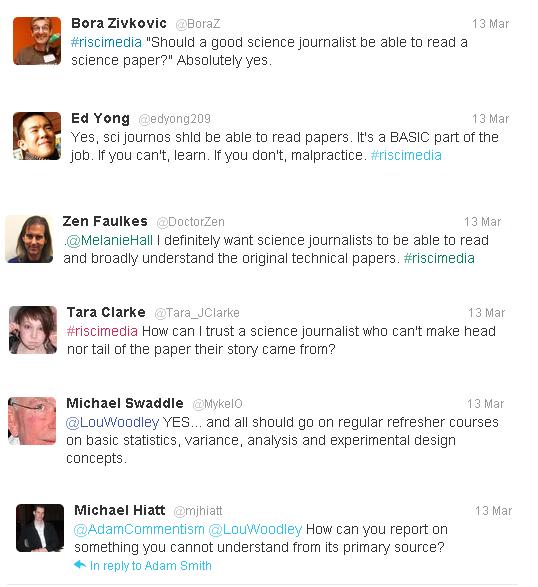
On March 13, the Royal Institution held a debate about the coverage of science in the media, asking whether scientists and journalists need different things from science. You can read the nature.com Communities team write-up and Storify of the tweets about the event here. While the event took place in London, it was followed online by a large (and vocal) group of scientists, science writers and others interested in how science is communicated. One of the questions that came up was whether reporters should read the scientific papers related to the story that they are covering.

The vast majority of responses can be summed up thus: “Yes.”

I agree that it would be great if reporters read all the papers they wrote about. However, I also think it is both wildly optimistic and very unrealistic to expect most journalists to do so. After all, the odds are excellent that the journalist would not be able to understand what they’re reading anyway.

To be clear: I’m not writing this to defend the practice of not reading papers. I am also not advocating that reporters should avoid reading papers. Rather, I’m hoping to explain why many reporters will either not read a paper, or will read a paper but not understand it (or worse, misunderstand it).

There are some reporters who are able to make a living writing about a specific field of study, whether it’s astrophysics or paleontology. But for most reporters, making a living means writing about whatever subject your editor assigns to you. Or, for freelancers, whatever story you can sell. That could mean writing about astrophysics and paleontology. And materials science. And entomology. And that’s just this week.


Researchers spend years learning the ins and outs of their fields, mastering a jargon that is beyond the ken of those outside their specific fields of study. Most reporters do not have that luxury.

This is where most scientists – and many science writers – chime in: “Stop!” you say. “We didn’t say it was easy. But how can you write about a paper you haven’t even read? That makes no sense. You’d just be making stuff up! You MUST rely on the primary literature.”

To which I say: Yes, it would be better if all journalists could read and understand every paper they write about. But, since they can’t, should we give up hope?

I don’t think so.

Full disclosure (and this will not shock you): I am not a scientist, I was not a science major, and while I try to read journal articles, I often don’t understand what I’m reading. It may be clear prose to you, but it’s a shibboleth to me (and if you don’t know what a shibboleth is, you’ll know how I feel when I read phrases like “rectification using multiheterojunction”).

Still, somehow, I’ve made a living writing about science (directly or indirectly) for 14 years. And I’ve never had to run a correction related to the scientific content I’ve written about. How is that possible, if I don’t understand the papers? Easy. I ask questions. A lot of questions. “What questions were you trying to answer with this research? Why? What was your methodology? What were the key findings? What new questions did this research this raise?” And every time I don’t understand the answer, I ask them to explain it.

In a sense, the researchers act as translators, walking me through the paper step by step. This sort of dialogue is essential for any non-expert (like me) who wants to write about a paper. It allows me to understand the content and context of the research in the paper, even though I don’t understand the lexicon used in the paper itself.

All that said, I do think reporters should try to read the papers they’re writing about. Once in a while, they’re actually written in prose that is accessible to the lay reader (or at least the abstract is). This is true for institutional science writers/public information officers (PIOs) too.

For example, a friend of mine is a PIO at a well-regarded university who writes research-oriented news releases (and, no, this is not a thinly-veiled reference to myself). A while back he was reading a paper and noticed that at least one of the statements in the “discussion” section of a paper was at odds with the data itself. When he mentioned it to the researchers, he found that he was right – and the mistake had somehow been missed by the authors, reviewers and journal editors.

When he was telling me this, he said, “This is another reason why [PIOs] should always read – and make sure they understand – studies” that they write about. I’ll meet him halfway. I think science writers – reporters and PIOs – should always understand the studies they write about. I just don’t think reading the paper always helps that much.

If you’ve enjoyed this post from Matt, you may like to read his 3-part mini-series on Soapbox Science about The Promise and Pitfalls of Public Outreach.

The Promise & Pitfalls of Public Outreach Part 3: Social Media: Taking Science To The People

Matt Shipman is a public information officer at North Carolina State University, where he writes about everything from forensic entomology to computer malware. He previously worked as a reporter and editor in the Washington, D.C. area for Inside EPA, Water Policy Report and Risk Policy Report, where he covered the nexus of science, politics and policy. He blogs about NC State research at The Abstract, and you can follow him on Twitter where he is @ShipLives

Explaining the nuances of scientific research to a lay audience has never been easy. Changes in the news media landscape over the past 20 years have created new challenges. The 24-hour news cycle, for example, offers little opportunity for reflective reporting on complex issues. However, there are still steps that scientists can take to communicate effectively about their work.  In my previous two posts I talked about how scientists can work with reporters, public information officers and others to disseminate information about their research to a non-expert audience and about being a science journalist with no scientific background, offering advice for all parties.  In my last post, I look at how the advent of blogs and social media has given researchers the ability to cut out the middle man entirely and speak directly to the public. Sounds great, right? It can be. But it poses its own challenges.

Social Media

There are a lot of social media platforms that allow us to share our thoughts with anyone who cares to listen. Twitter, Facebook and Google+ are clearly at the top of that list. If you set up a Twitter account, for example, you can say whatever you want, 140 characters at a time. But who’s reading it?

Just because you set up a social media account doesn’t mean that anyone will know about it. You’ll need to take the time to cultivate a following. You can start by figuring out your desired audience. Who do you want to be following you? Other scientists? Relevant science writers? Potential grad students? If you try to talk to everyone at once, you’ll end up pleasing no one.

Once you’ve defined your target audience (or audiences), you can begin reaching out to friends and colleagues who are already online. They can help point people to your Twitter account, Facebook page, etc. But if you really want people to pay attention, you need to have something to offer. Content is king, and you need to contribute something to the online conversation. In other words, why should people be listening to you?

For scientists, this could mean disseminating interesting articles you run across. It could also mean providing insight into new findings or news stories where you happen to have relevant expertise. Lastly, it is an opportunity to talk about your work. And here’s where things get tricky.

Social media platforms can be very limiting. For example, can you define genotype and phenotype in 140 characters or less? And even if you write a captivating treatise about the subject on Google+, which gives you far more space to work with, how many people want to read an essay on a social media platform? (Answer: very few.)

If you want to use social media to communicate effectively, you need to drive readers somewhere. This means writing an introductory line that gives readers an idea of what you want to talk about, then including a link which drives them to a site where you’re able to discuss the issue in greater detail. Which brings us to blogs.

Blogging

Clearly there are things that are best confined to peer-reviewed scholarly publications. E.g., you don’t want to scoop yourself. But blogging allows you to dig into the nuance, context and detail of a subject. It also gives you the opportunity to explore facets of news stories that have been ignored in other outlets, discuss papers that may have gone overlooked, or simply share anecdotes that highlight what you love (and loathe) about your field of study.

The one cardinal rule for scientists who blog is (or should be) this: do not regurgitate your papers as blog posts. If you’re simply going to paste your abstract into your blog, what’s the point? You need to bring something new to the table. And there are a lot of ways to do that.

If you want to reach the broadest possible audience, it’s always good to write for your blog in conversational language. Write as if you are writing for your mom (assuming your mom is not also a biochemist). A casual writing style can make even the most arcane subjects seem approachable. If you dive right into a subject using professional jargon, a lay audience will have no idea what you’re talking about – and you’ve lost them.

When you do use terms that may be unfamiliar to your readers, take the time to explain them. Remember, most people aren’t familiar with terms like proteomics, inviscid flow or parameter estimation. And be sure to clarify terms that have different meanings in different contexts. The word “significant,” for example, has a very specific definition when referring to statistics. But if you don’t make the distinction, readers will likely read it as meaning “important” – which may not be the case.

A blog can also be a great place to explain entire concepts. When writing journal articles, researchers can assume a certain amount of expertise on the part of readers. Huge chunks of existing knowledge are addressed with a few cursory sentences and journal citations. For everyone outside of that field, however, the research may appear to exist in a vacuum.

Blogs allow scientists to delve more deeply into the history of a subject, laying out the historical challenges and incremental achievements that brought us to this point. You can say: “Here’s what came before. Here’s why we had these questions. Here’s what we did, what we learned and why it matters.”

Reporters rarely have the time, opportunity or expertise to provide this level of background. But it can be a very effective way of helping people understand the importance of new research findings, without sensationalizing or misrepresenting the work.

Conclusion

Writing a blog gives substance to your social media presence. You have the opportunity to talk about science in a meaningful way, which ultimately helps people better understand the world around them. Answering those questions is probably why you got into science in the first place. Don’t be afraid to share what you’ve discovered.

PS: A final, cautionary note: it is important to remember that anyone could end up seeing what you write on social media. Privacy controls are helpful in some formats, but they aren’t necessarily foolproof. Don’t say anything online that could come back to haunt you.

A post-quantum world

Cross-posted with permission of OUPblog. 

Vlatko Vedral is at the University of Oxford and the Centre for Quantum Technologies, National University of Singapore. His popular book “Decoding Reality: The Universe as Quantum Information” (recently reprinted in paperback by Oxford University Press) discusses many aspects of the relationship between information, thermodynamics and physics.

Every time physicists face experiments that cannot be explained with the existing theories they have to decide which aspects of these theories to keep and which to throw away. Planck, when faced with the inability of classical physics to explain black body radiation, decided to keep the laws of thermodynamics, but threw away the assumption that energy is continuous (which is an integral part of Newtonian mechanics). Similarly, Einstein, when trying to explain the inability of the Michelson and Morley experiments to detect Earth’s motion through the ether, kept the Newtonian assumption that the laws of physics should be the same in all reference frames, but he also introduced the invariance of the speed of light in different reference frames (a fact that is naturally encoded into Maxwell’s theory of electro-magnetism, but not Newtonian physics). Continue reading