The Promise & Pitfalls of Public Outreach Part 3: Social Media: Taking Science To The People

Matt Shipman is a public information officer at North Carolina State University, where he writes about everything from forensic entomology to computer malware. He previously worked as a reporter and editor in the Washington, D.C. area for Inside EPA, Water Policy Report and Risk Policy Report, where he covered the nexus of science, politics and policy. He blogs about NC State research at The Abstract, and you can follow him on Twitter where he is @ShipLives

Explaining the nuances of scientific research to a lay audience has never been easy. Changes in the news media landscape over the past 20 years have created new challenges. The 24-hour news cycle, for example, offers little opportunity for reflective reporting on complex issues. However, there are still steps that scientists can take to communicate effectively about their work.  In my previous two posts I talked about how scientists can work with reporters, public information officers and others to disseminate information about their research to a non-expert audience and about being a science journalist with no scientific background, offering advice for all parties.  In my last post, I look at how the advent of blogs and social media has given researchers the ability to cut out the middle man entirely and speak directly to the public. Sounds great, right? It can be. But it poses its own challenges.

Social Media

There are a lot of social media platforms that allow us to share our thoughts with anyone who cares to listen. Twitter, Facebook and Google+ are clearly at the top of that list. If you set up a Twitter account, for example, you can say whatever you want, 140 characters at a time. But who’s reading it?

Just because you set up a social media account doesn’t mean that anyone will know about it. You’ll need to take the time to cultivate a following. You can start by figuring out your desired audience. Who do you want to be following you? Other scientists? Relevant science writers? Potential grad students? If you try to talk to everyone at once, you’ll end up pleasing no one.

Once you’ve defined your target audience (or audiences), you can begin reaching out to friends and colleagues who are already online. They can help point people to your Twitter account, Facebook page, etc. But if you really want people to pay attention, you need to have something to offer. Content is king, and you need to contribute something to the online conversation. In other words, why should people be listening to you?

For scientists, this could mean disseminating interesting articles you run across. It could also mean providing insight into new findings or news stories where you happen to have relevant expertise. Lastly, it is an opportunity to talk about your work. And here’s where things get tricky.

Social media platforms can be very limiting. For example, can you define genotype and phenotype in 140 characters or less? And even if you write a captivating treatise about the subject on Google+, which gives you far more space to work with, how many people want to read an essay on a social media platform? (Answer: very few.)

If you want to use social media to communicate effectively, you need to drive readers somewhere. This means writing an introductory line that gives readers an idea of what you want to talk about, then including a link which drives them to a site where you’re able to discuss the issue in greater detail. Which brings us to blogs.

Blogging

Clearly there are things that are best confined to peer-reviewed scholarly publications. E.g., you don’t want to scoop yourself. But blogging allows you to dig into the nuance, context and detail of a subject. It also gives you the opportunity to explore facets of news stories that have been ignored in other outlets, discuss papers that may have gone overlooked, or simply share anecdotes that highlight what you love (and loathe) about your field of study.

The one cardinal rule for scientists who blog is (or should be) this: do not regurgitate your papers as blog posts. If you’re simply going to paste your abstract into your blog, what’s the point? You need to bring something new to the table. And there are a lot of ways to do that.

If you want to reach the broadest possible audience, it’s always good to write for your blog in conversational language. Write as if you are writing for your mom (assuming your mom is not also a biochemist). A casual writing style can make even the most arcane subjects seem approachable. If you dive right into a subject using professional jargon, a lay audience will have no idea what you’re talking about – and you’ve lost them.

When you do use terms that may be unfamiliar to your readers, take the time to explain them. Remember, most people aren’t familiar with terms like proteomics, inviscid flow or parameter estimation. And be sure to clarify terms that have different meanings in different contexts. The word “significant,” for example, has a very specific definition when referring to statistics. But if you don’t make the distinction, readers will likely read it as meaning “important” – which may not be the case.

A blog can also be a great place to explain entire concepts. When writing journal articles, researchers can assume a certain amount of expertise on the part of readers. Huge chunks of existing knowledge are addressed with a few cursory sentences and journal citations. For everyone outside of that field, however, the research may appear to exist in a vacuum.

Blogs allow scientists to delve more deeply into the history of a subject, laying out the historical challenges and incremental achievements that brought us to this point. You can say: “Here’s what came before. Here’s why we had these questions. Here’s what we did, what we learned and why it matters.”

Reporters rarely have the time, opportunity or expertise to provide this level of background. But it can be a very effective way of helping people understand the importance of new research findings, without sensationalizing or misrepresenting the work.

Conclusion

Writing a blog gives substance to your social media presence. You have the opportunity to talk about science in a meaningful way, which ultimately helps people better understand the world around them. Answering those questions is probably why you got into science in the first place. Don’t be afraid to share what you’ve discovered.

PS: A final, cautionary note: it is important to remember that anyone could end up seeing what you write on social media. Privacy controls are helpful in some formats, but they aren’t necessarily foolproof. Don’t say anything online that could come back to haunt you.

SciWriteLabs 7.3: Long-form narratives, crappy first drafts, and the importance of wasting time

Seth Mnookin is a Lecturer in MIT’s Graduate Program in Science Writing. His most recent book, The Panic Virus: The True Story Behind the Vaccine-Autism Controversy, was called a “tour de force” by The New York Times and “a book that should be required reading at every medical school in the world…a brilliant piece of reportage and science writing” by The Wall Street Journal.

He is also the author of the 2006 bestseller Feeding the Monster: How Money, Smarts, and Nerve Took a Team to the Top, which chronicles the challenges and triumphs of the John Henry-Tom Werner ownership group of the Boston Red Sox, and 2004′s Hard News: The Scandals atThe New York Times and Their Meaning for American Media, which was a Washington Post Best Book of the Year.

Since 2005, he has been a contributing editor at Vanity Fair, and he blogs regularly at The Public Library of Science. For more information, visit his website or follow him on TwitterGoogle+, or Facebook.

It’s been two weeks since the previous installment of my three-part conversation with Pulitzer Prize-winning New York Times reporter Amy Harmon; today, finally, I’m posting the concluding chapter in what has been a fascinating discourse (for me, anyway). These discussions have focused loosely on “Navigating Love and Autism,” Harmon’s latest story in an ongoing series she’s working on titled “Autism, Grown Up.”

Today’s entry focuses on the peculiar challenges of writing long-form journalistic narratives.

Note: The first part of Harmon and my Q&A, which looked at neurodiversity and some of the issues that arise when writing about autism, is here; the second part, which examined what it means to be a science writer, is here. These interviews are part of an ongoing project called #SciWriteLabs, which examines topics related to science writing and journalism. Of related interest is a recent roundtable I conducted about autism with a group of self-advocates, parents, and writers; the first part of that discussion is here, and the second part, which ran on The Huffington Postis here. Finally, an obligatory mention: The Panic Virus, my book about the controversies over autism and vaccines, is out now in paperback.

SM: Over the past several weeks, one theme we’ve kept coming back to is the amount of work that’s required for long-form narrative projects. People who don’t work in the industry might not realize just how laborious it is to produce a 5,000 or 6,000 word story – and in an era of shrinking news budgets, just how at-risk these types of projects are. Can you talk a bit about what happens before your stories end up in print?

AH: There are different types of long-form narratives, so maybe it’s worth explaining first that I tend to do what are sometimes called “story narratives.’’ They have a plot and they are told through scenes and dialogue. They also have an argument, or at least a point, embedded in them, but it is often not explicitly stated, or perhaps only stated briefly in two or three “nut graphs” near the top. Like in a novel or a movie, the payoff comes at the end, so you need to make readers care about what happens to these characters, and if you can’t, you’re kind of screwed, because you then you have nothing.

These are different from explanatory narratives, which weave a story together with direct commentary by the reporter and/or experts the reporter has talked to; or essays, where you strive for a provocative argument; or profiles, where the point is to provide insight into an individual at a particular moment; or investigations. (Nieman Storyboard had a great interview recently with Jack Hart, a former narrative editor at The Oregonian, in which he distinguished between these genres.)

SM: That reminds of a presentation I saw last week by Deborah Blum. She and David Dobbs were speaking about story structure, and Deborah had a series of examples of ways writers can structure a story: By building a pyramid, or an inverse pyramid, or a diamond, or a circle; by weaving a braid, or creating a rainbow, or fashioning a wave. All of those can work – but the key, in every case, is to have the material that makes a reader want to find out more.

AH: Wow, I need a re-do of that presentation. I think that’s true, and the challenge for a story narrative, regardless of the structure, is that you’re relying exclusively on the scenes and characters to build that suspense.Jonah Lehrer’s essay in The New Yorker last week about how to foster group creativity, for instance, made me keep reading because the point he was making was intriguing and the way he argued it was engaging. With my stories, though, if I stepped out of the narrative to directly explain things, it would sound preachy and annoying. So even though I have an implicit argument  –“with the right kind of support, it’s possible for autistic youth to achieve a level of independence that previous generations have not,” say,  — I’m trying to always “show” not tell. I don’t think this type of narrative is any better or worse than the other kinds – I mostly do them because I’m not that good at the otherkinds. But they do require a different kind of reporting.

SM: What goes into the decision to do this specific kind of narrative?

AH: I think a lot ahead of time about whether I have the right character through which to illuminate whatever the broader cultural trend is that I’m trying to get at.  What is the key conflict, how is it most likely to be resolved? How much of it has already happened and how much of it will play out as I watch?

SM: Can you describe what that was like for these stories about autism?

AH: In the first one, “Autistic and Seeking a Place In An Adult World,” I wanted to show what I knew was a growing tension for many families and communities as more young adults like Justin seek jobs and a foothold in their communities. When I started following him, he had 18 months to find a job, and I thought it was a good bet that he would land one. “Navigating Love and Autism,” the story about Jack and Kirsten, took about two months to do, and I was very nervous about finding a good ending. I got lucky when they decided to get a cat.

SM: Jack’s father, John Elder Robison, noted in a comment how much commitment the “Navigating Love” piece took. What, exactly, was involved in that story?

AH: That was so nice of John to say. I did spend a lot of time with them. Between mid-October, when I first spoke to Jack and Kirsten on the phone, and mid-December, when I last saw them, I visited five times for two or three days each time — and when I wasn’t there, I talked to them on the phone pretty much daily. We also emailed and IM’d. (At one point I even invented a character in Eve Online, the Internet game Jack is semi-obsessed with, so that I could talk to him in the game, but it crashed my computer so I had to give up on that.)

There was one Saturday near the end of my reporting that I spent in Philadelphia, where John and Jack and Kirsten were giving a day-long workshop to a group of autistic teenagers and their parents. They drove down from Amherst the day before in John’s car—about a six-hour drive—and when I called ahead of time to ask if I could ride back with them, John said, “I don’t see why you would want to do that.” But to me, those six hours were a gift: I used every minute of that car ride to construct the detailed chronology I needed before I could start writing.

SM: When you’re interviewing someone, are there times when you know you’ve just found a perfect scene for some part of your story?

AH: One of my two favorite narrative journalism quotes is from Gay Talese: “I waste a lot of time. It’s part of my occupation.’’ He was being facetious, but he was also making the point that if you are trying to capture some truth about people’s lives, you have to be there for long stretches where not a lot happens. I pretty much take notes on everything, just in case, and when something really perfect happens, even if I’m not consciously thinking “I’m going to use this,’’ I know it because my note-taking suddenly becomes frenzied.

It wasn’t until the very end of that day in Philadelphia, for instance, that an anxious mother whose teenager has autism asked Kirsten and Jack if they were going to stay together and get married. That question, and Kirsten’s answer, turned into a crucial scene in the story:

A mother who had slipped into the room put up her hand.

“Where do you guys see your relationship going in the future?” she asked. “No pressure.”

Kirsten looked at Jack. “You go first,” she said.

“I see it going along the way it is for the foreseeable future,” Jack said.

One of the teenagers hummed the Wedding March.

“So I guess you’re saying, there is hope in the future for longer relationships,” the mother pressed.

Kirsten gazed around the room. A few other adults had crowded in.

“Parents always ask, ‘Who would like to marry my kid? They’re so weird,’ ” she said. “But, like, another weird person, that’s who.”

It shows how Kirsten and Jack’s struggles are relevant to other young adults with autism, and also, I thought, how universal those struggles are. It also speaks to why Kirsten and Jack persevere with each other despite their difficulties. So that was one of those times when I’m just typing furiously, as fast as I can, because I’m worried about missing one crucial word and I’m cursing the fact that I don’t have a recorder on, which I never seem to at the most important moments.

SM: I find the writing process to be much more painful and difficult than reporting, which is the part I actually enjoy. Is that also true for you?

AH: I like the very beginning of writing, when you have the illusion that it’s going to go really fast, and it’s been awhile since you last wrote, and you’re kind of remembering that you enjoy playing with words. And I like the very end, when you’re not really writing, you’re polishing, and it feels like it’s getting better with not much effort.  In between, it’s torture. I mentioned my first favorite narrative journalism quote already – my second is from John McPhee. In an interview in The Paris Review, he talks about how he gets in at nine, and basically procrastinates until five – not by surfing the Web, or anything, just sitting there and TRYING to write.  And then at five, he starts to write, and then at seven, he goes home. “So why don’t I work at a bank and then come in at five and start writing?’’ he says. “Because I need those seven hours of gonging around.’’

I think of that pretty much every day at 5:00 p.m. when I am writing, to try to make myself feel better. When I was stuck and totally miserable on the “Navigating Love’’ story, Dean Baquet, the Times’s managing editor, instructed me write what Anne Lamott calls a “shitty first draft.’’ I hated that idea — but he’s the managing editor, and I felt like I better do what he said.

So I wrote this awful first draft — and it was kind of a revelation. Making the shitty first draft better was much more fun than trying to write a perfect first draft. Also, on that story, I started writing it on Dec. 5, the day after they got the cat, and I basically did not look up until it ran on Dec. 27. For me, that was very fast, and I think just working straight through the weekends helped, because it’s always hard for me to start writing again after I stop for a while. But I probably can’t do that too often and maintain cordial relations with my family.

SM: I had a similar experience once, but the editor telling me to stop being so precious was my mother. I was complaining about having writers block, and she made the point that I didn’t actually have writer’s block — I hadn’t forgotten how to write. I was just obsessing about every word I wrote being perfect. Ever since then, I’ve been aware of how much more comfortable I am revising something that’s already on the page than I am starting something new — even if revising really means taking something I was working on and completely rewriting it.

Switching gears: The Times has had a great website for a longtime — but this story really seemed to highlight some of what the paper is trying to do in terms of adding value to stories online. What was involved in putting together the video clips and images that accompanied the piece?

AH: What I loved about the pop-up video clips and images that we used in these stories is that the technology really grew out of the needs of the story. No matter how I tried, I could not convey in mere words how Justin sounded, how he moved, all the subtle—often totally endearing, sometimes off-putting—mannerisms that make people think “he is different.’’  And we didn’t HAVE to rely on my words, because we had this great video footage that had been taken to accompany the story. It was when we were viewing the video for that first story, which was going to run as a mini-documentary alongside the piece, that the idea emerged to make the video and pictures PART of the story, rather than just running in parallel.

To go back to your first question, all of that requires a lot of work by a lot of great and talented people. I’ll just list some so you get the idea: Kassie Bracken shot the video, Patrick Farrell edited the video, Fred Conrad shot the pictures, Josh Williams created the technology behind the “quick links,’’ Anne Leigh did the layout. I’m not even mentioning the editors in video, photo and multimedia. Then there were also MY editors: Barbara Graustark and Glenn Kramon, who spent many hours shaping the stories and making them much better, and Kayne Rogers, the copy editor, who polished them. It really is a big production, and I feel very fortunate to work at a place where I can do this kind of story and also have so many people make it better than I could ever hope to on my own.

SM: I think that about does it — at least until March, when you and Kurt Andersen will be up in Cambridge for the 10th Anniversary Celebration of MIT’s Graduate Program in Science Writing. Any last words?

AH: I’m now in the phase of looking for my next stories, and I’m remembering how important it is to find the right way to do it t at the outset.  Chris Jones, who has won a bunch of awards writing this type of story for Esquire, tweeted something the other day that made me feel justified in spending the time up front. “Idea, reporting, writing, editing. Each as important as the other, but harder to rescue the earlier you lose the string.” Scary and true. Wish me luck.

SM: Luck…

The periodic table: matter matters

Cross-posted with permission of OUPblog.

eric.bmp

Eric Scerri is a chemist and philosopher of science, author and speaker. He is a lecturer in chemistry, as well as history and philosophy of science, at UCLA in Los Angeles. He is the author of several books including The Periodic Table, Its Story and Its Significance, Collected Papers on the Philosophy of Chemistry and Selected Papers on the Periodic Table. His latest book, The Periodic Table: A Very Short Introduction, is published this week.

As far back as I can remember, I have always liked sorting and classifying things. As a boy I was an avid stamp collector. I would sort my stamps into countries, particular sets, then arrange them in order of increasing monetary value shown on the face of the stamp. I would go to great lengths to select the best possible copy of any stamp that I had several versions of. It’s not altogether surprising that I have therefore ended up doing research and writing books on what is perhaps the finest example of a scientific system of classification – the periodic table of the elements. Following degrees in chemistry I wrote a PhD thesis in the history and philosophy of science and specialised in the question of whether chemistry has been explained by quantum mechanics. A large part of this work dealt with the periodic table, the explanation of which is considered as one of the major triumphs of quantum theory, and the notion of atomic orbitals.

As I often mention in public lectures, it is curious that the great 20th century physicist, Ernest Rutherford, looked down on chemistry and compared it to stamp collecting. But we chemists had the last laugh since Rutherford was awarded the Nobel Prize for chemistry and not for his beloved field of physics.

periodictable.jpg

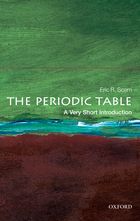
In 2007 I published a book called The Periodic Table, Its Story and Its Significance, which people tell me has become the definitive book on the subject. More recently I was asked to write a Very Short Introduction to the subject, which I have now completed. Although I first thought this would be a relatively easy matter it turned out not to be. I had to rethink almost everything contained in the earlier book, respond to comments from reviewers and had to deal with some new areas which I had not developed fully enough in the earlier book. One of these areas is the exploration of elements beyond uranium or element number 92, all of which are of a synthetic nature.

At the same time, there has been a veritable explosion of interest in the elements and the periodic table especially in the popular imagination. There have been i-Pad applications, YouTube videos, two highly successful popular books, people singing Tom Leher’s element song in various settings as well as artists and advertisers helping themselves to the elegance and beauty of the periodic table. On the scientific side, elements continue to be discovered or more precisely synthesised and there are official deliberations concerning how the recently discovered elements should be named.

table.jpg

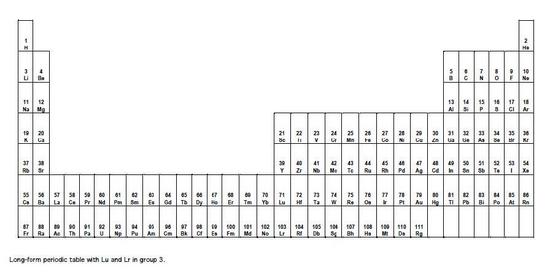
On November 4th The International Union for Pure and Applied Physics (IUPAP) officially announced that elements 110, 111 and 112 are to be known officially as darmstadtium (Ds), roentgenium (Rg) and copernicium (Cn). The names come from the German city of Darmstadt where several new elements have been artificially created; Wilhelm Konrad Roentgenm, the discoverer of X-rays; and the astronomer Nicholas Copernicus who was one of the first to propose the heliocentric model of the solar system. Of the three names it is the last one that has caused the most controversy. Apart from honouring a great scientist it was chosen because the structure of the atom broadly speaking resembles that of a miniature solar system in which the nucleus plays the role of the sun and the electrons behave as the planets do, an idea that originated with the work of Rutherford incidentally. Except that electrons don’t quite orbit the nucleus. One of the major discoveries to emerge from the application of quantum mechanics to the study of the atom has been the realisation that electrons do not follow planetary-like orbits around the nucleus. The electrons behave as much as diffuse waves as they do as particles, and as such they exist everywhere at once within so-called orbitals. The change in wording from ‘orbit’ to ‘orbital’ is a little unfortunate since it does not begin to convey the enormous conceptual change from Rutherford’s solar system model to the quantum model.

Another controversial aspect of all the synthetic elements, that lie beyond the old boundaries of the periodic table, or elements 1 to 92, is that they are radioactive and mostly very short lived which leads most people to think that making them is an enormous waste of time and resources. But such a view is a little short sighted. Some of these elements have found important applications. Take element 95 or americium for example. It has managed to find its way into every modern household as a vital component of smoke detectors.

Or consider the element technetium, which has a far lower atomic number of 43 but which was first discovered in Palermo, Sicily in 1937 after being artificially created in a cyclotron machine in Berkeley, California. Over the subsequent years technetium has found its way into every major hospital in the world and is used in a plethora of medical scanning procedures as well as for treating various medical conditions. It was later found that technetium occurs naturally on earth but in absolutely minute amounts. This happens because technetium is a bi-product of the natural decay of uranium and also because it is a bi-product in the operation of nuclear reactors. The second of these sources provides macroscopic amounts of technetium, which allow scientists to study the chemistry of the element in great detail and to make many new and medically useful compounds. There have been entire conferences devoted to the chemistry and uses of technetium.

Nobody has yet found the means of producing macroscopic amounts of the most recently named elements, and they probably won’t, but their formation provides chemists and physicists with an excellent opportunity to refine theories on nuclei and atoms and new techniques with which to experiment upon them. Almost of matter is made of the elements and that’s why the elements really matter to us, even the more exotic ones.

Geography Is Social

nicola.bmp

This week’s guest blogger is Nicola Osborne, a Social Media Officer for EDINA, a JISC National Data Centre based at the University of Edinburgh. Nicola began her career investigating “Y2K” for BP but, whilst studying engineering, she became more interested in writing and running review websites. After graduating Nicola joined the Edinburgh University Library then moved on to SUNCAT where she worked with library catalogue data and trialled various social media tools to promote the service. She was appointed to her current innovative role in 2009. Nicola Osborne is a regular speaker on social media, an organiser for the annual Repository Fringe events and regularly blogs on social media events, possibilities and issues for higher and further education.

I have the rather unusual job title of Social Media Officer for EDINA and I’ve been asked to explain what I do, though I should probably start by saying that my work varies hugely from day to day and week to week depending on the projects I’m working with, the events that are coming up, and the new technologies that have appeared lately (right now Google+ and Klout are the hot topics).

The largest part of my role is to work with colleagues across EDINA projects and services to encourage and support the use of social media and related communications technologies. We run services including Digimap, an online mapping and spatial data service including Ordnance Survey data; and JISC MediaHub, a huge resource of images, video and sound; and SUNCAT, the UK Serials Union Catalogue. I help my colleagues think about how we can engage our user communities through social media – whether by including sharing elements or social media-like features in an interface or through sharing training materials on YouTube or providing updates and alerts via blogs and twitter. I also help to manage the in-house blogs platform and authored the EDINA Social Media Guidelines which we have had a fantastic response to since we released them under Creative Commons license in January 2011. Acting as a social media “evangelist” is not only my passion but an official part of my job description so a significant part of my role is speaking, writing and running training events where I enthusiastically share new possibilities and best practice for using social media in the education sector.

At the moment I am also part of the team running the JISC GECO – Geo Engagement and Community Outreach – project. We are working with 12 JISC-funded geo projects across the UK to make connections between the use of geo information and “non-traditional” users, which tends to mean those outside of geography, geosciences or earth sciences. We are using “geo” in a very broad way so we would mean anything geographic, geospatial, geo-referenced, or anything where location and/or physical context is important. We are trying to build new connections between those who have expertise, experience and resources to share, those that are interested in using geo, and those who bring new perspectives on geo and on how geo data or tools could be used.

The diversity of projects and disciplines that interact with geo is so broad that GECO is proving to be a constantly challenging and inspiring project. Those projects we are working with include several elearning projects: GeoSciTeach is creating a phone app for teachers leading science fieldwork; JISC G3 are developing approaches to teach geographic concepts to non geographers; and ELOGeo are developing an e-learning framework for materials on open data, open source and open standards around geospatial information.

Many of our projects are exploring existing data: geoCrimeData project is looking at the relationship between location and crime statistics; U.Geo is investigating material held in the UK Data Archive to identify those with location information and potential for use as georeferenced data; PELAGIOS is applying the extremely modern concept of Linked Open Data to expose, share and combine online resources about the very ancient world; IGIBS is working with researchers in the Dyfi Biosphere (a UNESCO designated area of outstanding diversity of environment, culture, language, etc.) to create a tool that combines research data with authoritative maps and allows that work to become more visible and sharable between researchers; and the Halogen 2 project team are enhancing their existing cross-disciplinary History, Archeology, Linguistics, Onomastics and Genetics database.

Screenshots.bmp

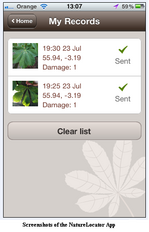
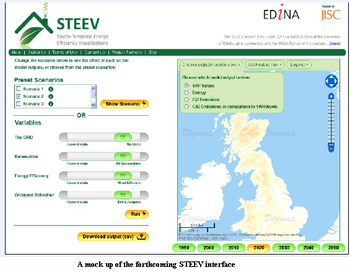
We are also working with the NatureLocator project who have created a curiously addictive phone app that lets you record the location and level of damage to horse chestnut trees which will help track the spread of the leaf minor moth; xEvents, who are creating a tool to build, share and map academic events; STEEV, a project to enable you to time travel through of historical energy efficiency data right through to future predictions. And, last but by no means least, the GEMMA project (which has a particularly fetching gerbil logo) is building a series of mapping applications and tools that can be combined and adapted so that any web user can make a map no matter how much or little that individual knows about mapping.

Steev.bmp

Most of these projects are reaching out far beyond traditional academic communities and all reach beyond traditional geo communities. Communicating with these audiences can be challenging, particularly for those used to working mainly with other specialists in their field. We are helping the projects find each other and related projects both within and outside of academia, and we are helping them to reach out with the broader community around their work. My main responsibility has been to help the project teams communicate what they are doing through their blogs. Some of the project teams include experienced bloggers but some of our researchers and developers are entirely new to sharing their work in such an informal and public space and we’ve been delighted to support them to become confident and talented bloggers.

In addition to the project blog we directly communicate key developments and announcements about these projects through a central JISC GECO blog and on Twitter as @jiscGECO. We are trying to highlight the connections between all manner of geo ideas, projects, concepts, tools and sites so we tend to share rather quirky finds in these spaces and always welcome comments, suggestions and guest posts. We will be running a number of events over the coming months and we will be amplifying these through liveblogging, tweeting and, where possible, videoing key content. We also have a mailing list to encourage broad discussion around geo – we do a lot of matchmaking between different people and communities and we want to help raise awareness of the ubiquity and importance that geo plays in everyday work and lives.

Our main focus at the moment is the organisation of an Open Source Geo and Health event (Twitter hashtag #GECOhealth ) which we will be running in Edinburgh on Tuesday 9th August. We have worked with the ELOGeo project at Nottingham University, the British Computing Society, Edinburgh Napier University and geo enthusiasts at the Edinburgh College of Art to create a fantastic programme exploring the intersections between geo and many aspects of health practice, theory, trends, policy, and we hope this will trigger some really interesting discussions and relationships that will continue long after the project comes to an end.