Cross-posted with permission of OUPblog.
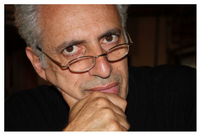
Eric Scerri is a chemist and philosopher of science, author and speaker. He is a lecturer in chemistry, as well as history and philosophy of science, at UCLA in Los Angeles. He is the author of several books including The Periodic Table, Its Story and Its Significance, Collected Papers on the Philosophy of Chemistry and Selected Papers on the Periodic Table. His latest book, The Periodic Table: A Very Short Introduction, is published this week.
As far back as I can remember, I have always liked sorting and classifying things. As a boy I was an avid stamp collector. I would sort my stamps into countries, particular sets, then arrange them in order of increasing monetary value shown on the face of the stamp. I would go to great lengths to select the best possible copy of any stamp that I had several versions of. It’s not altogether surprising that I have therefore ended up doing research and writing books on what is perhaps the finest example of a scientific system of classification – the periodic table of the elements. Following degrees in chemistry I wrote a PhD thesis in the history and philosophy of science and specialised in the question of whether chemistry has been explained by quantum mechanics. A large part of this work dealt with the periodic table, the explanation of which is considered as one of the major triumphs of quantum theory, and the notion of atomic orbitals.
As I often mention in public lectures, it is curious that the great 20th century physicist, Ernest Rutherford, looked down on chemistry and compared it to stamp collecting. But we chemists had the last laugh since Rutherford was awarded the Nobel Prize for chemistry and not for his beloved field of physics.
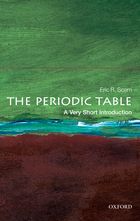
In 2007 I published a book called The Periodic Table, Its Story and Its Significance, which people tell me has become the definitive book on the subject. More recently I was asked to write a Very Short Introduction to the subject, which I have now completed. Although I first thought this would be a relatively easy matter it turned out not to be. I had to rethink almost everything contained in the earlier book, respond to comments from reviewers and had to deal with some new areas which I had not developed fully enough in the earlier book. One of these areas is the exploration of elements beyond uranium or element number 92, all of which are of a synthetic nature.
At the same time, there has been a veritable explosion of interest in the elements and the periodic table especially in the popular imagination. There have been i-Pad applications, YouTube videos, two highly successful popular books, people singing Tom Leher’s element song in various settings as well as artists and advertisers helping themselves to the elegance and beauty of the periodic table. On the scientific side, elements continue to be discovered or more precisely synthesised and there are official deliberations concerning how the recently discovered elements should be named.
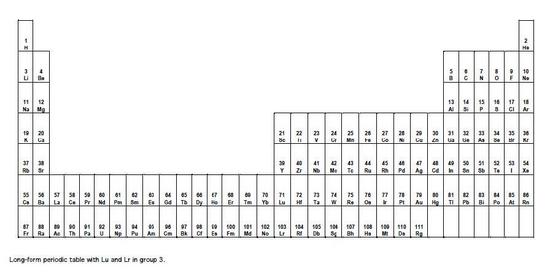
On November 4th The International Union for Pure and Applied Physics (IUPAP) officially announced that elements 110, 111 and 112 are to be known officially as darmstadtium (Ds), roentgenium (Rg) and copernicium (Cn). The names come from the German city of Darmstadt where several new elements have been artificially created; Wilhelm Konrad Roentgenm, the discoverer of X-rays; and the astronomer Nicholas Copernicus who was one of the first to propose the heliocentric model of the solar system. Of the three names it is the last one that has caused the most controversy. Apart from honouring a great scientist it was chosen because the structure of the atom broadly speaking resembles that of a miniature solar system in which the nucleus plays the role of the sun and the electrons behave as the planets do, an idea that originated with the work of Rutherford incidentally. Except that electrons don’t quite orbit the nucleus. One of the major discoveries to emerge from the application of quantum mechanics to the study of the atom has been the realisation that electrons do not follow planetary-like orbits around the nucleus. The electrons behave as much as diffuse waves as they do as particles, and as such they exist everywhere at once within so-called orbitals. The change in wording from ‘orbit’ to ‘orbital’ is a little unfortunate since it does not begin to convey the enormous conceptual change from Rutherford’s solar system model to the quantum model.
Another controversial aspect of all the synthetic elements, that lie beyond the old boundaries of the periodic table, or elements 1 to 92, is that they are radioactive and mostly very short lived which leads most people to think that making them is an enormous waste of time and resources. But such a view is a little short sighted. Some of these elements have found important applications. Take element 95 or americium for example. It has managed to find its way into every modern household as a vital component of smoke detectors.
Or consider the element technetium, which has a far lower atomic number of 43 but which was first discovered in Palermo, Sicily in 1937 after being artificially created in a cyclotron machine in Berkeley, California. Over the subsequent years technetium has found its way into every major hospital in the world and is used in a plethora of medical scanning procedures as well as for treating various medical conditions. It was later found that technetium occurs naturally on earth but in absolutely minute amounts. This happens because technetium is a bi-product of the natural decay of uranium and also because it is a bi-product in the operation of nuclear reactors. The second of these sources provides macroscopic amounts of technetium, which allow scientists to study the chemistry of the element in great detail and to make many new and medically useful compounds. There have been entire conferences devoted to the chemistry and uses of technetium.
Nobody has yet found the means of producing macroscopic amounts of the most recently named elements, and they probably won’t, but their formation provides chemists and physicists with an excellent opportunity to refine theories on nuclei and atoms and new techniques with which to experiment upon them. Almost of matter is made of the elements and that’s why the elements really matter to us, even the more exotic ones.