Peter Gallant found his love for chemistry as a schoolboy during the war while recovering from polio. After 30 years of working with rockets and nuclear power, he went on to apply his chemical experience in the voluntary sector advising inner-city groups.
He speaks to Alex Jackson about his lifelong passion for science.
“I read chemistry books like other people read detective stories,” says affable, wide-eyed 86-year-old Peter Gallant. Gallant’s story is one of remarkable fortitude that in recent years has seen him awarded an MBE.
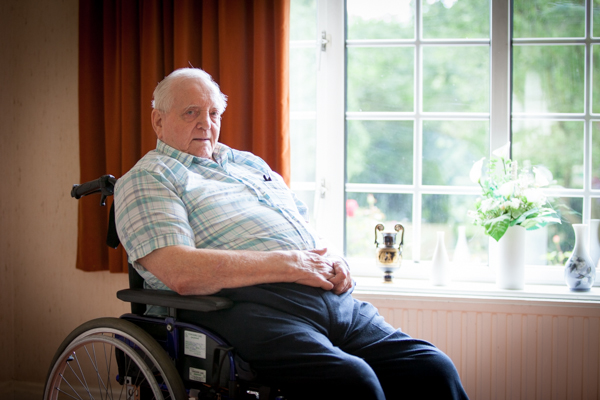
“I read chemistry books like other people read detective stories,” says Peter Gallant.
Photograph: Stephen Lake/Royal Society of Chemistry)
Early life
Growing up in the early 1930s in Edgware, London, Gallant’s early childhood was much like many of his schoolmates. Both his parents worked in the admiralty, his dad supplying crews for ships, and his mum, a secretary. An only child, he recalls how after class he would devour books, play with train sets, and listen avidly to his parents’ records. Yet one day at the age of nine, his life would dramatically change. Taken ill in the summer of 1938, Gallant was diagnosed with osteomyelitis, a nasty bone disease which infects and inflames the bone or bone marrow.
“It was a killer. Back then, the death rate was about 50%. There were no antibiotics; the only treatment was major orthopaedic surgery,” says Gallant, describing how the infection spread rapidly through his body. He had operations on the femur and tibia of his right leg, his pelvis and arms, leaving his right hip at about 30 degrees and right leg 6cm shorter than his left. “I went into hospital in June 1938 and didn’t come out until September 1942 — more than four years later. At the start I was so ill, there was no question of any education.”
“I went into hospital in June 1938 and didn’t come out until September 1942 — more than four years later. At the start I was so ill, there was no question of any education.”
Evacuated from Guy’s Hospital during the Munich crisis for fears of German air raids, he was taken to Treloar, a children’s hospital in Alton, Hampshire. He vividly recalls the five hospital ward blocks, each arranged in an arc on a hillside, facing the train tracks. His few hospital perks included watching the trains – a “huge hobby” – a daily half pint of stout “to build me up”, and being wheeled out onto the balcony in the summer of 1941 to see an eclipse.
“For four years I was strapped to two pieces of wood which went from my armpits to my feet and was fixed to the bottom of the bed,” recalls Gallant. “We would overhear dogfights on the street and see the flames rise on the southern horizon when Southampton and Portsmouth were being blitzed.”
Encouraged by his mother to read the daily News Chronicle paper while confined to his bed, Gallant would keep his mind active reading about the war and international affairs. A school teacher would also visit twice a day for an hour and “stop us forgetting what we already knew.”