Science: A Four Thousand Year History

pat 2.JPG

This weeks guest blogger, Patricia Fara, discusses some problems she faced when deciding how to begin her most recent book, Science: A Four Thousand Year HistoryShe lectures on the history of science at Cambridge University, where she is Senior Tutor of Clare College. Her other successful books include Newton: The Making of Genius (2002), Sex, Botany and Empire (2003) and Pandora’s Breeches: Women, Science and Power in the Enlightenment (2004).

Lewis Carroll knew how difficult it can be to tell a story. ‘Where shall I begin, please your Majesty?’, asked the White Rabbit. Alice listened for the answer. ‘Begin at the beginning,’ the King said, gravely, ‘and go on till you come to the end: then stop.’

To write Science: A Four Thousand Year History, I had to decide when science began. This is no trivial question, but gets right to the heart of what science might be. Looking back at the past, it is possible to pick out ideas and discoveries that later became incorporated within today’s global scientific enterprise. But at the time, they contributed to other goals – finding an auspicious time for religious festivals, winning wars, vindicating biblical prophecies, making a living.

Separating science from superstition is not always easy. When early astronomical observers looked up into the heavens, they saw seven planets circling around the Earth. The Sun and the Moon were the most obvious, but they also identified five others – Saturn, Jupiter, Mars, Venus and Mercury (the next one to be discovered, Uranus, was only spotted at the end of the eighteenth century). Finding planets, and working out how they move across the sky, demands skills that are important for modern science. On the other hand, the first sky-watchers were not primarily interested in how the universe operates, but instead were trying to relate the patterns of the stars to major events on earth, such as famines, floods or the death of a king.

Planets.gif

So it seems wrong to call them scientists. But does it make sense to disparage their conclusions? Modern astronomy rests on a foundation of data collected by expert star-gazers who were also astrologers. Their observations were generally sound, even if their theories have since been rejected. Many scientists find it hard to accept that their own expertise is rooted in beliefs which they dismiss as magic. For those who pledge their faith in progress, magical mumbo-jumbo has been eliminated by scientific reason: magic and science are clearly polar opposites, and any notion that they might share common origins is sacrilegious. But this comforting view is not always easy to reconcile with the historical facts.

newton1-1.JPGConsider Isaac Newton. He believed so firmly in the Greek idea of a harmonic universe that he divided the rainbow into seven colours to correspond with the musical scale. Before then, although opinions varied, artists mostly showed rainbows with four colours. It is, of course, impossible to make any objective decision about the correct number, because the spectrum of visible light varies continuously: there is no sharp cut-off between bands of different colours, so how you think about a rainbow affects how you see it. Be honest – can you tell the difference between blue, indigo and violet?

Since Newton has become an iconic scientific genius, it would seem strange to say that he did not practise science. On the other hand, modern scientists denigrate many of his activities as ridiculous, or even antithetical to science. In addition to his preoccupation with numbers and biblical interpretation, Newton carried out alchemical experiments, poring over ancient texts and careful recording his own thoughts and discoveries. This was no mere hobby: Newton regarded alchemy as a vital route to knowledge and self-improvement, and he incorporated his findings within his astronomical theories.

The example of Newton illustrates how hard it is to pin down exactly when science began. One possibility is to look for the first scientists. But the word scientist was not even invented until 1833, and even then was slow to catch on. Both Michael Faraday and Charles Darwin refused to let themselves be labelled with the new term, but a history that excludes them would seem strange. The most popular starting date is 1543, when Nicolas Copernicus suggested that the Sun and not the Earth lies at the centre of our planetary system. However, there are several objections to this choice, not least that it excludes the Islamic sages whose ideas were so significant in Renaissance Europe, and also the Greeks, whose theories remained influential well into the eighteenth century. So some historians decide choose to begin with the geometer Thales of Miletus, who lived on the Turkish coast around 2500 years ago, and successfully predicted an eclipse. But picking him results in leaving out all of his important predecessors, such as the Egyptians and the Babylonians.

Babylonian 'Queen of teh Night'For Science: A Four Thousand Year History, I decided to start with the Babylonians, whose way of thinking about the universe still affects modern science. Instead of counting in tens and hundreds, they used a base of sixty, which is why there are 360 degrees in a circle. Their complex mathematical techniques and detailed star observations enabled them to predict celestial events – and because their knowledge of the skies was inherited by later observers, it now forms the basis of astronomy as well as structuring everyday life. Thanks to the Babylonians, weeks have seven days, hours have sixty minutes, and minutes have sixty seconds. The next time you look at a digital clock, remember that it has more in common with a clay tablet than you might think.

The Meeting of Minds

Manjit Kumar.JPGThis week’s guest blogger is Manjit Kumar. Manjit’s book_, Quantum: Einstein, Bohr and the Great Debate, is about the nature of reality, and was shortlisted for the 2009 BBC Samuel Johnson Prize for Non-fiction. He writes and reviews regularly for a variety of publications, including The Guardian, The Independent, The Times and the New Scientist. He used to edit a journal called Prometheus that covers the arts and sciences, and he was also the consulting science editor at UK Wired._

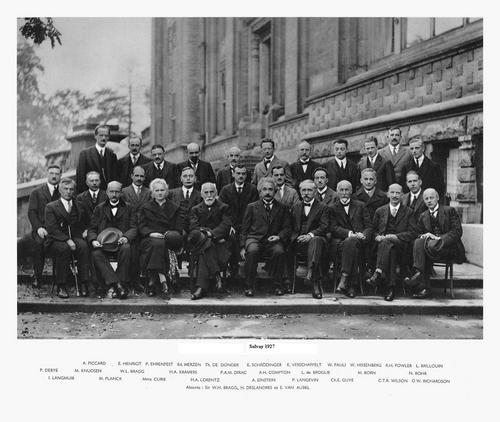
I first saw the photograph of those gathered at the fifth Solvay conference, which was held in Brussels from 24 to 29 October 1927, in a biography of Albert Einstein. This was in 1979, when I was just 16. I wondered what brought these people together, and soon learned that the picture included most of the key players involved in the discovery of the quantum, and the subsequent development of quantum physics. With 17 of the 29 invited eventually earning a Nobel Prize, the conference was one of the most spectacular meetings of minds ever held.

1927 Solvay Conference.jpg

When I was 18, I was given a print of the above photograph as a present. Many years later I began to think about it as a possible starting point for a book about the quantum. In the photograph there are nine seated in the front row. Eight men, and one woman; six have Nobel Prizes in either physics or chemistry. The woman has two, one for physics, awarded in 1903, and another for chemistry, awarded in 1911. It could only be Marie Curie. In the centre, the place of honour, sits Albert Einstein. Looking straight ahead, gripping the chair with his right hand, he seems ill at ease. Is it the winged collar and tie that are causing him discomfort, or is it what he has heard during the preceding week? At the end of the second row, on the right, is Niels Bohr, looking relaxed with a half-whimsical smile. It had been a good conference for him. Nevertheless, Bohr would be returning to Denmark disappointed that he had failed to convince Einstein to adopt his Copenhagen interpretation_ of what quantum mechanics revealed about the nature of reality.

Instead of yielding, Einstein had spent the week attempting to show that quantum mechanics was inconsistent, that Bohr’s ‘Copenhagen interpretation’ was flawed. Einstein said years later that:

This theory reminds me a little of the system of delusions of an exceedingly intelligent paranoic, concocted of incoherent elements of thoughts.

It was Max Planck, sitting on Marie Curie’s right, holding his hat and cigar, who discovered the quantum. In 1900 he was forced to accept that the energy of light, and all other forms of electromagnetic radiation, could only be emitted or absorbed by matter in bits, bundled up in various sizes. ‘Quantum’ was the name Planck gave to an individual packet of energy, with ‘quanta’ being the plural. The quantum of energy was a radical break with the long-established idea that energy was emitted or absorbed continuously, like water flowing from a tap. In the everyday world of the macroscopic, where the physics of Newton ruled supreme, water could drip from a tap, but energy was not exchanged in droplets of varying size. However, the atomic and subatomic level of reality was the domain of the quantum.

Bohr discovered that the energy of an electron inside an atom was ‘quantised’; it could possess only certain amounts of energy and not others. The same was true of other physical properties, as the microscopic realm was found to be lumpy and discontinuous. Not some shrunken version of the large-scale world that we humans inhabit, where physical properties vary smoothly and continuously, where going from A to C means passing through B. Quantum physics, however, revealed that an electron in an atom can be in one place, and then, as if by magic, reappear in another without ever being anywhere in between, by emitting or absorbing a quantum of energy.

By the early 1920s, it had long been apparent that the advance of quantum physics on an ad hoc, piecemeal basis, had left it without solid foundations or a logical structure. Out of this state of confusion and crisis emerged a bold new theory; known as quantum mechanics_, with Werner Heisenberg and Erwin Schrödinger,Schr%C3%B6dinger third and sixth from the right in the back row, leading the way. In 1927 Heisenberg made a discovery. It was so at odds with common sense that he initially struggled to grasp its significance. The uncertainty principle said that if you want to know the exact velocity of a particle, then you cannot know its exact location, and vice versa.

Bohr believed he knew how to interpret the equations of quantum mechanics; what the theory was saying about the nature of reality. Questions about cause and effect, or whether the moon exists when no one is looking at it, had been the preserve of philosophers since the time of Plato and Aristotle. However, after the emergence of quantum mechanics they were being discussed by the twentieth century’s greatest physicists.

The debate that began between Einstein and Bohr at the Solvay conference in 1927, raised issues that continue to preoccupy many physicists and philosophers to this day; what is the nature of reality, and what kind of description of reality should be regarded as meaningful?

No more profound intellectual debate has ever been conducted’, claimed the scientist and novelist CP Snow. ‘_It is a pity that the debate, because of its nature, can’t be common currency_.’

When Einstein and Bohr first met in Berlin in 1920, each found an intellectual sparring partner who would, without bitterness or rancour, push and prod the other into refining and sharpening his thinking about the quantum. ‘It was a heroic time,’ recalled Robert Oppenheimer, who was a student in the 1920s. ‘It was a period of patient work in the laboratory, of crucial experiments and daring action, of many false starts and many untenable conjectures. It was a time of earnest correspondence and hurried conferences, of debate, criticism and brilliant mathematical improvisation. For those who participated it was a time of creation.’

Planck, Einstein, Bohr, Heisenberg, Schrodinger, Born, Pauli, De Broglie, Dirac, the leading lights of the quantum revolution, are all there in that picture.

Where’s the catch?

John Farndon

This week’s guest blogger is John Farndon, with his second guest post. Having studied earth sciences at Cambridge University, John has written more than 300 books on science and nature including How the Earth Works, The Wildlife Atlas, The Practical Encyclopedia of Rocks and Minerals, and the forthcoming The Atlas of Oceans.

Last week, I saw in the news that the EU has pledged to change the clause in the Common Fisheries Policy which effectively forces fishermen to throw millions of dead fish back into the sea.

As it stands, fishing boats can only land particular numbers of particular fish. So any fish hauled up in the nets surplus to quota is simply chucked overboard, already dead. In the whitefish industry, up to half the catch is discarded. With flatfish, over 70 per cent of the catch goes overboard. The waste is appalling. As a policy designed to protect threatened fish populations, it clearly doesn’t work.

Thanks in part to public pressure stirred up by TV chef Hugh Fearnley-Whittingstall, EU fishery officials are now looking at how best to alter the system. One suggestion is that fishing boats are required to land all their catch and count any extra fish as part of the quota, regardless of species or size. So boats have to stop fishing as soon as they catch a certain tonnage, even if only a small proportion is the fish they want. The UK is trying this tactic out in the North Sea at the moment.

This is good, and yet it is just the tip of the iceberg, or rather the tiddler in the shoal. The fishing industry has created a global crisis in the oceans, the scale of which is only just beginning to dawn.

tuna final.JPGThe dreadful wastefulness of bycatch (unwanted fish caught up in the nets) is just part of the picture, as I discovered when writing my forthcoming book Atlas of Oceans (Yale UP and A & C Black). Each year a staggering 30 million tonnes of unwanted fish are dumped in the sea, including dolphins, whales, turtles as well as countless smaller sea creatures. Yet the wastefulness of bycatch, shocking though it is, is just part and parcel of the way the world’s fishing industry is now scooping marine life from the oceans like there was no tomorrow.

In the 1950s, the annual fish catch around the world was 20 million tonnes. Now, thanks to industrial fishing boats that can haul fish from the sea at an awesome rate, it is over four times that much at 80 million tonnes. The annual take has declined slightly in recent years – not because there has been much let up in the relentless pursuit of wild fish, but because fish are becoming so scarce they are harder to find even with modern location techniques.

Fishing quotas have been in place for decades but have not prevented many populations of once abundant fish being fished out. Northern cod, North Sea mackerel, Antarctica’s marbled rock cod, bluefin tuna and many other populations have all but gone. Ninety per cent of large predatory fish such as tuna, sharks and billfish have been removed over the last century. Notoriously, the fishmarket.JPG

In 2006, Boris Worm, a marine ecologist at Dalhousie University in Halifax, Nova Scotia, Canada, presented a study which projected that overfishing was proceeding at such a breakneck speed that the oceans would be entirely fished out of edible fish by 2048. Some experts argued that Worm was overstating the problem, and one of his critics, Ray Hilborn, joined him on a new study, completed in 2009. Even this new study suggested that 63 per cent of fish populations were being fished at such unsustainable levels that they will inevitably collapsed unless there is some change.

By themselves, EU quotas quickly become irrelevant. As fish populations in the inshore waters of the developed countries are fished out, so the boats move on to exploit the inshore waters of developing countries, or out into the deep, where species only recently discovered are already under threat of extinction. Commercial fisheries have also been ‘fishing down food webs’ which means that once they have fished out big fish, they move on to smaller fish and will eventually be catching jellyfish and plankton.

Nonetheless, there are grounds for hope. There are places where fish stocks are managed properly, and where there is only a limited amount of illegal fishing. There fish stocks do seem to show signs of sustainability and even recovery in some cases. Out of 10 regions in North America, northern Europe and Oceania that Worm and Hilborn’s team looked at closely, five showed signs of improvement, with diminishing rates of exploitation in recent years.

beam_trawler_graphic_430.jpg

In other words, political and government action can make a difference, and more importantly so can consumer pressure and choice to alter fishing practices. The biggest choice the consumer can make, though, is to remember that every morsel of wild food is precious. Jellyfish stew, anyone?

What is milk?

atkins_p_08.jpgPeter Atkins is Professor of Geography at Durham University . His main research interest is in food and drink, with particular reference to their materiality; the stuff in foodstuffs. His work ranges from arsenic poisoning in the groundwater in Bangladesh to a history of milk. His latest book, Liquid Materialities: a History of Milk, Science and the Law was published in 2010.

What is milk? It may sound like a trivial question or an inappropriate one for a serious science blog. Why should we take any interest at all in a substance that is a matter of everyday consumption? Put on the spot, most people would say that milk is a rather dull commodity and something they take for granted. The Spanish have a saying: blanco y en botella, leche. Literally this is if it’s white and in a bottle then it’s milk. However, slipped colloquially into conversation it means it’s obvious. My purpose in this post is to show that a discussion of milk is far from obvious and indeed is something that cannot be left to dairy science alone. We need to look beyond that to understand why milk is as it is today, and ultimately, what’s at stake is the quality of all of the food we consume.

The laboratory-based analysis of milk has its origins in the late eighteenth century. In the 1790s Parmentier and Deyeux were already estimating its constituents with simple experiments. They were followed in the early nineteenth century by other French, Swedish and German scientists. But milk is a complex emulsion of fat globules and water, and a fine dispersion or suspension of casein micelles, so at the time, it was very difficult to know what was in it, given the limited techniques of organic chemistry and physics. It was eventually realised that milk was a highly variable substance; its constituents can vary among mammals and during feeding time. Its principal constituents, fat, protein and sugar, also differ from one breed of dairy cow to another.

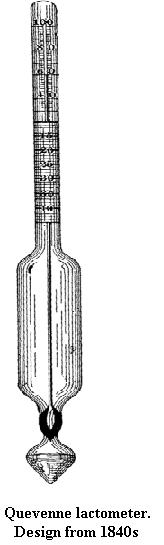
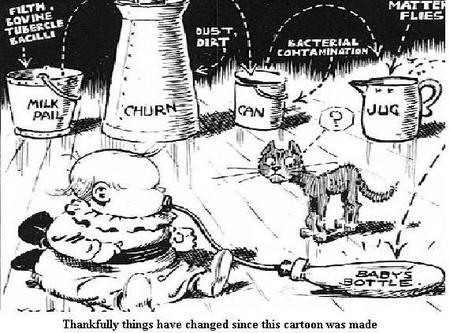
Quevenn.JPGSo what? you might ask. Well, food in the nineteenth century was frequently adulterated, and milk was the most notorious example because its dense whiteness enabled the addition of small amounts of water without anyone noticing. The average pint in London in the 1870s, for instance, contained about 25% of added water. Consumers were outraged by the unreliable quality. One simple method of analysis used by the milk trade was the lactometer, which measured the specific gravity of milk, but this had to be abandoned when it was realised that, by adding water and removing some of the butterfat, it was possible to simulate the physical properties of genuine milk.
Gravimetric and volumetric chemistry eventually made progress and adulterators were brought to book under a series of Sale of Food and Drugs Acts that started in 1860. The irony was that many innocent farmers were prosecuted before anyone thought to establish a legal definition of the real thing. This came about in 1901 with the Sale of Milk Regulations. In effect, it claimed that science could determine nature’s intentions. Natural cow milk was said to contain 3.0% of butterfat, for instance, and a milk that was more watery than this was presumed to have been fraudulently manipulated.

Problem solved? Well no, because what happened if cattle were fed on very watery grass or silage? The milk they produced would be as it came from the cow, nothing added and nothing taken away. However, it would still be of a low quality, fat-wise. Legal challenges in the early twentieth century proved that almost any milk coming from a healthy cow was acceptable, as long as it was not modified later.

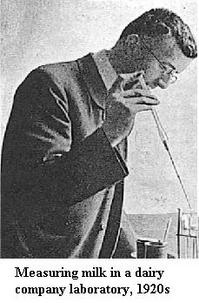
MeasuringMilk.JPGFrom 1901 to 1976 this whole milk idea remained the British consensus. Elsewhere, on the continent, a completely different approach prevailed. Countries such as the Netherlands had butter industries where it was in their economic interest to regard some extraction of fat as normal. This led to fixed, legal limits of quality, and later to the standardization of the constituents of milk. Britain’s entry into the European Community in the 1970s, meant accepting some legal definitions of foods. From 1981, it was possible for the first time to buy ‘semi-skimmed’ milk. Then, in 1933, milk with a standardized composition had to be allowed with the beginning of the Single milk market. However, it has only been since the Drinking Milk Regulations of 2008, that at last milk could be labelled with various fat levels. cartoon Rosenau 1912 p26.JPG

When you next go to the supermarket, have a look at the dairy shelves. You’ll find an astonishing range of milk. In addition to flavoured or filtered or fortified milk, you will find milk with 0.1%, 1%, 2% and 4% fat, and the consumer in England and Wales (but not Scotland) can also choose between raw milk and heated treated milks that have been pasteurized, sterilized or ultra heat treated. There is also homogenized and organic cow’s milk, not to mention goat’s milk and soya milk.

I’m not saying that these new Euro definitions of quality are better or worse, but they are certainly different from the long history of milk in Britain. It is almost as if milk has had its own life story and we can now write its biography. It seems that most milk drinkers are oblivious to this story and are now content that it is technology that defines what is genuine and natural. We no longer feel any obligation for our diet to reflect the foibles and the cycles of nature. We are now sure that we can improve upon nature by producing a substance which has a substantial human imprint. Finally, milk still resists us by turning sour and by persisting in being an ideal medium for the spread of disease, but both of these problems are susceptible to industrial processing.

cartoon.JPG

Ghosts of the Universe

frank.jpg This week’s guest blogger, Frank Close, is a particle physicist, author and speaker. He is Professor of Physics at the University of Oxford and a Fellow of Exeter College, Oxford. He is the author of several books, including the best-selling Antimatter, and the winner of the Kelvin Medal of the Institute of Physics for his “outstanding contributions to the public understanding of physics.”

Of all the things that make the universe, the commonest and weirdest are neutrinos*. Able to travel through the earth like a bullet through a bank of fog, they are so shy that half a century after their discovery we still know less about them than all the other varieties of matter that have ever been seen.

These will o’ the wisps are coming up from the ground beneath our feet, emitted by natural radioactivity in rocks, but most of those hereabouts were born in the heart of the Sun less than 10 minutes ago. In just a few seconds the Sun has emitted more neutrinos than there are grains of sand in the deserts and beaches of the world, greater even than the number of atoms in all the humans that have ever lived. As you read this, billions of them are hurtling, unseen, through your eyeballs at almost the speed of light. They pass through the earth as easily as a bullet through a bank of fog.

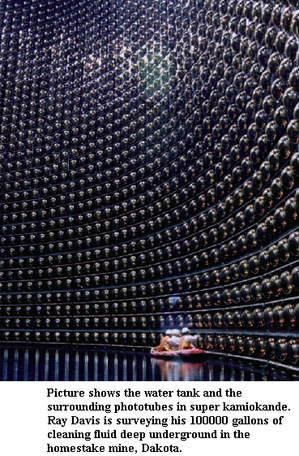
ray davis.bmpIf we could see with neutrino eyes, night would be as bright as day: solar neutrinos shine down on our heads by day and up through our beds by night, undimmed. To capture even a few of them requires thousands of tonnes of material. When Ray Davis began chasing solar neutrinos in 1960, many thought he was attempting the impossible. It nearly turned out to be: 40 years were to pass before he was proved right, winning his Nobel Prize in 2002, aged 87.
Patience is an asset in the neutrino business. Not only was Davis the first human to look inside a star, his legacy is a new science: neutrino astronomy. Not just the Sun; each of the stars visible to the naked eye, and the countless ones seen by the most powerful telescopes, are all filling the void with neutrinos. The neutrinos born in the Sun and stars, numerous though they are, are relative newcomers. Most are fossil relics of the Big Bang, and have been travelling through space unseen for over 13 billion years.

Scientists are now decamping to Antarctica, in the hope of achieving things even more remarkable than even Davis – capturing neutrinos from distant stars, and even some that are remnants of the big bang.

Neutrinos from afar

Apart from the sun, the only star ever seen to shine in neutrinos has been a supernova.

On 23 February 1987, utterly without warning, a supernova was seen to have erupted in the Large Magellanic Cloud, a satellite galaxy of the Milky Way in the southern skies. A blast of neutrinos from this explosion, having travelled across space for 170,000 years, passed through the Earth during about 15 seconds that day. Underground experiments detected a handful of neutrinos from the supernova.

Astrophysicists had long believed that the gravitational collapse of a supernova is a copious source of neutrinos; that the brilliant flash of light, the traditional manifestation of a supernova that can briefly outshine an entire galaxy, is only a minor part of the drama. Powerful though this intense electromagnetic radiation is, the visible light, radio waves, X rays and gamma rays all add up to less than 1 per cent of the whole. The bulk of the energy radiated by the supernova is carried away by neutrinos.

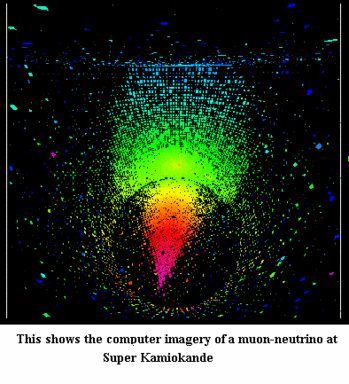
computer image.GIFFor the first time, we had detected neutrinos emanating from outside our galaxy, and proved that the theory of a supernova is right: when stars collapse they throw off their energy as neutrinos, up to 1059 – that’s one followed by 59 zeroes – a hundred billion trillion trillion trillion trillion of them.

Most had spread around the cosmos; only a few passing through the detectors on Earth. Even so, by detecting this momentary blast of neutrinos, we had our first look into the workings of a supernova. This confirmed everything that had previously been just theory: a supernova is the result of a star collapsing to form a neutron star.

Neutrinos on Ice

With the singular exception of supernova, neutrinos from stars in our galaxy and beyond are probably as faint compared to solar neutrinos as is starlight to daylight. To have any chance of capturing them requires detectors containing over a cubic kilometre of matter.

The ingenious solution is Ice Cube, an experiment just beginning at the South Pole, which uses the ice in the Antarctic as a natural detector of the vast numbers of neutrinos that fill the void

Ice in the Antarctic is not like ice that we are used to on a cold winter’s day at home. In the Antarctic, snow has fallen on ice for much longer than recorded-history. Deep down, the pressure is so great that all the air bubbles have been squeezed out, leaving ice so pure that light flashes, produced by neutrinos, can travel hundreds of metres.

Photomultiplier tubes – devices for recording the tell-tale flashes of light – have been lowered into the ice, down shafts that are made by a special drill that sprays out hot water and melts a hole. The detector is attached to a long cable, lowered into the ice, which then freezes it into place. From then on it records data continuously. The set-up is so sensitive that it regularly records neutrinos produced by cosmic rays hitting the atmosphere from all around the globe; some come from directly above the Antarctic, while others have travelled all the way through the Earth, from the North Pole.

Ice Cube will look further into space and into areas – such as the galactic core of the Milky Way – that we’ve never been able to see before. It is possible that neutrinos will interact with the background radiation from the big bang. There may be surprises, even more sensational than anything that has happened so far.

To learn more on this thrilling subject why not come to one of Frank Close’s talks, or read his book Neutrino. Details can be found on his website

*Definition: The neutrino is a sub atomic particle which holds no electrical charge, travels at nearly the speed of light, and passes through ordinary matter nearly unharmed. Neutrinos are emitted in huge numbers by stars like the sun.