The War on Cancer…Phobia

untitled.bmpDavid Ropeik is an international consultant in risk perception and risk communication, and an Instructor in the Environmental Management Program at the Harvard University Extension School. He is the author of How Risky Is It, Really? Why Our Fears Don’t Always Match the Facts and principal co-author of RISK A Practical Guide for Deciding What’s Really Safe and What’s Really Dangerous in the World Around You. He writes the blog Risk; Reason and Reality at Big Think.com and also writes for Huffington Post,  Psychology Today,  and Scientific American.

He founded the program “Improving Media Coverage of Risk,” was an award-winning journalist in Boston for 22 years and a Knight Science Journalism Fellow at MIT.

If you were to be diagnosed with cancer, how do you think you would feel? It would depend on the type of cancer of course, but there’s a good chance that no matter the details, the word ‘cancer’ would make the diagnosis much more frightening. Frightening enough, in fact, to do you as much harm, or more, than the disease itself.  There is no question that in many cases, we are Cancer Phobic, more afraid of the disease than the medical evidence says we need to be, and that fear alone can be bad for our health. As much as we need to understand cancer itself, we need to recognize and understand this risk, the risk of Cancer Phobia, in order to avoid all of what this awful disease can do to us.

In a recent report to the U.S. National Institutes of Health (NIH), a panel of leading experts on prostate cancer, the second most common cancer in men (after skin), said;

“Although most prostate cancers are slow growing and unlikely to spread, most men receive immediate treatment with surgery or radiation. These therapeutic strategies are associated with short- and long-term complications including impotence and urinary incontinence.”

“Approximately 10 percent of men who are eligible for observational strategies (keep an eye on it but no immediate need for surgery or radiation) choose this approach.”

“Early results demonstrate disease-free and survival rates that compare favorably (between observation and) curative therapy.”

“Because of the very favorable prognosis of low-risk prostate cancer, strong consideration should be given to removing the anxiety-provoking term ‘cancer’ for this condition.”

Let me sum that up. Many prostate cancers grow so slowly they don’t need to be treated right away…the unnecessary treatment causes significant harm…and one of the reasons nine men out of ten men diagnosed with slow-growing prostate cancer accept, indeed choose these unnecessary harms, is because “cancer” sounds scary.

Consider more evidence for Cancer Phobia. In “Overdiagnosis in Cancer”  doctors at Dartmouth classified “25% of mammographically detected breast cancers, 50% of chest x-ray and/or sputum-detected lung cancers, and 60% of prostate-specific antigen–detected prostate cancers”, as ‘overdiagnosed’, which they defined as “1. The cancer never progresses (or, in fact, regresses) or 2. The cancer progresses slowly enough that the patient dies of other causes before the cancer becomes symptomatic.” The doctors described the negative health effects such patients suffer from a range of treatments that often involve radical surgery and noted; “Although such patients cannot benefit from unnecessary treatment, they can be harmed.”

Add to those harms the damage from stress caused by the diagnosis of cancer, or even the fear of getting it. Chronic stress raises blood pressure and contributes to heart disease. Even more directly as regards cancer, chronic stress weakens the immune system, the very system our bodies need to help prevent, fight, or recover from, the disease itself. and beyond these harms to individual patients, consider the cost of Cancer Phobia at the societal level.

The basic biological mechanics of what causes both cancer and heart disease are still inadequately understood and need fundamental research. But the U.S. National Institutes of Health spend about four times as much on cancer research as on heart disease research, despite the fact that heart disease kills about 10% more people (60,000 each year, 25 per day), than cancer. We are spending far more on the second leading cause of death than we are trying to figure out what is much more likely to kill us.

Despite all the progress we’ve made on cancer, a recent Harris poll found that cancer is the most feared disease in the U.S., 41% to Alzheimer’s 31%. (Only 8% of American are most afraid of the leading cause of death in the U.S., heart disease). In August 2011, Cancer Research UK found 35% of Britons feared cancer most, followed by Alzheimer’s at 25%.And this fear is hardly new. 40 years ago the U.S. National Cancer Act of 1971, which declared “War on Cancer” said “…cancer is the disease which is the major health concern of Americans today.”

Cancer Phobia goes even further back. The term itself was coined in an article by Dr. George Crile, Jr., in Life Magazine, in 1955, “Fear of Cancer and unnecessary operations”. His insights describe conditions  today as accurately as they did then; “Those responsible for telling the public about cancer have chosen the weapon of fear, believing that only through fear can the public be educated. Newspapers and magazines have magnified and spread this fear, knowing that the public is always interested in the melodramatic and the frightening. This has fostered a disease, fear of cancer, a contagious disease that spreads from mouth to ear. It is possible that today, in terms of the total number of people affected, fear of cancer is causing more suffering than cancer itself. This fear leads both doctors and patients to do unreasonable and therefore dangerous things.”

Unfortunately, Dr. Crile Jr. overlooked the key truth about our fear of cancer; Cancer Phobia is hardly just the product of zealous health and environmental advocates magnified by media alarmism. It comes from the innate way we perceive all risks, a process that relies not only the statistical and medical facts, but on how those facts feel. Risk perception is a blend of conscious reasoning and subconscious instinct, and neuroscience suggests that between the two, instincts and emotions have the upper hand. While we’ve been busy studying cancer, we have also learned a lot about the specific psychological characteristics of cancer that make it particularly frightening.

The more pain and suffering a risk involves, like cancer, the scarier it is.

The less control over a risk we feel we have, the scarier it is. Despite great medical progress, cancer is still something that too often can’t be controlled. It is still widely assumed that a diagnosis of cancer is a death sentence.

The more a risk feels imposed on us, rather than the result of something we did by choice, the scarier it is. Many people continue to believe that a majority of cancers are ‘done to us’ by outside forces, despite the medical evidence that environmental cancers (beyond those caused by our lifestyle choices of diet and exercise) make up perhaps 10-15% of all cases.

The greater our ‘mental availability’ about a risk – how readily the risk comes to mind – the scarier it is. Cancer is constantly in the news. And the very mention of the word ‘cancer’ is instantly overwhelmingly negative, a psychological effect called Stigmatization that makes it difficult for us to think about things objectively.

“Cancer” is no longer the automatic death sentence it was once feared to be. From 1990 to 2010 the overall death rate from cancer in the U.S.has dropped 22% in men and 14% in women.  (Incidence in the U.S.has stayed about the same.) In the U.K., the male mortality rate has dropped 26% and the female rate has declined 16% since 1980, (even while the incidence rate in the UK have increased 22%).

We have learned an immense amount about cancer, allowing us to treat, or even prevent, some types that used to be fatal. But we have also learned a great deal about the psychology of risk perception and why our fears often don’t match the evidence. We are failing to use that knowledge to protect ourselves from the significant, tangible health risks of our innately subjective risk perception system. The proposal of the NIH panel to replace the “C” word with something else that is medically honest but emotionally less frightening, is a tiny first step in the right direction, to open a new front in the War on Cancer, the battle against Cancer Phobia.

Welcome to Soapbox Science

We’re almost finished introducing you to each of the blogs in the new look nature.com blogs network. We’ve already heard about the blogs run by journal and portal editors such as the News blog, the Spoonful of Medicine, the Sceptical Chymist,  StepwiseNaturejobsTrade Secrets IndigenusHouse of Wisdom,Methagora and Free Association. We’ve also heard about some of the blogs run by the nature.com Communities team; London and NYC. Now we introduce the Soapbox Science guest blog….

Take a stand on the soapbox!

Welcome to Soapbox Science, the nature.com guest blog hosted by the nature.com Communities team.

We aim to publish some of the most thought-provoking, informative science-inspired posts in the blogosphere. Soapbox Science posts could be controversial, opinionated, speculative or just to inform and may be written by any scientist, science communicator, author or science project coordinator with something to say. Contributors might already have a blog elsewhere and want to share their latest project here or maybe they don’t blog and just want to step onto the soapbox to let us know what’s on their mind.

Since Soapbox Science‘s inauguration in September 2010, the topics discussed on the blog have included new tools and techniquesthe history of sciencephilosophy, psychology or ethics, details of expeditionsoutreach activitiesscience organsiations and the subjects presented in popular science books. Don’t hesiate to get in touch if you have something to say about any of these areas.

Instant replay

In our archives you will already find diverse contributions from authors located around the world. Some of our more popular posts in 2011 are reviewed below:

It just doesn’t feel right – What determines our morality? and how consistent are our ethical judgments? In this provocative post, Simon Laham suggests that our sense of right and wrong may not be built on as solid foundations as we might like to think:

“When prodded, people’s moral foundations tend to wobble a little bit. Although many of us like to think that our moralities are firmly grounded in principles – thou shalt not kill, love thy neighbour as thyself – and that moral judgments spring from the logical application of such principles, it just so happens that many of our moral judgments aren’t driven by the rational, deliberative contemplation of moral rules at all. Rather they are driven by intuitions.”

Risk perception – Why are we so bad at determining the risk involved in certain situations? David Ropeik (who was also a panelist at the inaugural Science Online NYC event) explains the problem:

“…no matter how right our perceptions feel, we get risk wrong. We worry about some things more than the evidence warrants (vaccines, nuclear radiation, genetically modified food), and less about some threats than the evidence warns (climate change, obesity, using our mobiles when we drive). That produces what I have labeled The Perception Gap, the gap between our fears and the facts, which is a huge risk in and of itself.”

Science owes much to both Christianity and the Middle Ages – Author James Hannam explores the relationship between science and religion:

“Few topics are as open to misunderstanding as the relationship between faith and reason. The ongoing clash of creationism with evolution obscures the fact that Christianity has actually had a far more positive role to play in the history of science than commonly believed.”

Fractals: How nature just keeps on giving Jovan Nedic shares his passion for explaining interesting geometries with some pretty pictures and some interesting examples:

“River networks, clouds, coral reefs, leaves, lightning bolts, birds wings, broccoli, and the cardiovascular system are just a few examples that illustrate the abundance of this fractal pattern in nature. So there must be a reason as to why this is a naturally occurring phenomena and more importantly, could we exploit this in some way?”

Talk back

If you’ve enjoyed these, we’ve got more great posts lined up for 2012 and invite you to join the conversations. If you’d like to contribute a guest post, make a topic suggestion, or nominate someone, please get in touch.

**The views expressed in each blog post belong to the author and are not necessarily shared by Nature Publishing Group.

The public’s appetite for astronomy

Paul Crowther is a professor of astrophysics in the Department of Physics & Astronomy at The University of Sheffield. His main research area involves observations of hot, luminous stars in nearby galaxies using space- and ground- based telescopes (including Hubble Space Telescope and the Very Large Telescope) and he has co-authored a monograph on this subject. Paul has an interest in UK science policy and has maintained a website charting the highs and lows of the Science & Technology Facilities Council funding agency since its inception four years ago. He also tweets.

https://www.nature.com/news/neutrino-experiment-replicates-faster-than-light-finding-1.9393

Neutrino experiment

Has anyone else noticed that the mainstream media have gone slightly science gaga? Last week, Higgs-teria attracted front pages in broadsheets and lead stories in news bulletins, even though no more than “tantalizing hints” of the Higgs were announced. Before that, we had plenty of stories salivating over Kepler 22b, a.k.a. Earth 2.0, even though most exoplanet hunters were rather more cautious in their interpretation.  Indeed, the Kepler team themselves only claimed Kepler 22b was a “milestone on the road to finding Earth’s twin.” Only yesterday the first genuinely Earth-sized planets were reported, although they wouldn’t resemble our planet in any other respect, given their close proximity to their host star. And not to mention the shenanigans with those pesky Italian faster-than-light neutrinos that spurred nuclear physicist, Jim Al-Khalili, into promising to eat his boxer shorts on live TV should the result be confirmed.

As a jobbing astronomer, I can’t deny that I’m all for the latest physics results getting publicity. Of course, as with all other branches of science, such results are merely the tip of the iceberg, with dozens of astrophysics papers posted on free-access archives daily. Still, there is an inherent risk of adverse reactions too. Cynical presenters may criticize the fanfare about the latest exoplanet discovery as useless because of its great distance. Hadn’t we got along just fine without the Higgs boson? Couldn’t and shouldn’t the costs devoted to the Large Hadron Collider have been better spent? In our new era of austerity, fundamental scientists need to be mindful of the “so what?” or “why bother?” mentality. Technologies and tools required to do big science may sometimes make a (really) big splash in the real world, even though practical applications aren’t intended at the outset. Surely though the biggest benefit of the media’s reports about the Universe is the power to inspire, attracting pupils into science and technology.

The pulling power of astronomy – the second oldest profession – is unique in it’s extraordinary breadth of scale. Astronomical eye candy can serve a useful purpose, although media reports regularly fail to focus upon the science behind the pretty pictures. On the same day as the fanfare over Kepler 22b’s discovery, the biggest black holes and the fastest spinning star were announced, each with their own ‘artists impressions’. I too have stumbled upon such objects, having identified the ‘most massive star’ and ‘biggest stellar mass black hole’ known to date. Stumbled was the right verb in my own case, since these record breakers involved more than a dash of fortune, not having explicitly set out to find the most extreme example of their peers. Serendipity and science combine surprisingly often.

https://www.nature.com/news/record-breaking-black-holes-fill-a-cosmic-gap-1.9553

Record breaking black holes fill a cosmic gap. Credit: P.Marenfeld/NOAO/AURA/NSF

In common with most university-based scientists, most of my work involves teaching students, supervising graduate students and carrying out research. In my case I study the biggest, baddest stars of all. The public appetite for astronomy, though, also adds to my diary through Café Scientifique-type talks to the public, at local primary and secondary schools, or amateur societies. Occasionally, more unusual requests come my way. Earlier this month, I hosted a film crew from NHK (Japanese TV) who interviewed me about minute details of the most massive star known for a programme about the satellite galaxies of our own Galaxy. Last week, I was asked to watch and discuss the science (or lack of it) behind ‘Another Earth’ for a local culture listings magazine.

Beyond the mainstream broadcast and print media, there are many initiatives actively involving the general public in science. Galaxy Zoo has been particularly successful in `citizen science’ for astronomy, and social networking sites such as Twitter do help to make connections between scientists and the public. There’s an increasing archive of wonderful short films explaining complex subjects in an incredibly accessible way, such as minutephysics. Google and YouTube are funding new science ‘channels’.  Deep Sky Videos is one such initiative in which film make Brady Haran is ambitiously attempting to produce short videos on all 109 Messier objects, starting from next month.

 Despite the adverse risks, it’s reassuring that the media interest in fundamental physics and astrophysics remains strong. Curiosity-driven basic research can capture the public attention, perhaps especially so in the midst of the current gloomy economic crisis. For the moment, then, the future looks bright for physics and astronomy, even though UK funding for this branch of science has taken a sharp downturn turn over the past few years. Let’s hope too that – if, and when, they are eventually found – the Higgs and genuine Earth–like planets make a big splash in the media, and continue to inspire future generations of scientists.

So far, the jury remains undecided on the fate of those boxer shorts.


The rise of anomalistic psychology – and the fall of parapsychology?

Professor Chris French is the Head of the  Anomalistic Psychology Research Unit  in the Psychology Department at Goldsmiths, University of London.  He is also a Fellow of the British Psychological Society and of the Committee for Skeptical Inquiry and a member of the Scientific Advisory Board of the British False Memory Society.  His main current area of research is the psychology of paranormal beliefs and anomalous experiences. He frequently appears in the media casting a skeptical eye over paranormal claims. He edited The Skeptic magazine for more than a decade and sometimes writes for the Guardian’s online science pages. 

Ever since records began, people have reported strange experiences that appear to contradict our conventional scientific understanding of the universe. These have included reports that appear to support the possibility of life after death, such as near-death experiences, ghostly encounters and apparent communication with the dead, as well as claims by various individuals that they possessed mysterious powers such as the ability to read minds, see into the future, obtain information from remote locations without the use of the known sensory channels, or to move objects by willpower alone.  Such accounts are accepted as veridical by most of the world’s population in one form or another and claims relating to miraculous healing, alien abduction, astrological prediction and the power of crystals are also accepted by many.  Belief in such paranormal claims is clearly an important aspect of the human condition. What are we to make of such accounts from a scientific perspective?

Should we accept at least some of these claims more or less at face value? That is to say, should we accept that extrasensory perception (ESP), psychokinesis (PK), and life after death are all real? Parapsychologists have systematically investigated such phenomena for around 130 years but have so far failed to convince the wider scientific community that this is the case. The eminent scientists and intellectuals who founded the Society for Psychical Research in 1882 were convinced that, with the tools of science at their disposal, they would settle the issue one way or another within a few years. Clearly, that has not happened. Instead, parapsychology has been characterised by a series of ‘false dawns’ during which it has been declared that at last a technique has been developed which can reliably show under well-controlled conditions that paranormal effects are real. With time, however, the technique falls out of favour as subsequent research fails to replicate the initially reported effects and methodological shortcomings become apparent.

The latest candidate for such a ‘false dawn’ is a series of relatively straightforward experiments reported by Daryl Bem in the prestigious Journal of Personality and Social Psychology.  In eight of nine experiments, involving more than a thousand participants in total, Bem reported significant results suggesting that human beings are able in some way to sense events before they happen. For example, the study which produced the largest effect size appeared to show that participants are able to recall more words if they rehearse them than if they do not – even if the rehearsal does not take place until after recall has been tested! As so often happens, these controversial findings received widespread coverage in the mainstream science media. However, subsequent attempts at replication have failed, including a study involving three independent replication attempts carried by Richard Wiseman  (University of Hertfordshire), Stuart Ritchie (University of Edinburgh), and myself (Goldsmiths, University of London).

If paranormal forces really do not exist, how are we to explain the widespread belief in them and the sizeable minority of the population who claim to have had direct personal experience of paranormal phenomena? One possible answer is that there are certain events and experiences which may appear to involve paranormal phenomena but which can in fact be fully explained in non-paranormal, usually psychological, terms. This is the approach adopted by anomalistic psychologists. In general, anomalistic psychologists attempt to explain such phenomena in terms of known psychological effects such as hallucinations, false memories, the unreliability of eyewitness testimony, placebo effects, suggestibility, reasoning biases and so on. It is noteworthy that anomalistic psychologists have, in just a few decades, produced many examples of replicable effects that adequately explain a range of ostensibly paranormal phenomena.

Anomalistic psychology is definitely on the rise. Not only is it now offered as an option on many psychology degree programmes, it is also an option on the most popular A2 psychology syllabus in the UK.  Every year more books and papers in high quality journals are published in this area and more conferences and symposia relating to topics within anomalistic psychology are held. There is no doubt that anomalistic psychology is flourishing.

And what of parapsychology? The health of this discipline is somewhat harder to assess but apart from the occasional ray of hope offered by the latest false dawn, the situation does not look encouraging for parapsychologists. Funding for such research is inevitably more difficult to obtain in times of economic uncertainty. Scarce research funding will be invested in areas where the probability of success is high – and the history of parapsychology shows all too clearly that studies in this area often involve huge investments of time and resources and produce nothing in return. Without a genuine breakthrough in the near future, can parapsychology survive for much longer? Without psychic powers, it’s difficult to know but I certainly would not bet on it.

The periodic table: matter matters

Cross-posted with permission of OUPblog.

eric.bmp

Eric Scerri is a chemist and philosopher of science, author and speaker. He is a lecturer in chemistry, as well as history and philosophy of science, at UCLA in Los Angeles. He is the author of several books including The Periodic Table, Its Story and Its Significance, Collected Papers on the Philosophy of Chemistry and Selected Papers on the Periodic Table. His latest book, The Periodic Table: A Very Short Introduction, is published this week.

As far back as I can remember, I have always liked sorting and classifying things. As a boy I was an avid stamp collector. I would sort my stamps into countries, particular sets, then arrange them in order of increasing monetary value shown on the face of the stamp. I would go to great lengths to select the best possible copy of any stamp that I had several versions of. It’s not altogether surprising that I have therefore ended up doing research and writing books on what is perhaps the finest example of a scientific system of classification – the periodic table of the elements. Following degrees in chemistry I wrote a PhD thesis in the history and philosophy of science and specialised in the question of whether chemistry has been explained by quantum mechanics. A large part of this work dealt with the periodic table, the explanation of which is considered as one of the major triumphs of quantum theory, and the notion of atomic orbitals.

As I often mention in public lectures, it is curious that the great 20th century physicist, Ernest Rutherford, looked down on chemistry and compared it to stamp collecting. But we chemists had the last laugh since Rutherford was awarded the Nobel Prize for chemistry and not for his beloved field of physics.

periodictable.jpg

In 2007 I published a book called The Periodic Table, Its Story and Its Significance, which people tell me has become the definitive book on the subject. More recently I was asked to write a Very Short Introduction to the subject, which I have now completed. Although I first thought this would be a relatively easy matter it turned out not to be. I had to rethink almost everything contained in the earlier book, respond to comments from reviewers and had to deal with some new areas which I had not developed fully enough in the earlier book. One of these areas is the exploration of elements beyond uranium or element number 92, all of which are of a synthetic nature.

At the same time, there has been a veritable explosion of interest in the elements and the periodic table especially in the popular imagination. There have been i-Pad applications, YouTube videos, two highly successful popular books, people singing Tom Leher’s element song in various settings as well as artists and advertisers helping themselves to the elegance and beauty of the periodic table. On the scientific side, elements continue to be discovered or more precisely synthesised and there are official deliberations concerning how the recently discovered elements should be named.

table.jpg

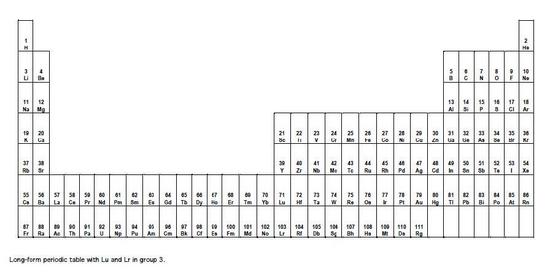
On November 4th The International Union for Pure and Applied Physics (IUPAP) officially announced that elements 110, 111 and 112 are to be known officially as darmstadtium (Ds), roentgenium (Rg) and copernicium (Cn). The names come from the German city of Darmstadt where several new elements have been artificially created; Wilhelm Konrad Roentgenm, the discoverer of X-rays; and the astronomer Nicholas Copernicus who was one of the first to propose the heliocentric model of the solar system. Of the three names it is the last one that has caused the most controversy. Apart from honouring a great scientist it was chosen because the structure of the atom broadly speaking resembles that of a miniature solar system in which the nucleus plays the role of the sun and the electrons behave as the planets do, an idea that originated with the work of Rutherford incidentally. Except that electrons don’t quite orbit the nucleus. One of the major discoveries to emerge from the application of quantum mechanics to the study of the atom has been the realisation that electrons do not follow planetary-like orbits around the nucleus. The electrons behave as much as diffuse waves as they do as particles, and as such they exist everywhere at once within so-called orbitals. The change in wording from ‘orbit’ to ‘orbital’ is a little unfortunate since it does not begin to convey the enormous conceptual change from Rutherford’s solar system model to the quantum model.

Another controversial aspect of all the synthetic elements, that lie beyond the old boundaries of the periodic table, or elements 1 to 92, is that they are radioactive and mostly very short lived which leads most people to think that making them is an enormous waste of time and resources. But such a view is a little short sighted. Some of these elements have found important applications. Take element 95 or americium for example. It has managed to find its way into every modern household as a vital component of smoke detectors.

Or consider the element technetium, which has a far lower atomic number of 43 but which was first discovered in Palermo, Sicily in 1937 after being artificially created in a cyclotron machine in Berkeley, California. Over the subsequent years technetium has found its way into every major hospital in the world and is used in a plethora of medical scanning procedures as well as for treating various medical conditions. It was later found that technetium occurs naturally on earth but in absolutely minute amounts. This happens because technetium is a bi-product of the natural decay of uranium and also because it is a bi-product in the operation of nuclear reactors. The second of these sources provides macroscopic amounts of technetium, which allow scientists to study the chemistry of the element in great detail and to make many new and medically useful compounds. There have been entire conferences devoted to the chemistry and uses of technetium.

Nobody has yet found the means of producing macroscopic amounts of the most recently named elements, and they probably won’t, but their formation provides chemists and physicists with an excellent opportunity to refine theories on nuclei and atoms and new techniques with which to experiment upon them. Almost of matter is made of the elements and that’s why the elements really matter to us, even the more exotic ones.