The top 20: a year of reading immersively


George Peabody Library, Baltimore, Maryland.

George Peabody Library, Baltimore, Maryland.{credit}Matthew Petroff{/credit}

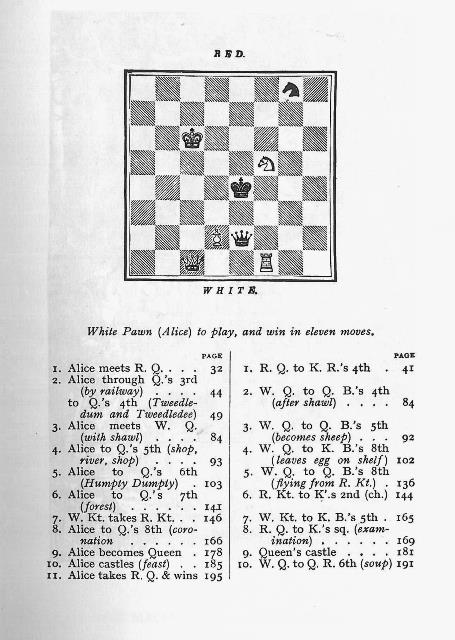
It has been quite a year. We found ourselves saturated with light and knee-deep in soil — even diving down the rabbit hole with Alice to explore Lewis Carroll’s legacy for logic. There were discoveries (the pockmarked beauty of Pluto) and rediscoveries (the taxonomic reinstatement of Brontosaurus).

Meanwhile, in my parallel biblio-Universe, hundreds of science, social-science and science-history books hove into view. As I read, relished, reviewed and commissioned, I too made discoveries. Fascinating patterns emerged — ripples from shifts in science, society, culture. Robots held pole position, as authors grappled with the deep implications of twenty-first-century mechanisation and AI. There was a burst of books on the soup-to-nuts story of the cosmos, and an astonishing irruption of butterfly studies. Bedbugs had a moment (in Richard Jones’s House Guests, House Pests, reviewed here, and Brooke Borel’s Infested), as did pigs (in offerings such as Barry Estabrook’s Pig Tales, reviewed here).

As always, pulling ‘the best’ out of this flood has been tough. The 20 that stood out for me have an original grain — not going with the flow but creating whorls of their own. Several are biographies themselves representing a life’s work for their authors. Death, rainforests, seashells, Alexander Humboldt and DNA get a look-in. In no particular order, here goes.

The Invention of Nature: Alexander Humboldt’s New World, Andrea Wulf. Knopf. The accomplished historian delivers an inspired biography of the German polymath, explorer, prescient proto-environmentalist and discoverer of climate zones. (Reviewed here.)

Life’s Greatest Secret: The Race to Crack the Genetic Code, Matthew Cobb. Profile. A zoologist reframes the double-helix story, interweaving findings across physics, chemistry and biology with the lives of the luminaries involved. (Reviewed here.)

On the Edge: The State and Fate of the World’s Tropical Rainforests, Claude Martin. Greystone. The seasoned conservationist traces decades of rainforest losses to map future strategies for sustainable management in a key report to the Club of Rome. (Reviewed here.)

Our Kids: The American Dream in Crisis, Robert D. Putnam. Simon and Schuster. The astute political scientist and author of Bowling Alone (2000) exposes the insidious erosion of US social mobility that is disenfranchising a generation. (Reviewed here.)

Spirals in Time: The Secret Life and Curious Afterlife of Seashells, Helen Scales. Bloomsbury Sigma. A marine biologist tours the exquisite morphology and multidimensional functionality of that architectural marvel, a mollusc’s shell. (Reviewed here.)

Pure Intelligence: The Life of William Hyde Wollaston, Melvyn C. Usselman. University of Chicago Press. A meticulous, engrossing biography of the Enlightenment polymath — discoverer of cystine and palladium — by the late chemist. (Reviewed here.)

Weatherland: Writers and Artists Under English Skies, Alexandra Harris. Thames & Hudson. A cultural historian traces the weather fronts moving through English literature and art, from Shakespeare’s storms to Turner’s meteorological sublime. (Reviewed here.)

Birth of a Theorem: A Mathematical Adventure, Cédric Villani. Bodley Head/Faber and Faber. The flamboyant French recipient of the 2010 Fields Medal parts the curtains on the “strange alternate universe” of a mathematician’s life. (Reviewed here.)

The Black Mirror: Looking at Life Through Death, Raymond Tallis. Yale University Press. The former geriatric specialist uses his future corpse as the philosophical focus for a layered journey through his sensory and emotional life. (Reviewed here.)

Alfred Wegener: Science, Exploration, and the Theory of Continental Drift, Mott T. Greene. Johns Hopkins University Press. The science historian brilliantly biographises the physicist, meteorologist and explorer who discovered the precursor to plate tectonics. (Reviewed here.)

Concrete Revolution: Large Dams, Cold War Geopolitics, and the US Bureau of Reclamation, Christopher Sneddon. University of Chicago Press. A geographer surveys the US hegemony in twentieth-century dam engineering that has spawned a mixed global legacy. (Reviewed here.)

The Brain: The Story of You, David Eagleman. Pantheon. The virtuosic neuroscientist skips into the skull for a cutting-edge tour of how meat can generate self. (Reviewed here.)

The Reproach of Hunger: Food, Justice and Money in the 21st Century, David Rieff. Verso. The veteran development observer reveals how philanthrocapitalists and aid agencies are failing to crack the deep political problem of poverty and hunger. (Reviewed here.)

The Invention of Science: A New History of the Scientific Revolution, David Wootton. Allen Lane. A robust, expertly synthesised revisionist retelling of the scientific revolution by a commanding historical mind. (Reviewed here.)

Applied Minds: How Engineers Think, Guru Madhavan. W.W. Norton. A bioengineer lifts the lid on the rigorous, solution-oriented, constraints-savvy mindset of the made world’s hidden heroes. (Reviewed here.)

Why Are We Waiting?: The Logic, Urgency, and Promise of Tackling Climate Change, Nicholas Stern. MIT Press. The towering economist examines the hellish complexities of climate change and the potential of future innovation to tackle them. (Reviewed here.)

The Vital Question: Why Is Life the Way It Is?, Nick Lane. Profile. The evolutionary biochemist analyses the “improbable” moment, 1.5 billion years ago, when an endosymbiosis event created the cellular forebear of complex life. (Reviewed here.)

Plant Behaviour and Intelligence, Anthony Trewavas. Oxford University Press. The plant physiologist draws on 50 years of research for a rollicking exploration of botanic behaviours. (Reviewed here.)

Sharing Cities: A Case for Truly Smart and Sustainable Cities, Duncan McLaren and Julian Agyeman. MIT Press. Two urban sustainability thinkers propose a paradigm for collaboration and inclusivity in cities that far outpaces the commercial sharing-economy model. (Reviewed here.)

Scientific Babel: The Language of Science from the Fall of Latin to the Rise of English, Michael Gordin. Profile/University of Chicago Press. A linguist and historian deftly analyses the irresistible rise of English as the scientific lingua franca. (Reviewed here.)


For Nature’s full coverage of science in culture, visit www.nature.com/news/booksandarts.

Five books for the COP negotiator

city-cars-traffic-eiffel-tower 3George Orwell, author of dystopian classics Nineteen Eighty-Four and Animal Farm, was a political animal par excellence. He understood how the language of politics could give “an appearance of solidity to pure wind”, as he put it in his 1946 essay Politics and the English Language. Those words should blast right through the miasmas forming over Paris as COP21 enters its second week.

Happily, 65 years after Orwell’s death, there is no shortage of miasma-busters out there, and I’ve assembled five books to prove it. But first, a closer look at the fog itself.

After decades of COP-watching, I remain as astonished by the halting nature of progress as I am by the number of spanners in their works. National politics and regional-bloc agendas are only some of the impedimenta. There are now, increasingly, external pressures such as corporate lobbying and well-meaning but often disruptive parallel actions by billionaire philanthropists. The whole looks, and often is, a hopelessly unwieldy form of decision-by-committee.

More, the COPs have accreted a culture that, like many variants of the UN model, might leave an ethnographer bemused. There are, for instance, the agreement rollouts that are vague, stretch decades into the future, or both. Climate policy analyst Oliver Geden has called the tendency “kicking the can down the road” — the “modus operandi of UN climate policy”. That pattern also popped up in Indian prime minister Narendra Modi’s announcement last week of a solar alliance involving 120 countries, including France.  India’s big date is 2030, by which time it plans to draw 40% of its energy needs from renewables — even as it formulates equally ambitious plans for its coal. France, meanwhile, currently gets 75% of its energy from nuclear, and that is only due to be reduced by 2025. Ambitious transitions, or a prime example of Orwellian doublethink (and can-kicking)?

French climate-change ambassador Laurence Tubiana, however, dubbed the solar alliance “a true game-changer”. That brings me to another staple of COP culture: hyperbole, deployed to give a sense of dynamism to the often seemingly imperceptible advance of climate decision-making. Yet a clear critique of proposed solutions is as important as sticking to the science on climate change: the facts are alarming enough.

Despite all, solutions need to emerge from the psychological push and pull of the negotiating room. On to the books that in my view could move mountains, or indeed miasmas.

Guru Madhavan’s Applied Minds: How Engineers Think (W.W. Norton, 2015) is by and about the pragmatic tribe who craft the made world (reviewed here). If it seems whimsical to imagine an engineer’s experience might translate to the delicate calibrations and manoeuvrings of negotiation, read on. Their mindset, as Madhavan shows, is focused totally on solutions. Trained in ‘modular systems thinking’, engineers handle complexity by considering the components, the interdependencies and the totality of problems. Engineers are, moreover, deft operators under constraints such as time, finance, physics and human behaviour. Finally, they have a nuanced grasp of tradeoffs and can weed out weak from strong goals. To me, pragmatic, time-sensitive grappling with multidimensional problems doesn’t seem alien in the context of the COPs, which are, after all, attempts to construct a framework. And in a broader sense, systems-thinking seems key to achieving sustainability in an inherited cascade of environmental problems.

History, by deepening our understanding of how today’s looming issues have evolved, can give some insight into solutions. Janet Biehl’s Ecology or Catastrophe: The Life of Murray Bookchin (Oxford University Press, 2015), reviewed here, reminds how 50 years ago, important thinking on climate change was already very much out there. Bookchin, an independent radical ecologist, revealed a rare grasp of the global scale of environmental problems in books such as the 1965 Crisis in Our Cities, in which he wrote: “Theoretically, after several centuries of fossil-fuel combustion, the increased heat of the atmosphere could even melt the polar ice caps”. Bookchin’s solutions to the crisis were as prescient, not least in integrating social with environmental elements. Working from a vision of urban ecotopias, he inspired and championed community-centred, solar-powered, closed-loop food production as early as the 1970s.

David Rieff’s The Reproach of Hunger (Simon and Schuster, 2015), reviewed here, is about the global food crisis, a challenge intimately linked with climate change and like it, human-driven. Rieff, a veteran writer on aid and development issues, spent six years researching this study, and it shows. It is perhaps most acute, and balanced, on why the current melee of international policy bodies, the private sector, “philanthrocapitalists” and technophiles is failing to find viable solutions to hunger. Rieff points to the greater context: a globalised, neoliberal economic system which — as others such as economist Joseph Stiglitz have pointed out — drives the inequities behind global problems, not least the wealth of a tiny minority. I commend this book to my hypothetical negotiator as a salient reminder of the politics infusing global challenges.

In Climate Shock: The Economic Consequences of a Hotter Planet (Princeton University Press, 2015), reviewed here, economists Gernot Wagner and Martin Weitzman deliver a stinging slap to the reluctant or somnolent negotiator. They creatively reframe climate change as a risk management issue — asking why, if there is a 10% chance that climate change will lead to catastrophe, we are not girding ourselves through ‘insurance’, such as pushing industry and policymakers to get on with the transition. They marshall excellent evidence to show that the longer the world waits to act, the likelier it will be that extreme events will happen. A welcome reminder that we must avoid becoming lobsters dawdling at the bottom of a slowly boiling pot.

And finally, a primer on what is at the bottom of all the horror and hoopla — fossil fuels. Two years ago I extolled The Burning Question by Mike Berners-Lee and Duncan Clark (Profile Books, 2013). It is even more relevant now. They lay out the maths, showing that we have “five times as much oil and coal and gas on the books as climate scientists think it is safe to burn”. Yet we are planning to burn it, because fossil-fuel companies treat underground reserves as an existing asset. If the stuff stayed in the ground, they note, it would be goodbye to trillions — but a real commitment to carbon curbing. At a COP partly sponsored by oil interests, my putative negotiator might want to mull over the real costs of a carbon economy.

We refer to the COPs as ‘talks’, and the negotiations themselves do proceed in a soup of arcane UN-speak. Outside those established constraints, the players in this global endeavour need to think deeply about language. It is a shaper of reality. As Orwell noted, the use of a hackneyed phrase “anaesthetizes a portion of one’s brain”. By contrast, lucid and original language and the independent thinking it fosters — as seen in these five exemplary books — are a “necessary first step towards political regeneration” and some dispelling of the murk.


For Nature’s full coverage of science in culture, visit www.nature.com/news/booksandarts.
Suspended animation: Calder’s sculptural revolution

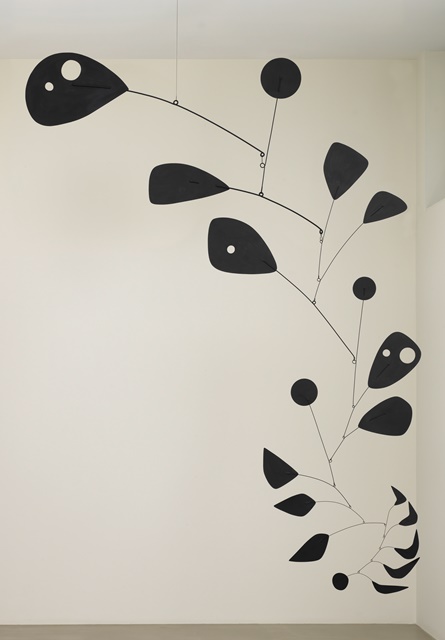
Alexander Calder's mobile Black Widow, c. 1948 (wire and painted metal), Instituto de Arquitetos do Brasil, São Paulo.

Black Widow, ca. 1948 (wire and painted metal), Instituto de Arquitetos do Brasil, São Paulo.{credit}© 2015 Calder Foundation, New York / DACS, London{/credit}

She hangs dark, immense and pocked with holes in a white room, a beast of many parts languidly revolving in the air. Part leaf, part lever, all magisterial grace, Black Widow is a quintessential Calder mobile — one of the signature inventions of the extraordinary twentieth-century artist-engineer.

This tremendous piece, three and a half metres long, is the finale to Alexander Calder: Performing Sculpture at London’s Tate Modern, a show that maps the evolution of Calder’s thought and practice on a route that is itself like the slow turn of a mobile. I spiralled through rooms mesmerised by manifestations of the propulsive, experimental drive of the man. Calder was not just a pioneer of kinetic sculpture and one of the first to use industrial materials other than pigments, such as steel. His early wire sculptures are scribbles in metal, yet miraculously evoke heft through mere line. And his fascination with sound and performance led to probings of chance and uncertainty that influenced avant-garde US composers such as Earle Brown and John Cage.

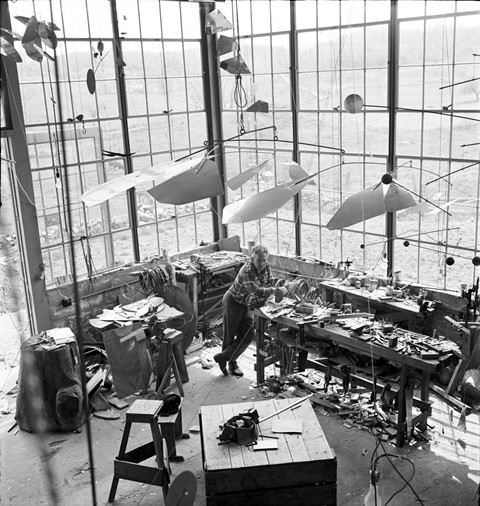
Alexander Calder in his Roxbury studio, 1941.

Alexander Calder in his studio in Roxbury, Connecticut, 1941.
{credit}Calder Foundation, New York / Art Resource, NY© ARS, NY and DACS, London 2014{/credit}

Astrophysics also exerted a singular pull on the artist. Fired by the sight, from shipboard, of a serendipitous equilibrium — a setting Sun and rising Moon on opposite horizons — Calder would declare years later that the “underlying sense of form in my work has been the system of the Universe”, the “idea of detached bodies floating in space, of different sizes and densities”. Calder was to investigate such momentous problems of motion and relationship in mobiles both wind-driven and motorised, such as A Universe (1934), in which two spheres go through different 40-minute cycles. (Einstein reportedly watched them from start to finish while viewing the piece in New York’s Museum of Modern Art.)

As the Tate show makes clear, Calder’s own balancing act — one foot in science, one in art — arose from both chance and deliberation. Born into a family of artists and sculptors, he decided at 17 to study descriptive geometry and applied kinetics at the Stevens Institute of Technology in New Jersey. He then pursued painting at New York’s seminal Art Students League in the early 1920s and, after experimenting with metal sculpture, set off in 1926 for the cultural crucible of Paris.

Here he began to explore the suggestion of movement in the fluidity of works in wire such as Hercules and the Lion (1928). The star of this period, however, is the Cirque Calder, a troupe of miniature acrobats and animals sculpted in wire, wood, cork, fabric and other materials and used for live-action shows that enthralled the likes of Joan Miró and Piet Mondrian. While the ingenious palette of materials may owe something to the Constructivism of Russian-born artist Naum Gabo, the wit and dogged study of the physics of moving objects are Calder’s own. A 45-minute film of him putting his performers through their paces, as fiercely concentrated as a four-year-old with a train set, is a major delight of this show.

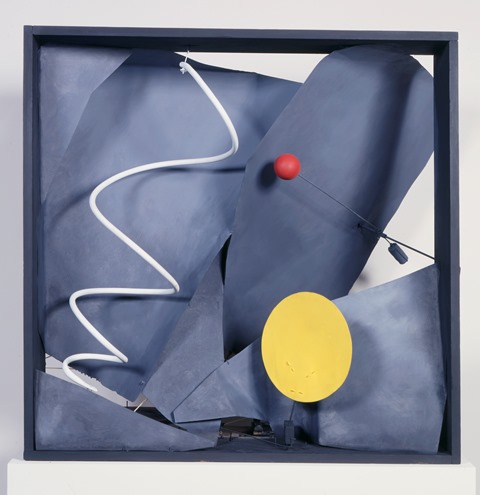
Black Frame, 1934.

Black Frame, 1934: one of Calder’s motorised sculptures. {credit}Calder Foundation, New York © 2015 Calder Foundation, New York / DACS, London{/credit}

And it’s one among many. We can, for instance, trace the gestation of Calder’s mobiles from his visit to Mondrian’s Paris studio in 1930, where he wondered why the Dutch painter didn’t set the cardboard rectangles he used to aid composition oscillating. Mondrian was dubious; Calder felt “like the baby being slapped to make its lungs start working”.

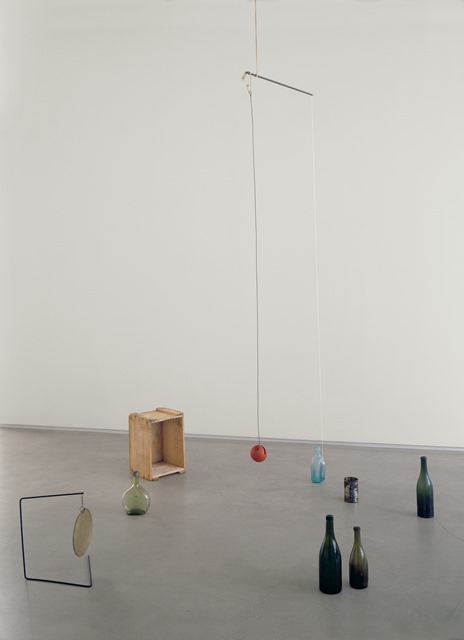
Small Sphere and Heavy Sphere 1932/33 (iron, wood, cord, thread, rod, paint, and impedimenta).

Small Sphere and Heavy Sphere 1932/33 (iron, wood, cord, thread, rod, paint, and impedimenta).{credit}Calder Foundation, Mary Calder Rower Bequest, 2011 © 2015 Calder Foundation, New York / DACS, London{/credit}

He began creating free-standing wire constructions hung with geometric forms in white, black and Mondrian-esque primaries, such as Small Feathers (1931). He played with mechanised motion in works like Black Frame (1934). And, distributing force through precise arrangements of levers and their fulcrums, he created suspended mobiles — suggesting orbiting planets, snowstorms, schools of fish, flotillas of cloud or, as some have noted, animated Mirós. He became an engineer of air, a definer of space.

Around the same time, Calder’s interest in the aural grew. The elements of his sculptures, he noted, were “weight, form, size, colour, motion and then you have noise”. Small Sphere and Heavy Sphere (1932/3) is an open-ended experiment in which two suspended coloured balls are arranged so that one hits a collection of bottles, a box, a can and a gong. Visitors would reorganise these to create randomised ‘compositions’.

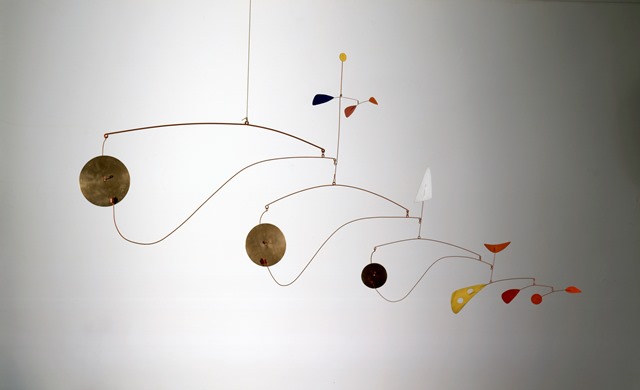
Such investigations of ‘open form’ reached a new pitch in the 1940s. Calder fitted large mobiles such as Triple Gong (1948) with beaters and differently pitched brass gongs to create evocative music as they shifted in air, not unlike exquisitely calibrated windchimes. Later still, he collaborated with Earle Brown on Calder Piece, a “sonic animation” of Calder’s mobile Chef d’Orchestre, which by moving ‘conducts’ a percussion ensemble.

As the show reveals, Calder’s boldness in testing possibilities extended to other materials and contexts. Mercury Fountain, created for the Spanish Pavilion at the 1937 World’s Fair in Paris  is one; there were also theatrical sets, the Water Ballet, an ‘acoustical ceiling’ in Caracas — and more.

Triple Gong, ca. 1948 (brass, sheet metal, wire, paint).

Triple Gong, ca. 1948 (brass, sheet metal, wire, paint).{credit}Calder Foundation, New York © 2015 Calder Foundation, New York / DACS, London{/credit}

Scientifically inspired art of the twentieth century might seem the usual seepage of ideas across disciplinary boundaries. Painters such as the Dadaist Max Ernst and muralist Diego Rivera were deeply influenced by developments in mathematics and particle physics, for instance. Sculptors, however, did not just depict; they embodied. Calder shaped the stuff of physics into a biomorphic aesthetic to rival Barbara Hepworth’s. And like Hepworth and her insistent use of voids in solid form, he found a way to marry the immateriality of air with a significant tonnage of standing and hanging metal.

This reassessment of an artist who created 22,000 works over an unstoppable career was a journey of discovery for me. As a child of thoroughly modernist artists, I early on absorbed (and loved) many of Calder’s works. But I found myself entranced, and educated, all over again — and seething with questions. I’d give a hell of a lot to know, for instance, what was going through Einstein’s mind as he gazed at Calder’s A Universe.

Alexander Calder: Performing Sculpture runs at Tate Modern, London, through 3 April 2016. The quotes from Calder in this piece are from the show’s programme notes.


For Nature’s full coverage of science in culture, visit www.nature.com/news/booksandarts.
On reflection: the art and neuroscience of mirrors

Posted on behalf of Alison Abbott

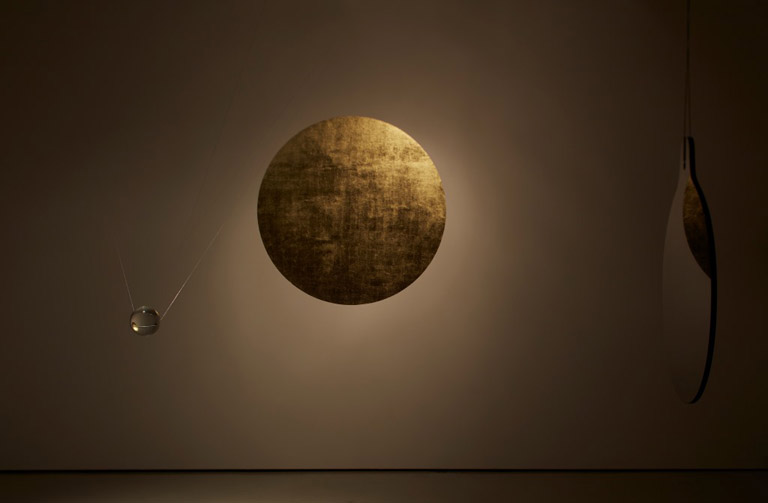
The installation Smoking Mirror by Otavio Schipper and Sergio Krakowski, 2015.

The installation Smoking Mirror by Otavio Schipper and Sergio Krakowski, 2015.{credit}Nick Ash{/credit}

Two linked exhibitions in Berlin – Mirror Images in Art and Medicine and Smoking Mirror – begin where Narcissus left off. The hero of Greek mythology wasted away gazing transfixed at his own beauty reflected on the surface of a dark pool. He left his name both to the narcissus (daffodil) that sprang up on the banks where he died, and to psychology.

The desire to see one’s own reflection more conveniently than kneeling at the waters’ edge on a sunny day  appears universal. Most of the world’s major cultures invented their own types of portable mirror over the millennia. The earliest so far found, in Anatolia, were made from polished obsidian, a naturally occurring volcanic glass, and date back 8,000 years. Later came mirrors made from polished metal, and around the first century AD, metal-coated glass.

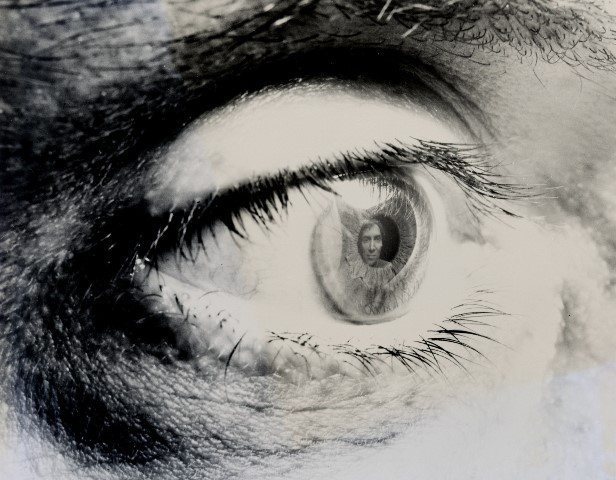
Examples of mirror-based objects – like the extraordinary non-reversing mirror invented by US mathematician Andrew Hicks in 2010 – are on display in Mirror Images at the Museum of Medical History at the Charité. But at its most provoking, the exhibition explores the psychological and neuroscientific power of reflections. It departs from the relatively simplistic notion of narcissism – an unhealthy concern with one’s self – to examine deeper and altogether more fascinating concepts of ‘self’.  How do we perceive the boundary between the outer limits of our body and the environment in which our bodies move? Is our perception of our individual ‘self’ constant or manipulable?

These concepts have both medical and philosophical significance. In the past half-century, artists have been doing their own explorations of what self means, exploiting video technology to capture ‘reflections’ more permanently than mirrors can. Mirror Images shows, as few similar ventures have been able to do, how art and science really do sometimes converge on important questions in a meaningful way.

'Maintenance III (Self Portrait)' by William Anastasi (1967).

‘Maintenance III (Self Portrait)’ by William Anastasi (1967). {credit}© William Anastasi{/credit}

The exhibition showcases several mirror-containing instruments that transformed medicine in the nineteenth and early twentieth centuries. Among them is an exquisite 1851 ophthalmoscope in its original wood, velvet and silk case. Invented by pioneering physicist and physiologist Herrmann von Helmholtz, the instrument was the first to allow light to be shone directly into any part of the body that is sealed from the environment by a membrane, and it gave physicians their first view inside a functioning eye. This was long before photography became common, so physicians had to draw what they saw there. A sample watercolour alongside the ophthalmoscope shows how impressive their artistic skills could be.

The exhibition also showcases the healing potential of reflections. A series of photographs on display, taken of herself in different locations during paralysing panic attacks, helped artist Sabina Grasso to cure her psychological disorder. She says the cure resulted from being able to contemplate from a distance the images of her own captured body.

A version of neuroscientist Vilayanur Ramachandran’s famous mirror box is available for visitors to test its illusory powers on their own bodies. Ramachandran  developed the deceptively simple device in the 1990s to help amputees who feel phantom pain from their missing limb. The pain may occur because the brain responds as if the limb were not missing, but in spasm. The patient places his or her remaining limb in front of a vertical mirror so that its reflection appears as if it could be the missing limb. The brain registers the spasm-free movements and, in some cases, stops sending the painful signals.

'DM/1978 Talks to DM/2010'. In this media project by Dalibo Martinis, the artist answers questions he posed to himself over 30 years before.

‘DM/1978 Talks to DM/2010’. In this media project by Dalibo Martinis, the artist answers questions he posed to himself over 30 years before. {credit}Dalibo Martinis{/credit}

A different, even more startling, type of body illusion is presented by Croatian artist Dalibor Martinis in a video interview between two of his ‘selves’, separated by more than three decades. In 1978, at 31, he video-recorded a series of questions, in English, addressed to his future self. The mature Martinis responds in 2010 in a Croatian television show. He finds his younger self “a bit puffed up”, and comments “if we are at all the same person, it is neither you nor I”.

Across town, a darkened exhibition room at the Schering Foundation hosts the mesmerizing installation Smoking Mirror. It was created by two Brazilian artists: one, Otavio Schipper, has a degree in physics; the other, jazz musician Sergio Krakowski, a PhD in mathematics.

The artwork comprises three reflecting objects suspended from the ceiling, each inspired by the working tools of the astronomer-astrologer mathematician John Dee, advisor to the Tudor Queen Elizabeth I. One is a large obsidian mirror, another a glass sphere filled with water, and the third, a circular, concave surface coated with gold. (The originals are held in the British Museum.) Sound waves emitted from speakers on opposite walls during a 26-minute sound composition by Krakowski cause the objects to turn slowly, shifting their mutual reflections as ever-changing lighting plays on their surfaces.

And the mesmeric sounds? The brain-wave frequencies recorded during different states of consciousness (awake, sleeping, dreaming); frequencies of resonances in the Earth’s atmosphere; spoken sequences of numbers recorded from the mysterious shortwave numbers radio stations in the airways whose purposes may be espionage. The installation keeps just this side of mysticism, but its draw is like that of Narcissus to his pool. The sensory domination does, as intended, channel the minds of visitors, turning thoughts inwards.

 Alison Abbott is Nature’s senior European correspondent.

Mirror Images runs at the Museum of Medical History at the Charité, Berlin, Germany, until 3 April 2016. Smoking Mirror runs at the Schering Foundation, Berlin, Germany, until 23 January 2016.


For Nature’s full coverage of science in culture, visit www.nature.com/news/booksandarts.
The making of Alice

Posted on behalf of Alysoun Sanders

Alice and the White Rabbit.

John Tenniel’s illustration of Alice and the White Rabbit in Alice’s Adventures in Wonderland.{credit}© Macmillan Publishers Ltd{/credit}

On 19 October 1863 an unknown mathematician, Charles L. Dodgson, was introduced to the publisher Alexander Macmillan in Oxford by Thomas Combe, director of the Clarendon Press and printer to Oxford University. Macmillan’s publishing business, established with his brother in 1843, was growing. He had built a reputation among scholars and authors as a leading academic publisher in fields such as mathematics and geology.

Dodgson, a master and tutor at Christ Church, Oxford, was friends with the Christ Church dean Henry George Liddell. On 4 July 1862 Dodgson, his friend the Reverend Robinson Duckworth and Liddell’s eldest daughters Lorina, Alice and Edith, rowed up the Thames to Godstow — the “golden afternoon” when Dodgson responded to Alice’s pleas for a story with the rudiments of what would become Alice’s Adventures in Wonderland. The first version was a handwritten and self-illustrated manuscript, Alice’s Adventures Underground, which Dodgson presented to Alice in 1864. The final book would be published by Macmillan under Dodgson’s pen name, Lewis Carroll.

Carroll insisted on a bold red cover for Alice’s Adventures.{credit}© Macmillan Publishers Ltd{/credit}

Macmillan had published Charles Kingsley’s children’s novel The Water Babies in 1863 to contemporary acclaim. Realising the potential of Carroll’s tale, he agreed to take it on a commission basis: Carroll paid for the printing and marketing, while Macmillan was paid a set commission on sales. Macmillan went on to publish all of Carroll’s books, as well as many of his works written under his own name, on mathematics, geometry and logic (as well as Lawn Tennis Tournaments: The True Method of Assigning Prizes, with a Proof of the Fallacy of the Present Method).

So, intertwined with the story of Carroll’s intrepid heroine Alice is the story of another remarkable journey — the long alliance of a brilliant author and enabling publisher who together created a world tale. Alice’s Adventures in Wonderland has never been out of print with Macmillan since 1865, and has been translated into more than 170 languages.

A deep bond

Carroll and Macmillan had a rare mutual respect, love of literature, and interest in education, new technologies, innovation and scientific enquiry. (A rich source for the depth of this relationship is the volumes of their outgoing correspondence in the Macmillan archive at the British Library.) The writer did not attend Macmillan’s famous “Tobacco Parliaments”, where a scientific magazine, which became Nature, was mooted. He preferred to keep his identity secret, but regularly visited Macmillan and his family and sent them puzzle books to try out before publication.

Chess diagram from Through the Looking-Glass, with the Kings in place (Macmillan, 1871).

Chess diagram from Through the Looking-Glass, with the Kings in place (Macmillan, 1871).{credit}© Macmillan Publishers Ltd.{/credit}

The relationship between the two men was not without some tension, however. Carroll took a great interest in the printing, design and production of his books, discussing all aspects of the process with Macmillan. His eye for beauty, order and perfection and his expertise in the then intricate, difficult technology of photography drew him to such technicalities. This could backfire. He frequently delayed publication because he was unhappy with the quality of production (or instructing the printers to let the paper dry for long enough before binding). In 1878, he insisted that slips should be inserted into copies of Through the Looking-Glass, and What Alice Found There after observing that both the Kings had vanished from the chess-diagram in the front of the book.

Carroll’s meticulous instructions extended to securing parcels: a diagram showing how the string was to be knotted hung in the Macmillan post-room for many years. His careful analysis of accounts for his books, in particular the Alice volumes, caused him to question booksellers’ profits – a concern shared by Alexander and later addressed by his nephew, Frederick Macmillan, leading to the Net Book Agreement of 1899.

A technological tale

At the start of Alice’s Adventures, Alice wonders, “what is the use of a book…without pictures or conversations?” Up to this time, children’s books were sparsely illustrated. The creative Carroll — ever interested in visual impact, particularly on his young readers — realised their importance in storytelling, however, and asked artist John Tenniel, cartoonist at the satirical magazine Punch, to illustrate the book.

These classic drawings have become as well known as the story. Beautifully capturing Alice and the characters in Wonderland and the looking-glass world, they are cleverly incorporated into the text through innovative positioning on the page.

An electrotype of Tenniel's illustration of Alice and the Cheshire Cat in Alice's Adventures, and the printed result.

An electrotype of Tenniel’s illustration of Alice and the Cheshire Cat in Alice’s Adventures, and the printed result.{credit}© Macmillan Publishers Ltd{/credit}

Tenniel first made pencil drawings, then created a tracing from which the main features were transferred in reverse to a woodblock; the drawing was finished on the block, which was then sent to be engraved by the Dalziel brothers, George and Edward. The leading Victorian commercial wood engravers, the Dalziels also worked with artistic luminaries of the day, including pre-Raphaelites John Everett Millais and Edward Burne-Jones. Printing was not done from the blocks; more durable copper electrotypes (electros) were cast to save the wood.

Macmillan suggested their use — ultimately, sound advice from one who could not have foreseen how many copies would eventually be printed. The electros wore out after several thousand printings, after which they were melted down and recast.

The 'Mouse's Tale' in Alice's Adventures was too tricky to set in type, so was treated like an illustration.

The ‘Mouse’s Tale’ in Alice’s Adventures was too tricky to set in type, so was treated like an illustration.{credit}© Macmillan Publishers Ltd.{/credit}

A set of electros was held by the printer Richard Clay, who continued to print from them until the introduction of letterpress in the 1960s. A spare set is still held in the Macmillan archive, including an electro for the ‘Mouse’s Tale’. This section of text had to be treated like an illustration; it was too tricky to set, being narrow and serpentine like a tail. (For more on this, see The Complete Alice.)

After Carroll’s death, the woodblocks were handed over by his estate to Macmillan. In 1932, they were displayed at the Lewis Carroll Centenary exhibition in London, after which they were thought to have been moved to a museum or library.

However, in October 1984 Macmillan’s company secretary was called to the National Westminster Bank to open several metal trunks that had lain in its Covent Garden vault for years. To his amazement, he found the woodblocks, stored there in almost perfect conditions.

It was decided to take one unique printing from the blocks, which had never been printed from directly. This was skilfully done by the Rocket Press — 92 prints in a limited edition of 250 copies, together with a specially commissioned book on the engravings. It is copies of these prints that have been scanned to create the images for the 150th anniversary editions published by Pan Macmillan in 2015. The blocks are now in the British Library.

Alexander Macmillan's descendant Lord Stockton with Lord Boardman, chairman of the National Westminster Bank, look at the original woodblocks made by the Dalziel brothers for Tenniel's illustrations for the Alice books

Lord Stockton (great-great grandson of Alexander’s brother Daniel Macmillan) and Lord Boardman, chairman of the National Westminster Bank, look at the original woodblocks made by the Dalziel brothers from Tenniel’s illustrations.{credit}© Macmillan Publishers Ltd.{/credit}

Publishing disaster — and triumph

In 1865, Carroll was keen for the first edition of Alice’s Adventures to come out as close as possible to the day on which the story was first told, three years before. Despite long delays, it was printed by the Clarendon Press in good time. Dodgson ordered a specially bound white vellum copy to be received by Alice Liddell on 4 July.

Then, on 19 July, the exacting Tenniel wrote to say that he was dissatisfied with the printing of the illustrations. As there were also faults with the printing of the text, all copies were withdrawn. The book, reprinted by Richard Clay, was finally published on 11 November that year in time for the Christmas market (and so bearing the year 1866 on the title page).

It was originally agreed that the unbound sheets of the faulty edition would be sold as waste paper. Instead, US firm David Appleton & Co bought them and 1,952 copies (of the original 2,000 copy print run) were sent to New York. The title page was redone with a New York imprint dated 1866, and the sheets machine-folded and put into cloth bindings. Of the copies not sent to the United States, just a few are known to have survived, and are extremely valuable.

The Macmillan file copy of the rejected printing, including 10 of Tenniel’s original preliminary pencil drawings, was acquired by Lord Swaythling around 1899. Eventually it made its way to collector Justin G. Schiller, who identified the purple markings as those made by Macmillan staff to show corrections for the new printing.

Within three weeks, 500 copies of the corrected November edition had been sold. On 23 December, The London Review deemed it “a delightful book for children” and “for grown-up people, provided they have wisdom or sympathy enough to enjoy a piece of downright hearty drollery”. That it was a trove of mathematical conundrums had yet to be discovered.

At Carroll’s death in 1898, the total number of copies sold by Macmillan exceeded 150,000.

A page from the 'Macmillan Editions Book' showing print runs from the end of 1865 to the end of 1875.

A page from the ‘Macmillan Editions Book’ showing print runs from the end of 1865 to the end of 1875.{credit}© Macmillan Publishers Ltd{/credit}

Almost four years after Alice’s Adventures was published, Nature emerged on 4 November 1869. It is likely that the profits from book publishing, including those from the Alice books, enabled Macmillan to continue to publish the journal for many years. Carroll himself became a contributor to Nature.

The phenomenally fruitful and occasionally fraught partnership of author and publisher lasted for over three decades. It was a bond Carroll publicly celebrated as a factor in the success of the Alice books. In his The Profits of Authorship (Macmillan, 1884), he wrote:

The publisher contributes about as much as the bookseller in time and bodily labour, but in mental toil and trouble a great deal more. I speak…having myself, for some twenty years, inflicted on that most patient and painstaking firm, Messrs. Macmillan and Co., about as much wear and worry as ever publishers have lived through. The day when they undertake a book for me is a dies nefastus for them. From that day till the book is out – an interval of some two or three years on an average – there is no pause in the ‘pelting of the pitiless storm’ of directions and questions on every conceivable detail. To say that every question gets a courteous and thoughtful reply – that they are still outside a lunatic asylum – and that they still regard me with some degree of charity – is to speak volumes in praise of their good temper and of their health, bodily and mental.

The electro of Alice and the White Rabbit.

The electro of Alice and the White Rabbit.{credit}© Macmillan Publishers Ltd.{/credit}

Alysoun Sanders is the archivist for Macmillan Publishers Ltd.

See Macmillan’s ‘Alice: 150 years’ website here. Mathematical Wonderlands: Lewis Carroll, the Alice books and beyond — a new ebook collection of pieces by and about Carroll in Macmillan publications, Nature and Scientific American — is available here. (Morton Cohen’s The Selected Letters of Lewis Carroll, published by Palgrave, also offers fascinating insights into Carroll as mathematician.) The British Library’s exhibition Alice in Wonderland runs from 20 November to 17 April 2016. 


All images are from The Macmillan Archive, © Macmillan Publishers Ltd.

For Nature’s full coverage of science in culture, visit www.nature.com/news/booksandarts.
Electrifying: Tesla on television

Posted on behalf of Liesbeth Venema

teslaseries_poster_medtAn eccentric genius in an impeccable suit and a level-headed young sidekick who have to use their wits to combat a time-travelling automaton and save the Earth. No, this is not the plot of the latest Doctor Who. It is Nikola Tesla and the End of the World, a fun and highly original four-episode science fiction series created by Ian Strang nominated at the 2015 Raindance film festival best British Series category (and available free to view online).

What is the greatest innovation the world has ever seen? According to physicist Sophie Clarke (played by Gillian MacGregor), the doctor in this fictional duo, it is the transmission of energy. This is a topic the real-life nineteenth-century engineer-inventor Tesla thought a great deal about, and in a way that often leaped far ahead of his time. Tesla shaped the modern world with inventions such as the alternating current system for large-scale electric power distribution, radio transmission and fluorescent light bulbs.

Several of these exist only as sketches for patents, and more than a few conspiracy theories about their intended purposes do the rounds. It doesn’t help that Tesla himself made outrageous claims such as being able to receive extraterrestial signals. He indulged in ambitious visions of human advancement and tried to build a power station — the infamous Wardenclyffe tower in New York —  that would provide the world with free wireless communication and energy by making use of the Earth’s electromagnetic field. The project was doomed, leaving Tesla penniless and with his reputation shattered. Recent years have seen a renewed interest and re-appreciation of his work. For example, a new documentary, Tower to the People, hymns the concepts and humanitarian vision behind the Wardenclyffe project.

Doubly ahead of his time

For an SF series like Strang’s, it is a stroke of genius to transport to the present a charismatic inventor decades ahead of his contemporaries and pair him up with a down-to-earth physics lecturer. The action starts when Clarke stumbles upon a detailed sketch for a wireless power transmitter with Tesla’s signature and does the only reasonable thing a clear-thinking experimental physicist would do: tries to build it.

Tesla (Paul O'Neill) and Dr Clarke (Gillian MacGregor) find their way round the London Underground.

Tesla (Paul O’Neill) and Dr Clarke (Gillian MacGregor) find their way round the London Underground.{credit}Ian Strang{/credit}

Clarke’s first test, sensibly carried out outside at a safe distance from any power cables, doesn’t go as expected. The machine’s mechanical components become unexpectedly electrified: discharge currents flow, bulbs light up, an energy beam shoots out and finally, a rift in time and space appears through which a rather dashing Tesla (Paul O’Neill) materialises.  And with him, a whole bunch of misguided conceptions about technology, humanity and social norms.

This Tesla is full of initiative and wants to see immediately what great social advances his inventions have wrought. Inevitably, modern life disappoints him. He decides the world needs to be enlightened with his ideas — which for him, means he has to enlist the support of industrialists: “Bring me to Richard Branson!”

Clarke’s answer to Tesla’s rash plans is to go to her London university to do proper tests. But her motto — “There’s value in understanding how things actually work” — falls on deaf ears. The two must, however, overcome their differences as it soon turns out something went horribly wrong. The time machine conveyed a villainous figure to the present who also intends to deploy Tesla’s inventions — but to destroy the human race. Soon, lightning bolts are striking all over London and, as a warm-up, the Bank of England is blown up.

Dr Clarke and the 'time machine'.

Dr Clarke and the ‘time machine’.{credit}Ian Strang{/credit}

Only in the fourth episode do we see this mysterious figure – and an answer to the burning question of why he has a bad French accent (no spoilers, you’ll have to see for yourself). Fortunately, by the end Tesla has learned to value Clarke’s common sense and has accepted her as his equal.

Strang has taken a great physics geek idea and run wild with it. There are some wonderful exchanges between Tesla and Clarke: in one striking scene, the mismatched duo walks back to London along a deserted path on an icy afternoon, arguing about whether or not Tesla waves are possible. Unavoidably, a few action scenes feel a bit amateurish, but a huge amount of attention has gone into details such as the original musical score by Canadian songwriter Connie Kaldor.

One quibble: though Clarke disproves many stereotypes and doesn’t overplay the geek-card, she could do with a bit more personality. Throughout she remains unreasonably unfazed. She announces that “something is wrong with the weather and I am pretty sure we have something to do with it” as if saying she may have accidentally knocked over a shelf in Ikea’s furniture showroom.

But her character will surely develop in further episodes, which I absolutely hope will be filmed. (Strang promises to do so if there is sufficient interest.) For now, we have to trust that Clarke isn’t going to sit still knowing there is an evil force lurking in the future waiting to destroy the world as we know it, using Tesla’s invention of free energy transmission. “I’d better get on that,” she assures us.

Liesbeth Venema is senior physics editor at Nature. She tweets at @LCVenema.

For Nature’s full coverage of science in culture, visit www.nature.com/news/booksandarts.
Robots I have known

Posted on behalf of Celeste Biever

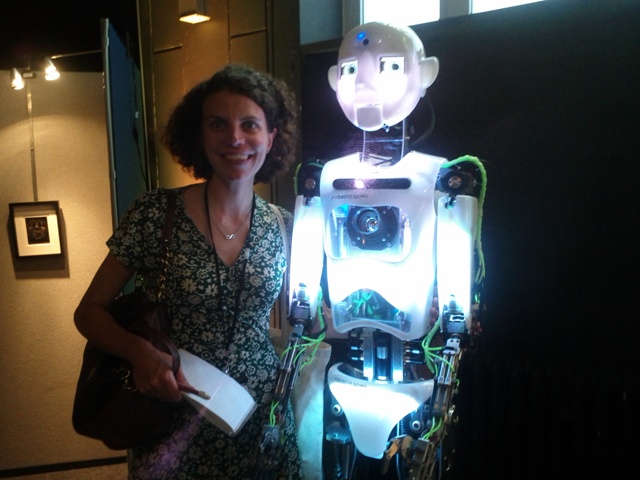
Bonding with RoboThespian at London's Science Museum.

Bonding with RoboThespian at London’s Science Museum.

You remember your first robot – at least, if you are as fixated on them as I am. A recent review of three books that explore the implications of artificial intelligence took me back to 2006 — and the machine that lit my obsession. It wasn’t pretty or even cute, though many automatons are. It was creepy: a four-legged metal crawler that could figure out how to limp if one of its legs was shortened.

At the time, I was a technology reporter for New Scientist with an assignment to write a news story about the quadruped. In order to limp, the robot first had to detect that something had changed. To do this, it maintained a software version of itself, which it constantly compared with the position of its real physical body. When the two no longer matched, it knew it had to modify its gait to cope with its new shape.

It seemed neat, even potentially useful, but not the stuff of philosophy — until a computational biologist I spoke to cast the machine in a new light. Because the robot built a model of itself that was distinct from its real physical body, he suggested that its creators had – perhaps inadvertently – given it a sense of self. With at least the semblance of an inner experience, he said, the robot provided a glimmer of what consciousness could look like in a machine. That was it. My world shifted, I understood the power of robots and I was hooked.

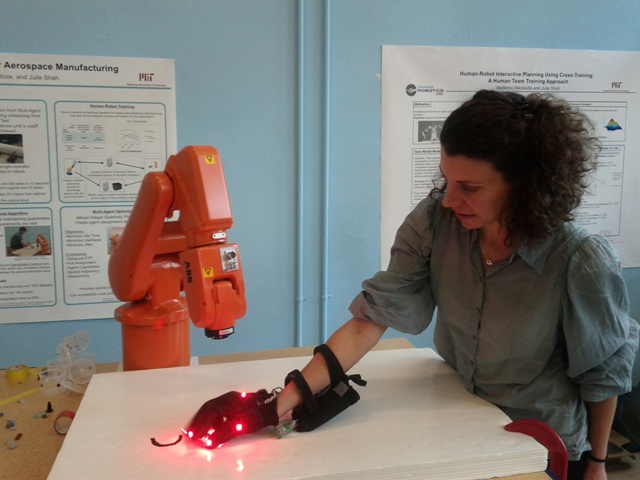
Trading places with Abbie the robot arm at Massachusetts Institute of Technology.

Trading places with robot arm Abbie at Massachusetts Institute of Technology.

Until then, I had regarded them as either gimmicks that disappointed or cold, destructive Terminators. The crawler represented a third option: a way to figure out how humans work.

My next discovery was Nico, a metal skeleton that could recognise its reflection in a mirror. Dressed in a sweatshirt and baseball cap, he did this in a similar way to the crawler: he compared what he saw in the mirror to the movement commands he had just sent to his body, and looked for a match.

Nico didn’t really recognise himself. He just reproduced the behaviour – or so many biologists I spoke to insisted. But the Turing test challenges us to consider what the difference would be between behaviour that seems human and that of a real human. And undeniably, Nico classified his own reflection differently from the sight of anyone else.

Nico set me on a roll. Weekly news meetings became a sport in which I competed with biology reporters to discover beings that chipped away at what it means to be human. Scrub jays are birds clever enough to move their food stores to trick potential pilferers, but I discovered a furry robot that passed a test for theory of mind and a wheeled rover that deceived its opponent to play hide-and-seek.

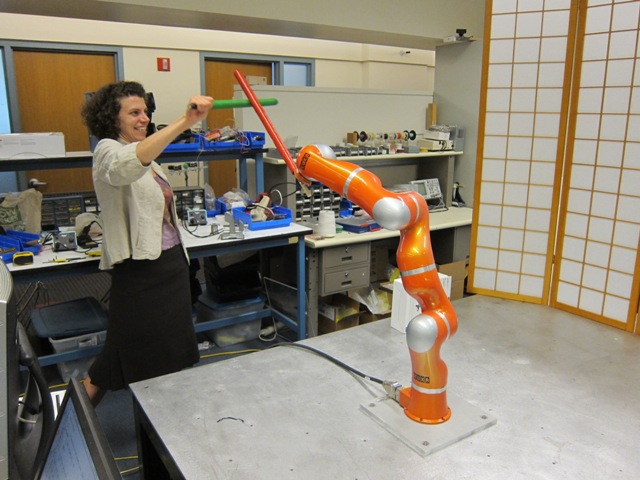
Sparring with Jedibot at Stanford University in California.

Sparring with Jedibot at Stanford University in California.

These synthetic creatures had a crucial selling point: people had programmed them and so understood how they worked, making them the ultimate tool for discovering whether simple rules can produce complex behaviours. Unlike animals, with robots you know exactly what your psychological ingredients are.

My passion led me to shake hands with a knee-high pearly white humanoid as it stepped off the red carpet at the Robot Film Festival (in TriBeCa, New York, in 2011 – I was a judge). I fenced with an orange robot arm, Jedibot. And I mentally ‘traded places’ with another orange robot arm, Abbie, as we worked together to insert screws into a tabletop. The point was to see if the switch improved our ability to collaborate, a psychological trick that is known to work with human-only teams.

Throughout these adventures, my feelings towards robots have often dramatically differed from many others’. Elon Musk and Stephen Hawking, for instance, are among those who have recently warned that the creation of artificial intelligence is risky because of the potential to create Terminator-style killing machines. There’s also the fear, fashionable right now, that robots are on the brink of making human jobs redundant, leaving us with nothing useful left to do.

Perhaps I should be more afraid. But I can’t help but think of one further entry in my robot diary: there is a piece of software that falls for the same optical illusion as people. Trained to estimate the lightness of a pixel based on examples of images it had seen, the program classified grey regions of an image as darker when placed on a white background and lighter when on a black one. This highlights the main reason I don’t fear robots: if you believe that we humans are just complex machines — and I do — aren’t we on some level just one big happy family?

Celeste Biever is Nature’s chief news editor. She tweets at @celestebiever.


For Nature’s full coverage of science in culture, visit www.nature.com/news/booksandarts.
The ornithological photographer

3Q: Todd Forsgren

Black-headed nightingale-thrush (Catharus mexicanus).

Black-headed nightingale-thrush (Catharus mexicanus).{credit}Todd Forsgren{/credit}

Many ornithologists use mist nets to capture birds briefly to collect key data or ring them before release. Photographer and birdwatcher Todd Forsgren has spent years working with researchers to freeze-frame those moments, now collected in Ornithological Photographs (Daylight Books).  He talks about the ethics of mist netting, the challenge of photographing hummingbirds, and upcoming projects such as photographing the lengths we go to to rescue critically endangered species.

Zeledon's antbird (Myrmeciza zeledonia)

Zeledon’s antbird (Myrmeciza zeledonia).{credit}Todd Forsgren{/credit}

Do you think mist netting is ethical?

I do. The moment birds spend in the net seems strange and perilous, but is an important contribution to the gathering of data that is incredibly valuable for conservation. Some people don’t like it as a practice, as there is a low incidence of mortality. In my view it is justified, especially since recent research suggests that incidents of injury are quite low due to rigorous oversight and training of ringers. Exponentially more damage is done per year by outdoor cats or office buildings with their lights left on overnight during migration, and climate change too. (For example, data from the North American Monitoring Avian Productivity and Survivorship (MAPS) programme suggests that bird populations overall are declining, on average, by 1.77% per year.) I’m very proud to say that every bird I photographed was released by the ornithologists with status code 300 – meaning it flew off without any apparent harm. By contrast, John James Audubon and other early ornithological painters would shoot birds out of the sky to make their paintings.

How do you take these avian ‘portraits’, and which is your favourite?

Keel-billed toucan (Ramphastos sulfuratus)

Keel-billed toucan (Ramphastos sulfuratus).{credit}Todd Forsgren{/credit}

Basically, I very quickly create a photo studio around the bird. I have a white cloth as a background, which an assistant holds behind the bird, and a flash with a soft box on it, to create the right sort of lighting effect and to ‘freeze’ the bird’s motion. All the birds I’ve photographed have been caught in the course of scientific research, and I always defer to the scientist’s judgement: if a species is too sensitive or has been in the net for a while we don’t photograph it. As for a favourite, I think the keel-billed toucan is the most ostentatious of the images — it’s just so colourful and charismatic. I took the photo on a second trip to Costa Rica, on my second-to-last day there; we never managed to catch one on the first trip. The first worm-eating warbler I saw as a young birder was so vivid, that’s always been a special species for me. The hummingbirds are very frustrating to photograph because my depth of field is only an inch or so and they’re often fluttering around quite a bit. You’ve got to work really fast. So the three hummingbirds I photographed are also very special.

 What else are you working on?

I’m hoping to ramp up another project centring on wildlife, photographing the great lengths that humanity has gone to in order to alter or restore landscapes to keep critically endangered species alive. I’ve also been photographing US Geological Survey experimental forests in the American West, looking at the infrastructure and traces of scientists working in the landscape. I find that the alterations and evidence of scientific research can be very interesting in and of itself. For example, at H.J. Andrews and Cascade Head Experimental Forests, both in Oregon, researchers have set up long-term log decomposition studies that I’m following. But I also just had my first child, so I imagine I won’t be working on much other than that over the next few months.

Interview by Daniel Cressey, a reporter for Nature in London. He tweets at @DPCressey.


For Nature’s full coverage of science in culture, visit www.nature.com/news/booksandarts.
Beyond the Antikythera mechanism

Posted on behalf of Jo Marchant

'The Wrestler', a marble sculpture from the Antikythera shipwreck showing wear on the side not buried in sand.

One of the first-century BC marble sculptures from the Antikythera shipwreck, showing wear on the side not buried in sand.{credit}Copyright: Jo Marchant{/credit}

The sea has great destructive power, but it can also preserve. A new exhibition of 2,000-year-old artefacts retrieved in 1900 from a shipwreck near the Greek island of Antikythera includes some breathtakingly pristine treasures — such as a bowl made of delicate coils of turquoise, yellow and purple glass, and a miniature golden figure of Eros hanging from an earring set with garnets, an emerald and 20 tiny pearls.

The ancient ship is famous for having contained a geared astronomical device from the first century BC, dubbed the Antikythera mechanism.  What’s less well known, however, is that the rest of its cargo is hugely important too: a dizzying collection of items from statues to ships’ nails that provide a unique insight into first-century-BC seafaring and trade.

The exhibition, called “The Sunken Treasure: The Antikythera Shipwreck”, includes hundreds of items on loan from Athens’ National Archaeological Museum – the first time they have been permitted to leave Greece – and runs at the Basel Museum of Ancient Art and Ludwig Collection in Switzerland until 27 March 2016.

The journey down

Curator Esaù Dozio and Paris-based exhibition designers Studio Adeline Rispal clearly want to take visitors on a journey. To enter the exhibition, we descend into a black-walled room with elegantly placed bronze and marble statues set against the ocean displayed on a 16-metre-wide screen. According to the notes, we’re in a Roman seaside villa. Around 70 BC, when the Antikythera ship sailed, wealthy Romans loved to decorate their homes with Greek artworks, and commissioned thousands of ships to deliver them from territories in the eastern Mediterranean.

The Exosuit

Photo of the Exosuit, a US$1-million wearable submarine used at Antikythera in 2014, with marble finds from the wreck.{credit}Copyright: Jo Marchant{/credit}

Then we take a voyage, filing past a model of a Roman cargo vessel, and ship components retrieved from the Antikythera wreck itself, including a bilge pipe, hull planking, bronze nails and rigging rings. Next come cooking pots and oil lamps used on board, and what may have been the belongings of an aristocratic passenger – gold jewellery, and silver coins from Pergamum and Ephesus on the Asia Minor coast. Found near female skeletal remains, these items have sparked stories of a royal bride travelling to Rome with her dowry.

We descend a ramp to the sound of whistling wind and emerge on the seabed, another black room with marble statues from the shipwreck artistically arranged on piles of white-painted pebbles. The effect is beautiful yet ghostly. The torso of a horse – one of four that may have formed a chariot group – lies stranded on the stones. Crouching nearby is a naked boy. His head and half of his body (presumably protected over the millennia by being buried in sand) are exquisitely preserved, while his other arm and leg are rough, pitted stumps eaten away by the sea.

These marbles date from the first century BC, made of stone from the Aegean island of Paros. Meanwhile bronze statues, held in glass cases against the walls, are thought to date from the second and third centuries BC, already antiques when loaded onto the ship. These are mostly in pieces, including the arm of a boxer with a bandage-wrapped hand, and a philosopher’s head with piercing glass eyes and tousled hair. The missing parts are presumably still buried below the seabed.

Mosaic bowl.

Patterned ‘mosaic’ bowl.{credit}Copyright: Jo Marchant{/credit}

Other items provide a snapshot of thriving Mediterranean trade: there’s glassware from Alexandria; fragments of a wood-and-bronze couch, probably from the island of Delos; and wine jars from Kos and Rhodes. A small room dedicated to the Antikythera mechanism doesn’t contain the surviving fragments (these are too fragile to leave Athens) but does feature several models – of the mechanism itself and other ancient geared devices, including the “sphere of Archimedes” described by the Roman writer Cicero.

Technological shifts

The exhibition also nods to the changing technology used to explore the wreck. On the “seabed”, we see a canvas diving suit like the one used by sponge divers to salvage the 55-metre-deep site in 1900; a model of the boat used by marine researcher Jacques Cousteau when he investigated the wreck in 1976; and a giant photograph of the Exosuit, a US$1-million wearable submarine deployed at Antikythera in 2014.

That latest project, directed by Brendan Foley of Woods Hole Oceanographic Institute in Massachusetts with archaeologists from the Greek Ephorate of Underwater Antiquities, aims to discover whether any of the ship’s cargo remains buried on the seabed. In September 2015, divers retrieved items including a blue game pawn, sections of a bone flute and pieces of mosaic glass. They hope future excavations might yield more statues, or even another mechanism, to add to the items on display.

But the Antikythera collection is opening up in another way too. As well as excavating the wreck site, Foley says he is determined to carry out as many scientific tests as possible, not just on new discoveries but on the existing artefacts. For example, lead isotope analysis on the ship’s hull sheeting should show where it was built, while DNA analysis on the contents of ceramic jugs and jars may reveal the contents of the foodstuffs, medicines and perfumes they held.

Bronze statuette discovered by researcher Jacques Cousteau in the 1970s. Its base may have rotated when a key was inserted.

Bronze statuette discovered by researcher Jacques Cousteau in the 1970s. Its base may have rotated when a key was inserted.{credit}Copyright: Jo Marchant{/credit}

Other possibilities include fracture analysis on the bronze statue pieces to investigate how and when they broke, and X-ray imaging. A prime candidate for X-ray analysis is a bronze statuette discovered by Cousteau’s team in 1976. It stands on a circular base with what looks like a broken-off key on the front. According to the exhibition notes, a mechanical device inside the base rotated the statue when this key was turned. Yet this idea has never been investigated or confirmed. The statue dates from the second century BC, so if X-ray imaging does reveal an internal mechanism, this statuette would trump the Antikythera mechanism as the world’s oldest known geared device.

The Basel exhibition is truly stunning, but for me, the most exciting thing about this collection is the paradigm shift now being driven by Foley and his team. Since 1900, these objects have been beautiful but static, seen merely as artworks to be admired and conserved. The introduction of a scientific approach promises to transform them into a dynamic, rich source of new information about this fascinating period of ancient history.

Jo Marchant is author of a book about the Antikythera mechanism called Decoding the Heavens: Solving the Mystery of the World’s Computer. Her next book, Cure: A Journey into the Science of Mind over Body, will be published by Canongate in February 2016.

For Nature Video’s film Building the Sphere of Archimedes, see here. For Nature’s full coverage of science in culture, visit www.nature.com/news/booksandarts.
Hunger games: food security on stage and screen

Metta Theatre's production of Lydia Adetunji's play Bread on the Table, Trafalgar Studios, London.

Metta Theatre’s production of Lydia Adetunji’s Bread on the Table juxtaposes food commodity trading and starvation in poorer countries.{credit}Richard Davenport{/credit}

A Nigerian farmer feeds her last cow to a man who pays with his life. A biologist in an agribusiness-dominated dictatorship risks death by growing potatoes. An official in a world of water wars tortures a man dehumanised by thirst.

Mouthful, a set of six playlets at London’s Trafalgar Studios, offers pungent glimpses — some bleakly comic, some harrowing — of food crises real and potential. It joins a spate of films — including the documentaries 10 Billion and Land Grabbing — and books re-examining the issues to ask how and why hunger still haunts us, after decades of humanitarian and scientific effort, and enshrinement in the Millennium Development Goals.

Some 795 million people remain malnourished, according to the UN Food and Agriculture Organization. But globally, the complexities of food production, distribution and consumption create another kind of havoc. The World Health Organization notes that over 600 million adults are obese. Humanity’s relationship with food has become intractably tangled in tandem with population growth, globalisation, economic inequities, and technological changes such as factory farming and food processing. We swim in a bouillabaisse of biotech agribusiness, threatened crop biodiversity, rising food prices, and a vast tonnage of wasted food.

Alisha Bailey of Metta Theatre in Neil LaBute's drought-ridden dystopia 16 Pounds.

Alisha Bailey of Metta Theatre in Neil LaBute’s drought-ridden dystopia 16 Pounds.{credit}Richard Davenport{/credit}

Six scientists steeped in the issues collaborated with the six playwrights behind Mouthful. Thus Tim Benton,  champion of the UK Global Food Security programme, teamed up with renowned film director and writer Neil LaBute for his drought-bound dystopia 16 Pounds (Benton also helped hammer out issues explored by all the plays). Lydia Adetunji, whose trenchant Bread on the Table picks at the link between food commodification and the Middle East food riots, worked with plant breeder Molly Jahn. The researchers were sounding boards and fact checkers, ensuring assertions were evidence-based, and suggesting real-world concerns as dramatic inspiration.

These joint ventures are a world away from Duncan Macmillan’s recent 2071. Essentially a lecture on climate change by climate scientist Chris Rapley, that play drew fire from many critics for its bald didacticism. Mouthful gets its multiple messages across via the expressive skill of the Metta Theatre ensemble (whose four members play all the roles) and director Poppy Burton-Morgan. Interludes by artistic director William Reynolds deliver quantification — projections of data and brief videos — but at so rapid a pace it was hard to get more than an impression of the facts.

And that made me wonder how someone new to them might experience Mouthful. Where the drama in 2071 is meant to emanate from the science alone, here theatrical skill is the weight-bearing element. Certainly, the performances are superb, particularly Doña Croll’s as, in turn, a commodity broker’s client, a Fulani farmer and a biodiversity activist, and Robert Hands’s as a starving Tunisian — and a giant insect in the interval revue Try Me, a paean to entomophagy.

Mouthful is best at taking humanity’s botched attempts to feed itself to their logical conclusions, and at showing with some subtlety the interlinkages between conflict, corporate greed and hunger. It is politicised, but that is inevitable given the economic inequalities that are the worm at the core of this unwieldy problem.

Feeding the billions

10 Billion covers much of the same territory as Mouthful. But the film’s dramatic tension is sparked by the friction between extremes — top-down, lab-bound, big-money solutions alternating with bottom-up experiments and experiences. While the dichotomy and development paradigms are familiar, the director — environmental journalist Valentin Thurn — gives us a mindboggling range of responses to the food crisis.

The film opens on Thurn munching a deep-fried grasshopper, intoning that apropos of food, “It may not be long before we can’t afford to be picky any more”. It’s a taster for a sometimes queasy tour taking in a Mozambican farmer ejected from her land by soy growers, a panoply of organic farmers, the scientific advisor to a high-tech Japanese lettuce factory, the director of a vast industrial chicken production business in India, Canadian researchers genetically modifying salmon, “in vitro meat” engineer Mark Post and many others. These individuals become unique windows on the often baffling world of ‘global food’.

Thurn makes no secret of his disdain for agribusiness. This is muckraking of a serious type, and that some of his interviewees are hoist with their own petard is in the nature of documentary-making. Thurn does, however, milk the visual contrast between the researchers and farmers. The technicians in lab coats under artificial light seem shot with a slo-mo surreality, giving their work an alien, claustrophobic feel in stark contrast to that of the farmers in sunny fields full of scurrying livestock.

B. Soundararajan of Indian company Suguna Poutry Farm, featured in 10 Billion.

B. Soundararajan of Indian company Suguna Poutry Farm, featured in 10 Billion.{credit}Prokino 2015{/credit}

Again like Mouthful, 10 Billion is strongest in its revelations of interconnections and tradeoffs. Thurn shows how vast multitudes of factory-farmed chickens mean more soy fields in Africa to feed them, and how food commodities speculation in Chicago can cause the price of staple crops to fluctuate in scores of poor countries. He is unimpressed by the idea — propounded by Jim Rogers, founder of the Rogers International Commodity Index — that high food prices benefit farmers, arguing that profits often circulate solely within the commodities market.

His point that small farmers can, by becoming self-sufficient, opt out of the global system entirely is hardly novel, but the case studies are salutary. Malawian Fanny Nanjiwa, for instance, intercrops pigeon peas, cabbage and cassava to keep her food supply resilient. Across the world in Wisconsin, basketball veteran Will Allen boosts urban community food security through Growing Power. The venture features intensive vermicomposting and ‘aquaponics’, a closed system neatly meshing fish farming with food cropping.

A highlight is Thurn’s look at Indian landraces. Many of these indigenous crop varieties, having evolved under highly variable local conditions, are very hardy; and there is a resurgence of interest in them. We see Kusrum Misra, an ebullient Balasore-based seed collector, touring conservation fields preserving over 700 varieties of rice resistant to salt, flooding and drought.

Small farmers in Cambodia who were forced off the land, featured in Land Grabbing.

Small farmers in Cambodia who were forced off the land, featured in Land Grabbing.{credit}Wolfgang Thaler{/credit}

One wonders what Misra would make of Jes Tarp. Chairman of a company called Asian Global Management, he is shown gazing proudly over a rippling monoculture soy field saying, “two years ago, this looked like that” as he points to a nearby forest. Tarp, however, is not pushing people off the land — a now worldwide phenomenon. The Austrian documentary Land Grabbing by Kurt Langbain and Christian Brüser graphically reveals the cost of this practice in Cambodia, Romania, Sierra Leone and Ethiopia.

And it is high. Western demand for the crops fuelling our lifestyle — sugarcane for sugar and ethanol, oil palms for the saturated vegetable oil used increasingly in everything from lipstick to sweets — is met in part by companies operating in poverty-stricken countries. Land Grabbing explores that relationship in depth, and clarifies the extent of savannah and rainforest clearances that make way for vast plantations, and the siphoning off of water supplies. As entire villages can be burnt, bulldozed or simply divested of cropland in the process, social stability can be lost along with biodiversity and scarce resources.

Land Grabbing is a film less orchestrated than 10 Billion, and the better for it. Martin Hausling — a German farmer-turned-MEP in the European Parliament for the Greens  — does provide some context, notably on the links between European Union subsidies and evictions of hundreds of thousands of small farmers in Cambodia, which have been amply reported elsewhere. But on the whole we parse for ourselves the pronouncements of an agribusiness consultant fired up by palm-oil profits (a hefty $40 million per 10,000 hectares a year), World Bank advisors thrilled by opportunities for agricultural entrepreneurship in Africa, ethanol producers — and farmers traumatised by the grabs.

Vegetable picker Alemgema Alemayoh, featured in Land Grabbing.

Vegetable picker Alemgema Alemayoh, featured in Land Grabbing.{credit}Wolfgang Thaler{/credit}

And it is the people working the land who speak loudest. I was struck by two of the Ethiopians interviewed. One, Alemgema Alemayoh, picks peppers and tomatoes in a vast, foreign-run greenhouse whose produce is airlifted to five-star restaurants in Saudi Arabia. (The Ethiopian government, we are told, offers investors the lease of 3.6 million hectares of land at 5 euros a hectare per year.) She has never tasted these vegetables; she and her six children live on maize.

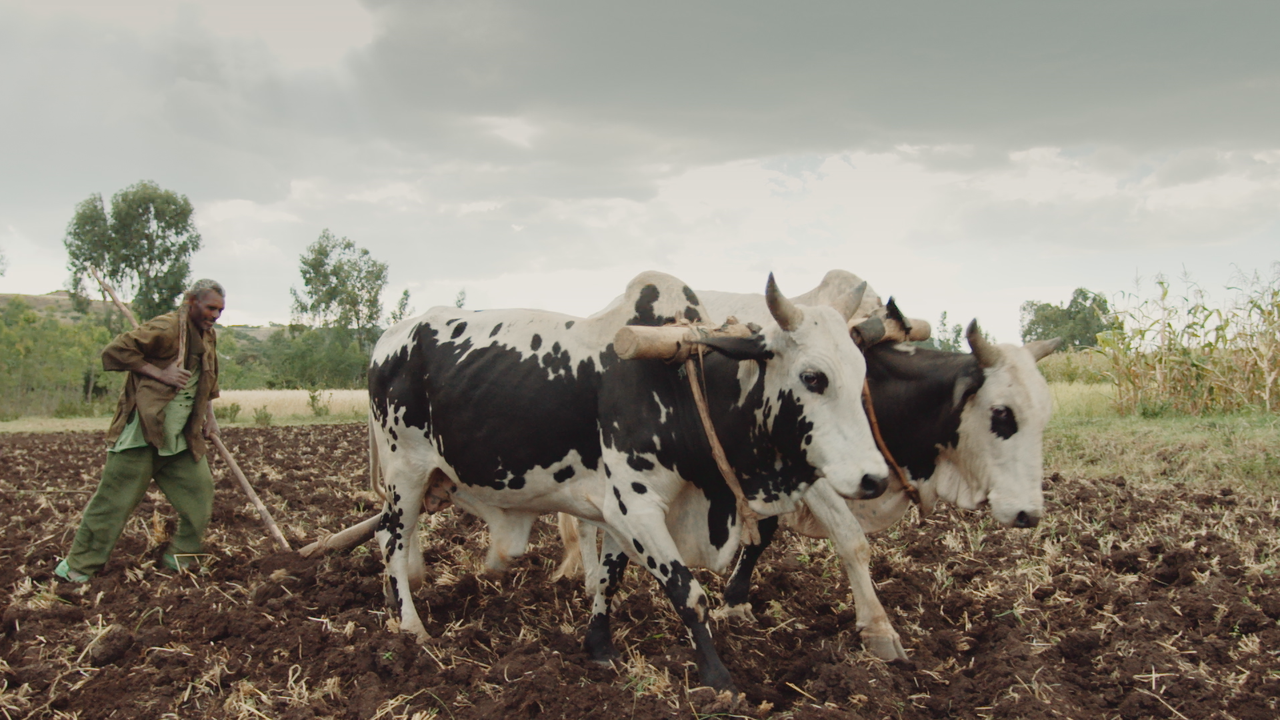
The other is Gebreyesus Tesfay. Under a government project helping small farmers improve soils, compost, intercrop and row-plant the grain teff, Tesfay is shown cultivating his land with a magnificent brace of oxen and a formidable handmade plough. Before, he says, they starved. Now they plant vegetables three times a year and are secure, although it is obviously still a tough life. As with Nanjiwa and Allen, self-sufficiency enlightened by the best of tradition and of small-scale science can work, if bad governance and skewed economics are held at bay.

Gebreyesus Tesfay on his farm in Ethiopia, featured in Land Grabbing.

Gebreyesus Tesfay on his farm in Ethiopia, featured in Land Grabbing.{credit}Wolfgang Thaler{/credit}

Globally, small farms number half a billion and support an estimated 2.5 billion people. They are, as these plays and films reveal, vulnerable; but they are centrally important as bulwarks against hunger. Meanwhile, the West’s demand for crammed supermarket aisles seems largely decoupled from a full understanding of the human dramas behind all that bounty. If tackling hunger is a ‘war’, it’s fought on many fronts; and it is winnable only if, in addition to appropriate technologies and sustainable innovation, richer societies fully grasp the politics that complicate this fraught issue.


See here for a Nature Podcast on Mouthful. For Nature’s full coverage of science in culture, visit www.nature.com/news/booksandarts.