Why learning to mentor and teach is more important for US faculty members than publishing papers

An influential ally aims to reform the experience of US PhD students in science, technology, engineering and math (STEM) by advocating for a system that rewards faculty members for mentoring and advising students rather than for their own publications.


By Chris Woolston

In a 29 May report , Graduate STEM Education for the 20th Century, the National Academies of Science, Engineering and Medicine (NASEM) in Washington DC calls for providing faculty members with incentives for developing skills such as teaching and mentoring while de-emphasizing the importance of publications. The report recommends that institutions change their promotion and tenure policies and practices to recognise and reward faculty members’ contributions to graduate mentoring and education.

Continue reading

Train ’em up and kick ’em out

Plans for non-EU graduate students to leave the UK, once their courses and visas have expired, have been halted.

In December 2014, Theresa May, the UK home secretary, proposed plans for “zero net student immigration” in the UK, arguing that this would be part of a fair immigration policy. The plans (initially set out in the Conservative Party Manifesto of 2010) stated that any non-EU student at a UK university would be required to leave the UK, immediately upon completion of their degree. Any universities and institutions failing to enforce this policy would be penalised. 

These plans have been halted, for now, due to resistance from the Chancellor of the Exchequer George Osborne, with support from the former UK universities minister, David Willets, and inventor Sir James Dyson. They argue that the benefit to the UK economy, of attracting talented researchers from around the world, outweighs the negatives of increasing immigration.

The current rules stipulate that students have 4 months after graduation to apply for a graduate job that pays £24,000 per year. This looks set to remain the case for the time being, but it is unclear whether May’s plans have been buried completely or if they’ve just been delayed. Clearly this is a complex set of issues at a time when governments, on one hand, are being forced to control immigration to control public spending, and on the other hand recognise the need to import talent that not only supports the higher education “industry”, whose research-based innovation could drive economic growth.

We’re interested to hear from the Naturejobs readers about the potential impacts of this policy. So, please vote in our poll to let us know if you think this policy should go through and in the comments, please provide your reasons and answers to the questions below:

  • Are you a non-EU student in the UK? What was your experience of applying for a job here? Would a proposal like this make you think twice?
  • Are you a non-EU student thinking of coming to study in the UK? How would this proposal affect you?
  • Are you an existing UK or EU student studying in the UK? What do you think about this proposal?

Thanks!


The Physics Factory: Putting the fizz back into physics teaching

The Physics Factory: Bringing teachers together to talk the wonder and thrills of physics.

The Physics Factory: Bringing teachers together to talk the wonder and thrills of physics.

Guest Post blog by Gareth Sturdy, physics teacher and co-ordinator of The Physics Factory

Gareth Sturdy has been a teacher since graduating from the University of Liverpool in 1993, and currently splits his time between teaching physics at the East London Science School, coordinating the Physics Factory and worrying about the fortunes of Arsenal FC.

Don’t be misled by her stern portraits: Marie Curie, who died 80 years ago this summer, approached her work with wonder and imagination. “A scientist in his laboratory,” she wrote “is not a mere technician; he is also a child confronting natural phenomena that impress him as though they were fairytales.”

Summer is a particularly sensitive time for those interested in the young and science. As A-level and GCSE results are published, will we again be enchanted with the fairytale of continuous grade improvement?

Actually this year could be a different story for the first time in ages. Like Cinderella in reverse, students who thought they were going to the freshers’ ball are now worried they may not be. The Department of Education (DofE) has pushed for a tougher academic climate in schools, more rigorous assessment and an end to the re-sit culture. The first effects of this tectonic shift are about to be felt. Many students believe it’s a shift of the goalposts – what if last year’s A grade marks are only worth a B now? Yet universities welcome the attempt to close the gap between the feel-good fairy story of results headlines, and the more sober reality of what students actually know when they turn up.

Continue reading

Who knew? Popular teens are not immune to bullying either

Turns out being popular might not save you from sneering, jabbing and harassment in school yards, a new University of California study concludes – the persecution is certainly not exclusive to those who are poor or “physically vulnerable.” In fact, becoming popular increases the risk of getting bullied, and worsens the negative consequences of being victimized, according to the same study.

“In contrast to stereotypes of wallflowers as the sole targets of peer aggression, adolescents who are relatively popular are also at high risk of harassment, the invisible victims of school-based aggression,” says Robert Faris, associate professor of sociology at UC Davis and co-author of the study, “Casualties of Social Combat: School Networks of Peer Victimization and their Consequences.”

“Do aggressors attack the weak?,” the study asks. “According to our findings, the answer to this question is: not as often as they attack the strong. Aside from a few isolated students, the highest rates of victimization are observed among students of relatively high social standing.” The brunt of it decreases however as students rise to the pinnacle of the hierarchy of social standing.

Being “easier targets,” girls face much harassment too, but are not under-represented in studies on school violence and bullying. And what usually goes unchecked is their repertoire of retaliation, like using gossip in counter strikes for instance. Girls are not always physically aggressive, while guys are expected to “defend their honor with brute force.” It’s a play between social expectations and constraints, the study explains.

It’s worth noting however that “girls do not harass other girls generally, but focus their harassment on girls who date,” since they pose threats to other female students’ social standing, and “represent potential rivals when it comes to securing a boyfriend.” It’s also interesting that once a victim of bullying, you put your friends at higher risk of being victimized by proxy.

“It’s kind of a hidden pattern of victimization that is rooted in the competition for social status,” the author was quoted as saying in a press release.

“We view aggression as fundamentally rooted in status processes, and we identify an overlooked class of victims, who, by virtue of their relatively lofty social positions, experience at least as much distress—at the margin—as do those for whom victimization is routine,” reads the study, which used social network centrality as an indicator of status. The research sample was predominantly white and African American but roughly split between genders.

There isn’t a country or community that is absolutely immune to school victimization, it seems – in Egypt alone, statistics by the National Centre for Social and Criminal Research suggest that 30 per cent of students suffer from some type of harassment or bullying in schools, and across the Arab World, a 2012 study published in the Arab Journal of Psychiatry, confirmed that the phenomenon is prevalent, especially among middle-school adolescents. In the United Arab Emirates, 20 per cent of teens are bullied, in Morocco, 31.9 per cent are, in Lebanon the number rises to 33.6 per cent, as per the same study, and Oman and Jordan reportedly suffer from the highest prevalence of school bullying at 39.1 per cent and 44.2 per cent respectively.

During reporting on sectarian violence in several towns in Upper Egypt, this writer has personally come across several cases where Coptic Christian students complained they were specifically targeted –sometimes physically attacked– by their Muslim peers for their beliefs. But no official figures or studies that assess the extent or range of religious-based bullying –or bullying of minorities– in Egypt have yet been released. The same goes for studies that measure the relation between bullying and social status within school hierarchy.

Bullying –unlike school violence—usually happens in the absence of provocation, and is marked by a clear power imbalance between the bully and the bullied. Recent scholarship, according to Faris’ study, even points out traditional views that saw bullies as mentally troubled or socially marginalized seem to be outdated, and that students usually harass their peers, not to reenact their troubled home lives, but to gain status.

I showed Faris’ research to Melanie Hayden, a secondary school counselor based in Cairo, Egypt. She found the findings “interesting” adding that she has “occasionally been aware of a ‘popular’ student being targeted in some way by others who saw them as a threat (either to their own ‘popularity’ position or a jealousy issue).” And as a psychologist, she “can certainly understand where a student trying to ‘work their way up’ the hierarchy is also vulnerable to being bullied, certainly before they’ve ‘arrived’ and they’re becoming a threat to others’ status etc.”

“For those ‘at the top’ I can see how they’re much less vulnerable due to the ‘power’ of being very popular, or very successful – and likely better self-esteem, which I’d think is a key factor,” she says.

It’s not clear however whether the conclusions of this study can be used to generalize about bullying dynamics across cultures; and whether or not school structures in the United States, or the degree of competitiveness between students in certain schools, contribute to the instrumental factors that shape this brand of victimization. Then again, sample students from the research played sports, went on dates, and lived with parents, at least one of who attended college.

These factors may not be present in many Arab schools that are often gender-segregated, may not be as ripe with extra-curricular activities as U.S. schools are, may not place strong emphasis on sports as an indicator of student status and are certainly more conservative than their American counterparts in terms of tolerating “cross-gender” relationships.

Finally, the study mentions how such findings related to bullying are not merely theoretical and carry practical implications—as they should—on national discourse; the ranks of victims are not exclusively dominated by vulnerable, socially marginal students, but are also full of many students who relatively popular, and who seem well-adjusted, at least on the surface. “We hope these more central victims, hidden in plain sight, are acknowledged in the national dialogue,” says Faris. “And that the current focus on bullying expands to include more subtle forms of harassment and cruelty.”

February’s SoNYC: On Science and Social Media – An Academic’s Viewpoint

Science Online NYC (SoNYC) is a monthly discussion series held in New York City where invited panellists talk about a particular topic related to how science is carried out and communicated online. For this month’s SoNYC we’ve teamed up with the American Museum of Natural History (AMNH) for a special event for Social Media Week. We’re looking at how social media can be used to communicate science, with the intention of concentrating on how the experiences can have educational value. More details of this month’s SoNYC can be found here.

To complement the event, we’re running a series of guest posts, recounting experiences where social media has been a key part of an education project. To start the discussions, Dr Alan Cann from Leicester University gives an academic’s viewpoint on how social media can be used as part of the curriculum. His post considers how the effects of social media usage can be measured and what the future holds for such technology. 

One of the best things about working at a medical school is that we have lots of students and lots of technology, so three years ago we ran a student through our most powerful NMR machine, and this is what we saw:

Attention!
Image Source

Just in case you’ve had a sense of humour bypass, or my Ethics Committee is reading this, we didn’t really – this was one of those Photoshop experiments 😉

Nevertheless, institutional eLearning tools cannot effectively compete with the current generation of social networks for student attention. Yet there are good reasons for educators not to compete online with the attractions of alcohol and sex. In general terms, attention online is in short supply and although we know that Facebook can be a positive tool for education in some circumstances [1], I prefer to sidestep the complications of predominantly social spaces in order to provide some distinction. I try to foster the use of social tools for academic and professional development.

Dissatisfied with the lack of “social” in institutional tools such as virtual learning environments (VLEs), I started down a more outward looking path some years ago. Students log into the university VLE which acts an authentication hub, confirming their identities and providing us with a secure channel for information such as course marks, which, under the terms of the UK Data Protection Act, cannot be trusted to public sites. The university login provides us with an administrative layer but the interaction, and arguably the learning, takes place elsewhere. Although students may download PowerPoint presentations from the VLE, higher thought processes such as analysis and evaluation are associated with actions such as reading current content from RSS feeds on Google Reader and discussing the relevance of shared items to taught courses on Google+. Vital to this approach is the incorporation of student peer networks to amplify staff input [2].

Initially, I focussed on a range of social tools designed to foster student interactions. These included social bookmarking sites such as delicious, social citation tools such as CiteULike and wikis such as WetPaint and Wikispaces. Students were assessed on their use of these sites, but when assessment ceased, we found that very few students continued to use the tools. Some sort of social glue was required to maintain the enthusiasm. Our initial tool-based personal learning environment (PLE) concept rapidly turned into a people-based personal learning network (PLN) approach. As with all effective education, conceptual frameworks, in this case provided by a peer group rather than solely by teaching staff, win out over content alone.

A people-centred approach to peer learning, where academics assume the role of content curator, mentor, and technical support, places communication as a crucial requirement for success. This explains the failure of our initial tool-based approach to encourage students to curate their own information. In comparison with conventional tagging formats, the “just-in-time” attention management of activity stream architecture, where attention is continually refocused by active items returning to the top of the page, provides the reinforcement needed for continued use. Activity streams and the crowd wisdom of a peer network are at the centre of my approach to online learning. All this might seem like dry, academic posturing – but don’t say that to Facebook and Google, who have spent the last three years betting the farm on activity stream architecture.  Starting with the highly influential but now moribund Friendfeed, we were able to demonstrate the effectiveness of this approach in terms of monitoring student engagement [3]. Students engaged in peer to peer discussions around shared resources and personal reflection on their own learning. The patterns of online activity were mapped using graphical tools and were used to inform staff how to guide individual students. Our statistical analysis showed that student contributions to the network could be used to discern student engagement with education in a way which give a far richer picture of online activity than traditional summary statistics such as course or exam marks.

Six months ago, concerned about the sustainability of FriendFeed, I switched our student network to the newly available Google+, and have not looked back. Google+ is conveniently linked to other tools that students use on our course (Google Documents for collaborative writing, Google Reader for RSS feeds), and has fine-grained privacy controls based on the idea of sharing content with user-defined Circles (see: here), which gives users confidence about sharing thoughts and content online. Google+ has proved to be an effective and engaging tool for student feedback [4].  We are currently analysing the structure of student networks on Google+ and looking in depth at usage patterns. If you’re interested in finding our more about this, follow me on Google+ where I post regular updates about my research.

What does the future hold? As connectivity continues to improve, undoubtedly massive open online courses (MOOCs) such as the recent Stanford AI class will keep growing, but the notion that universities will be swept away by organizations such as Udacity and Kahn Academy and abandon qualifications from ancient institutions in favour of free badges and Klout scores is as fanciful now as it was on the barricades of 1968. Eventually our sleeping educational leviathans will rouse themselves and stumble towards the sunlight uplands of enlightenment. Unless Google gets there first of course.

Alan Cann is a senior lecturer in the School of Biological Sciences at the University of Leicester. His interests are science education and exploiting emerging social technologies to enhance the student experience and maximise student and researcher development. He is the author of two highly successful textbooks, has served on the editorial boards of several scientific journals, is creator of MicrobiologyBytes.com, and is Internet Consulting Editor of the Annals of Botany. He has worked as a consultant for numerous educational and scientific institutions, and has published extensively in the area of educational research. More information 


References 

[1] (Junco, R. (2012) The relationship between frequency of Facebook use, participation in Facebook activities, and student engagement (Computers & Education 58(1): 162-171)

[2] (Cann, A.J. & Badge, J. (2011) Reflective Social Portfolios for Feedback and Peer Mentoring. Leicester Research Archive)

[3] (Badge, J.L., Saunders, N.F.W. & Cann, A.J.(2012) Beyond marks: new tools to visualise student engagement via social networks. Research in Learning Technology 20: 16283)

[4] (Cann, A.J. (2012) An efficient and effective system for interactive student feedback using Google+ to enhance an institutional virtual learning environment. Leicester Research Archive)

“Reaching Further” The Exscitec Project

shreena.PNGThis week’s guest blogger is Shreena Patel, Scientific Projects Manager for Exscitec. In partnership with Imperial College Outreach,

they provide hands-on practical activities for students to raise aspirations in Science, Technology, Engineering and Maths (STEM).

Science is cool. Science is fun. If you’re anything like me, you love keeping up to date with the latest technologies and discoveries that emanate from the scientific world. However, trying to convince a less than enthusiastic 14 year old that a peak in the data from the Large Hadron Collider could possibly change Physics as we know it…well that’s slightly more challenging! The reality is that for a large number of students, science is simply not seen as fun or cool.

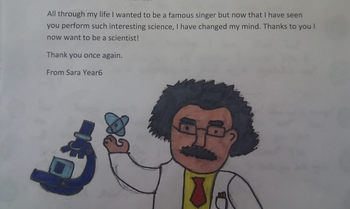
Recently I asked a group of year 6 students (10-11 year olds) “What is a scientist?” What appeared on the whiteboard was a disturbing cross between Doc Brown and Einstein. I was told by the students that the image depicted in the picture was concentrating hard on NOT blowing up the ‘potions’ in his lab and was about to invent something spectacular (hence the light bulb hovering over his head). The excitement in the room was so infectious that even I wanted to meet this amazing scientist drawn on my whiteboard.

Ask this same question of year 10 (14-15 year olds) and the image on the whiteboard becomes the stereotype of a boring, geeky individual stuck in a dingy lab all day. Despite some very hard working teachers, a lot of students at this age just don’t realise how vast the reach of STEM is in the real world.

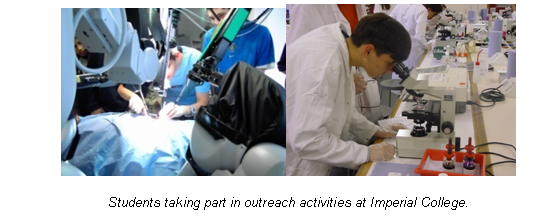
As outreach providers for Imperial College, over the past 12 years, Exscitec has provided bespoke courses for school students of all ages and abilities. Whether it’s building robots, synthesizing compounds or discovering who committed murder most foul through forensic testing, we try to take STEM off the textbook page and into the real world. In a nutshell, we try give students that ‘wow’ factor that will change the way they look at STEM.

part 1.bmp

With the new Reach Out Lab (ROL) at Imperial College, we are now able to connect with even more students throughout the year. Opened in 2010 and championed by Professor Lord Winston, Chair of Science and Society, this multi-purpose laboratory provides a year round teaching facility for young people and teachers. Exscitec’s CEO, Alan West, who is also the Director of the ROL, was recently awarded an MBE for services to STEM education. Speaking about his work, he says, “In recent years, my work, and that of the Exscitec team, has focused very much on the development of STEM enrichment activity connected with Imperial’s Reach Out Lab, the success of which is enabling us to develop more exciting initiatives in support of STEM education”.

One of these new initiatives is called Reaching Further, which is a program which allows school students the opportunity to work with PhD, MRes and Masters students from the Imperial College research community. The premise is simple: students get to speak to a “real scientist”, and in return, researchers are able to share their work and strengthen their public engagement portfolio.

By giving students the opportunity to work with these researchers, we are able to tackle one of the main issues facing young students studying science: the time it takes for scientific breakthroughs to make it into students’ textbooks. This disconnect is one of the major issues we are trying to overcome here at the ROL. So far we have worked with researchers from the National Heart and Lung Institute, the Energy Futures Lab, the Grantham Institute for Climate Change, UK Energy Research Centre (UKERC) to name but a few.

Sarah Lester, Energy and Mitigation researcher at the Gratham Institute for Climate Change, along with Dr Jeff Hardy and other colleagues from UKERC, recently led Energy Islands – a role play workshop where year 12 students (16-17 years old) negotiated a reduction in carbon emissions for their world. Talking about her work with outreach so far, Sarah says, “I think the outreach work has been going really well and has helped the students get involved with academics and research on climate change. The Energy Islands game has also given us great motivation and an excellent tool to work with under 18s and the public as part of our education and information sharing work. One of the best things was being reminded how passionate people can be about this area once they feel they can make a difference.”

I couldn’t have put it better myself. When it boils down to it, students want to be spoken to, not at. Once they feel that someone is listening, you find that they have an awful lot to say. Whether it’s stem cells or solar cells, who better to talk to than those who are at the forefront of the field? As Claire Doyle, PhD student in Organic Chemistry put it, “It definitely added variety to my doctorate and has given me some great experience for the future. Plus it was very rewarding to see students so excited about what I did.”

part 2.bmp

So to all those hard working researchers sitting reading this during a break from their next round of tests, I urge you to get involved in outreach in whatever way you can. One interaction can literally change a student’s whole outlook on a subject. Science becomes cool, science becomes fun and as a consequence back at school the attitude towards science learning changes too.

fun.JPG

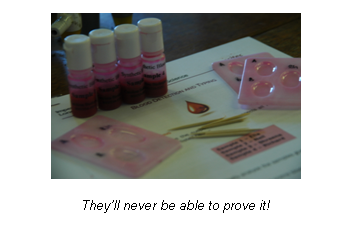
With that, it’s time I return to my lab, where a group of year 9 students (13-14 year olds) from Watford are eagerly waiting to accuse me of murder based on some smudged fingerprints and some suspicious stains on my clothing… which may have tested positive for blood (rookie mistake!) I have been informed that I am going to be thoroughly interrogated after lunch…!

part 3.bmp

If you’re interested in reading more about mentoring in science, the nature.com Communities team ran a recent Science Online NYC (#sonyc) discussion about “Reaching the Niches”. Links to our coverage, including a series of guest posts on other mentoring initiatives can be found here.