Naturejobs career expo: What a day among classic cars told me about my future career

Lessons can be learned from the cars that crowded the background at the Naturejobs Career Expo in Düsseldorf, says Thais Moraes.

Guest contributor Thais Moraes


On the 26th of November in Düsseldorf, the Naturejobs career expo took place at the perfect venue. The Classic Remise center displays a collection of classic and historical cars that we all admired during the short breaks at the event.20151126_133138-edit

It was my first time at a career fair, and my first impression was that there were only young people there, starting the ignition in their professional lives. Since I already have many years on the road, I didn’t think it was for me. I was completely wrong: after listening to the talks, I was reminded that I don’t need to keep driving in the same direction just because it’s a road I’ve already started down.

The environment could have been just novel and enjoyable, but it also made me think about my future career plans, especially the fears and challenges that arise when you go for something new. There are four things that these machines brought to my mind.


Continue reading →

The faculty series: Recruiting staff

Modern and traditional networking techniques can help junior faculty attract top students and postdocs to their labs.

Guest contributor Viviane Callier

Recruiting a critical mass of good students and postdocs is one of the first challenges for a new investigator to establish their lab. “It is easy to order equipment, but much harder to staff the lab and create a lab culture,” says Courtney Babbitt, assistant professor of biology at UMass Amherst, MA since fall 2014.

Recruiting is especially challenging for those who do not have a big name or a history of steady funding to attract trainees, like new faculty. It can be difficult to draw talent to geographically undesirable locations and/or less prestigious institutions, because big cities may offer a variety of career and networking opportunities (in academia and elsewhere), as well as cultural activities that contribute to quality of life. But students and postdocs are needed to help collect data that and move the lab’s long-term research agenda forward; they also bring complementary skill sets, fresh ideas and new research directions. Continue reading →

Scientific communities: Membership at learned societies

There’s a decrease in the number of people knowing about learned societies, says Sarah Blackford at the 2015 London Naturejobs Career Expo.

Sarah Blackford is the Head of Education & Public Affairs at the Society for Experimental Biology. Here she answers a question from the 2015 London Naturejobs Career Expo on the decreasing interest in learned societies.

You are currently viewing a placeholder content from YouTube. To access the actual content, click the button below. Please note that doing so will share data with third-party providers.

More Information

Further reading

Scientific communities: Build your own.

How to make the most of professional societies


Taking control of your career as a female physicist

The Institute of Physics recently held an event on ‘Taking control of your career as a female physicist’. Naturejobs sent Jack Leeming to find out more.

Late, I sneak into the back of a room on the 4th floor of a conference centre in central London, where 70 young female physicists are listening to Professor Dame Athene Donald speak. I try not129692-compressor (2) to break their concentration as I find a chair. Professor Donald is relaxed and passionate, and manages to condense her advice – put into context through deeply personal, humorous anecdotes – into ten simple points to live by. Donald has had a hugely successful career (though, she admits, she is still embarrassed when people say it), making her way through the physics of metals and polymers, then the physics of food, then colloids, then starch, then proteins and
cellular biophysics, and finally ending up in her current area of the physics of biological and soft systems. She’s now the Master of Churchill College at Cambridge. It’s a quite the CV, and made all the more impressive by her achievements outside the world of academia.

Donald casually weaves her personal life into her career as she speaks. She has to leave early – her husband has been to the hospital recently for a bad leg, and still needs looking after. Her daughter did a placement when she was 17 and learnt a lot about office politics; apparently it was useful. Her message is one of pro-activity, self-confidence and overcoming failure. She’s been the gender equality champion for Cambridge University, has written for The Guardian, The Observer and The Conversation, and her blog ­– started in 2010 – has become enormously popular online. Somebody asks her what’s next. She says retirement. I don’t think anyone quite believes her. Continue reading →

The faculty series: Nobody rides for free

Faculty need to learn how to add value to their institution when starting their first role, says John Tregoning.

Guest contributor John Tregoning

Congratulations, you have your first academic appointment and are now a member of faculty.

Commiserations, you are now a massive financial burden to the faculty and will need to continually justify your appointment.

As a postdoc, financially you were someone else’s problem: your salary came from whoever funded your project. Now, as a member of faculty, the cost of your salary comes from the university’s pocket. But it doesn’t stop at salary. The university also pays for bench space, utilities, parental leave, and – if you were better than me at negotiating – consumables, equipment and possibly even a technician’s salary. None of which comes cheaply. In this age of austerity, heads of department are forced to make budgetary decisions and salaries are not only the biggest cost to most departments, they often account for more than 50% of the total budget. In business speak, these costs mean that not only do you need to demonstrate that the department is making a return on its investment in you, but you also need to add value. Continue reading →

Most read on Naturejobs: November 2015

Career supervision, networking, women in science and more from Naturejobs in November 2015!

naturejobs-readsAnother busy month for the Naturejobs team, as we’ve held our very first Career Expo in Dusseldorf, Germany only last week. As well as that, we’ve started publishing the films from the 2015 London Naturejobs Career Expo.

And last Friday, we published out last podcast of the year, celebrating the failures in science.

So, there’s been plenty for you to feast your eyes and ears on. We’ve had a look at the numbers, and here are your favourite pieces from the last month.

Managing laboratory members as well as a research strategy can be difficult for early-career principal investigators, but help is at hand, says Boer Deng in Supervision: Clear direction.

Networking: Hello stranger, by Emily Sohn, explores how conferences are great for career development, but miscalculated moves can foil future prospects.

Non-profit organizations: Scientists on a mission, by Julie Gould, explores how scientists are ideally suited to a career in the non-profit sector. Continue reading →

Networking: How to make the most of professional societies

Like-minded individuals, networking and career advancement opportunities are just some of the things professional societies can offer, says Alaina G. Levine.

Guest contributor Alaina G. Levine

Network-societies-naturejobs-blog-small

Professional societies bring together like-minded people in a scientific discipline.

Although professionals may know about their own professional society, many people do not consider the wealth of career advancement, networking and self-promotion opportunities that they offer. Yes, they know about the conference and maybe they read the newsletter, but there is so much more that you can experience from being a member or simply demonstrating your interest in membership.

A professional society is typically a non-profit dedicated to advancing the profession and the professionals of a given discipline, field, industry or sector. (In fact, this is essentially the tagline of the American Statistical Association.) In science and engineering in particular, professional societies are often are founded with the original intent of bringing together like-minded individuals to discuss topics of interest and potential collaborations, and to provide a collective voice for policy, advocacy and even funding concerns. As they grow, these same societies strive to provide opportunities for professionals in the community to become involved in the governance of the societies as official, or paid, members. Continue reading →

Scientific communities: Build your own

Learned societies and online platforms can be great ways to develop a mutually beneficial network, say panellists at the 2015 Naturejobs Career Expo in London.

Guest contributor Paul Brack

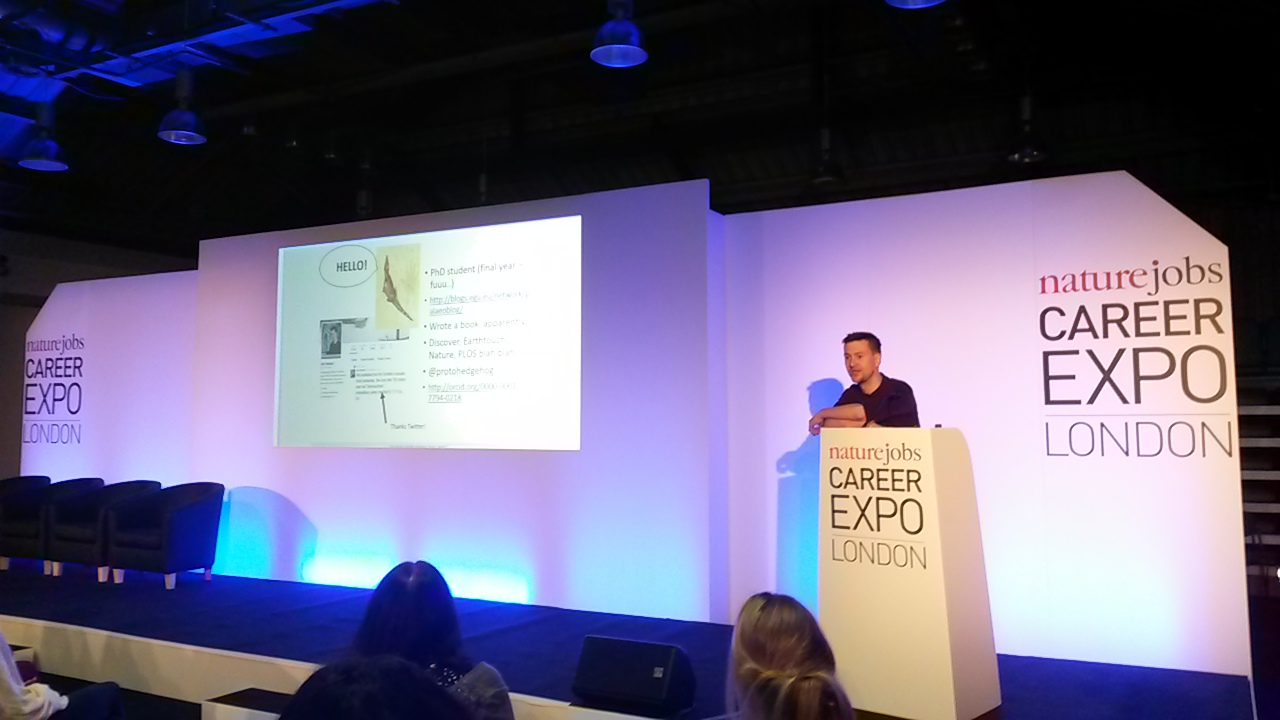
Jon-Tennant-NJCE15-communities-naturejobs-blog

Jon Tennant and the merits of online scientific communities {credit}Image credit: Julie Gould{/credit}

“Networking isn’t just me trying to get something from you,” said Julie Gould, editor of Naturejobs, as she opened the session on Building Scientific Communities at the 2015 London Naturejobs Careers Expo. “Networking is about building a relationship with another person that will benefit both of you.” The two invited speakers in this session, Sarah Blackford, head of Education & Public Affairs at the Society for Experimental Biology, and Jon Tennant, an Imperial College London PhD student, discussed some methods that early career scientists can use to start these types of relationships.

Learned societies

Learned societies, such as the Royal Society of Chemistry or the Biochemical Society, are, according to Blackford, “clubs for people with a similar interest in an academic discipline.” Early-career scientists often underestimate how useful learned societies can be in helping them advance their careers. Blackford pointed out that learned societies have quite a lot of money, and, as they’re not-for-profit, “they give that money back into the scientific community.” Learned societies do this partly by organising and subsidising events, such as conferences on topics that interest their members and giving travel grants to early-career scientists to enable them to attend external meetings. Continue reading →

Career paths: Out of the Ivory Tower

Taking small steps to build up your transferable skills and contacts can be the key to moving away from academia and towards your dream job.

Guest contributor Lauren Emily Wright

Phill-Jones-NJCE15-Keynote-naturejobs-blog

{credit}Image credit: Lauren Emily Wright{/credit}

Ever thought “I want to leave academia, but all I know is lab work”? Well despair no more — the path out isn’t as treacherous as it may seem. In a great keynote speech at the Naturejobs Career Expo 2015 on 18 September 2015, Phill Jones told the story of how he left academia to become the head of publisher outreach at Digital Science, a company that provides a multitude of services to scientists, institutions, publishers, and funding bodies.

Jones gave the audience the sense that calculated planning and sheer luck had both played their part in his career. With a PhD in physics, he was firmly grounded in the world of academia. But after following his wife to Boston, Jones realised that a postdoc in physics would be hard to come by in such a biology-centred city. “I had to be a little more flexible in my career,” he said.

As Jones notes, it is necessary to have an open mind when thinking of changing career paths. “You can’t think ‘all I know is how to pipette’.” Instead, think about what sort of transferrable skills you can offer an employer. For example, Jones finished his PhD with an in-depth knowledge of optics — perfect for a position in a biology lab that used optical imaging to investigate strokes.

But how can you identify which transferrable skills you already have, and which you need to gain for that ideal new career? How can you make contacts outside academia? Continue reading →

Finding job satisfaction as a medical science liaison

David Crosby urges young scientists to take real advantage of the mentorship opportunities that abound everywhere.

David_CrosbyAfter completing a PhD at the University of California, Irvine and a postdoc at the University of California, San Francisco, David Crosby found job satisfaction teaching health care providers the latest information about hepatitis therapies. Here he describes how he founds this career, and the connections to land his first position.

Read more about David’s career transition here.

What’s the difference between medical science liaisons (MSL) and pharmaceutical sales reps?

In sales, they are principally involved in promotion. They spend a lot of time talking about the product, its utility within that physician’s practice, and strengths in comparison with the competition. My role, on the surface, it looks similar. I too go into the physician’s office and discuss the disease state and available medication. But my goal is not specifically to motivate the physician to use our product versus another product.

How did you learn that MSL jobs exist?

My sister-in-law has been in pharmaceutical sales for fifteen years. She asked me “did you ever think about becoming an MSL?” I said “what’s an MSL?” She plugged me in to some former colleagues who gave me more insight from the perspective of former bench scientists.

Then, I talked to a friend of mine from University of California, Irvine. She was a crystallographer, and she ended up going down the MSL route. I thought, “I’ve spent the last nine years working in infectious disease. That’s a little bit more closely related to the clinic than crystallography!” Continue reading →