Scientific communities: Build your own

Learned societies and online platforms can be great ways to develop a mutually beneficial network, say panellists at the 2015 Naturejobs Career Expo in London.

Guest contributor Paul Brack
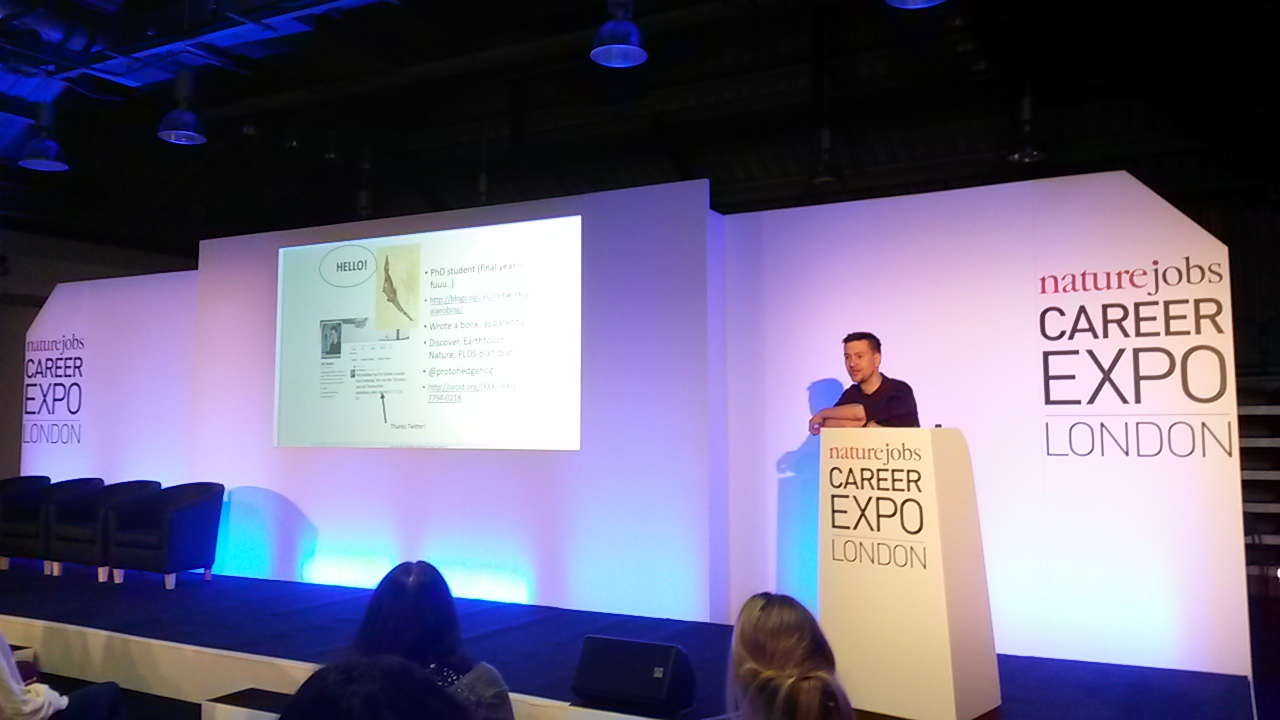
Jon-Tennant-NJCE15-communities-naturejobs-blog

Jon Tennant and the merits of online scientific communities {credit}Image credit: Julie Gould{/credit}

“Networking isn’t just me trying to get something from you,” said Julie Gould, editor of Naturejobs, as she opened the session on Building Scientific Communities at the 2015 London Naturejobs Careers Expo. “Networking is about building a relationship with another person that will benefit both of you.” The two invited speakers in this session, Sarah Blackford, head of Education & Public Affairs at the Society for Experimental Biology, and Jon Tennant, an Imperial College London PhD student, discussed some methods that early career scientists can use to start these types of relationships.

Learned societies

Learned societies, such as the Royal Society of Chemistry or the Biochemical Society, are, according to Blackford, “clubs for people with a similar interest in an academic discipline.” Early-career scientists often underestimate how useful learned societies can be in helping them advance their careers. Blackford pointed out that learned societies have quite a lot of money, and, as they’re not-for-profit, “they give that money back into the scientific community.” Learned societies do this partly by organising and subsidising events, such as conferences on topics that interest their members and giving travel grants to early-career scientists to enable them to attend external meetings. Continue reading
Networking for introverts

Being prepared can help introverts start conversations at big conferences, says Paul Brack.

Guest contributor Paul Brack

social-media-naturejobs-blog

Social media is a great tool for networking for introverted scientists.{credit}iStockphoto/thinkstock{/credit}

In the last few years, introverts have become the new geeks. In the past we were painted as miserable wallflowers. Now, thanks in large part to Susan Cain’s book Quiet and her accompanying TED talk in 2012, we’re often portrayed as the conscientious, thoughtful people who are going to quietly invent the technology needed to save the world.

Whilst the reality has of course always lain somewhere between these two extremes, there’s one thing that is true for introverts: we generally struggle with networking. Introverts find over-stimulating environments, like large groups at conferences, difficult to navigate. But that shouldn’t put an introverted scientist off from adapting their networking tools to suit their character.

At its heart, networking is about forming relationships. Some psychologists have suggested that introverted people take longer to make connections than extroverted people, as they find it more tiring. This is based on the description formulated by Katharine Cook Briggs and Isabel Briggs Myers (building on the work of Carl Jung), the developers of the Myers-Briggs Type Indicator ‘personality test’, that whereas extroverts are energised by meeting new people, introverts are drained. Continue reading