Vlatko Vedral is at the University of Oxford and the Centre for Quantum Technologies, National University of Singapore. His popular book “Decoding Reality: The Universe as Quantum Information” (recently reprinted in paperback by Oxford University Press) discusses many aspects of the relationship between information, thermodynamics and physics.
Every time physicists face experiments that cannot be explained with the existing theories they have to decide which aspects of these theories to keep and which to throw away. Planck, when faced with the inability of classical physics to explain black body radiation, decided to keep the laws of thermodynamics, but threw away the assumption that energy is continuous (which is an integral part of Newtonian mechanics). Similarly, Einstein, when trying to explain the inability of the Michelson and Morley experiments to detect Earth’s motion through the ether, kept the Newtonian assumption that the laws of physics should be the same in all reference frames, but he also introduced the invariance of the speed of light in different reference frames (a fact that is naturally encoded into Maxwell’s theory of electro-magnetism, but not Newtonian physics). Continue reading →
Paul Crowther is a professor of astrophysics in the Department of Physics & Astronomy at The University of Sheffield. His main research area involves observations of hot, luminous stars in nearby galaxies using space- and ground- based telescopes (including Hubble Space Telescope and the Very Large Telescope) and he has co-authored a monograph on this subject. Paul has an interest in UK science policy and has maintained a website charting the highs and lows of the Science & Technology Facilities Council funding agency since its inception four years ago. He also tweets.
Neutrino experiment
Has anyone else noticed that the mainstream media have gone slightly science gaga? Last week, Higgs-teria attracted front pages in broadsheets and lead stories in news bulletins, even though no more than “tantalizing hints” of the Higgs were announced. Before that, we had plenty of stories salivating over Kepler 22b, a.k.a. Earth 2.0, even though most exoplanet hunters were rather more cautious in their interpretation. Indeed, the Kepler team themselves only claimed Kepler 22b was a “milestone on the road to finding Earth’s twin.” Only yesterday the first genuinely Earth-sized planets were reported, although they wouldn’t resemble our planet in any other respect, given their close proximity to their host star. And not to mention the shenanigans with those pesky Italian faster-than-light neutrinos that spurred nuclear physicist, Jim Al-Khalili, into promising to eat his boxer shorts on live TV should the result be confirmed.
As a jobbing astronomer, I can’t deny that I’m all for the latest physics results getting publicity. Of course, as with all other branches of science, such results are merely the tip of the iceberg, with dozens of astrophysics papers posted on free-access archives daily. Still, there is an inherent risk of adverse reactions too. Cynical presenters may criticize the fanfare about the latest exoplanet discovery as useless because of its great distance. Hadn’t we got along just fine without the Higgs boson? Couldn’t and shouldn’t the costs devoted to the Large Hadron Collider have been better spent? In our new era of austerity, fundamental scientists need to be mindful of the “so what?” or “why bother?” mentality. Technologies and tools required to do big science may sometimes make a (really) big splash in the real world, even though practical applications aren’t intended at the outset. Surely though the biggest benefit of the media’s reports about the Universe is the power to inspire, attracting pupils into science and technology.
The pulling power of astronomy – the second oldest profession – is unique in it’s extraordinary breadth of scale. Astronomical eye candy can serve a useful purpose, although media reports regularly fail to focus upon the science behind the pretty pictures. On the same day as the fanfare over Kepler 22b’s discovery, the biggest black holes and the fastest spinning star were announced, each with their own ‘artists impressions’. I too have stumbled upon such objects, having identified the ‘most massive star’ and ‘biggest stellar mass black hole’ known to date. Stumbled was the right verb in my own case, since these record breakers involved more than a dash of fortune, not having explicitly set out to find the most extreme example of their peers. Serendipity and science combine surprisingly often.
Record breaking black holes fill a cosmic gap. Credit: P.Marenfeld/NOAO/AURA/NSF
In common with most university-based scientists, most of my work involves teaching students, supervising graduate students and carrying out research. In my case I study the biggest, baddest stars of all. The public appetite for astronomy, though, also adds to my diary through Café Scientifique-type talks to the public, at local primary and secondary schools, or amateur societies. Occasionally, more unusual requests come my way. Earlier this month, I hosted a film crew from NHK (Japanese TV) who interviewed me about minute details of the most massive star known for a programme about the satellite galaxies of our own Galaxy. Last week, I was asked to watch and discuss the science (or lack of it) behind ‘Another Earth’ for a local culture listings magazine.
Beyond the mainstream broadcast and print media, there are many initiatives actively involving the general public in science. Galaxy Zoo has been particularly successful in `citizen science’ for astronomy, and social networking sites such as Twitter do help to make connections between scientists and the public. There’s an increasing archive of wonderful short films explaining complex subjects in an incredibly accessible way, such as minutephysics. Google and YouTube are funding new science ‘channels’. Deep Sky Videos is one such initiative in which film make Brady Haran is ambitiously attempting to produce short videos on all 109 Messier objects, starting from next month.
Despite the adverse risks, it’s reassuring that the media interest in fundamental physics and astrophysics remains strong. Curiosity-driven basic research can capture the public attention, perhaps especially so in the midst of the current gloomy economic crisis. For the moment, then, the future looks bright for physics and astronomy, even though UK funding for this branch of science has taken a sharp downturn turn over the past few years. Let’s hope too that – if, and when, they are eventually found – the Higgs and genuine Earth–like planets make a big splash in the media, and continue to inspire future generations of scientists.
So far, the jury remains undecided on the fate of those boxer shorts.
This week’s guest post features an interview with Michael Brooks. As well as holding a PhD in quantum physics, Michael is an author, journalist and broadcaster. He’s a consultant to New Scientist, has a weekly column for the New Statesman, and is the author of the bestseller in non-fiction titled ‘13 Things That Don’t Make Sense’. As part of an ongoing cycle of lectures, the City of Arts and Sciences in Valencia, Spain, together with the British Council, recently invited Michael Brooks, to explain the simple question of the origins of the universe.
For a quick taster, here are a few snippets from Michael’s interview, but you can listen to the full interview in the podcast at the end of the post.
Q When did humans first begin to take an interest in discovering the origins of the universe?
Michael Brooks It’s a really interesting phenomenon that today, in 2011, we think of there being an origin to the universe or a beginning, because actually that’s a relatively new idea. It wasn’t really put out there till the 1920s by a Belgian catholic priest called Georges Lemaître. He came up with this idea of a day without yesterday, and there was a kind of firestorm, fireworks and suddenly, what he called the primeval atom, kind of exploded… and from this came the universe.
And… he kind of put this out in the late 1920s, and when Einstein heard about it in 1933, he said: “This is the most beautiful idea I’ve ever heard of”. In the meantime Edwin Hubble, the astronomer, had been gathering data that showed that most of the galaxies that surround us are moving away from us very fast, and if you wind that back, that implies that somehow they were all together in one place at the same time, which we would consider to be the beginning of the universe.
This seems like a common-sense idea to us now, actually it wasn’t accepted until the 1960s; it did 30 years in the cold and there were various debates over whether the universe had always existed. You couldn’t say anything about a beginning until we discovered the cosmic microwave background radiation, which was the echo of the Big Bang, and proved that there was some kind of cosmic explosion, like Lemaître had said. And that was the point at which we just dropped the idea of there being a steady state, always existing universe, and decided that there had to have been a beginning of everything.
Q Might the idea of the origins of the universe be challenging for certain religious sects in the same way that Darwin’s Origin of the Species has been?
Michael Brooks It’s very important to realise that scientists aren’t deliberately undermining people of faith and religious ideas. What they are doing is looking out into the cosmos and finding evidence for this and for that, and with that evidence we adjust our ideas – of course with Galileo we adjusted our ideas about whether the earth was at the centre of the universe. Based on the evidence we had to change that to having the sun as the centre of the solar system and the earth spinning around it.
Now, there is some backlash against this, particularly in the United States, where people want to only deal in terms of what their faith tells them to believe, or what their religious leaders tell them to believe. Science is no respecter of that really, in many ways, science comes in and says, “this is just what the evidence says, and this is what our experiments tell us,” or, “this is what we uncover in the fossil record.” I don’t think there is a deliberate attempt to create trouble; it’s certainly not an attempt to undermine some of the other benefits of faith communities and everything else. I think it’s just that there are historically always areas where science just treads on the toes of people who hold religious faiths, and whereas science doesn’t really kind of pull any punches, the religious people, the religious leaders have to bend and accommodate the new scientific understanding. So this is always going to happen, I think.
Q Scientific discovery is obviously accelerated massively in the last hundred years. How much more is there for mankind to discover?
Michael Brooks Science is actually very humble in a sense, in that we’ve had 400 years of discovery, and cosmology has uncovered the history of the universe – 13.7 billion years old. But at the same time we realise how little we know, and we’ve discovered that 96% of the universe is in some form that we don’t understand, 72% is dark energy, a mysterious force that seems to be pushing on the very fabric of the universe, and 24% is dark matter, the stuff that exists out there, we know it must be there, or we think it must be there, or our calculations say it must be there. And we then have to work out what it is and look for it, and we’ve actually been looking for it properly for about 40 years now and still not found any clue about where it might be, or what kind of particles these might be.
So it keeps us humble, in a sense inside, and that’s one of the great things, [that] for every discovery that we make, there seem to be about ten more unanswered questions coming. And I think that’s one of the beauties of science, that it never seems to end, it seems to provoke more and more curiosity and questions.
Q You and the City of Arts and Sciences in Valencia coincide in their desire to bring science closer to ordinary people and to make it accessible. Many people might see this as the exact opposite of the arts, where great art is not always meant to explain itself. Why is this?
Michael Brooks I think science takes the trouble because some of the concepts that we deal in are so abstract and so difficult to grasp. You can look at a painting and appreciate a painting without really knowing an awful lot about who painted it, or why, or what they were trying to get across, and you get this aesthetic beauty. Whereas some of the aesthetic beauty in science lies in very complicated equations, or in complicated ideas about, for instance, the beginning of the universe.
And so scientists are really taking it upon themselves to explain. And also there is a passion as well, about what we’ve discovered. It’s an extraordinary thing to be able to discover these things about the universe and how they work. So it’s very rewarding in and of itself to actually explain these to people and see their faces light up.
So maybe some of the arts, certainly painting and writing, people can take it in at whatever level they want to take it in at. So they don’t need so much kind of advocacy, they don’t need so much explanation and communication, whereas science is actually quite inaccessible until somebody is there acting as a bridge between the scientific community and the general public.
North by Southwest is an English-language radio programme giving a taste of British and international culture and arts in Spain and also explores social, scientific and educational issues. North By Southwest is broadcast every week on RNE’s Radio Exterior (World Service) as part of its English-language programming.
This week’s guest blogger isManjit Kumar.Manjit’s book, Quantum: Einstein, Bohr and the Great Debate,is about the nature of reality, and was shortlisted for the 2009BBC Samuel Johnson Prize for Non-fiction.He writes and reviews regularly for a variety of publications, including The Guardian, The Independent, The Times and the New Scientist. He used to edit a journal called Prometheus that covers the arts and sciences, and he was also the consulting science editor atUK Wired.
The first Solvay Conference on Physics, held in Brussels
Left-to right standing – Robert Goldschmidt, Max Planck, Heinrich Rubens, Arnold Sommerfeld, Frederick Lindemann, Maurice de Broglie, Martin Knudsen, Fritz Hasenöhrl, Georges Hostelet, Edouard Herzen, James Hopwood Jeans, Ernest Rutherford, Heike Kamerlingh Onnes, Albert Einstein, Paul Langevin. Seated – Walther Nernst, Marcel Brillouin, Ernest Solvay, Hendrik Lorentz, Emil Warburg, Jean-Baptiste Perrin (reading), Wilhelm Wien (upright), Marie Curie, Henri Poincaré.
In June 1911 Albert Einstein was a professor of physics in Prague when he received a letter and an invitation from a wealthy Belgium industrialist. Ernst Solvay, who had made a substantial fortune by revolutionizing the manufacture of sodium carbonate, offered to pay him one thousand francs if he agreed to attend a ‘Scientific Congress’ to be held in Brussels from 29 October to 4 November. He would be one of a select group of twenty-two physicists from Holland, France, England, Germany, Austria, and Denmark being convened to discuss ‘current questions concerning the molecular and kinetic theories’. Max Planck,Ernest Rutherford,Henri Poincare,Hendrik Lorentz and Marie Curie were among those invited. It was the first international meeting devoted to a specific agenda in contemporary physics: the quantum.
Planck and Einstein were among the eight asked to prepare reports on a particular topic. To be written in French, German, or English they were to be sent out to the participants before the meeting and serve as the starting point for discussion during the planned sessions. Planck would discuss his blackbody radiation theory, while Einstein had been assigned his quantum theory of specific heat. Accorded the honour of giving the final talk, there was no room on the proposed agenda for a discussion of his light-quanta – better known these days as photons.
‘I find the whole undertaking extremely attractive,’ Einstein wrote to Walter Nernst, ‘and there is little doubt in my mind that you are its heart and soul.’ Nernst with his love of motorcars was more flamboyant than the staid Planck, but was just as highly respected – in 1920 he was awarded the Nobel Prize for chemistry for what became known as the third law of thermodynamics. A decade earlier, in 1910 he was convinced that the time was ripe to launch a cooperative effort to try and get to grips with the quantum he saw as nothing more than a ‘rule with most curious, indeed grotesque properties’. Nernst put the idea to Planck who replied that such ‘a conference will be more successful if you wait until more factual material is available’. Planck argued that ‘a conscious need for reform, which would motivate’ scientists to attend the congress was shared by ‘hardly half of the participants’ envisaged by Nernst. Planck was sceptical that the ‘older’ generation would attend or would ‘ever be enthusiastic’. He advised: ‘Let one or even better two years pass by, and then it will be evident that the gap in theory which now starts to split open will widen more and more, and eventually those still remote will be sucked into it. I do not believe that one can hasten such processes significantly, the thing must and will take its course; and if you then initiate such a conference, a hundred times more eyes will be turned to it and, more importantly, it will take place, which I doubt for the present.’
Undeterred by Planck’s response, Nernst convinced Solvay to finance the conference. Interested in physics, and hoping to address the delegates about his own ideas on matter and energy, Solvay spared no expense as he booked the Hotel Metropole. In its luxurious surrounding, with all their needs catered for, Einstein and colleagues spent five days talking about the quantum and, as Lorentz said in his opening remarks, the reasons why the ‘old theories do not have the power to penetrate the darkness that surrounds us on all sides’. However, he continued, that the ‘beautiful hypothesis of the energy elements, which was first formulated by Planck and then extended to many domains by Einstein, Nernst, and others’ had opened unexpected perspectives, and ‘even those who regard it with a certain misgiving must recognize its importance and fruitfulness.’
‘We all agree that the so-called quantum theory of today, although a useful device, is not a theory in the usual sense of the word, in any case not a theory that can be developed coherently at present,’ said Einstein. ‘On the other hand, it has been shown that classical mechanics…cannot be considered a generally useful scheme for the theoretical representation of all physical phenomena.’ Whatever slim hopes he abhorred for progress at what he called ‘the Witches’ Sabbath’, Einstein returned to Prague disappointed at having learnt nothing new. ‘The h-disease looks ever more hopeless,’ he wrote to Lorentz after the conference.
Nevertheless, Einstein had enjoyed getting to know some of the other ‘witches’. Marie Curie, whom he found to be ‘unpretentious’, appreciated ‘the clearness of his mind, the shrewdness with which he marshalled his facts and the depth of his knowledge’. During the congress it was announced that she had been awarded the Nobel Prize for chemistry. She had become the first scientist to win two, having already won the Physics prize in 1903. It was a tremendous achievement that was overshadowed by the scandal that broke around her during the congress. The French press had learned that she was having an affair with a married French physicist. Paul Langevin was another delegate at the congress and the papers were full of stories that the pair had eloped. Einstein, who had seen no signs of a special relationship between the two, dismissed the newspaper reports as rubbish. Despite her ‘sparkling intelligence’, he thought Curie was ‘not attractive enough to represent a danger to anyone’.
The Solvay Congress was the end of the beginning for the quantum. It dawned on physicists that it was here to stay and they were still struggling to learn how to live with it. When the proceedings of the conference were published it brought to the attention of others, not yet aware or engaged in the struggle, what an immense challenge it was to successfully do so. The quantum would be the focus of attention at the fifth Solvay conference in 1927. What happened in the intervening years is, as they say, history.
This week’s guest blogger, Frank Close, is a particle physicist, author and speaker. He is Professor of Physics at the University of Oxford and a Fellow of Exeter College, Oxford. He is the author of several books, including the best-selling Antimatter, and the winner of the Kelvin Medal of the Institute of Physics for his “outstanding contributions to the public understanding of physics.”
Of all the things that make the universe, the commonest and weirdest are neutrinos*. Able to travel through the earth like a bullet through a bank of fog, they are so shy that half a century after their discovery we still know less about them than all the other varieties of matter that have ever been seen.
These will o’ the wisps are coming up from the ground beneath our feet, emitted by natural radioactivity in rocks, but most of those hereabouts were born in the heart of the Sun less than 10 minutes ago. In just a few seconds the Sun has emitted more neutrinos than there are grains of sand in the deserts and beaches of the world, greater even than the number of atoms in all the humans that have ever lived. As you read this, billions of them are hurtling, unseen, through your eyeballs at almost the speed of light. They pass through the earth as easily as a bullet through a bank of fog.
If we could see with neutrino eyes, night would be as bright as day: solar neutrinos shine down on our heads by day and up through our beds by night, undimmed. To capture even a few of them requires thousands of tonnes of material. When Ray Davis began chasing solar neutrinos in 1960, many thought he was attempting the impossible. It nearly turned out to be: 40 years were to pass before he was proved right, winning his Nobel Prize in 2002, aged 87.
Patience is an asset in the neutrino business. Not only was Davis the first human to look inside a star, his legacy is a new science: neutrino astronomy. Not just the Sun; each of the stars visible to the naked eye, and the countless ones seen by the most powerful telescopes, are all filling the void with neutrinos. The neutrinos born in the Sun and stars, numerous though they are, are relative newcomers. Most are fossil relics of the Big Bang, and have been travelling through space unseen for over 13 billion years.
Scientists are now decamping to Antarctica, in the hope of achieving things even more remarkable than even Davis – capturing neutrinos from distant stars, and even some that are remnants of the big bang.
Neutrinos from afar
Apart from the sun, the only star ever seen to shine in neutrinos has been a supernova.
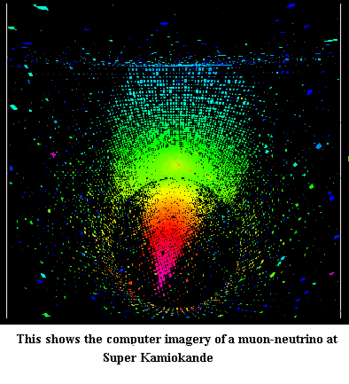
On 23 February 1987, utterly without warning, a supernova was seen to have erupted in the Large Magellanic Cloud, a satellite galaxy of the Milky Way in the southern skies. A blast of neutrinos from this explosion, having travelled across space for 170,000 years, passed through the Earth during about 15 seconds that day. Underground experiments detected a handful of neutrinos from the supernova.
Astrophysicists had long believed that the gravitational collapse of a supernova is a copious source of neutrinos; that the brilliant flash of light, the traditional manifestation of a supernova that can briefly outshine an entire galaxy, is only a minor part of the drama. Powerful though this intense electromagnetic radiation is, the visible light, radio waves, X rays and gamma rays all add up to less than 1 per cent of the whole. The bulk of the energy radiated by the supernova is carried away by neutrinos.
For the first time, we had detected neutrinos emanating from outside our galaxy, and proved that the theory of a supernova is right: when stars collapse they throw off their energy as neutrinos, up to 1059 – that’s one followed by 59 zeroes – a hundred billion trillion trillion trillion trillion of them.
Most had spread around the cosmos; only a few passing through the detectors on Earth. Even so, by detecting this momentary blast of neutrinos, we had our first look into the workings of a supernova. This confirmed everything that had previously been just theory: a supernova is the result of a star collapsing to form a neutron star.
Neutrinos on Ice
With the singular exception of supernova, neutrinos from stars in our galaxy and beyond are probably as faint compared to solar neutrinos as is starlight to daylight. To have any chance of capturing them requires detectors containing over a cubic kilometre of matter.
The ingenious solution is Ice Cube, an experiment just beginning at the South Pole, which uses the ice in the Antarctic as a natural detector of the vast numbers of neutrinos that fill the void
Ice in the Antarctic is not like ice that we are used to on a cold winter’s day at home. In the Antarctic, snow has fallen on ice for much longer than recorded-history. Deep down, the pressure is so great that all the air bubbles have been squeezed out, leaving ice so pure that light flashes, produced by neutrinos, can travel hundreds of metres.
Photomultiplier tubes – devices for recording the tell-tale flashes of light – have been lowered into the ice, down shafts that are made by a special drill that sprays out hot water and melts a hole. The detector is attached to a long cable, lowered into the ice, which then freezes it into place. From then on it records data continuously. The set-up is so sensitive that it regularly records neutrinos produced by cosmic rays hitting the atmosphere from all around the globe; some come from directly above the Antarctic, while others have travelled all the way through the Earth, from the North Pole.
Ice Cube will look further into space and into areas – such as the galactic core of the Milky Way – that we’ve never been able to see before. It is possible that neutrinos will interact with the background radiation from the big bang. There may be surprises, even more sensational than anything that has happened so far.
To learn more on this thrilling subject why not come to one of Frank Close’s talks, or read his book Neutrino. Details can be found on hiswebsite
*Definition: The neutrino is a sub atomic particle which holds no electrical charge, travels at nearly the speed of light, and passes through ordinary matter nearly unharmed. Neutrinos are emitted in huge numbers by stars like the sun.

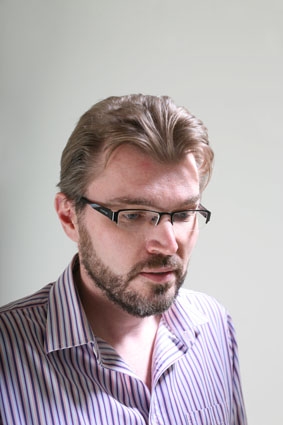 Vlatko Vedral is at the University of Oxford and the Centre for Quantum Technologies, National University of Singapore. His popular book “Decoding Reality: The Universe as Quantum Information” (recently reprinted in paperback by Oxford University Press) discusses many aspects of the relationship between information, thermodynamics and physics.


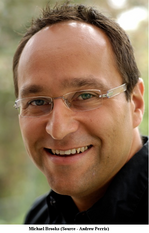
 This week’s guest blogger is
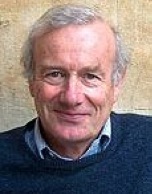 This week’s guest blogger,
 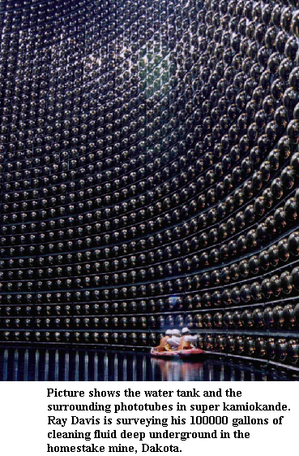 If we could see with neutrino eyes, night would be as bright as day: solar neutrinos shine down on our heads by day and up through our beds by night, undimmed. To capture even a few of them requires thousands of tonnes of material. When
  For the first time, we had detected neutrinos emanating from outside our galaxy, and proved that the theory of a supernova is right: when stars collapse they throw off their energy as neutrinos, up to 1059 – that’s one followed by 59 zeroes – a hundred billion trillion trillion trillion trillion of them.