

“It was an entirely new world, and IT opened my eyes to how few black and brown young men were active in the technology industry.” (Image courtesy of All Star Code)
In the last instalment of our series celebrating prominent women in science and technology across the world, we speak to Christina Lewis Halpern, the founder of All Star Code, a charity which aims to prepare talented young men from minority backgrounds for careers in science and technology.
Christina Lewis Halpern is a social entrepreneur and award-winning journalist who is the founder of All Star Code, a unique, fast-growing non-profit education organization that attracts, prepares and places more young men of color in the technology sector. Christina is a board member of the Reginald F. Lewis Foundation, has been profiled in Fortune, Fast Company, Domino, and Vanity Fair and her work has been published in The New York Times Magazine and other publications. She has been recognized as a White House 2014 Champion of Change for STEM Access and has given talks at Harvard Law School, J.P. Morgan, the Wealth and Giving Forum, among others. She graduated from Harvard College and lives in New York City with her husband, son and dog.
On a sign that adorns the premises of the vibrant New York technology charity, All Star Code, the bold messaging could not be clearer. Displayed in large writing are the top ten principles that inspired the charity’s creation. Most prominently placed, and one that will ring true to many Americans, is number one. It reads: “Boys Matter: Young men of color are one of our nation’s greatest sources of untapped talent.” This is a sentiment echoed throughout the organisation’s activities, which primarily aims to prepare talented young men from minority backgrounds for careers in science and technology.
The west Chelsea offices have the look and feel of a traditional start-up. It is at once informal, accommodating and inclusive – the key ingredients that the charity, one year in, has thrived on. And yet, the protagonist behind its creation had until recently been very much an outsider to the technology community.
Wealth gap
Former Wall Street Journal business journalist, Christina Lewis Halpern, had a front row seat to observe and analyse the growth in income inequality and those with assets, who “reaped the seemingly ever-increasing rewards.” Through interviews with the upper echelons of the business world and covering real estate during both boom and bust, she became quickly attuned to the wealth gap. “The gap is very stark in the US with the average white household’s net worth of $110,000, compared to the average black household of around $6,000?” says Lewis Halpern. “It is a terrible problem. When I left the newspaper I was determined to see what I could do to make a difference.”
Lewis Halpern didn’t need to look far for inspiration, as the daughter of one of the most charismatic and powerful African-American businessmen in the US, the late Reginald F.Lewis. The month before her father died in 1993, she was named to the board of his foundation, aged just 12 years-old. The Reginald F. Lewis Foundation had for many years funded grants of more than $10m to various non-profit programmes and organisations. It was dedicated to supporting youth, arts and education programmes that help minority communities.
Through writing a memoir on her father’s life, called Lonely at the Top, she was fortunate enough to speak to the professor who ran the access programme her father attended and which ultimately encouraged him to pursue law. “My father was one of the first African Americans to work in a white shoe law firm on Wall Street in the 1960s and 1970s, and was a pioneer in his field,” says Lewis Halpern. “He did this because of an access programme. Run by Harvard Law School, the programme would recruit college juniors from black colleges in the south and bring them to the city to introduce them to corporate law.”
Speaking to the now 85-year-old professor and Holocaust survivor, she felt immediately empowered and spurred on to create a prep programme that was as effective as her father’s. It was by chance that she attended her first ever technology conference, a world very different to the corporate environment she was used to reporting in. “It was an entirely new world, and IT opened my eyes to how few black and brown young men were active in the technology industry. It was clear this was the next economic opportunity and was where the wealth, innovation and job opportunities were,” declares Lewis Halpern.
She notes that if her father was a young man today, he would no doubt be working in technology. Through researching the industry and looking at what was available, it was clear there were some great programmes for young women, such as Black Girls Code, but a lack of opportunities for young minority men. “In honor of my father’s legacy – and everyone else who has fought for equal rights – I created this program to help the future generation of youth catch the next wave of opportunity,” remarks Lewis Halpern on her clear intentions for All Star Code.
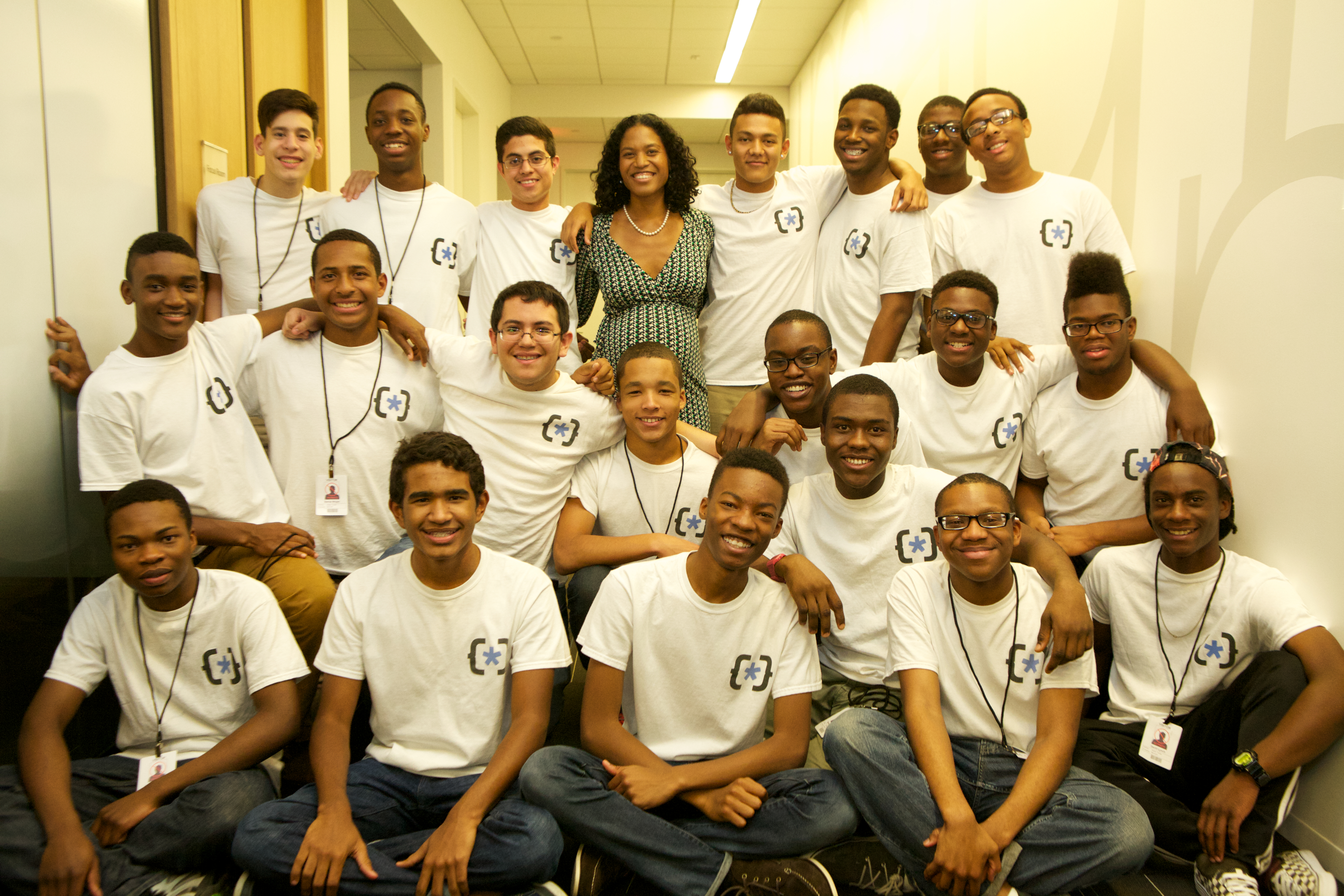
“Many students we speak to have never heard of a hackathon or even knew there was such thing as a computer scientist. It’s clear we need more access in the pipeline.” (Image courtesy of All Star Code)