Risk perception

untitled.bmp

David Ropeik is an international consultant in risk perception and risk communication, and an Instructor in the Environmental Management Program at the Harvard University Extension School. He is the author of How Risky Is It, Really? Why Our Fears Don’t Always Match the Facts, principal co-author of RISK A Practical Guide for Deciding What’s Really Safe and What’s Really Dangerous in the World Around You, and blogs for Huffington Post, Psychology Today, and has written guest blogs for Scientific American, Climate Central, and Big Think. He founded the program “Improving Media Coverage of Risk,” was an award-winning journalist in Boston for 22 years and a Knight Science Journalism Fellow at MIT.

You are reading a piece in Nature, so you are probably fairly well-educated, and there is a better than even chance that you fancy yourself a fact-based thinker and reasonably rational. Meaning no disrespect, but that assumption is fanciful, at least when it comes to the perception of risk. Ambrose Bierce was right when he defined the brain as “the organ with which we think we think.” Research from diverse fields, and countless examples from the real world, have convincingly established that our perceptions of risk are an inextricable blend of fact and feeling, reason and gut reaction, cognition and intuition. No matter what the hard risk sciences may tell us the facts are about a risk, the social sciences tell us that our interpretation of those facts is ultimately subjective.

While this system has done a good job getting us this far along evolution’s winding road, it also gets us into trouble because sometimes, no matter how right our perceptions feel, we get risk wrong. We worry about some things more than the evidence warrants (vaccines, nuclear radiation, genetically modified food), and less about some threats than the evidence warns (climate change, obesity, using our mobiles when we drive). That produces what I have labeled The Perception Gap, the gap between our fears and the facts, which is a huge risk in and of itself.

The Perception Gap produces dangerous personal choices that hurt us and those around us (declining vaccination rates are fueling the resurgence of nearly eradicated diseases). It causes the profound health harms of chronic stress (for those who worry more than necessary). And it produces social policies that protect us more from what we’re afraid of than from what in fact threatens us the most (we spend more to protect ourselves from terrorism than heart disease)…which in effect raises our overall risk.

We do have to fear fear itself…too much or too little. So we need to understand how our subjective system of risk perception works, in order to recognize and avoid its pitfalls. Surprisingly, few people are aware of how much we know about this system. (I’ve tried to summarize that knowledge in my book, How Risky Is It, Really? Why Our Fears Don’t Always Match the Facts). Here’s a mad dash through the literature on risk perception;

• Neuroscience by Joseph LeDoux et.al. has discovered neural pathways that insure that we respond initially to risky stimuli subconsciously/instinctively, before cognition kicks in. And in the ongoing risk response that follows, the wiring and chemistry of the brain also insure that instinct and affect (feelings) play a significant role, sometimes the primary role, in how we perceive and respond to danger. Simplistically, the brain is designed to subconsciously feel first and consciously think second, and to feel more and think less.

• The research of Daniel Kahneman et.al. has discovered a mental toolbox (as Gird Gigerenzer puts it) of heuristics and biases we use to quickly make sense of partial information and turn a few facts into the full picture of our judgment. These mental shortcuts occur subconsciously, outside (and often before) conscious reasoning. This research further confirms that we are far more Homo Naturalis than Homo Rationalis.

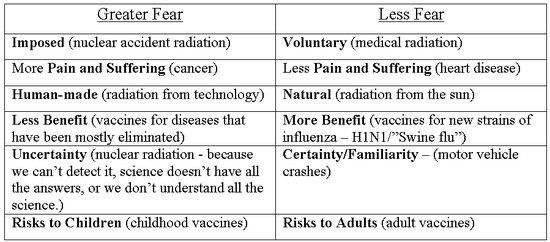
• The Psychometric Paradigm research of Paul Slovic et.al. has revealed a suite of psychological characteristics that make risks feel “more” frightening, or less, the facts notwithstanding. These ‘risk perception factors’ include:
untitled.bmp

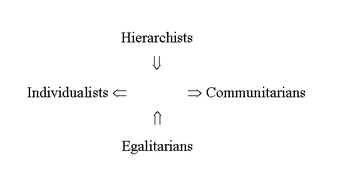
• Recent research on the theory of Cultural Cognition by Dan Kahan et.al has found that our views on risks are shaped to agree with those we most strongly identify with, based on our group’s underlying feelings about how society should operate. We fall into four general groups about the sort of social organization we prefer, defined along two continua, represented as a grid. We all fall somewhere along these two continua, depending on the issue.
untitled1.bmp

Individualists prefer a society that maximizes the individual’s control over his or her life. Communitarians prefer a society in which the collective group is mire actively engaged in making the rules and solving society’s problems (Individualists deny environmental problems like climate change because such problems require a ’we’re all in this together’ communal response. Communitarians see climate change as a huge threat in part because it requires a social response). Along the other continuum, Hierarchists prefer a society with rigid structure and class and a stable predictable status quo, while Egalitarians prefer a society that is more flexible, that allows more social and economic mobility, and is less constrained by ‘the way it’s always been’. (Hierarchists deny climate change because they fear the response means shaking up the free market-fossil fuel status quo. Shaking up the status quo is music to the ears of Egalitarians, who are therefore more likely to believe in climate change.)

—

That risk is inescapably subjective is disconcerting for those who place their faith in the ultimate power of Pure Cartesian “I think, therefore I am” Reason. But the robust evidence summarized above makes clear that;

1. Risk perception is inescapably subjective

2. No matter how well educated or informed we may be, we will sometimes get risk wrong, producing a host of profound harms.

3. In the interest of public and environmental health, we need a more holistic, and more realistic, approach to what risk means. Societal risk management has to recognize the risk of risk misperception, the risk that arises when our fears don’t match the evidence, the risks of The Perception Gap.

Letting go of our naïve fealty to perfect reason will allow us to recognize and understand these hidden dangers. Once brought to light, the harms to society from declining vaccination rates, the lost benefits of genetically modified food, the morbidity and mortality and societal costs of obesity – these risks and many more can be studied and quantified and managed with the same tools we already use to manage the risks from pollution or crime or disease. The challenge is not how to manage the risks of the Perception Gap. The challenge is to rationally let go of our irrational belief in the mythical God of Perfect Reason, and use what we know about the psychology of risk perception to more rationally manage the risks that arise when our subjective risk perception system gets things dangerously wrong.

Further Reading:

The neuroscience of risk perception – LeDoux J, The Emotional Brain, Simon and Schuster, 1996

Heuristics and Biases – Kahneman, D., Slovic, P. & Tversky, A. Judgment Under Uncertainty: Heuristics and Biases, Cambridge University Press, 1982)

The Psychometric Paradigm ‘risk perception factors’ – Slovic P, The Perception of Risk, Earthscan 2000
Cultural Cognition.

On being

Cross-posted with permission of OUPblog.

Peter_Atkins_Paris_2007.JPG

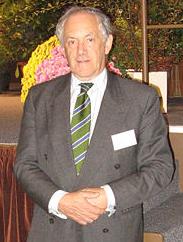
Peter Atkins is the author of almost 60 books, including Galileo’s Finger: The Ten Great Ideas of Science, Four Laws that Drive the Universe, and the world-renowned textbook Physical Chemistry. His latest book is On Being, which is a scientist’s exploration of the great questions of existence. You can watch a video of him in conversation about this book here._

Deep questions of existence have entertained both sharp and dull minds throughout the history of humanity. Where did it all come from? What is the point of it? What happens after you die? Great mounds of implausible speculation have been tipped on these pressing questions by theologians and philosophers; whole churches have been founded as a result of the institutionalization of the answers. But all those answers were guided by speculation and sentiment and typically expressed in compelling language that captured minds but concealed emptiness. They were emperor’s new clothes with no emperor within.

Then, along came science. It is really very surprising that it took humanity so long to stumble on a technique of investigation that is so obvious: to examine the world to discover what it is really like rather than merely to think about it and then assert what it is like. At first, like a child with its milk teeth, the emerging band of scientists could tackle only the soft pap of questions, such as the swing of a pendulum, the action of a lever, and the motion of a planet. In due course, those milk teeth gave way to fangs of a sharper cut, and the international, interacting, intercultural army of practised scientists began to think about tough questions. Even the grand questions, such as the large-scale structure of the universe became part of their diet, and they began to digest what hitherto had seemed indigestible.

Science can now illuminate the great questions of being. Admittedly not fully, for science is not yet complete and certainly cannot tell us yet how the universe emerged out of absolutely nothing, nor can it tell us all the details of the emergence of the organic from the inorganic and its subsequent flourishing as the biosphere. It does know in considerable detail how life achieves a certain virtual immortality by passing on its embedded information from one generation to the next, and it understands in remarkable detail how Nature has stumbled on a way of interpreting that information as actual organism. It also knows in considerable detail how nature goes about clearing out those organisms once they have had the opportunity to pass on their precious information to the next cart, a clearing out that makes way for the continuation of other lives. Science can even speculate, but now with speculation in the hard grip of theories devised on the basis of observation, what the long-term future of the world and perhaps even the universe will be.

Science is still stumped by some of the great questions of being. It still is unable to provide the answers to perhaps the two greatest questions of all: how something came into being from absolutely nothing, not just empty space, and how that something acquired the ability to reflect on such questions (that is, the emergence and nature of consciousness). But neither great question is outside the grasp of science, and both are becoming open to investigation. As scientists are cautious optimists, there is every hope that these truly great and extraordinarily difficult questions will give way to their mode of investigation.

All of humanity should take pride in the fact that the grasp of the human mind, especially when working collectively and in collaboration across space and time, appears to be capable of boundless comprehension. It is a taste of its achievements, which in my view adds wonder to existence, that I seek to provide in On Being.

Science: A Four Thousand Year History

pat 2.JPG

This weeks guest blogger, Patricia Fara, discusses some problems she faced when deciding how to begin her most recent book, Science: A Four Thousand Year History. She lectures on the history of science at Cambridge University, where she is Senior Tutor of Clare College. Her other successful books include Newton: The Making of Genius (2002), Sex, Botany and Empire (2003) and Pandora’s Breeches: Women, Science and Power in the Enlightenment (2004).

Lewis Carroll knew how difficult it can be to tell a story. ‘Where shall I begin, please your Majesty?’, asked the White Rabbit. Alice listened for the answer. ‘Begin at the beginning,’ the King said, gravely, ‘and go on till you come to the end: then stop.’

To write Science: A Four Thousand Year History, I had to decide when science began. This is no trivial question, but gets right to the heart of what science might be. Looking back at the past, it is possible to pick out ideas and discoveries that later became incorporated within today’s global scientific enterprise. But at the time, they contributed to other goals – finding an auspicious time for religious festivals, winning wars, vindicating biblical prophecies, making a living.

Separating science from superstition is not always easy. When early astronomical observers looked up into the heavens, they saw seven planets circling around the Earth. The Sun and the Moon were the most obvious, but they also identified five others – Saturn, Jupiter, Mars, Venus and Mercury (the next one to be discovered, Uranus, was only spotted at the end of the eighteenth century). Finding planets, and working out how they move across the sky, demands skills that are important for modern science. On the other hand, the first sky-watchers were not primarily interested in how the universe operates, but instead were trying to relate the patterns of the stars to major events on earth, such as famines, floods or the death of a king.

Planets.gif

So it seems wrong to call them scientists. But does it make sense to disparage their conclusions? Modern astronomy rests on a foundation of data collected by expert star-gazers who were also astrologers. Their observations were generally sound, even if their theories have since been rejected. Many scientists find it hard to accept that their own expertise is rooted in beliefs which they dismiss as magic. For those who pledge their faith in progress, magical mumbo-jumbo has been eliminated by scientific reason: magic and science are clearly polar opposites, and any notion that they might share common origins is sacrilegious. But this comforting view is not always easy to reconcile with the historical facts.

newton1-1.JPGConsider Isaac Newton. He believed so firmly in the Greek idea of a harmonic universe that he divided the rainbow into seven colours to correspond with the musical scale. Before then, although opinions varied, artists mostly showed rainbows with four colours. It is, of course, impossible to make any objective decision about the correct number, because the spectrum of visible light varies continuously: there is no sharp cut-off between bands of different colours, so how you think about a rainbow affects how you see it. Be honest – can you tell the difference between blue, indigo and violet?

Since Newton has become an iconic scientific genius, it would seem strange to say that he did not practise science. On the other hand, modern scientists denigrate many of his activities as ridiculous, or even antithetical to science. In addition to his preoccupation with numbers and biblical interpretation, Newton carried out alchemical experiments, poring over ancient texts and careful recording his own thoughts and discoveries. This was no mere hobby: Newton regarded alchemy as a vital route to knowledge and self-improvement, and he incorporated his findings within his astronomical theories.

The example of Newton illustrates how hard it is to pin down exactly when science began. One possibility is to look for the first scientists. But the word scientist was not even invented until 1833, and even then was slow to catch on. Both Michael Faraday and Charles Darwin refused to let themselves be labelled with the new term, but a history that excludes them would seem strange. The most popular starting date is 1543, when Nicolas Copernicus suggested that the Sun and not the Earth lies at the centre of our planetary system. However, there are several objections to this choice, not least that it excludes the Islamic sages whose ideas were so significant in Renaissance Europe, and also the Greeks, whose theories remained influential well into the eighteenth century. So some historians decide choose to begin with the geometer Thales of Miletus, who lived on the Turkish coast around 2500 years ago, and successfully predicted an eclipse. But picking him results in leaving out all of his important predecessors, such as the Egyptians and the Babylonians.

Babylonian 'Queen of teh Night'For Science: A Four Thousand Year History, I decided to start with the Babylonians, whose way of thinking about the universe still affects modern science. Instead of counting in tens and hundreds, they used a base of sixty, which is why there are 360 degrees in a circle. Their complex mathematical techniques and detailed star observations enabled them to predict celestial events – and because their knowledge of the skies was inherited by later observers, it now forms the basis of astronomy as well as structuring everyday life. Thanks to the Babylonians, weeks have seven days, hours have sixty minutes, and minutes have sixty seconds. The next time you look at a digital clock, remember that it has more in common with a clay tablet than you might think.

Where’s the catch?

John Farndon

This week’s guest blogger is John Farndon, with his second guest post. Having studied earth sciences at Cambridge University, John has written more than 300 books on science and nature including How the Earth Works, The Wildlife Atlas, The Practical Encyclopedia of Rocks and Minerals, and the forthcoming The Atlas of Oceans.

Last week, I saw in the news that the EU has pledged to change the clause in the Common Fisheries Policy which effectively forces fishermen to throw millions of dead fish back into the sea.

As it stands, fishing boats can only land particular numbers of particular fish. So any fish hauled up in the nets surplus to quota is simply chucked overboard, already dead. In the whitefish industry, up to half the catch is discarded. With flatfish, over 70 per cent of the catch goes overboard. The waste is appalling. As a policy designed to protect threatened fish populations, it clearly doesn’t work.

Thanks in part to public pressure stirred up by TV chef Hugh Fearnley-Whittingstall, EU fishery officials are now looking at how best to alter the system. One suggestion is that fishing boats are required to land all their catch and count any extra fish as part of the quota, regardless of species or size. So boats have to stop fishing as soon as they catch a certain tonnage, even if only a small proportion is the fish they want. The UK is trying this tactic out in the North Sea at the moment.

This is good, and yet it is just the tip of the iceberg, or rather the tiddler in the shoal. The fishing industry has created a global crisis in the oceans, the scale of which is only just beginning to dawn.

tuna final.JPGThe dreadful wastefulness of bycatch (unwanted fish caught up in the nets) is just part of the picture, as I discovered when writing my forthcoming book Atlas of Oceans (Yale UP and A & C Black). Each year a staggering 30 million tonnes of unwanted fish are dumped in the sea, including dolphins, whales, turtles as well as countless smaller sea creatures. Yet the wastefulness of bycatch, shocking though it is, is just part and parcel of the way the world’s fishing industry is now scooping marine life from the oceans like there was no tomorrow.

In the 1950s, the annual fish catch around the world was 20 million tonnes. Now, thanks to industrial fishing boats that can haul fish from the sea at an awesome rate, it is over four times that much at 80 million tonnes. The annual take has declined slightly in recent years – not because there has been much let up in the relentless pursuit of wild fish, but because fish are becoming so scarce they are harder to find even with modern location techniques.

Fishing quotas have been in place for decades but have not prevented many populations of once abundant fish being fished out. Northern cod, North Sea mackerel, Antarctica’s marbled rock cod, bluefin tuna and many other populations have all but gone. Ninety per cent of large predatory fish such as tuna, sharks and billfish have been removed over the last century. Notoriously, the fishmarket.JPG

In 2006, Boris Worm, a marine ecologist at Dalhousie University in Halifax, Nova Scotia, Canada, presented a study which projected that overfishing was proceeding at such a breakneck speed that the oceans would be entirely fished out of edible fish by 2048. Some experts argued that Worm was overstating the problem, and one of his critics, Ray Hilborn, joined him on a new study, completed in 2009. Even this new study suggested that 63 per cent of fish populations were being fished at such unsustainable levels that they will inevitably collapsed unless there is some change.

By themselves, EU quotas quickly become irrelevant. As fish populations in the inshore waters of the developed countries are fished out, so the boats move on to exploit the inshore waters of developing countries, or out into the deep, where species only recently discovered are already under threat of extinction. Commercial fisheries have also been ‘fishing down food webs’ which means that once they have fished out big fish, they move on to smaller fish and will eventually be catching jellyfish and plankton.

Nonetheless, there are grounds for hope. There are places where fish stocks are managed properly, and where there is only a limited amount of illegal fishing. There fish stocks do seem to show signs of sustainability and even recovery in some cases. Out of 10 regions in North America, northern Europe and Oceania that Worm and Hilborn’s team looked at closely, five showed signs of improvement, with diminishing rates of exploitation in recent years.

beam_trawler_graphic_430.jpg

In other words, political and government action can make a difference, and more importantly so can consumer pressure and choice to alter fishing practices. The biggest choice the consumer can make, though, is to remember that every morsel of wild food is precious. Jellyfish stew, anyone?

What is milk?

atkins_p_08.jpgPeter Atkins is Professor of Geography at Durham University . His main research interest is in food and drink, with particular reference to their materiality; the stuff in foodstuffs. His work ranges from arsenic poisoning in the groundwater in Bangladesh to a history of milk. His latest book, Liquid Materialities: a History of Milk, Science and the Law was published in 2010.

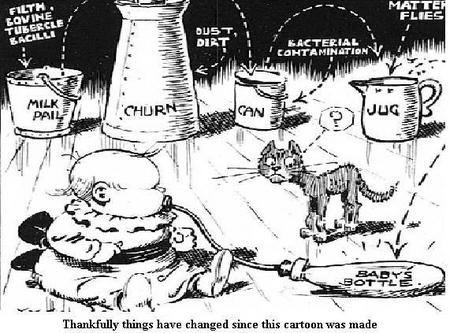
What is milk? It may sound like a trivial question or an inappropriate one for a serious science blog. Why should we take any interest at all in a substance that is a matter of everyday consumption? Put on the spot, most people would say that milk is a rather dull commodity and something they take for granted. The Spanish have a saying: blanco y en botella, leche. Literally this is if it’s white and in a bottle then it’s milk. However, slipped colloquially into conversation it means it’s obvious. My purpose in this post is to show that a discussion of milk is far from obvious and indeed is something that cannot be left to dairy science alone. We need to look beyond that to understand why milk is as it is today, and ultimately, what’s at stake is the quality of all of the food we consume.

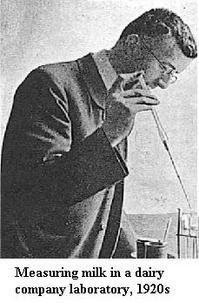
The laboratory-based analysis of milk has its origins in the late eighteenth century. In the 1790s Parmentier and Deyeux were already estimating its constituents with simple experiments. They were followed in the early nineteenth century by other French, Swedish and German scientists. But milk is a complex emulsion of fat globules and water, and a fine dispersion or suspension of casein micelles, so at the time, it was very difficult to know what was in it, given the limited techniques of organic chemistry and physics. It was eventually realised that milk was a highly variable substance; its constituents can vary among mammals and during feeding time. Its principal constituents, fat, protein and sugar, also differ from one breed of dairy cow to another.

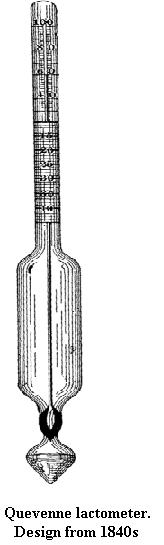
Quevenn.JPGSo what? you might ask. Well, food in the nineteenth century was frequently adulterated, and milk was the most notorious example because its dense whiteness enabled the addition of small amounts of water without anyone noticing. The average pint in London in the 1870s, for instance, contained about 25% of added water. Consumers were outraged by the unreliable quality. One simple method of analysis used by the milk trade was the lactometer, which measured the specific gravity of milk, but this had to be abandoned when it was realised that, by adding water and removing some of the butterfat, it was possible to simulate the physical properties of genuine milk.
Gravimetric and volumetric chemistry eventually made progress and adulterators were brought to book under a series of Sale of Food and Drugs Acts that started in 1860. The irony was that many innocent farmers were prosecuted before anyone thought to establish a legal definition of the real thing. This came about in 1901 with the Sale of Milk Regulations. In effect, it claimed that science could determine nature’s intentions. Natural cow milk was said to contain 3.0% of butterfat, for instance, and a milk that was more watery than this was presumed to have been fraudulently manipulated.

Problem solved? Well no, because what happened if cattle were fed on very watery grass or silage? The milk they produced would be as it came from the cow, nothing added and nothing taken away. However, it would still be of a low quality, fat-wise. Legal challenges in the early twentieth century proved that almost any milk coming from a healthy cow was acceptable, as long as it was not modified later.

MeasuringMilk.JPGFrom 1901 to 1976 this whole milk idea remained the British consensus. Elsewhere, on the continent, a completely different approach prevailed. Countries such as the Netherlands had butter industries where it was in their economic interest to regard some extraction of fat as normal. This led to fixed, legal limits of quality, and later to the standardization of the constituents of milk. Britain’s entry into the European Community in the 1970s, meant accepting some legal definitions of foods. From 1981, it was possible for the first time to buy ‘semi-skimmed’ milk. Then, in 1933, milk with a standardized composition had to be allowed with the beginning of the Single milk market. However, it has only been since the Drinking Milk Regulations of 2008, that at last milk could be labelled with various fat levels. cartoon Rosenau 1912 p26.JPG

When you next go to the supermarket, have a look at the dairy shelves. You’ll find an astonishing range of milk. In addition to flavoured or filtered or fortified milk, you will find milk with 0.1%, 1%, 2% and 4% fat, and the consumer in England and Wales (but not Scotland) can also choose between raw milk and heated treated milks that have been pasteurized, sterilized or ultra heat treated. There is also homogenized and organic cow’s milk, not to mention goat’s milk and soya milk.

I’m not saying that these new Euro definitions of quality are better or worse, but they are certainly different from the long history of milk in Britain. It is almost as if milk has had its own life story and we can now write its biography. It seems that most milk drinkers are oblivious to this story and are now content that it is technology that defines what is genuine and natural. We no longer feel any obligation for our diet to reflect the foibles and the cycles of nature. We are now sure that we can improve upon nature by producing a substance which has a substantial human imprint. Finally, milk still resists us by turning sour and by persisting in being an ideal medium for the spread of disease, but both of these problems are susceptible to industrial processing.

cartoon.JPG

Ghosts of the Universe

frank.jpg This week’s guest blogger, Frank Close, is a particle physicist, author and speaker. He is Professor of Physics at the University of Oxford and a Fellow of Exeter College, Oxford. He is the author of several books, including the best-selling Antimatter, and the winner of the Kelvin Medal of the Institute of Physics for his “outstanding contributions to the public understanding of physics.”

Of all the things that make the universe, the commonest and weirdest are neutrinos*. Able to travel through the earth like a bullet through a bank of fog, they are so shy that half a century after their discovery we still know less about them than all the other varieties of matter that have ever been seen.

These will o’ the wisps are coming up from the ground beneath our feet, emitted by natural radioactivity in rocks, but most of those hereabouts were born in the heart of the Sun less than 10 minutes ago. In just a few seconds the Sun has emitted more neutrinos than there are grains of sand in the deserts and beaches of the world, greater even than the number of atoms in all the humans that have ever lived. As you read this, billions of them are hurtling, unseen, through your eyeballs at almost the speed of light. They pass through the earth as easily as a bullet through a bank of fog.

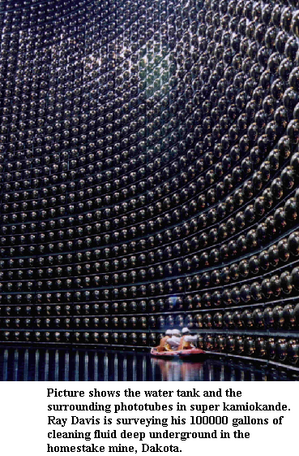
ray davis.bmpIf we could see with neutrino eyes, night would be as bright as day: solar neutrinos shine down on our heads by day and up through our beds by night, undimmed. To capture even a few of them requires thousands of tonnes of material. When Ray Davis began chasing solar neutrinos in 1960, many thought he was attempting the impossible. It nearly turned out to be: 40 years were to pass before he was proved right, winning his Nobel Prize in 2002, aged 87.
Patience is an asset in the neutrino business. Not only was Davis the first human to look inside a star, his legacy is a new science: neutrino astronomy. Not just the Sun; each of the stars visible to the naked eye, and the countless ones seen by the most powerful telescopes, are all filling the void with neutrinos. The neutrinos born in the Sun and stars, numerous though they are, are relative newcomers. Most are fossil relics of the Big Bang, and have been travelling through space unseen for over 13 billion years.

Scientists are now decamping to Antarctica, in the hope of achieving things even more remarkable than even Davis – capturing neutrinos from distant stars, and even some that are remnants of the big bang.

Neutrinos from afar

Apart from the sun, the only star ever seen to shine in neutrinos has been a supernova.

On 23 February 1987, utterly without warning, a supernova was seen to have erupted in the Large Magellanic Cloud, a satellite galaxy of the Milky Way in the southern skies. A blast of neutrinos from this explosion, having travelled across space for 170,000 years, passed through the Earth during about 15 seconds that day. Underground experiments detected a handful of neutrinos from the supernova.

Astrophysicists had long believed that the gravitational collapse of a supernova is a copious source of neutrinos; that the brilliant flash of light, the traditional manifestation of a supernova that can briefly outshine an entire galaxy, is only a minor part of the drama. Powerful though this intense electromagnetic radiation is, the visible light, radio waves, X rays and gamma rays all add up to less than 1 per cent of the whole. The bulk of the energy radiated by the supernova is carried away by neutrinos.

computer image.GIFFor the first time, we had detected neutrinos emanating from outside our galaxy, and proved that the theory of a supernova is right: when stars collapse they throw off their energy as neutrinos, up to 1059 – that’s one followed by 59 zeroes – a hundred billion trillion trillion trillion trillion of them.
Most had spread around the cosmos; only a few passing through the detectors on Earth. Even so, by detecting this momentary blast of neutrinos, we had our first look into the workings of a supernova. This confirmed everything that had previously been just theory: a supernova is the result of a star collapsing to form a neutron star.

Neutrinos on Ice

With the singular exception of supernova, neutrinos from stars in our galaxy and beyond are probably as faint compared to solar neutrinos as is starlight to daylight. To have any chance of capturing them requires detectors containing over a cubic kilometre of matter.

The ingenious solution is Ice Cube, an experiment just beginning at the South Pole, which uses the ice in the Antarctic as a natural detector of the vast numbers of neutrinos that fill the void

Ice in the Antarctic is not like ice that we are used to on a cold winter’s day at home. In the Antarctic, snow has fallen on ice for much longer than recorded-history. Deep down, the pressure is so great that all the air bubbles have been squeezed out, leaving ice so pure that light flashes, produced by neutrinos, can travel hundreds of metres.

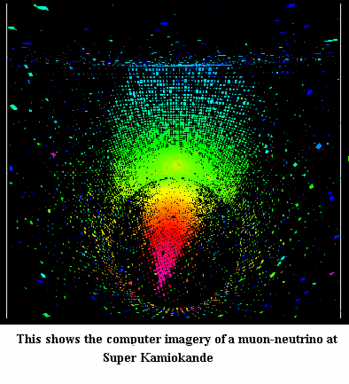
Photomultiplier tubes – devices for recording the tell-tale flashes of light – have been lowered into the ice, down shafts that are made by a special drill that sprays out hot water and melts a hole. The detector is attached to a long cable, lowered into the ice, which then freezes it into place. From then on it records data continuously. The set-up is so sensitive that it regularly records neutrinos produced by cosmic rays hitting the atmosphere from all around the globe; some come from directly above the Antarctic, while others have travelled all the way through the Earth, from the North Pole.

Ice Cube will look further into space and into areas – such as the galactic core of the Milky Way – that we’ve never been able to see before. It is possible that neutrinos will interact with the background radiation from the big bang. There may be surprises, even more sensational than anything that has happened so far.

To learn more on this thrilling subject why not come to one of Frank Close’s talks, or read his book Neutrino. Details can be found on his website

*Definition: The neutrino is a sub atomic particle which holds no electrical charge, travels at nearly the speed of light, and passes through ordinary matter nearly unharmed. Neutrinos are emitted in huge numbers by stars like the sun.

A pack of cards and a little calculated hocus-pocus

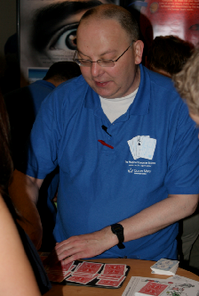
PETER 2.bmp

This weeks guest blogger, Peter McOwan, is currently a Professor of Computer Science and Dean for Taught Programmes in Science and Engineering at Queen Mary, University of London. His research interests are in visual perception, mathematical models for visual processing, in particular motion, cognitive science and biologically inspired hardware and software. He is also active in science outreach through various projects such as cs4fn and Sodarace. Peter was awarded a National Teaching Fellow in 2008 by the Higher Aducation Academy.

Since I was a kid I’ve been fascinated by magic, the way that you can use science and maths to make it look as if you’re breaking the rules of the natural world. Way back I remember being amazed with diagrams in old magic books from my local library showing how the Victorians created ghosts on stage using sheets of glass, or how you could pour a colourless liquid into a glass and it would turn to ‘wine’ or ‘milk’, (all done not with mirrors, but with physics and chemistry). My favourite tricks were the ones where the ‘secret’ was in the hidden maths. With a pack of cards I could entertain my friends and family, being able to perform seemingly impossible feats of mind reading or memory; as a kid that was cool!

Fast forward to the present day; my interest in science and maths led me through various earlier incarnations to being a professor of computer science, researching into biologically inspired artificial intelligence (I also loved Dr Who and Sci Fi on TV, but that’s another story…). Computer science, the study of information and how we process it is, I believe, at the core of understanding the modern world round us. In the past we needed physics chemistry and biology; now we also need computer science. If you look at it, computer science underpins much of the progress in diverse scientific endeavors, for example bioinformatics or climate change, it is also fundamental to our economic prosperity, banking and businesses. It’s computer science that today lets us work, rest and play. But computer science also has a significant ‘image’ problem. The fundamentals are often hidden in our everyday devices, it’s considered to be filled with socially inept ‘geeks’ , it’s seen as too hard or dull, with a low uptake of students at all levels and an almost invisible profile with the public. Why were people not getting it?! It perhaps needed a bit of magic.

With my colleagues Paul Curzon and Jonathan Black I set about applying my knowledge of magic techniques to create a series of entertaining tricks the hidden secrets for which were some fundamental computer science principles. In the same way as those Music Hall illusions from the past had inspired me to study science, we would create tricks to inspire people to explore computing. It wasn’t that hard, in the back of my mind during my scientific career I’d come across techniques that I realised were used in the mathematical based tricks I loved, I just never thought those links would be useful.

One of the first moments of magical ‘fusion’ was with computer assisted tomography, the Radon transform technique which is used to back project and reconstruct 2D images from an angular sequence of 1D scans clicked, it was exactly the same idea that was used to construct forcing matrixes as used by mentalists. The more I looked the more I realised that a whole load of magic tricks involved computer sciency things like binary searches, Markov sequences and so on. These ideas had been developed by magicians, and by scientist separately but they used the same principles. I was intrigued and started to do more research. To my surprise I discovered that there were a number of famous magical effects that had been developed by computer scientists.

Alex Elmsley, who created the wonderful slight of hand move called the Elmsley Count (perfecting which had taken many days of my youth) was actually a Cambridge computer scientist – his famous 16th card trick was a binary search algorithm!

Then I discovered Dr Brent Morris, who has probably the only doctorate in the world in card shuffling with the snappy title of “Permutations by Cutting and Shuffling: A Generalization to Q Dimensions.” Brent was an amateur magician who had practiced long and hard to perfect the Faro (or so called perfect shuffle), where a pack is split in two and weaved together so that the cards interlock alternatively one by one with each other. It’s inspiring to see (I’m still practicing!). The Faro shuffle was known by magicians of old as being a way to shift a card from one position in the pack to another while looking like you’re shuffling the deck. Brent spotted that if you understood the maths of how to move things around you could equally apply the method to efficiently moving data in a computer memory instead of sneakily shifting cards. It got him his computer science doctorate and also two U.S. patents on computers designed with shuffles. I was impressed!

So with all of these fascinating stories of amazing people and equally amazing secrets, we set about writing our first Magic of Computer Science book, hoping that it would catch the imagination, and it did. We traveled the UK doing magic shows, entertaining and educating. The books was translated into Welsh, Italian and German, so we wrote another.

This time we used it to make the point that good software needs both a good mathematical algorithm but also an understanding of how human brains work. This is the all important software usability agenda and it linked with some lovely magic. Magicians for centuries have known how to confuse their audience – its called misdirection – they point left and do something sneaky on the right. Magicians deliberately get you to make mistakes. Understanding how that happens means that you can reverse the procedure and build better software for use in safety critical situations like hospitals, so that the users are directed to pay attention to what’s important.

You would expect that strange out-of-this-world type things happen in magic, and they do! We ended up helping private space explorer and computer games designer Richard Garriott design science based magic tricks to perform on his 2008 visit to the International Space Station (yet another scientist who loves magic). The magic is working.

Finally a blog on magic wouldn’t be complete without a trick…

Shuffling cards.bmpShuffle a deck of cards. Spread the cards on the table face down. Now think of the colour RED and select any 8 cards, then think of the colour BLACK and select another 7 cards at random. Now think of RED again, select another 6 random cards, then finally BLACK again and select 5 cards. Shuffle the cards you chose, and then turn the pile face-up. Take the remaining cards, shuffle them and spread them face-down. Now the magic starts. Concentrate. You are going to separate the cards you selected (and that are now in your face-up pile) into two piles, a RED pile and a BLACK pile.

Go through your face-up cards one at a time. If the card is RED put it in the RED pile. For each RED card you put in your RED pile think RED and select a random card from the face-down cards on the table. Put this card face-down in front of your RED pile. Similarly if the next card is a BLACK card put it face up on your BLACK pile, think BLACK and select a random face down cardand put this face-down card in front of your BLACK pile. Go at it until you run out of face-up cards.

You now have a RED pile and in front of that a pile containing the face-down cards you selected while thinking RED. You also have a BLACK pile in front of which is a pile of cards you selected while thinking BLACK.

Interestingly your thoughts have influenced you choice of random cards! Don’t believe me? Look at the pile of cards you chose and put in front of your RED pile. Count the number of RED cards in this pile. Now look at the cards in front of your BLACK pile, and count the number of BLACK cards you selected. They are the same! You selected the same number of RED and BLACK cards totally at random! Amazing.

And for our next trick, wait and see…

The magic books mentioned can de downloaded for free here, we also wish to thank EPSRC, Google and Microsoft for their support of our work, they are all magic!