From despair to repair: Empowering communities to restore their oceans

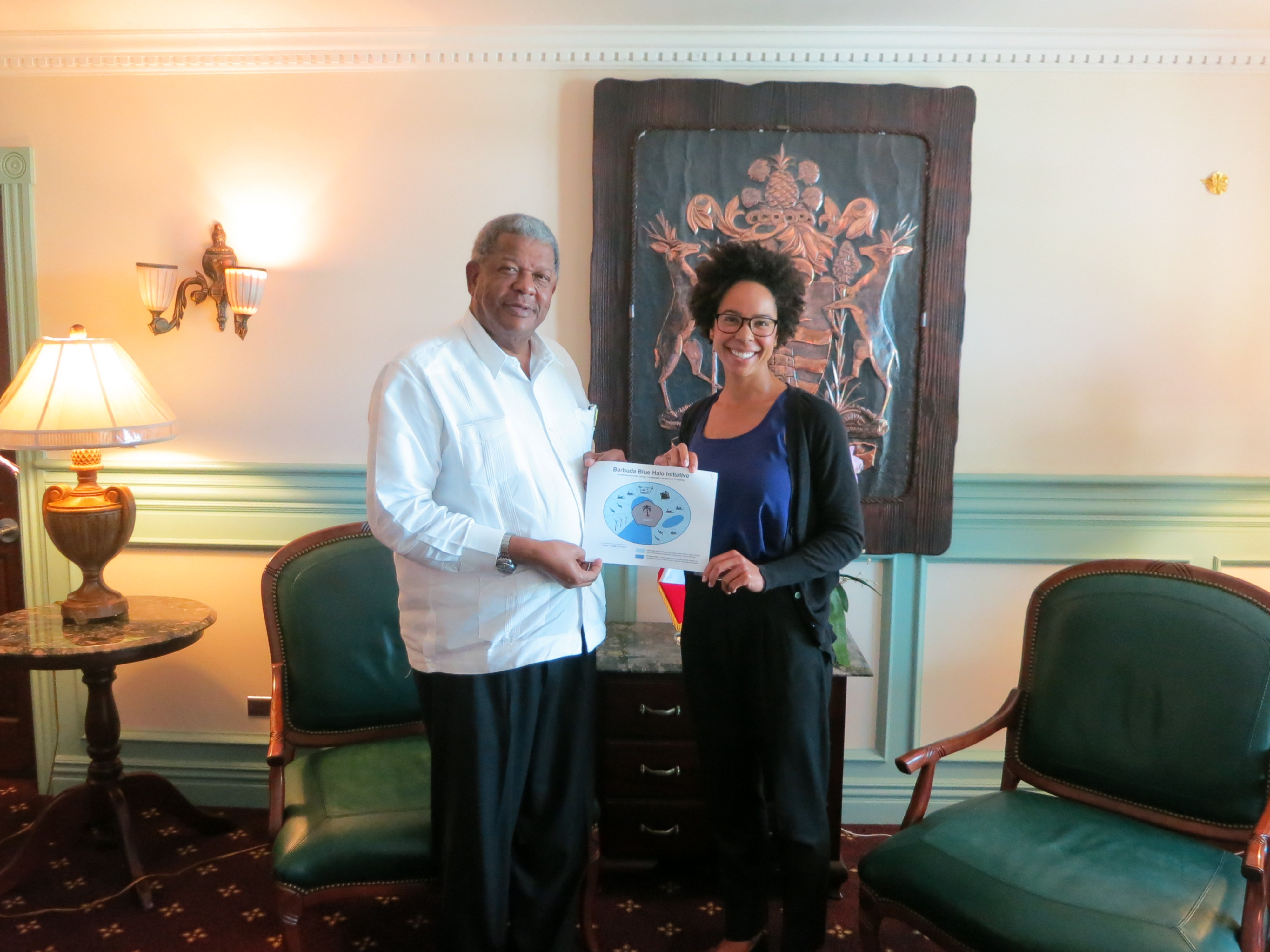
Dr Ayana Elizabeth Johnson with Barbuda Prime Minister, Baldwin Spencer.

Dr Ayana Elizabeth Johnson with then Antigua and Barbuda Prime Minister, Baldwin Spencer. (Image: Waitt Institute)

Dr. Ayana Elizabeth Johnson is a marine biologist and Executive Director of the Waitt Institute. Johnson’s mission is to collect, create, actualize and amplify the best ideas in ocean conservation. Her work has been featured in the New York Times, on her blog for National Geographic, in The Atlantic, and elsewhere. She holds a Ph.D. from Scripps Institution of Oceanography, a BA from Harvard University in Environmental Science and Public Policy, and has worked on ocean policy at both the National Oceanic and Atmospheric Administration (NOAA) and the Environmental Protection Agency (EPA). You can find her talking oceans on Twitter @ayanaeliza

“People used to talk about the size of the fish they caught vertically,” says a perspicacious 15-year-old Curaçaoan holding his hands off the ground at head height. “But now we show fish size horizontally.” As the young man lowers his hands at shoulder width apart to demonstrate this, it is strikingly clear the great fishing catches of old have all but gone in the southern Caribbean Sea.

The vibrantly scenic shores and glistening beaches of this bustling island are in stark contrast with the rather gloomier outlook of the once thriving Caribbean ecosystems that supported local fisheries. Speak to any of the older residents or fishermen on Curaçao and they’ll swear by the unprecedented changes they’ve seen in their oceans in the last half century.

This is a familiar picture across the Caribbean, which is suffering from the same threats of overfishing, climate change, pollution and habitat loss, seen worldwide. In August 2014, the National Oceanic and Atmospheric Administration (NOAA) listed 20 species of coral as threatened under the Endangered Species Act, including five Caribbean species. Projected impacts of global warming and ocean acidification motivated this action, but as marine biologist Ayana Elizabeth Johnson eloquently writes in a New York Times op-ed: “climate change really is only half the story.”

Johnson’s encounter with the young Curaçaoan and his jarringly precocious words struck a chord with her eight years ago, in the midst of her PhD research. Focusing on fisheries management and ecology in the southern Caribbean, she interviewed more than 400 fishermen, scuba divers, and locals in Curaçao and Bonaire, to inquire what major changes they had seen in their oceans.

“It is critical to understand what local people see as the threats to the ocean, as the perceived problems have a huge influence on what the perceived solutions should be,” says Johnson. “Often scientists’ outside perspective can be very different to the local one – and this can lead to disconnect when discussing sustainable policy and solutions.”

Continue reading

Ignorance in Climate Science

Jerome Ravetz wrote Scientific Knowledge and its Social Problems (1971, 1996) and (with Silvio Funtowicz) Uncertainty and Quality in Science for Policy  (1990).  They created the NUSAP notational system and the theory of Post-Normal Science.  He is currently associated with the Institute for Science, Innovation and Society at Oxford University.

Our modern scientific view of knowledge was defined by a throwaway line in Descartes’ Discourse on Method.  Referring to his dissatisfaction with his education at school, he claimed,

“I was convinced I had advanced no further in all my attempts at learning, than the discovery at every turn of my own ignorance”. 

He was careful to say that his school was not to blame, although a little later he did a brilliant assassination job on the whole humanistic curriculum.  Readers now might not notice the irony in Descartes’ complaint.  It was not merely another case of late-adolescent angst.  For in the mention of the discovery of ignorance, his  educated readers would have recognised an echo of Socrates.  This founder of philosophy was remembered as saying that his whole life’s work was the discovery of his ignorance.  By the criteria of Socrates and all who followed, the education of the young Descartes had been a great success:  so early in life he had succeeded in discovering his ignorance!  With both Descartes and his readers knowing this background, they would recognise his complaint as the casual discarding a couple of millennia of moral philosophy.  “Know thyself” was out, “Discover truth” was in.

This point is not of merely scholarly historical interest.  The Scientific Revolution produced a variety of accounts of scientific knowledge, differing in their balance of reason and experience, and also in the strength of their claims to certainty.  But they all agreed in their tacit elimination of ignorance from their pictures of the acquisition of knowledge.  Of course, publicists for science recognise ignorance, but mainly as something out there to be conquered by the advance of science.  When scientists have undergone a lengthy and rigorous training in which they learn that for every real problem there always one (and only one) correct answer, there is little danger of them sharing Descartes’ school-leaver’s predicament.

The relevance of this issue today is, to what extent should we incorporate ignorance, as distinct from tameable uncertainty, into our reasonings about science and science policy?  I would argue that the suppression of ignorance in our debates, perhaps even its repression in our thinking, seriously impedes our management of our scientific affairs.

There is evidence that, particularly in climate science, ignorance is something of a taboo idea, even when it might seem to be most relevant.  I have two illustrative examples from the climate science area.  The first relates to a proposed scale of uncertainty, designed by James Risbey and Milind Kandlikar [1], and adopted by the IPCC [2].  This has the merit of providing a single robust scale of degrees of uncertainty, based on the notations for expressing it in numerical form.  It could be of great use in resolving the confusing variety of schemes that are employed in the various special fields that contribute to climate science.  The scale includes five degrees of increasing uncertainty, concluding with a sixth category for ignorance.  The authors were pleased to see the scale adopted by the IPCC, but then surprised to see that the category for ignorance had been deleted in the IPCC version [3].

Another example provides even stronger evidence of a consistent attitude.  Two authors who are eminent in their own fields, Sir Nicholas Stern and Leonard Smith, recently published a paper on the characterisation of uncertainty in climate science [4].  The paper is truly magisterial, bringing deep analytical clarity to this very confused subject.  But, again surprisingly, a search for ‘ignorance’ in the text produces only three citations, and two of those are incidental (p. 16 twice).  The only substantive reference relates ‘ignorance’, rather ‘recognised ignorance’, back to ‘ambiguity’ or ‘Knightian uncertainty’ (p.4).  It would seem that ignorance, in its own right as a qualitatively deeper sort of uncertainty, is not relevant here.   The absence must be deliberate, for the whole essay can be read as a detailed warning of the many pitfalls of mismanagement of uncertainty, along with the ‘fallacy of misplaced concreteness’ in relation to models. Indeed , it can be read as a Socratic exercise in all but name and vocabulary.

Particularly for that reason, I confess that I cannot agree with the absence of ignorance.  Suppose that a senior planner, responsible for the long-range defences of the Thames Estuary, approaches experts for an estimate of the sea-level rise to the end of the century.  It would be technically correct to say, “It will probably be somewhere between one and four metres, but where inbetween is a matter of ambiguity”.  The planner might prefer to be told simply, “`I don’t know,” with a review of the reasons for speculating on the likelihood of one range of values over another.

It is not as if ignorance were totally banned from policy-relevant science.  In medicine, for example, we know that we don’t know the causes of some important diseases, as indeed we are aware of our ignorance of the course of future epidemics.  The sciences do not lose public prestige because of their frankness about their deep limitations in relation to some urgent issues.  Rather, they gain trust because of their honesty with their publics.

We can see the explicit recognition of ignorance as part of the programme of a ‘technology of humility’ proposed by  Sheila Jasanoff of Harvard University [5].  It would fit particularly well with climate science, since this is after all a part of a great humanitarian project rather than a quest for profit, power or privilege.  The message of Socrates, rejected with such ultimately devastating effect by Descartes, could inform such a science and provide it with an enriching humane element.

References

[1] Risbey, J.  & M. Kandlikar, 2007: Expressions of likelihood and confidence in the IPCC uncertainty assessment process. Climatic Change, 85 (1-2), 19-31.

[2] Mastrandrea, M., C. Field, T. Stocker, O. Edenhofer, K. Ebi, D. Frame, H. Held, E. Kriegler, K. Mach, G. Plattner, G. Yohe, and F. Zwiers 2010: Guidance notes for lead authors of the IPCC fifth assessment report on consistent treatment of uncertainties, Available at https://www.ipcc.ch

[3] Risbey, J. and T. O’Kane 2011: Sources of knowledge and ignorance in climate research:  Climatic Change, 108 /4, 755-773,

[4] Leonard Smith and Nicholas Stern 2011, Uncertainty in science and its role in science policy, Phil. Trans. R. Soc. A 369, 1–24.

[5] Sheila Jasanoff 2003, Technologies of Humility:  Citizen Participation in Governing Science, Minerva 41: 223–244.

Widening the climate conversation

Richard Betts is Head of Climate Impacts at the Met Office Hadley Centre and a visiting Professor at the Universityof Exeter.  He was a lead author on the IPCC Fourth Assessment Report with Working Group 1 (Physical Science Basis) responsible for the assessment of radiative forcing due to land cover change.  For the Fifth Assessment Report he is a lead author, assessing impacts on terrestrial ecosystems.  Richard was also a lead author on the Millennium Ecosystem Assessment.  He is a regular contributor to climate blogs such as https://bishophill.squarespace.com/ and https://judithcurry.com/ and can be found on Twitter as @richardabetts

Richard Feynman used to bemoan the fact that much of the communication of science was focussed on whether a particular discovery provided a cure for cancer.  An analogous situation seems to apply to communication of climate science – the message often seems to be about whether a new piece of work has shown anthropogenic climate change to be either a greater or lesser problem than previously thought, and hence whether cuts in greenhouse gas emissions are even more urgent or completely unnecessary.

But climate science is not a single-issue subject.  It is not carried out solely to see whether cuts in greenhouse gas emissions are needed or not.  A further and increasingly important issue is to understand the changes and variability we are seeing in order to help us live with the ever-changing weather and climate.  Also, of course, it is important simply to increase the sum total of human understanding simply as an end in itself.  Like art and music, gaining deeper insights into how the world around us actually works can enrich our lives and bring enjoyment.

Unfortunately, these other aspects of climate science are rarely seen outside of the scientific community, giving a skewed impression of the science.  Public discussion of the science mostly focuses on the implications for policy, and also increasingly on attacking or defending the integrity of the science rather than on its intellectual content.  A very large proportion of the commentary on climate science is not actually from working scientists, it is from others who have a political rather than scientific interest.  When scientists are involved, they are often discussing it within the usual policy context.  It seems that in an increasingly polarised debate on climate policy, science can get sucked in and used as a political football.

In any policy debate, opponents of a policy will naturally seek to question and challenge the evidence base underpinning the need for the policy.  They may perceive or claim the evidence to be unreliable or even biased.  Promoters of the policy will naturally be defensive of the evidence base.  This is all expected behaviour in the policy world.

The difficulty comes when those responsible for gathering the evidence feel under attack and respond in a defensive manner themselves.  If they perceive themselves as opponents of those challenging the evidence whilst being allies of those defending the evidence, and start behaving accordingly, this only reinforces the perception of bias from the opponents, and positive feedback sets in.  This appears to have happened with climate science in the context of mitigation policy.  The scientific aspects of the wider climate debate have become increasingly focussed on one end of the policy debate or the other.  It is much less common to see discussion of the implications of the science for other questions such as adaptation planning, and even rarer to see public discussion of climate science merely for intellectual interest.  Climate scientists have consequently become perceived as being part of the debate on a single policy issue, rather than as just scientists seeking to advance knowledge.

This leads to the risk of loss of trust in scientists as objective advisors.  If climate science communication remains focussed on a single policy issue then of course the science can be perceived or presented as being part of the policy and not merely informing it.  Despite repeated protestations that the science is objective, the constant framing of it within a narrow policy discussion does nothing to back this up.

What to do about this?  I think the only solution is to talk about the science as science, in the context of all its implications and also for its own academic interest – and talk about it to everyone irrespective of their position in the policy debate.  This includes talking with sceptics, and not in defensive mode but as scientists willing to talk around the issue.  It used to be the received wisdom that climate scientists should not engage with “sceptics” beause, it was said, it only wasted time and gave credibility to arguments that had already been countered many times before.  In my view this is no longer a helpful strategy, if it ever was.  Counter-arguments to criticism are given from a distance, but without direct engagement they may be ignored, and without a proper conversation it is often hard to get the real heart of the issue and address the real nature of the disagreement.  Also, while arguing from a distance may address some of the scientific issues, it is hard to clarify misconceptions of motivation.  If “sceptics” believe scientists to be motivated by political agendas or simply protecting their jobs, and scientists believe sceptics to be “anti-science” or promoted or even funded by vested interests, each side merely claiming otherwise is unlikely to make a difference.  Proper discussion is required if true motivations are to be understood.

Of course this needs to happen in a wide variety of communications arenas, but social media offers great opportunities for such engagement.  A large number of blogs cover climate change issues, but with one or two exceptions these cover scientific discussions with little direct engagement from critics, or feature discussions amongst groups of largely like-minded individuals who merely reinforce each others views. There are signs that this is starting to change, for example with some scientists engaging with sceptic blogs, and while discussions can often be robust they can be constructive if participants take care to remain civil.  Twitter, with its completely open and unmoderated format and easy facilities for tracking and searching topics, increasingly features discussions from across the traditional divide.  However, there is still room for much greater engagement outside of traditional interest groups.

Importantly, such discussions need to move on from being anchored in the usual one-dimensional policy debate.  Scientists need to be willing to discuss uncertainties, controversies and technical challenges (ie: the interesting bits!) rather than just feeling they need to defend themselves against attack.  Only by scientists being clearly seen to operate as scientists will trust be maintained – and this means being seen to explore the issues, challenge each other and not worry about how this will be seen or presented in the mitigation policy debate.

As Feyman said, ““Scientific knowledge is a body of statements of varying degrees of certainty — some most unsure, some nearly sure, none absolutely certain.”  Focussing only on the nearly sure may suit the policy debate but it doesn’t help advance the science or engage others in it.  Let’s talk about it all, with everybody.

Climate change and extreme events

Dr Andy Russell is a climate science lecturer in the Institute for the Environment at Brunel University. His research focuses on how severe storms develop in Europe and Antarctic climate dynamics. He blogs his thoughts on weather and climate issues and tweets as @dr_andy_russell.

Despite the recent controversies regarding the Intergovernmental Panel on Climate Change (IPCC), the international effort to summarise the state of the climate and make projections about its likely condition by the end of the 21st Century rumbles on.

As I type, I have a massive chapter for the next full Assessment Report (due to be published in 2014) sitting on my desk to review and a couple of analysis routines churning their way through terabytes of climate model data. There’ll be hundreds of other people around the world focussed on similar things. The aim is to produce the 5th series of Assessment Reports since the IPCC was formed in 1988 to help decision makers, well, make decisions.

But the IPCC has been up to other things recently as well. In November 2011 it published a Special Report Summary for Policymakers on “Managing the Risks of Extreme Events and Disasters to Advance Climate Change Adaptation” (or SREX, the full report will be published in February 2012). Understanding how extreme events might change in the future is really important as it’s these things that will really impact people: heat waves, flash floods, hurricanes, droughts and sea level rise related inundation. This is far more useful to know than the quite abstract concept of global mean temperature change. This report looks like an advance in the IPCC procedure as it involved a far more integrated approach than usual IPCC outputs, having authors from climate science, impacts and adaptation backgrounds as well as disaster risk management experts.

Although it sounds obvious, one of the key conclusions of SREX was that the impact of extreme climatic events is greatest where vulnerability is highest. On the ground, this has manifested itself as higher fatality levels in developing nations and higher economic losses in developed countries. There’s a lot to think about here in terms of how developing nations move forward and how developed nations approach things sustainably to reduce exposure. That’s not really my area though.

From a scientific point of view, they also point out that analysing extremes is relatively difficult as they are rare and data from around the world are not always up to the job. That said, this depends a lot on the particular “extreme” being investigated – this has always struck me as slightly odd about the climate extremes community in that the only common theme is the statistics and not the science behind the phenomena.

Looking to projections, the IPCC SREX assign their highest confidence assessment (“virtually certain”) to increases in temperature extremes by 2100. This is because this is pretty much a direct response to the radiation changes forced by atmospheric greenhouse gas emissions. Everything else is a slightly more messy consequence of the temperature changes and these other fields vary much more amongst the 12 different models used in this analysis making their projections uncertain. However, it also looks likely that heavy precipitation events will increase in certain regions and that the maximum winds associated with tropical cyclones will increase whilst their total number will likely decrease.

Oddly enough, the emissions pathway that we take in the future (the IPCC analyses different sets of projections based on different socioeconomic and technological development assumptions) has little impact on extreme events in the next 30 years or so – they don’t appear to have an impact until the latter half of the 21st Century when inter-model variability masks most of the climate signal anyway. This highlights how making projections of extreme events is a difficult game. In that spirit, here are two of the key problems as I see them relating to my area of research on severe storms in Europe:

Loading the dice or getting new dice?

If we assume that climatic quantities have a normal distribution (which isn’t always the case, especially with precipitation) then you can view the extremes as the tails at either end of the distribution e.g. hot or cold. So climate change could be viewed as like loading dice – you start rolling more sixes (or getting more hot days). However, when the climate regime changes this analogy breaks down as, instead of just rolling more sixes, you start needing to roll sevens as climate records are broken (see the figure below). This poses a problem for climate models as, like a six sided die isn’t designed to roll a seven, climate models haven’t been designed (or at least haven’t been verified against) conditions that have never been observed.

We’re gonna need a smaller box.

The second problem is that some important things – like severe storms, tornados and regional and local changes such as river catchment area precipitation changes – are too small for climate models to represent or resolve. The reason for this is that these computer models split the atmosphere (and oceans) into a 3D array of boxes. The important equations are solved in each box and then they pass information to neighbouring boxes as appropriate at each model time step. These boxes usually have horizontal dimensions of around 100-400 km to allow for a convenient computational time. However, storms and tornados work on scales of significantly less than 100 km so there’s no way that the models can tell us anything about these things. This problem is particularly acute in relation to the IPCC SREX as this analysis used a suite of climate model data from a project called CMIP3, which was completed in 2006 for the last IPCC assessment and, therefore, does not use the most up-to-date and highest resolution model data. (The data currently being prepared for the next IPCC Assessment Report called CMIP5 is, however, not yet complete so perhaps this criticism is a bit unfair.)

Is this good enough?

So does this mean that analyses using these model data are not useful or reliable? When faced with this question I struggle to get past the fact that, however much they can improve in the future, these models are still the best and only tool we have for making climate projections. Beyond that, we can take comfort in the fact that the very basic physics of climate science is really well understood – even very simple energy balance models can tell us useful things about the effects of increasing atmospheric greenhouse gas changes. What we’re talking about here are the details, albeit very important details, and in that respect our current analyses are consistent with the things that we’re pretty sure of.

The green curve represents the distribution of Swiss summer temperatures from 1864 to 2002. Clearly, 2003 does not align well with that distribution and is an example of an extreme breaking a previous record. This figure has been taken from the IPCC AR4, for more details see here.