Hidden Figures: the movie

Posted on behalf of Elizabeth Gibney
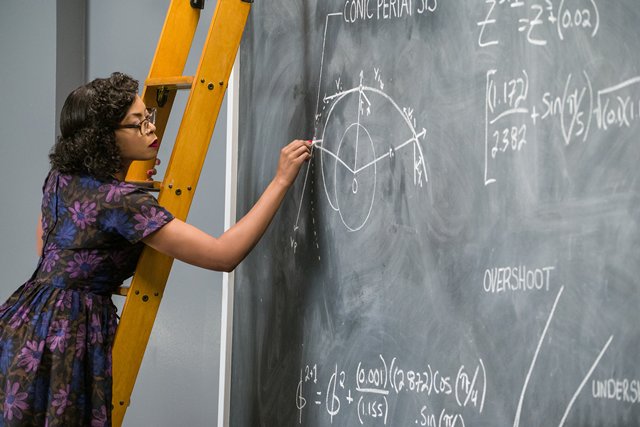
Taraji P. Henson as NASA ‘human computer’ Katherine Johnson. Over the course of her career, Johnson calculated the trajectories and launch windows for flights including the early missions of John Glenn and the Apollo 11 flight to the Moon, and did early work on the Mars mission.{credit}Courtesy of Twentieth Century Fox{/credit}

High-profile protests dominated the media during the civil rights era in 1960s America. At NASA, a quieter struggle was already underway. From the 1940s, African-American women had been chipping away at perceptions and making incursions into the early space programme — that otherwise very white, male world.

The stories of three of these scientific whizzes – Dorothy VaughanKatherine Johnson and Mary Jackson – are now told in Hidden Figures, a film directed by Theodore Melfi and based on a book of the same name by Margot Lee Shetterly (reviewed here for Nature by Alexandra Witze).

This sharp, witty triple biopic captures the focused frenzy of the United States’ space race with the Soviet Union, when NASA was trying to figure out how to achieve the remarkable feat of launching a man into orbit atop a rocket and returning him safely. That all-out effort meant opening the doors to the best people — which in turn created an opportunity for these pioneering African-American women to take on roles previously barred to them.

xxx

The Langley band of ‘human computers’ led by Dorothy Vaughan (played by Octavia Spencer).{credit}Courtesy of Twentieth Century Fox{/credit}

The movie recreates NASA’s Langley Research Center in Virginia, a state that in the early 1960s remained segregated. Vaughan, Johnson and Jackson are among Langley’s human “computers”: women hired to do the mathematics behind space flight, in the days just before the room-sized first IBM machine did it for them. This smart, passionate band, who made up the West Computing group, spend their days calculating launch and landing trajectories and air flow around capsules, armed only with pencils and reams of paper.

The trio were truly extraordinary. Vaughan, played by Academy Award-winner Octavia Spencer, is the matriarch. Although head of the computing group, she is not initially recognised as such for racist reasons. The film shows her initiative over the years in becoming an expert programmer of computing machines as the march of technology sees electronic counterparts to human computers emerge. Meanwhile Jackson, played with spirit by singer Janelle Monáe, wants to be an engineer. She struggles to reach ever-moving goalposts, including segregation laws that prevent her from attending the only school where she could get the necessary qualifications. Monáe’s vivacity earns her most of the film’s best lines.

xxx

Octavia Spencer as ‘human computer’ supervisor Dorothy Vaughan.{credit}Courtesy of Twentieth Century Fox{/credit}

The main focus in on Johnson, perhaps the most remarkable of the three. Her work stands at the very heart of US success in space. The film opens with her as a child prodigy, then zips past degrees in mathematics and French, and graduate school at West Virginia University — where she was one of the first black students to attend. At NASA she was soon picked to join the Space Task Force, who needed her talents in calculating the geometries of parabolic and, later, orbital flight. So indispensable was she that astronaut John Glenn asked for her to personally check the calculations of his trajectory by hand, ahead of the first US orbital flight in 1962.

Johnson is portrayed by Taraji P. Henson as quiet, tenacious and warm-hearted. The character could not be more different from Henson’s role as gangster Cookie Lyon in the music-industry television drama Empire. Johnson is a whizz with the chalk, often seen up a ladder scrawling calculations on a giant blackboard. She carves out her own position in the team, and in colourful outfits and heels offers a human face as often the only woman in a sea of white-shirted, pencil-tied men. (Among many excellent supporting actors, such as The Big Bang Theory’s Jim Parsons, Kevin Costner as a fictional amalgamation of several real NASA leaders deserves special mention. Gum-chewing and hard-nosed, he insists on referring to his team as “gentlemen” despite Johnson’s presence; but his desire to reach the heavens is what gives her her chance.)

xxx

Janelle Monáe as Mary Jackson, who later became a NASA engineer.{credit}Courtesy of Twentieth Century Fox{/credit}

Hidden Figures succeeds in revealing the institutionalised racism faced by the women and their families. Bathrooms, drinking fountains, schools, libraries — all were segregated. One of the best exchanges is between Vaughan and computing pool supervisor Vivian Mitchell (Kirsten Dunst), who insists, “I have nothing against y’all”. To this, Vaughan kindly replies: “I know you probably believe that.” And the women’s status as invisible engines driving the space programme contrasts clearly with the pomp surrounding the astronauts, who as the faces of NASA seem constantly showered with red, white and blue confetti.

Yet the upbeat film can sometimes come across as sanitised. There are no real baddies: even the racist characters, flawed with conscious or unconscious bias, seem ultimately good. A touch more anger wouldn’t have detracted from the enjoyable feel-goodness, epitomised by a bouncing soundtrack  by co-producer Pharrell Williams (composer of mega-hit Happy).

On another level, this may be an effort to avoid the film being solely about race. Rather, it is about women and their love of science. Vaughan, Johnson and Jackson had families to support and could not risk everything in the political fight for equality. In chasing their passions, these three chose to foment change from the inside. Hidden Figures fleshes its characters out into real human beings, and tells their cracking story with grace.

Elizabeth Gibney is a reporter on physics for Nature based in London. She tweets at @LizzieGibney. Hidden Figures’ US premiere is 25 December 2016; general release is on 6 January. The film’s UK premiere is 10 February 2017; general release is on 17 February.  


For Nature’s full coverage of science in culture, visit www.nature.com/news/booksandarts.
Picturing science: top 5 illustrated books

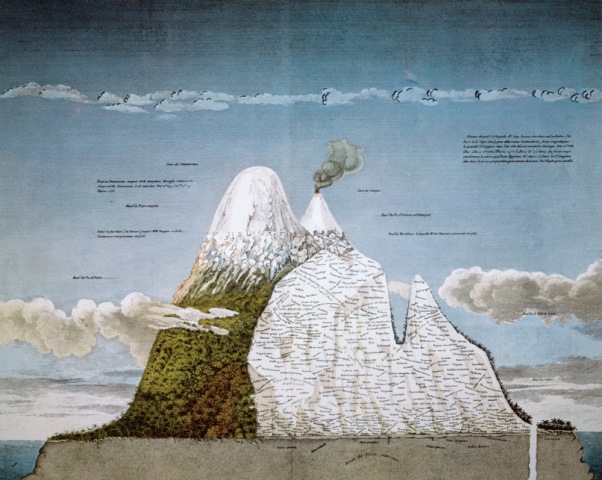
A study from Alexander von Humboldt's detailed expedition notebooks. This cross-sectional study of Chimborazo in Ecuador (1805) shows flora growing at different altitudes.

Alexander von Humboldt kept immensely detailed expedition notebooks. This cross-sectional study of Chimborazo in Ecuador (1805), derived from a sketch, shows flora growing at different altitudes on the volcano.{credit}akg-images. Reproduced in Explorers’ Sketchbooks. {/credit}

We live in illustrated times — a golden age for science graphics, data visualisation and scientific illustration generally. Photography has become positively eye-popping — from the cosmoscapes of Hubble to the Earthly delights of nature photography and photo archives the world over. And luckily for us, this gargantuan trove is being steadily funnelled into science-oriented coffee-table books.

I confess that in early in 2016 I was hanging around waiting for one. Then, like a fleet of barouches, several came along at once. In them I’ve found aesthetic thrills, deep insights and unexpected hilarity. Here are five of the best.

xxx turtle in xxx.

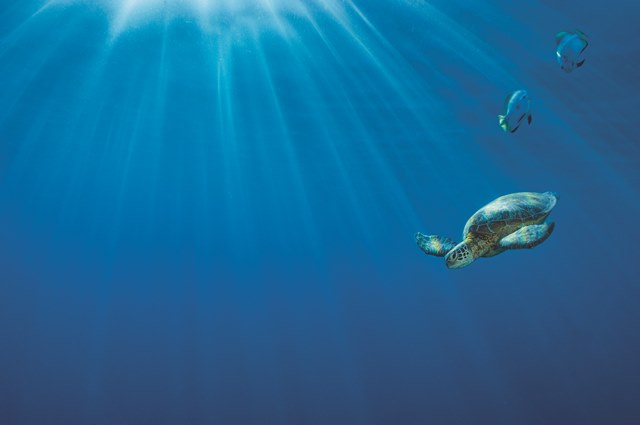
A green turtle (Chelonia mydas).{credit}Alex Mustard, in Secrets of the Sea.{/credit}

Animals proved a draw  — archival menageries and photo-surveys playing on our unquenchable fascination with other species. Secrets of the Seas: A Journey into the Heart of the Oceans (Bloomsbury), with text by marine biologist Callum Roberts and photographs by underwater adept Alex Mustard, explores the wild beneath the waves. It begins in the Coral Triangle, where 4 million square kilometres of tropical ocean support three-quarters of the world’s corals and 2,500 fish species. One denizen, the paddle-flap scorpionfish Rhinopias eschmeyeri of Indonesia, is a cartoon in bubble-gum pink. Beauties throng here too, from the sinuous ballets of California sealions Zalophus californianus to silver blizzards of shoaling fish — mackerel to barracuda.

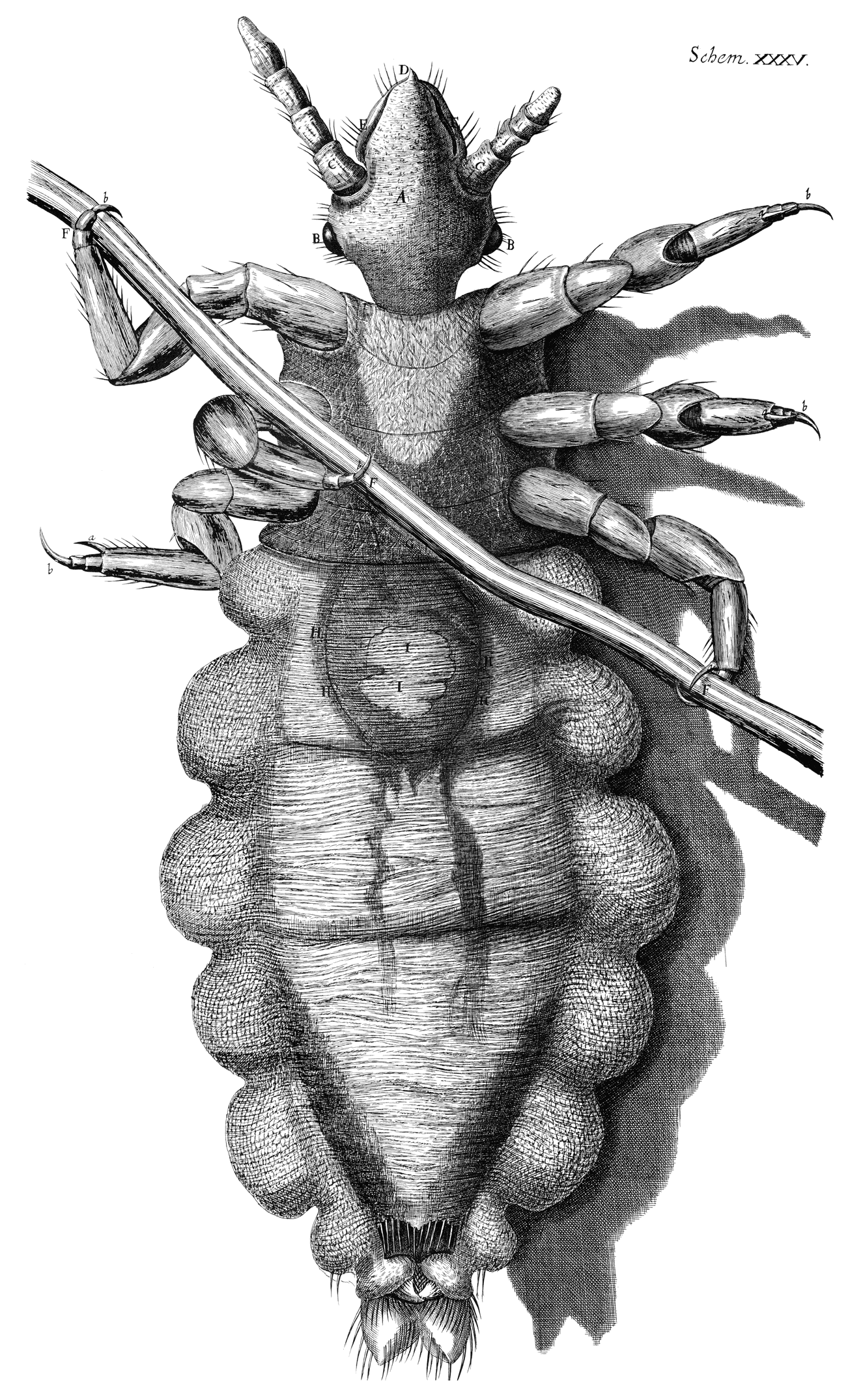
Robert Hooke's 1665 drawing of a louse on a human hair, from Micrographia.

Robert Hooke’s 1665 engraving of a louse on a human hair, from Micrographia.{credit}National Library of Wales. Reproduced in The Paper Zoo.{/credit}

Roberts’s urgent text underlines the state of play for today’s beleaguered marine animals. The Paper Zoo focuses firmly on the planet’s biodiverse past, rummaging through the British Library’s wealth of natural history illustrations spanning 500 years. Science historian Charlotte Sleigh leads us through an ark of beasts from the exotic to the ‘paradoxical’, limned by greats of scientific illustration. Robert Hooke’s eighteenth-century microscopic menagerie of drone flies and lice jostle with natural historian John Ray’s Dürer-like renderings of fish from the 1680s. The nineteenth-century art ranges further South; my favourite is an anonymous double portrait of langurs (one black, one white) staring sagely out in mid-snack.

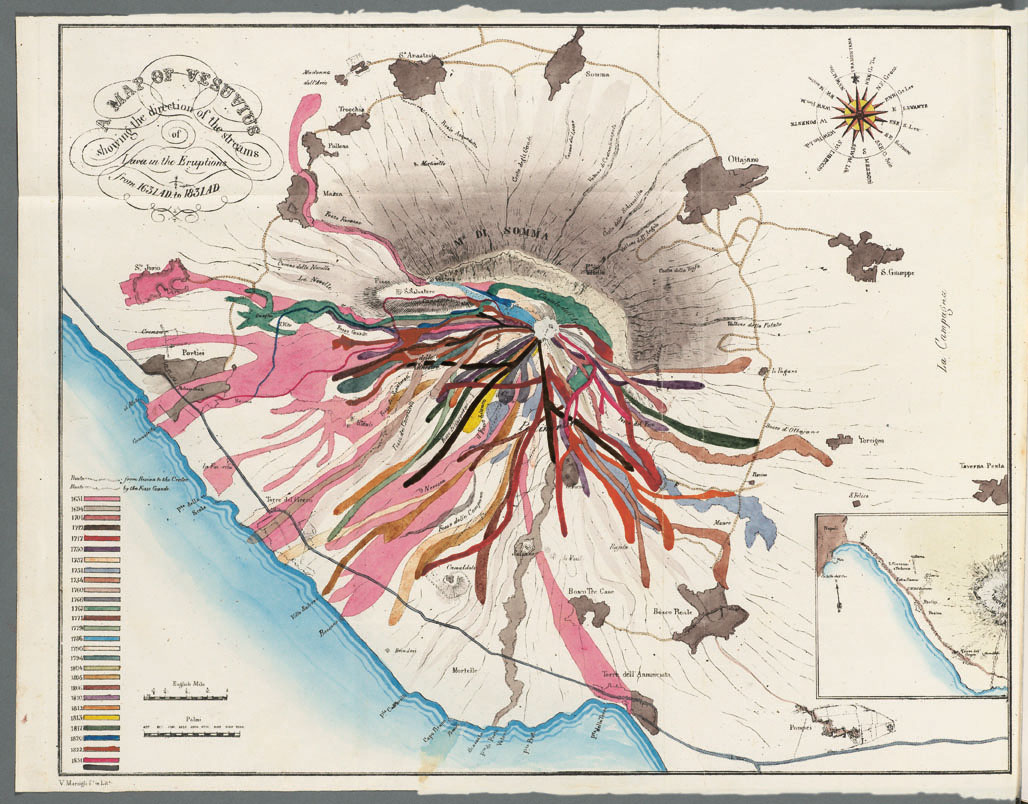
By necessity, many explorers were illustrators manqué — before the advent of reliable cameras, sketches were essential records of the geological, zoological and meteorological wonders they encountered. Explorers’ Sketchbooks: the Art of Discovery and Adventure (Thames & Hudson), by cultural historians Huw Lewis-Jones and Kari Herbert, is a mesmerising multiverse of them. Facsimile pages from the notebooks of 70 ‘terranauts’ give a stunning immediacy to distant time and space. Edward Wilson’s dreamlike evocations of the Antarctic, Maria Sibylla Merian’s caiman chomping on a false coral snake, the lava streams on Vesuvius mapped by John Auldjo, Alexander von Humboldt’s bold cross-section of Chimborazo — every turn of the page is a subtle thrill.

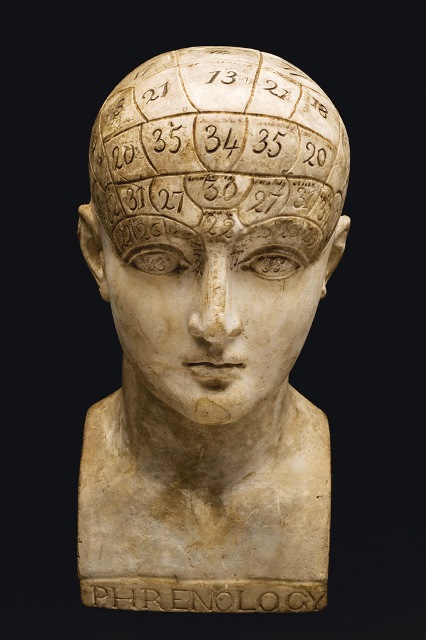
A phrenological bust.

A phrenological bust.{credit}Wellcome Library, London. Pictured in This Way Madness Lies.{/credit}

There are outer, and inner, journeys. Mike Jay’s This Way Madness Lies (Thames & Hudson) peers into the history of mental illness and its treatment as ‘madhouses’ gradually morphed into mental hospitals. (The book accompanies the Wellcome Collection show Bedlam.) Many of the more than 600 images, gleaned from European and US archives, are harrowing portraits of marginalised people further marginalised by experimental treatments ranging from the bizarrely exploitative to the ineffectual. Yet, as Jay notes, there were countercurrents. Franco Basaglia’s 1960s-70s psychiatric revolution in Italy sought to reinstate patient autonomy and social integration. Community refuges from Geel, Belgium, to Gould Farm, Massachusetts, offer treatment based on acceptance and occupation. And the science advances — even as depression and psychoses remain very much with us. A gallery features astounding art by the diagnosed, from proto-surrealist and Victorian parricide Richard Dadd to Adolf Wölfi, a talented abstractionist confined to a Bern asylum for life in 1895.

Finally, there are journeys into myth. The Un-Discovered Islands: An Archipelago of Myths and Mysteries, Phantoms and Fakes (Polygon) by travel writer Malachy Tallack and artist Katie Scott relates the stories of islands that never were. The Terra Novas off East Antarctica spotted by expedition leader Phillip Law in the 1960s were probably icebergs. The Auroras, a trio of islands halfway between the Falklands and South Georgia, were discovered in 1762, actually surveyed in 1796, and finally declared non-existent in the nineteenth century. There are more, from Hy Brasil to Bermeja, and all embellished by Scott’s strange and powerful images of whales, rabbits and jellyfish — species inhabiting what Tallack calls the “geography of the mind”.

John Auldjo's nineteenth-century map of successive lava flows on Vesuvius.

John Auldjo’s nineteenth-century map of successive lava flows on Vesuvius.{credit}Houghton Library, Harvard University, Cambridge, Massachusetts. Reproduced in Explorers’ Sketchbooks. {/credit}


For Nature’s full coverage of science in culture, visit www.nature.com/news/booksandarts.
Top 20 books: a year that made waves

beach-1836366_960_720This was a year that made waves — some so steep that I found myself reaching for a psychological surfboard. I skimmed along the discovery of gravitational waves (featured in Janna Levin’s Black Hole Blues and Other Songs of Outer Space), and rode the CRISPR tsunami. The political turbulence stateside, in Britain and beyond had me scrabbling for balance — and historical precedents. Yet amid all the Sturm und Drang, it has been a terrific year for science and culture.

In Nature’s first sci-fi special, we celebrated two anniversaries that stand as reminders of profound — and much-needed — humanistic vision. One was the 150th of the birth of H.G. Wells, ‘Shakespeare of science fiction’, prolific author and frequent Nature contributor; the other, the 50th of Gene Roddenberry’s pioneering franchise Star Trek. And as ever I was able to trace bright currents in the bookish deeps.

Oncologist and writer Siddhartha Mukherjee plunged into the genetics riptide with The Gene — fortuitously, in a year when Richard Dawkins’s name-making classic The Selfish Gene hit 40 and a pod of genome-editing studies surfaced. There was a glut of big physics, notably Roger Penrose’s trenchant Fashion, Faith, and Fantasy in the New Physics of the Universe. And forests, earthquakes, biomechanics and military technology were all ‘trending’. But in trawling hundreds of books for my top 20, one of the more astonishing confluences was in the history of women in science — specifically, the ‘computers’ or number-crunchers behind key astronomical discoveries and space missions. (I’ve cheated here by counting three books on this phenomenon as one — as they are both important self-contained stories and part of a great historical trajectory.) The rest are pretty wonderful too. Enjoy.

The Glass Universe: How the Ladies of the Harvard Observatory Took the Measure of the Stars, Dava Sobel. Viking. The science writer traces the stories of pioneering women ‘computers’ who, from the late nineteenth century, made astronomical history at Harvard College Observatory. (Reviewed here.) 
Hidden Figures:
The American Dream and the Untold Story of the Black Women Mathematicians Who Helped Win the Space Race, Margot Lee Shetterly. William Morrow. A historian extols the brilliant African-American women mathematicians at NASA’s Langley Research Center who helped propel postwar America to the Moon and beyond. (Reviewed here.)
Rise of the Rocket Girls: The Women Who Propelled Us, from Missiles to the Moon to Mars, Nathalia Holt. Little, Brown. The HIV researcher on the women at NASA’s Jet Propulsion Lab who from the 1940s number-crunched in near-secrecy to launch missiles and the first US satellite. (Reviewed here.)

Lab Girl, Hope Jahren. Knopf. A palaeobiologist reveals the joy (and strangeness) of field and lab life through the lens of a woman in science. (Reviewed here.)

Half-Earth: Our Planet’s Fight for Life, Edward O. Wilson. Liveright. The eminent biologist issues a compelling call to commit half the planet to the rest of nature. (Reviewed here.)

Reality Is Not What It Seems, Carlo Rovelli. Allen Lane. The theoretical physicist invites us to gaze through a window at a world where space is granular and time does not exist. (Reviewed here.)

The Serengeti Rules: The Quest to Discover How Life Works and Why It Matters, Sean B. Carroll. Princeton University Press. An evolutionary biologist distils a vast body of biological research into six rules of regulation for the restoration of ecosystems and management of the biosphere. (Reviewed here.)

The Shock of the Anthropocene: The Earth, History and Us, Christophe Bonneuil and Jean-Baptiste Fressoz, trans. David Fernbach. Verso. Two historians dig into technological history, economics and climate science to reveal the role of imperialist ideology in today’s planetary crises. (Reviewed here.)

Serendipity: An Ecologist’s Quest to Understand Nature, James A. Estes. University of California Press. An innovative ecologist unpacks his life’s work tracing the top-down control of ecosystems by sea otters as apex predators. (Reviewed here.)

The Life Project: The Extraordinary Story of Our Ordinary Lives, Helen Pearson. Allen Lane. The Nature editor unravels the 70-year history of the British cohort studies and the crucial insights they offer on socioeconomic inequities. (Reviewed here.)

White Trash: The 400-Year Untold History of Class in America, Nancy Isenberg. Viking.  A historian delivers a searing indictment of the US political forces that persistently marginalise poor whites. (Reviewed here.)

Imbeciles: The Supreme Court, American Eugenics, and the Sterilization of Carrie Buck, Adam Cohen. Penguin. The award-winning writer revisits Buck vs Bell, the notorious 1920s case highlighting the dark history of US eugenics. (Reviewed here.)

Weapons of Math Destruction, Cathy O’Neil. Crown. A data scientist and former Wall Street quant uncovers the biases in the algorithmic overlords that micromanage the US economy. (Reviewed here.)

Bellevue: Three Centuries of Medicine and Mayhem at America’s Most Storied Hospital, David Oshinsky. Doubleday. The historian surveys the key advances and bold open-door policy that have made the New York public hospital a medical beacon. (Reviewed here.)

The Cyber Effect, Mary Aiken. John Murray. A forensic cyberpsychologist examines the mental lures built into sociotechnology and their impact on individuals and society. (Reviewed here.)

The Most Wanted Man in China: My Journey from Scientist to Enemy of the State, Fang Lizhi, trans. Perry Link. Henry Holt. The late astrophysicist and dissident on the scientific passion and quest for freedom of expression that drove his extraordinary life. (Reviewed here.)

Marconi: The Man Who Networked the World, Marc Raboy. Oxford University Press.  The communications scholar investigates the complexities of a giant of technology devoted to both science and fascism. (Reviewed here.)

How Not to Network a Nation: The Uneasy History of the Soviet Internet, Benjamin Peters. MIT Press. A communications specialist plumbs the messy and engrossing history of a Soviet technological failure on the grand scale. (Reviewed here.)

The Great Departure: Mass Migration from Eastern Europe and the Making of the Free World, Tara Zahra. W.W. Norton. An accomplished historian busts myths and adds nuance to the story of the 58 million Europeans who poured into the Americas from 1846 to 1940. (Reviewed here.)

Fine Lines: Vladimir Nabokov’s Scientific Art, edited by Stephen H. Blackwell and Kurt Johnson. Yale University Press. In this collection, a Russian scholar and entomologist trace the novelist’s significant contribution to lepidoptery and how that played out through his fiction. (Reviewed here.)

Bone Rooms: From Scientific Racism to Human Prehistory in Museums, Samuel J. Redman. Harvard University Press. A historian harks back to the nineteenth-century ‘skull wars’ and after, which packed US museums with human remains and fired ethical debates that still burn. (Reviewed here.)

The Euro: How a Common Currency Threatens the Future of Europe, Joseph E. Stiglitz. W.W. Norton. The Nobel laureate and economist analyses the failures of eurozone policymakers and the shape radical reform might take. (Reviewed here.)

Listen to my Nature Podcast interview on the top 20 books with Scientific American’s Steve Mirsky here.


For Nature’s full coverage of science in culture, visit www.nature.com/news/booksandarts.
The making of science

Posted on behalf of Jo Baker

Make-Shift-lock-up-1_eps fin4Scientists are makers. The specialized skills they hone in the lab over many years – from assembling robots and circuits to growing microbes and cells – mirror the practices of artisans such as seamstresses and potters. Chemists may melt, stretch and snap a glass tube to make a pipette. Jewellers rearrange silver atoms each time they warm the metal to anneal or soften it.

Bringing together makers of all stripes to innovate was the focus of MAKE:SHIFT, a two-day biennial conference this month in Manchester’s Museum of Science and Industry, home to Charles Babbage’s loom-inspired computing machines. Scientists and designers explored in talks, panel discussions and demonstrations how joint working can advance sustainability, healthcare and communities.

Across smart materials, biodesign, wearable electronics and more, the speakers showed how such collaborations have led them to think and work differently. They explored emerging trends, such as 3D printing and small-scale production. And they asked big questions, such as how the concepts of craft and making have become lost in today’s digital world of instant gratification, yet remain central to hatching new models and cultures of innovation. The following insights and individuals stood out.

Tools and workshops are increasingly accessible, linked and powerful. Fabrication labs or ‘fab labs’ – where members of the public and skilled experts recycle furniture or even edit genes – are proliferating. There are now 700 around the world. And 16 cities (including Barcelona, Boston in the US and Shenzhen) have signed up to become ‘fab cities’– aiming to produce locally 50% of what they consume by 2054. Online networking and exchanges of experience between make spaces is increasing, linking know-how in California with needs in Cape Town, for example.

Small-scale manufacturing is on the rise, aided by the Internet and cheaper production technologies such as 3D printers. Digital blueprints allow anyone with such means to construct furniture or even houses locally. Generic designs can be customized. Garment patterns that can be tweaked and knitted on demand avoid wastage. Customers increasingly care where their products come from, and value sustainability, social good and ethical work practices.

The nature of materials is being rethought. Bio-materials such as fungal webs (mycelium) can be used to ‘grow’ bricks, pots and even dresses on wood-chip, clay or textile frames. Amsterdam-based ecodesigner Maurizio Montalti of Officina Corpuscoli described how, after working with University of Utrecht microbiologists on scaling up these fungal creations, his studio began to look more like a lab. University College London materials scientist Mark Miodownik invoked a future devoid of roadworks if self-healing asphalt becomes reality.

Fungal Futures: a selection of mycorrhyzal materials by Maurizio Montalti for Officina Corpuscoli.

A selection of materials grown directly from fungi by Maurizio Montalti for Officina Corpuscoli.{credit}Fungal Futures © Maurizio Montalti-Officina Corpuscoli, 2016{/credit}

The Anthropocene offers new geologically inspired materials. ‘Fordite’, or ‘detroit agate’,  is made from fine layers of hardened car paint and can be cut and polished like semi-precious stone. We may one day dig up deposits of ‘bone marble’, retrieved from the metamorphosed skeletons of culled farm animals. The fashion industry is the second most polluting in the world, but sportswear company Adidas is scooping waste plastics out of the ocean to make its knitted footwear.

Crafts people are sensitive to people’s emotional responses to materials and objects. Yet few designers are included in research teams examining interactions between robots and humans, for example. Caroline Yan Zheng from London’s Royal College of Art is using soft robotics to make wall panels and accessories that swell or reshape in response to facial emotions. People tell her they find them comforting; one day they might be used to promote calm in hospitals.

Caroline Yan Zheng's soft robotic artefact prototype #4, exploring the performativity of kinetic silicone soft robotics.

Caroline Yan Zheng’s soft robotic artefact prototype #4, exploring the performativity of kinetic silicone.{credit}Caroline Yan Zheng, 2016{/credit}

Surgery is a craft – you don’t want your operation done by someone who has only read a book. Richard Arm from Nottingham Trent University brought in gorily realistic models of parts of the thoracic cavity that he has been making in silicone for surgeons to train on – complete with slimy finish, spurting arteries and the slash across the chest for you to dig your hand into. But introducing design innovations into the healthcare sector is difficult, Jeremy Myerson from the Royal College of Art noted; the sector is risk averse. His redesigned ambulance interior reduces the time it takes for paramedics to treat a patient’s wounds, by giving them better access to the patient and equipment. Yet, despite running it through ‘clinical trials’ successfully, it has yet to be taken up.

For making to drive innovation, many challenges need to be overcome. Craft has an old-fashioned hobbyist image, and many courses are closing as universities struggle to attract students. Yet jewellers and textile and industrial designers are open to new materials and technologies as never before, while few scientists are trained in metalworking or AutoCAD. And it is hard even to define what tacit skills and knowledge are.

Gravity Stool (detail) by Jólan van der Wiel, 2012. Photo

Jólan van der Wiel’s Gravity Stool (detail), created from magnetic plastic compounds, 2012.

That said, some technologies are overhyped. 3D printing remains expensive and impractical with many materials, such as porcelain. While printing is useful to make a detailed prototype, traditional processes like casting are often better for mass production. Also, the software needs to become more intuitive. Ann Marie Shillito of Edinburgh College of Art showed how she is using touch-sensitive ‘haptic’ computer design software to form organic shapes.

So how far can this model of local production be scaled? Ways must be found to promote collaboration between workshops, and optimize who makes what, where. And new business models are needed so that small-scale manufacturers can make a living; most workspaces depend on government grants. Nonetheless, MAKE:SHIFT was a heartening experience that highlighted what science and design have in common rather than, as is too often the case, what divides them. After all, even graphene (carbon that is 1 atomic layer thick) has been linked to traditional craft: the Japanese paper-cutting art of kirigami have been applied to graphene sheets to make stretchable electrodes, hinges and springs.

Jo Baker is senior Comment editor at Nature.


For Nature’s full coverage of science in culture, visit www.nature.com/news/booksandarts.
O brave new world of fantastic beasts

Posted on behalf of Stuart Pimm and his research group

Fantastic BeastsFrom the start, European visitors to the New World have celebrated its fantastic biodiversity. What looks like a scarlet macaw embellishes German cartographer Martin Waldseemüller’s 1507 world map, the first to name these lands “America”. Eighty years later the English artist John White, a governor during England’s first attempt at settling North Carolina, was painting fireflies, “which in the night [emit] a flame of fire” (a sight of pure magic on a warm summer’s evening).

And in the 1920s, magizoologist Newt Scamander — with portable menagerie in tow — visited New York with the entirely laudable aim of returning a thunderbird to its home in Arizona. Thus begins Fantastic Beasts and Where to Find Them, the David Yates-directed film based on J.K. Rowling’s book of the same name – one of the set texts her boy wizard, Harry Potter, must study at school.

With my research group, including graduate students Alexandra Sutton, Ryan Huang and Rubén Palacio, I had waited anxiously for this new treatment of Scamander’s classic work on the natural history, biogeography and conservation status of the world’s biodiversity invisible to muggles. (That’s you non-wizards.) We entered the seminar room (transformed to resemble a movie theatre), surrounded by young wizards in Hogwarts’ school uniforms. We had many questions in mind.

Would this hidden biodiversity be as diverse and unexpected as that encountered by the first European settlers in the Americas? How would species be distributed across different biomes? Rowling’s previous accounts of the fauna around Hogwarts have merely hinted at the range of possible species, obviously limited to the school’s location in Scotland. Northern, island ecosystems have few species, albeit a plethora of owls.

Here be dragons

Scamander’s ‘zoo’ fits into a single suitcase, which like Doctor Who’s Tardis is very much larger on the inside. And in we go, where we quickly learn of a wide variety of species mostly unknown to the muggle world. We expected dragons, of course. The theoretical ecologist Robert May and colleagues have discussed them in the pages of this journal and, indeed, predicted their resurgence with global warming (Nature 264, 16-17 (1976); Nature 520, 42-43 (2015).

There are many other species. We see the range of ecosystems occupied, extending beyond the Americas and ranging from frozen Arctic wastes to African savannahs. In the latter, we encounter what could be a horned relative of the gargantuan rhinoceros Paraceratherium, long thought to be extinct. Nor does Scamander neglect those world rulers, the arthropods: there are stag beetles as big as dogs. And a relative of the praying mantis, though it does not pray and, despite exhortations, cannot even be persuaded to smile. Australian fauna are also included, with an engaging duck-billed platypus relative that has a bowerbird’s propensity to collect things — in this case, shiny coins and jewellery.

Dan Fogler as Jacob, Eddie Redmayne as Newt Scamander and a beast called a Bowtruckle in Warner Bros. Pictures' fantasy adventure Fantastic Beasts and Where to Find Them.

Dan Fogler as Jacob, Eddie Redmayne as Newt Scamander and a beast called a Bowtruckle in Warner Bros. Pictures’ fantasy adventure Fantastic Beasts and Where to Find Them.{credit}© 2016 Warner Bros. Fantastic Beasts © JKR{/credit}

Following the presentation, I asked my students: What were the key management issues in the magical world? And how do they compare and contrast to those that muggles experience in their world?

Alexandra noted Scamander’s contradictions: “He’s often the conservationist and he advocates the education of fellow wizards about the value of these magical beasts in their world. But he’s also the collector, keeping wild animals as pets in an environment that’s not necessarily suited to them”. The tension here recalls the species-bagging of early naturalists such as the eccentric Lionel Walter Rothschild, whose vast collection is now held at London’s Natural History Museum.

Species in Scamander’s zoo escape and cause considerable physical damage to New York. It takes much magic to undo the damage, an option unavailable to muggle professionals facing invasive species. As Ryan put it, the movie is also a reminder that “with keeping animals captive comes the callousness by which people traffic in beasts”.

Much of this callousness is borne of our growing separation from the natural world. Rubén reflected: “Some species are mighty, and if not treated correctly, can be dangerous, but this comes from our ignorance. Scamander…understands and engages the animals.” Ryan agreed: “Even though there have been very few wolf attacks on humans, people still fear wolves. Scamander affirms that we humans are the most dangerous beasts of all. When we are scared, we lash out.”

And my view? It tallies with Scamander’s. He asks why “magical beasts, even those that are savage and untameable”, are protected. The answer? To “ensure that future generations enjoy their strange beauty…as we have been privileged to do”.

Stuart Pimm is professor of conservation at the Nicholas School of the Environment, Duke University, Durham, North Carolina, and directs the non-profit SavingSpecies, www.savingspecies.orgHe tweets at @StuartPimm.


For Nature’s full coverage of science in culture, visit www.nature.com/news/booksandarts.
Werner Herzog gets geological

Posted on behalf of Noah Baker

InfernoThe film Into the Inferno opens with a grand spectacle. The camera glides up and over tiny figures clustered on the peak of the volcanic island of Ambrym in Vanuatu in the South Pacific. Far below, an ominous lava lake splutters to a bombastic choral soundtrack. There is a sense of ritualistic grandeur here that sets the tone for what follows.

The documentary, created by legendary filmmaker Werner Herzog and Cambridge volcanologist Clive Oppenheimer, straddles the science and culture of volcanoes. It is strong on exploring the significance of volcanoes to humanity — their role in local mythologies, traditions and lifestyles, now and through the centuries. The film even suggests that our relationship with these geological giants stretches back to early hominids living in the shadows of volcanoes in East African rift valleys.

Like many Herzog films, Inferno goes off on tangents and strays into quirky side stories, hopping about among unusual locations. One moment we’re hearing from a volcanology station in North Korea, where Oppenheimer, in a rare international collaboration, has been working with local volcanologists for several years. The next we’re in the midst of an archaeological dig in Ethiopia, scientists scraping away at the soil in search of early hominid remains. The stories and locations do link back to volcanoes, but sometimes a little obliquely.

Oppenheimer occasionally brings insights into the science among the craters and cones, but his central quest remains cultural. And that yields a trove — not least the ‘cargo cult’ on the island of Tanna in Vanuatu. Its members worship a US serviceman called John Frum, who they claim lives in local volcano Yasur.

Noah Baker is senior editor in Nature’s multimedia team. Hear his Nature Podcast interview with Oppenheimer here.


For Nature’s full coverage of science in culture, visit www.nature.com/news/booksandarts.
Show home for the Red Planet

Posted on behalf of Elizabeth Gibney

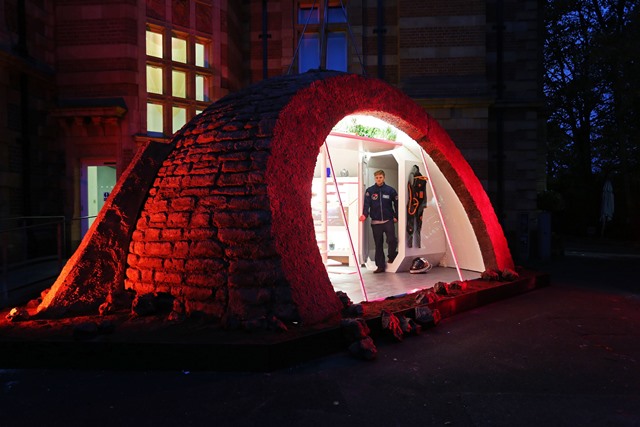
Mars show home at the Royal Observatory Greenwich, London.

The National Geographic Mars show home at the Royal Observatory Greenwich, London. The habitat is the work of Wild Creations in consultation with observatory astronomers and Stephen Petranek, author of How We’ll Live on Mars.{credit}National Geographic mini-series MARS runs through 19 December{/credit}

A big red igloo with a towering antenna seems a little overblown for a London show home. And so it proves. The object squatting outside the Royal Observatory Greenwich is actually a life-sized mock-up of a Mars habitat, billed as the imaginary dwelling of a second wave of settlers from Earth. That is, those who might live on the Red Planet in their thousands by around 2037, if the ambitious plans of space entrepreneurs such as SpaceX’s Elon Musk bear fruit.

The mock-up, in London this week to 16 November, promotes the National Geographic channel docudrama MARS, by director Ron Howard and Brian Grazer. Launched on 13 November, the mini-series charts the 2033 journey of a fictional first crewed mission to Mars by a blissfully collaborative International Mars Science Foundation, and subsequent attempts to establish a settlement.

As Earth’s second-nearest neighbour after Venus, Mars is widely seen as the best candidate planet for human colonization. But it lacks Earth’s thick atmosphere and global magnetic field, and is extremely inhospitable in myriad other ways. Colonists would need to be protected from temperatures that plummet to -70 degrees Celsius at night at the equator, as well as the high-energy cosmic particles and ultra-violet solar radiation that pummel the planet’s surface.

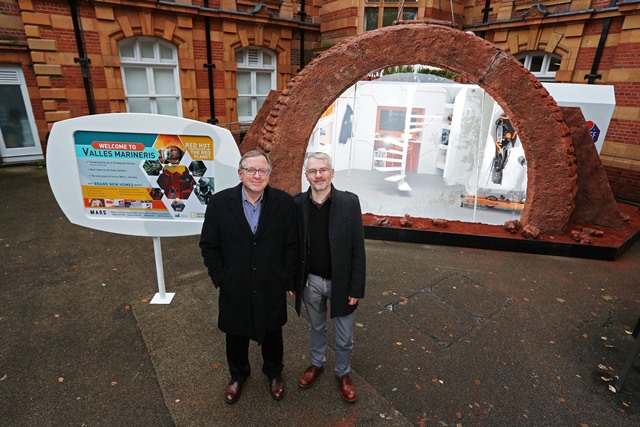
Author Stephen Petranek with Marek Kukula, the Royal Observatory Greenwich public astronomer.

Author Stephen Petranek with Marek Kukula, the Royal Observatory Greenwich public astronomer.{credit}National Geographic mini-series MARS runs through 19 December{/credit}

The Martian igloo, the work of display and model-making company Wild Creations, is a fun way of exploring what constraints the environment would put on design. The walls are a whopping 60 centimetres thick — just an eighth of the almost 5-metre depth they would need to be capable of protecting colonists from the radiation, said Stephen Petranek at the show-home opening. His book How We’ll Live on Mars inspired the series, and he consulted on the show home alongside the observatory’s public astronomer Marek Kukula. Moreover, Petranek notes, it would need to be built of bricks made by microwaving a mixture of polymer granules with Mars’ clay mineral-based soil. And an igloo is just one possible design. The same bricks could easily make bigger structures, even a large Gothic cathedral, he says. Or homes on the Red Planet could be built in the natural underground hollows that once housed lava, or in the side of craters.

Daily life for the 10,000 people Petranek imagines might some day dwell in this kind of shelter does not look appealing. Accessed via an ‘airlock’ stuck into the igloo wall, the dome’s interior is claustrophobically small — just a few paces across. Features would have to include an exercise machine to combat muscle wastage in the low-gravity environment, and an indoor farm. The small potted plants I spot on a mezzanine near the building’s ceiling hardly look substantial enough to sustain a hungry Martian for more than a few weeks — in contrast to the heaps of potatoes ingeniously grown by fictional astronaut Mark Watney (Matt Damon) in Ridley Scott’s 2015 film The Martian. Settlers would also need access to water, which (assuming it is there) may only exist in liquid form dozens of metres down in the planet’s concrete-hard ground.  

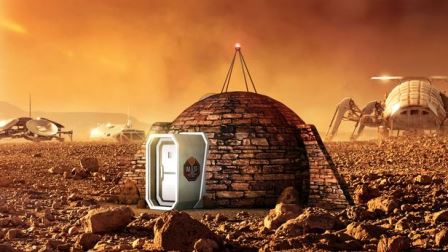
Artist's depiction of the show home in situ.

Artist’s depiction of the show home in situ.{credit}National Geographic{/credit}

The message here seems to be about thinking big to encourage ambition, as with the MARS mini-series. That uses an innovative format: the drama unfolds amid “flashbacks” to interviews with actual scientists and space pioneers, such as Musk. These highlight how real progress often initially involves failure, but  also serve to make the dramatised scenes seem even more fictional.

Petranek notes that plans such as Musk’s are “much more realistic than people give them credit for”. And whether or not they succeed, SpaceX is driving all space exploration in the direction of human missions to Mars, he argues. But for now, most planetary scientists still see living there as science fiction, and that’s not just because of unfeasible costs or optimistic technology projections.

Many researchers don’t actually want to send people to the Red Planet yet. It could well have harboured life billions of years ago, and finding that would tell us that life on Earth was not a one-off fluke. NASA, the European Space Agency (ESA) and the China National Space Administration all plan to put rovers on Mars in the 2020s to scour it for ancient life. But while rovers can be carefully sterilised to prevent contamination, sending humans would almost certainly contaminate the planet, and could mean we never find out. From that perspective at least, there is no hurry.

Elizabeth Gibney is a reporter on physics for Nature based in London. She tweets at @LizzieGibney. Listen in to her Nature Podcast talk with Andrew Coates, the planetary scientist working on the ESA’s first Mars rover. 

MARS runs through 19 December on the National Geographic channel. 


For Nature’s full coverage of science in culture, visit www.nature.com/news/booksandarts.


The warp and weft of wearable electronics

Zhang 1

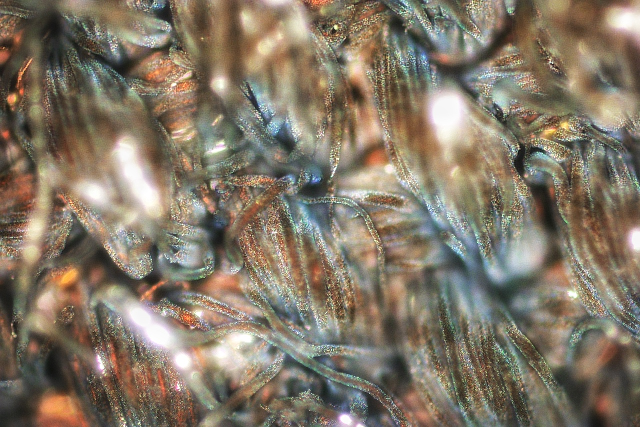
Optical microscope image of a battery electrode made of metallic textiles and active materials. {credit}Dongrui Wang{/credit}


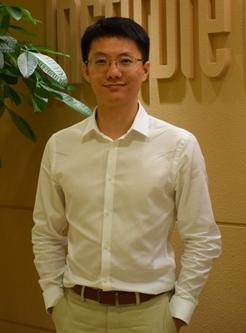
3Q: Zijian Zheng

One of today’s challenges for materials scientists is wearable electronics — smart materials that monitor ailments, harvest energy, track performance or communicate. These remain expensive and hard to produce in bulk, and are often unattractive. Polymer scientist Zijian Zheng takes inspiration from his designer and business colleagues at Hong Kong Polytechnic University’s Institute of Textiles and Clothing. His solution: lightweight electronic yarns that can be made into textiles by adapting existing production processes.

 How do you create wearable electronics?

People need to feel like they’re not wearing electronics, so the materials must be lightweight and flexible. They must also be high-performance, as devices have to charge rapidly, last for a long time and be sweat-proof. Applying all these criteria, we create electronic textiles in which the fabrics themselves form the sensors and devices – from light-emitting diodes, photovoltaics, organic transistors and supercapacitors to batteries. We can make a supercapacitor using conductive yarn, made by coating cotton with nickel, and penetrating it with a form of graphene oxide. If you put a pair of these strands together in parallel, and fill the space between with an electrolyte gel, you can make it work as a supercapacitor storing energy as positively and negatively charged ions collect at the different wires. You could use that to power other devices, such as sensors, or store energy generated from photovoltaics. We’re working on making lithium batteries using the same principles.

Polymer scientist Zijian Zheng.

Polymer scientist Zijian Zheng.

What are your biggest challenges?

When integrating different materials together in an electronic textile, the interfaces create the biggest problems. You can get mismatches between mechanical and thermal expansion properties, and in a flexible system the weakest points are where the device twists or bends. In my group we focus on using polymers to address these issues. For example, we make new polymers that add texture to the surface of textiles, allowing them to be coated in copper at low temperatures for durability. To ensure scalability, our goal is to make textiles that can be integrated with the technology the clothing industry has used for the past 200 years. Our composite yarns can be used in sewing machines, and complicated patterns can be created from them using machine embroidery. From there, you start to add active materials to make devices in ways that are compatible with textile processing. For example, we’re now making photovoltaic cells printable via textile colour-printing technology and encapsulating them with textile-finishing technology. And we are set to make a radio-frequency identification tagging device within a garment, powered by a supercapacitor. We’ve designed it to hide the supercapacitor as an embroidered pattern, like camouflage. We also have a student working with local textile company EPRO Development, trying to put the metallic, conducting textile into real production. Devices will come a bit later as they are ten times more complex to make. Cost is a challenge too: the textile industry cares about every penny. In introducing functional elements into garments such as a breathable section, you might only be allowed to increase production costs by around 10 cents.

Zhang 2

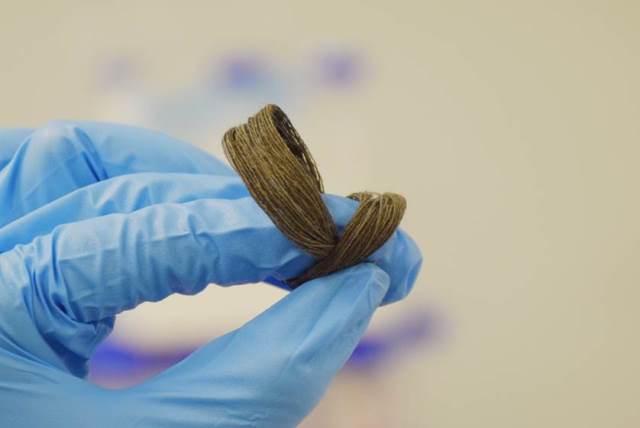
One hank of copper-coated cotton yarns used for making wearable devices and circuits.{credit}Ka-chi Yan{/credit}

How do the different disciplinary strands in your institute work together?

My institute covers the whole chain of production for textiles and clothing – with materials science and chemistry groups sitting alongside business and design. So we have three streams of students and teaching is totally different for each. The major challenge when I lecture is how to deliver my engineering or scientific-based content to a bunch of artists. We tend to give them an overview to help them understand first, with lots of examples, before we come down into the fundamentals. It’s very different from the physical science students, where we take them through a logical sequence from beginning to end. The artists ask so many questions. Generally they want to know if they can do something with a material, and don’t care about why it functions. They seldom ask “Why does this electron go through there?”

Interview by Elizabeth Gibney, a reporter on physics for Nature based in London. She tweets at @LizzieGibney.


For Nature’s full coverage of science in culture, visit www.nature.com/news/booksandarts.

The art of engineering: 9 Evenings revisited

Composer John Cage's xxxx at 9 Evenings, October 1966.

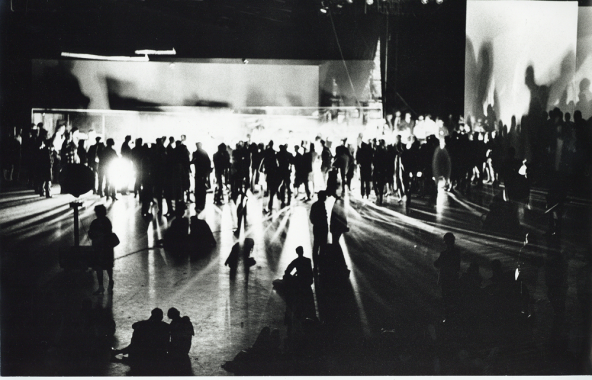
John Cage, Variations VII, 9 Evenings: Theatre & Engineering, October 1966.{credit}Adelaide de Menil{/credit}

I’m gazing at a stage draped in white when a giant zipper suddenly appears, projected onto one wall. As it works its way noisily around, more projections — live-streamed or pre-recorded moving images of buildings, blurred pedestrians, discarded clothing and simmering water — judder on crumpled backdrops. An apparently random urban soundtrack lulls and roars in the background. In the foreground, performers skip rope and cut hair; one solemnly rips up, boils and eats her shirt. It’s quite an evening.

Robert Whitman at performance of Side Effects, October 2016.

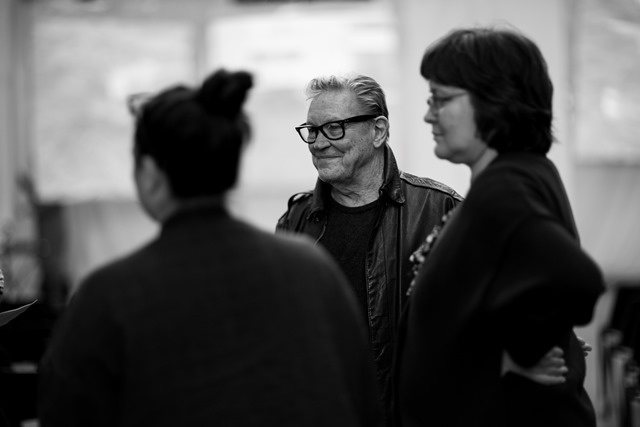
Robert Whitman (centre) at performance of Side Effects, October 2016.{credit}Christopher Fernandez{/credit}

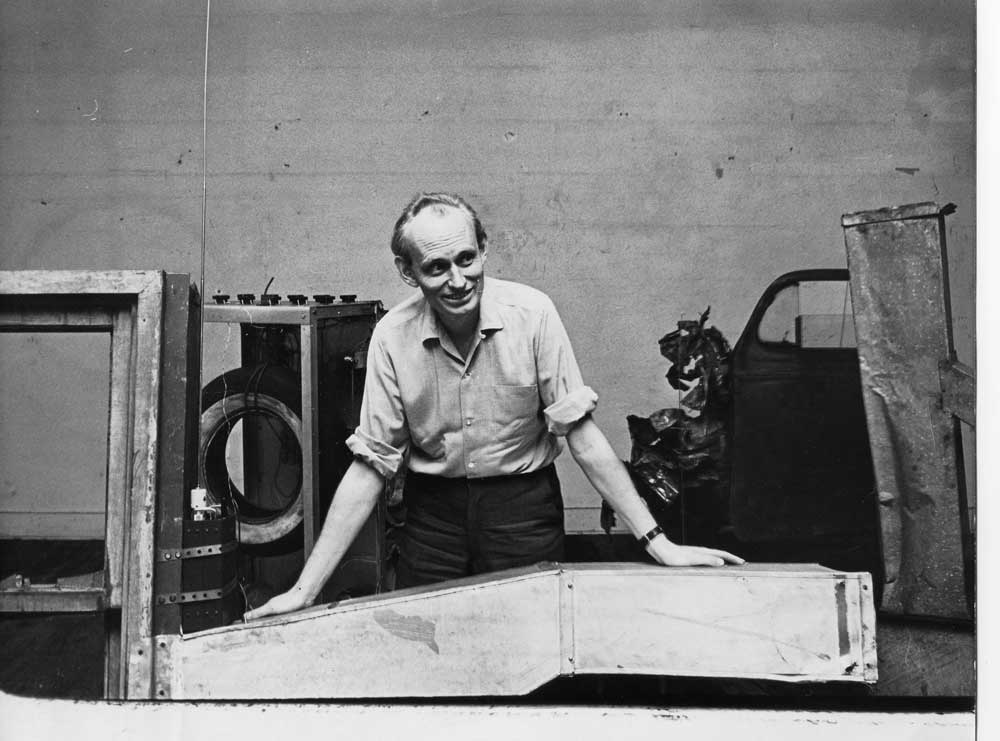
The artist behind this indeterminate, playful, technologically rich and vaguely disturbing piece, Side Effects (commissioned by Arts Catalyst) is Robert Whitman. The evening is an homage to 9 Evenings: Theatre & Engineering, a legendary series of performances that, 50 years ago, galvanised New York with an unprecedented mix of cutting-edge technologies and avant-garde art. Whitman was one of 10 artists — among them multi-media maverick Robert Rauschenberg, composer John Cage and choreographer Lucinda Childs — who collaborated one-to-one with 30 engineers, most from research powerhouse Bell Labs and including, notably, the visionary electrical engineer Billy Klüver. Klüver was adamant about involving technologists rather than scientists, feeling that technology is essentially about “the material and the physicality”. It was a moment that paved the way to crossover disciplines such as digital art.

There was a utopian edge to technology then, as America literally reached for the Moon. For artists seeking new media, high-tech expertise enabled fresh explorations in sound and vision. For the engineers, artists expanded what Klüver (already a veteran of collaborations with Jean Tinguely, Andy Warhol, Rauschenberg and Cage) saw as constrained horizons. Whitman, whom I caught up with after the performance of Side Effects, recalled that the 9 Evenings teams included a lot of “arranged marriages”, but worked if goals and enthusiasms chimed.

Billy Kluver in 1965.

Billy Klüver with Robert Rauschenberg’s work Oracle in 1965.{credit}New York Times, courtesy of E.A.T.{/credit}

By that time (October 1966), Whitman had been creating immersive pieces for some years, combining film, performers and ‘shape-changing’ props such as plastic sheeting. His 1960 The American Moon, for instance, had a hallucinatory quality and a sense of “slow time”, according to fellow experimentalist Claes Oldenburg. 9 Evenings offered a chance to push the boundaries in a bold venue.

That was the 69th Regiment Armory, a hangar-like midtown Manhattan edifice where, over 50 years before, another exhibition had exploded America’s cultural complacency with artworks such as Marcel Duchamp’s Nude Descending a Staircase. For 9 Evenings, some 1,500 people a night filed into its reverberating spaces.

Signal splitters, Geiger counters

Whitman’s contribution Two Holes of Water – 3 featured input from a number of engineers, including cellular telephony researcher Robby Robinson. The piece involved 23 performers, seven plastic-wrapped cars equipped with film projectors, one of the first fibre-optic miniature video cameras, film shot using an optical device with parallel mirrors, and a signal splitter that allowed a performer’s front and back view to be superimposed. A projected live image of water being poured into a glass on the Armory floor and documentary footage of Alaskan flora and fauna also featured.

Equally bravura was Cage’s composition Variations VII (pictured above), which harnessed live feeds from numerous sound sources. As Cage ‘played’ several transistor radios, 10 telephone lines picked up ambient noises from locations round the city, including the 14th Street Con Edison electric power station and the press room of the New York Times. Signals from two Geiger counters were converted into sounds; six contact microphones amplified noises generated by performers handling devices such as juicers, while data from electrodes on the forehead of another were converted into sound waves.

Robert Whitman in the 1970s.

Robert Whitman in the late 1960s.{credit}A&T archives, courtesy Los Angeles County Museum of Art{/credit}

Some critics tore into the event, as technology historian Patrick McCray has noted. Whitman, Rauschenberg, Klüver and fellow engineer Fred Waldhauer, however, had already forged ahead with another venture. The non-profit foundation Experiments in Art and Technology (E.A.T.) took the cross-fertilisation further. By 1969, E.A.T. comprised 2,000 artists and as many technologists, riding the wave of innovation in electronics and communications. Their Projects Outside Art series, for instance, featured Telex: Q&A, which linked public spaces in India, Japan, New York and Sweden to encourage citizens of each to question future possibilities.

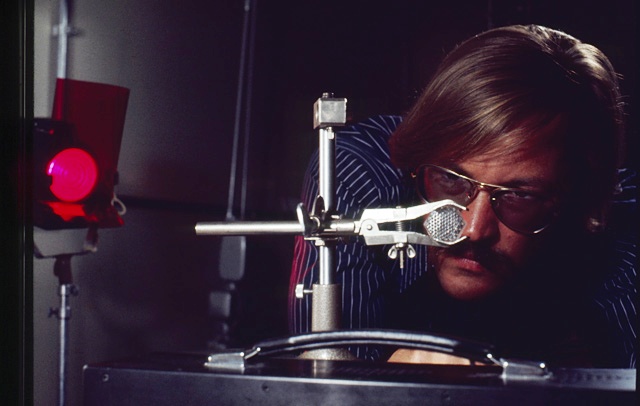
Meanwhile, a programme with aims similar to E.A.T.’s had sprung up at the Los Angeles County Museum of Art (LACMA). Art and Technology, the brainchild of curator Maurice Tuchman, boasted star physicist Richard Feynman as consultant. Whitman was also involved. So began his immensely fruitful teamwork with optical scientist John Forkner, then at Philco-Ford, the company that built the equipment at NASA’s Johnson Space Center mission control.

Optics scientist John Forkner.

Optical scientist John Forkner.{credit}A&T archives, courtesy Los Angeles County Museum of Art{/credit}

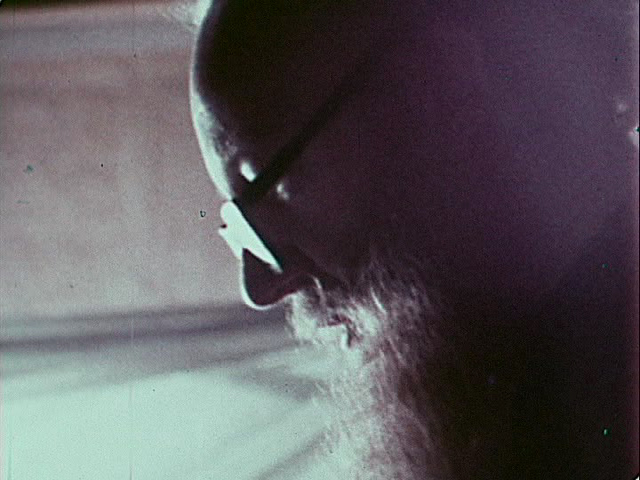
“This public-relations official introduced me to a guy with a long beard. I was lucky,” says Whitman. “John was a natural genius in optics and very interested in music and art. I remember that at one point I was sitting in a car with Feynman and he said, ‘Where’d you find him? He’s terrific.’”

Over 18 months, Whitman and Forkner created a spectacular installation for LACMA at the US Pavilion at Expo ’70 in Osaka, Japan. Tuchman described the work as an “optical tour de force” incorporating 1,000 corner-shaped mirrors reflecting the viewer’s multiplied image to them, as well as pulsating mylar mirrors and “eerily bright three-dimensional objects (a pear, drill, goldfish bowl with live fish, a knife, a clock, ferns, etc.).”

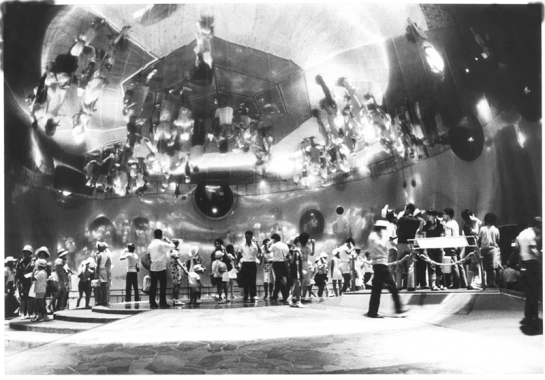
E.A.T. was equally busy at Expo ’70: the Pepsi Pavilion was a focus for several of its cutting-edge collaborations. A major element was a spherical mirror over 27 metres in diameter that created real images of visitors, hanging in space above their heads. Whitman contributed here too, along with physicist Elsa Garmire, while artist Fujiko Nakaya worked with physicist Tom Mee to create the evocative fog sculpture capping the structure. It was clear that by this time, as McCray puts it, artists and engineers between them had “rewired modern art”.

Mirror dome room at the Pepsi Pavilion at Expo '70 in Osaka.

Mirror dome room at the Pepsi Pavilion at Expo ’70 in Osaka.{credit}Shunk-Kender{/credit}

Whitman is now 81, and busy. Many other movers and shakers behind 9 Evenings and E.A.T. are gone. As for E.A.T. itself, it has effectively ended as an entity, but “exists as an idea,” notes its director Julie Martin (Klüver’s widow). Klüver himself, in a 1999 interview with Hans Ulrich Obrist, said, “once everybody understands the idea of artists and engineers working together, there is no reason for E.A.T. to exist”.

I asked Whitman what he thought about 9 Evenings now. “Looking back is what I call ‘dead guy stuff’. You need to get onto the next thing. As for the future, it’d be fun to be around.” There is something there of the unquenchably optimistic technophile, always looking for the next innovation. Yet just for a moment, he did look back. “I didn’t know it at the time, but for me it all started with Emmett Kelly,” he told me. On a childhood visit to the circus in the 1940s, Whitman had been galvanised by the iconic American clown, who had a routine where he swept up the spotlight with a broom. “I was staring at everyone around me, wondering why they weren’t seeing this miracle. It set me on my way.”

I thought of the spotlit zipper in Side Effects, and began too to see how an early bent towards flux and illumination led him to performance, advanced technology and the intensive mix of both that was 9 Evenings. And beyond.

Arts Catalyst’s 9 Evenings: Theatre and Engineering Revisited 1966/2016 continues to 29 October.

Archival information on 9 Evenings and E.A.T. can be accessed at the Daniel Langlois Foundation Collection. Maurice Tuchman’s report on LACMA can be accessed here. My thanks to Robert Whitman, Julie Martin and Patrick McCray for additional information. McCray is currently writing a book (tentatively entitled Art Rewired: Engineering a New Creative Culture) on the art-technology nexus in that era. His Leaping Robot blog meanwhile offers much fascinating detail on 9 Evenings, E.A.T. and more.

Science fiction: journey to the East

Cixin Liu

Cixin Liu.{credit}Li Yibo{/credit}

Posted on behalf of Iulia Georgescu

Last week’s Chinese Sci-Fi event at the London Literature festival was irresistible: I love science fiction and have a keen interest in the Far East. The star here was Cixin Liu, whose 2008 Hugo-awarded novel The Three-Body Problem is a huge best-seller in China and, since its English translation (Head of Zeus, 2015), beyond. (See Nature’s interview with its translator, sci-fi writer Ken Liu, here.) Liu’s fellow panellist was Xiaolu Guo, the award-winning, genre-defying Chinese novelist and filmmaker now living in Britain, whose works include the 2014 I Am China and 2012 UFO In Her Eyes.

Xiaolu Guo.

Xiaolu Guo.{credit}provided by Xiaolu Guo{/credit}

Both Cixin Liu and Guo had much to say. They agreed that sci-fi is a Western concept imported into China in the late 1970s and 80s. Post-Cultural Revolution China had the perfect climate for nurturing the genre, they said. First, there was a void in fantastic and speculative literature: much of Chinese literature in the twentieth century was focused on realism. Secondly, as science education was very poor at that time, sci-fi was a means of educating about science. The public fell upon it, eager to learn more about the latest discoveries.

Although Liu was heavily influenced by Western sci-fi writers, Chinese sci-fi has unique features. The difference, he seemed to think, lies in the Christian tradition imprinted on Western fiction. For instance, there is much discussion of whether the ethical implications of human cloning are perceived differently in China (see this Nature article). Liu averred that more than that, the idea of a doomsday, so dominant in Western thought, is less so in Chinese culture, which enshrines the concept of time flowing continuously and eternally.

imagesThat said, Liu’s The Three-Body Problem is about the end of the world — which is perhaps one of the reasons for its international popularity. (Japanese sci-fi is rich in apocalyptic scenarios too, for example in classics such as Kobo Abe’s Inter Ice Age 4, Sakyo Komatsu’s Japan Sinks, or the Neon Genesis Evangelion media franchise.)

Liu and Guo agreed that for them, the appeal of sci-fi lies in its departure from realism. Guo suggested that sci-fi is perhaps the only way for writers living in China to talk about political and social issues, as with Jingfang Hao‘s Hugo-winning novelette Folding Beijing (set in a future where three social classes inhabit Beijing in different spatial dimensions that only occasionally overlap). For Liu, sci-fi allows him to explore a bigger picture – humanity as a whole and its place in the Universe, as in the last book of his Three-Body trilogy, set in the very distant future.

The event made me realize anew how little of contemporary Asian literature has been translated into English. I hope that Liu’s popularity prompts publishers to more translations: I already have a long wish list.

Iulia Georgescu is senior editor, Nature Physics.


Access Natures science fiction special here; and Natures science-fiction column Futures (and Future Conditional blog) here. For Nature’s full coverage of science in culture, visit www.nature.com/news/booksandarts.