Safe spaces

rorandall_BW_cropped (2).JPG

Rosemary Randall is a psychotherapist, founder of the community-based charity Cambridge Carbon Footprint and the nationally acclaimed Carbon Conversations project. Her work brings insights from psychotherapy to work on climate change and she writes and lectures widely on the psychological dimensions of the public response to the issue. Links to her work can be found on her website.

The idea of the ‘safe space’ is crucial to psychotherapy. What relevance does it have to climate change?

Many people find it hard to accept the reality of climate change and the need for both urgent action and widespread socio-political change. This is often an emotional rather than an intellectual problem: climate change threatens much that people hold dear. ‘Safe spaces’ where people can come to terms with what may happen, the changes that are needed and their own feelings about it can be crucial in helping them take action both in their personal lives and politically, as citizens.

In psychotherapy the safe space is created by the therapist who initiates a relationship that:

• Is non-judgmental and offers tolerance and respect

• Accepts the complexity and strength of feelings

• Embodies belief in the possibility of change and development

• Offers challenge as well as support

• Encourages and trusts in people’s creativity

The ‘safe space’ is not one which feels cosy but one which allows creativity and change to occur. It is safe enough to think, to feel, to question, to become uncomfortable, to be upset, to argue, fall out, make up and survive. If the safe space becomes merely comforting or self-congratulatory it is not doing its job.

The relevance for this to climate change relates to the fact that people do not change their opinions or adopt new behaviours through being given information or being put under pressure. Information on its own doesn’t work. Telling, arguing, shocking or bludgeoning just don’t do it. What does help is creating situations where people can reflect and get in touch with their own conflicting feelings, motivations and creativity. Creating situations that draw on the idea of the ‘safe space’ can lead to some interesting outcomes.

Examples

In my work for the charity Cambridge Carbon Footprint, the idea of the ‘safe space’ lay behind the Carbon Footprint interviews we conducted with over 2500 people in the City between 2005 and 2008. 32 questions about their home, their travel, the money they spent and the food they ate took people quickly to the heart of their carbon-dependent lives. Although an answer emerged at the end which told people where they stood in relation to the national average footprint, the point was the conversation that took place. Training the interviewers to make this a non-judgmental, exploratory, welcoming experience was key.

My subsequent work has continued this emphasis on safe spaces. Training volunteers in personal communications skills helps them judge quickly how a climate change conversation is going, alerts them to the subtle resistances that people bring to difficult subjects and helps them offer appropriate support and challenges. Carbon Conversations, a scheme now organised nationally by COIN, brings people together in small facilitated groups to share their responses to climate change and explore how to make major reductions to their carbon footprints. Again, it’s the creation of the safe, responsive space which is key to the success of these groups.

Safe spaces are not unique to psychotherapy. They can be found in many other contexts and can occur spontaneously where people trust each other enough to open themselves to new ideas and possibilities. Sharing values is often key and I experienced a good example of this at the recent Sustainability in Crisis conference in Cambridge. This was a conference of people from faith groups, primarily Christians, and so it had the ease of understanding and acceptance that comes when people know that their basic premises about life are likely to be affirmed and understood by others. Into this conference, (which like many meetings of like minds carried a risk of cosiness) flew Bill McKibben, the US environmentalist and activist, fresh from cooling his heels in a Washington clink, having been arrested during a demonstration about the planned oil pipeline from Canada. Warm, engaging, sharp and inspiring, McKibben embodied the creative challenge that the safe space both needs and makes possible. McKibben was uncompromising in his argument that the additive process of individual action won’t work. Political engagement is critical. He reminded his audience of the origins of non-violent direct action in the Christian tradition and encouraged them to stand up, take part and risk arrest. Conversations over coffee and supper were testament to the way he pitched his challenge but it was the context of the safe space that made it possible for him to be properly heard.

Politics and campaigning

In more directly political work the tension between the need to challenge and the need for a safe space can be tricky. Confrontation, uncompromising demands and irresistible pressure on those in power are necessary. The clue is to think about who needs to be confronted and who needs to be safe. There is often a dual audience, those in power who need to be challenged and a potentially sympathetic public who need to be engaged and encouraged to come on side and take part. Climate Rush with their mix of humour, drama and surprise is one group who seem to have a good balance of confronting those in power without alienating those who witness their demonstrations. Occupy London seem similarly well positioned in engaging the public while causing grave discomfort to those in power. Bill McKibben’s plea was for climate protestors to abandon the polar bear outfits and come dressed in respectable suits in order to demonstrate visually to the powerful that this is a protest of mainstream opinion and to mainstream opinion that here is a protest they can identify with and participate in. However it is done, the capacity to create the space in which ordinary people feel safe enough to pause, become curious, explore and then act is essential.

“Reaching Further” The Exscitec Project

shreena.PNGThis week’s guest blogger is Shreena Patel, Scientific Projects Manager for Exscitec. In partnership with Imperial College Outreach,

they provide hands-on practical activities for students to raise aspirations in Science, Technology, Engineering and Maths (STEM).

Science is cool. Science is fun. If you’re anything like me, you love keeping up to date with the latest technologies and discoveries that emanate from the scientific world. However, trying to convince a less than enthusiastic 14 year old that a peak in the data from the Large Hadron Collider could possibly change Physics as we know it…well that’s slightly more challenging! The reality is that for a large number of students, science is simply not seen as fun or cool.

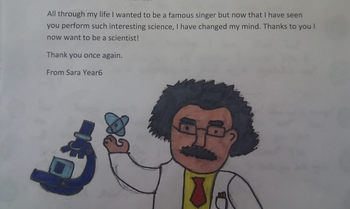
Recently I asked a group of year 6 students (10-11 year olds) “What is a scientist?” What appeared on the whiteboard was a disturbing cross between Doc Brown and Einstein. I was told by the students that the image depicted in the picture was concentrating hard on NOT blowing up the ‘potions’ in his lab and was about to invent something spectacular (hence the light bulb hovering over his head). The excitement in the room was so infectious that even I wanted to meet this amazing scientist drawn on my whiteboard.

Ask this same question of year 10 (14-15 year olds) and the image on the whiteboard becomes the stereotype of a boring, geeky individual stuck in a dingy lab all day. Despite some very hard working teachers, a lot of students at this age just don’t realise how vast the reach of STEM is in the real world.

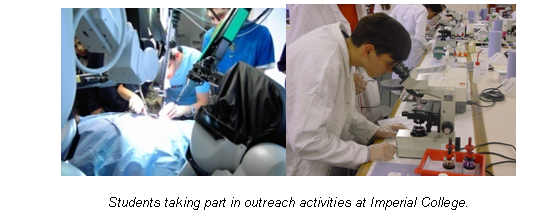
As outreach providers for Imperial College, over the past 12 years, Exscitec has provided bespoke courses for school students of all ages and abilities. Whether it’s building robots, synthesizing compounds or discovering who committed murder most foul through forensic testing, we try to take STEM off the textbook page and into the real world. In a nutshell, we try give students that ‘wow’ factor that will change the way they look at STEM.

part 1.bmp

With the new Reach Out Lab (ROL) at Imperial College, we are now able to connect with even more students throughout the year. Opened in 2010 and championed by Professor Lord Winston, Chair of Science and Society, this multi-purpose laboratory provides a year round teaching facility for young people and teachers. Exscitec’s CEO, Alan West, who is also the Director of the ROL, was recently awarded an MBE for services to STEM education. Speaking about his work, he says, “In recent years, my work, and that of the Exscitec team, has focused very much on the development of STEM enrichment activity connected with Imperial’s Reach Out Lab, the success of which is enabling us to develop more exciting initiatives in support of STEM education”.

One of these new initiatives is called Reaching Further, which is a program which allows school students the opportunity to work with PhD, MRes and Masters students from the Imperial College research community. The premise is simple: students get to speak to a “real scientist”, and in return, researchers are able to share their work and strengthen their public engagement portfolio.

By giving students the opportunity to work with these researchers, we are able to tackle one of the main issues facing young students studying science: the time it takes for scientific breakthroughs to make it into students’ textbooks. This disconnect is one of the major issues we are trying to overcome here at the ROL. So far we have worked with researchers from the National Heart and Lung Institute, the Energy Futures Lab, the Grantham Institute for Climate Change, UK Energy Research Centre (UKERC) to name but a few.

Sarah Lester, Energy and Mitigation researcher at the Gratham Institute for Climate Change, along with Dr Jeff Hardy and other colleagues from UKERC, recently led Energy Islands – a role play workshop where year 12 students (16-17 years old) negotiated a reduction in carbon emissions for their world. Talking about her work with outreach so far, Sarah says, “I think the outreach work has been going really well and has helped the students get involved with academics and research on climate change. The Energy Islands game has also given us great motivation and an excellent tool to work with under 18s and the public as part of our education and information sharing work. One of the best things was being reminded how passionate people can be about this area once they feel they can make a difference.”

I couldn’t have put it better myself. When it boils down to it, students want to be spoken to, not at. Once they feel that someone is listening, you find that they have an awful lot to say. Whether it’s stem cells or solar cells, who better to talk to than those who are at the forefront of the field? As Claire Doyle, PhD student in Organic Chemistry put it, “It definitely added variety to my doctorate and has given me some great experience for the future. Plus it was very rewarding to see students so excited about what I did.”

part 2.bmp

So to all those hard working researchers sitting reading this during a break from their next round of tests, I urge you to get involved in outreach in whatever way you can. One interaction can literally change a student’s whole outlook on a subject. Science becomes cool, science becomes fun and as a consequence back at school the attitude towards science learning changes too.

fun.JPG

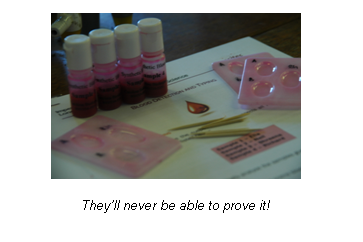
With that, it’s time I return to my lab, where a group of year 9 students (13-14 year olds) from Watford are eagerly waiting to accuse me of murder based on some smudged fingerprints and some suspicious stains on my clothing… which may have tested positive for blood (rookie mistake!) I have been informed that I am going to be thoroughly interrogated after lunch…!

part 3.bmp

If you’re interested in reading more about mentoring in science, the nature.com Communities team ran a recent Science Online NYC (#sonyc) discussion about “Reaching the Niches”. Links to our coverage, including a series of guest posts on other mentoring initiatives can be found here.

Science Across Egypt© Project

gihan.png This week’s guest blogger is Gihan Samy Soliman, an Educational Consultant & Master’s Researcher at the Institute of Environmental Studies & Research, Ain Shams University.

Since 1936, when Egypt became a party to the Convention Relative to the Preservation of Fauna and Flora in their Natural State, they have been among the pioneering countries taking an active interest in the conservation of biodiversity and the preservation of natural resources. In 1992, Egypt signed the Biodiversity Convention of Rio de Janeiro and ratification of this Convention was completed in 1994. This Convention required the parties to formulate national strategies setting a framework for the conservation of biological diversity (biodiversity). Although much “technical” attention has been paid to biodiversity in Egypt, with many conferences, recommendations and ratification of laws, the problem of an evidently defective system of education in Egypt means that the right information on conservation doesn’t seem to reach the right people: students.

fig 1.jpg

Teaching methods in Egypt need to be addressed, particularly in relation to biodiversity. Biodiversity is the degree of variation of life forms within a given ecosystem and is a measure of the health of ecosystems. Biologists define biodiversity as the “totality of genes, species, and ecosystems of a region.” For students in the US, biodiversity is studied as a science; students can explore textbooks and review material according to their curriculum, which is usually based on each state’s learning standards (Figure 1). However, in Egypt there is hardly any real relationship between science and the environment, making learning about these issues difficult.

Several attempts at reform have been made to enhance science education in Egypt and raise awareness of biodiversity issues. However, they’re usually confined to issuing books, booklets, CDs and posters which are not systematically presented to students and end up sitting on school library shelves and hidden away in cupboards (e.g. www.biomapegypt.org ).

As an educational consultant working with Ahmed Abdel Azeem, Ph.D, I have started working with schools on a self-financing environmental and applied science project called Science Across Egypt©. The project’s aim is to integrate conservation of biological diversity into curricula and extra-curricular activities in “Egyptian schools”.:https://www.misrnewsagency.com/main/art.php?id=109&art=10914

fig 2.png

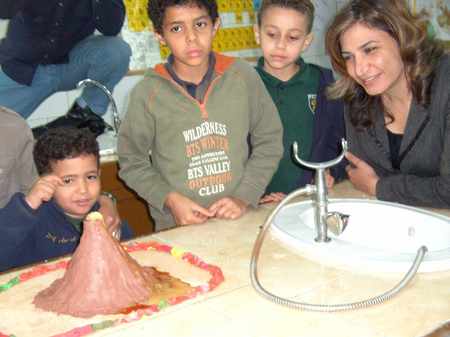
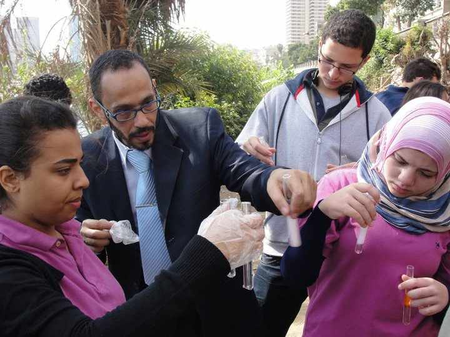
The Science Across Egypt project carries out many initiatives that aim to teach children more about the environment. As an example, on International Water Day on March 22, 2011, students of Port Said American School

were accompanied to the Nile River bank to celebrate the event and take water samples to measure the level of pollution onsite. They also campaigned for declaring the river Nile as a natural protectorate (Figure 2). The Media reported the event as being a unique opportunity for children to learn more about the environment.

fig 3.jpg

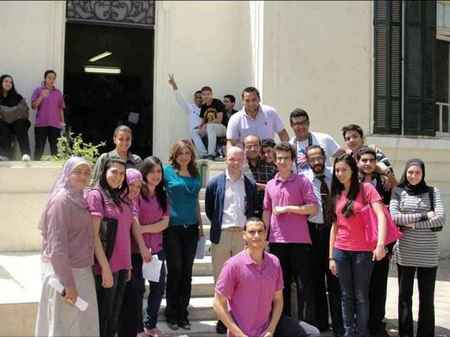
Reforming science education in Egypt will need more determined efforts on both national and international levels (Figure 3). Taking a step in this direction, for the first time in Egypt, a group of scientists and attentive community leaders have established an international Egyptian NGO (International Foundation for Environment Protections and Sustainability) to address the issues of biodiversity in Egypt (www.ifeps.org ). Will such efforts work? Let’s keep our fingers crossed.

Geography Is Social

nicola.bmp

This week’s guest blogger is Nicola Osborne, a Social Media Officer for EDINA, a JISC National Data Centre based at the University of Edinburgh. Nicola began her career investigating “Y2K” for BP but, whilst studying engineering, she became more interested in writing and running review websites. After graduating Nicola joined the Edinburgh University Library then moved on to SUNCAT where she worked with library catalogue data and trialled various social media tools to promote the service. She was appointed to her current innovative role in 2009. Nicola Osborne is a regular speaker on social media, an organiser for the annual Repository Fringe events and regularly blogs on social media events, possibilities and issues for higher and further education.

I have the rather unusual job title of Social Media Officer for EDINA and I’ve been asked to explain what I do, though I should probably start by saying that my work varies hugely from day to day and week to week depending on the projects I’m working with, the events that are coming up, and the new technologies that have appeared lately (right now Google+ and Klout are the hot topics).

The largest part of my role is to work with colleagues across EDINA projects and services to encourage and support the use of social media and related communications technologies. We run services including Digimap, an online mapping and spatial data service including Ordnance Survey data; and JISC MediaHub, a huge resource of images, video and sound; and SUNCAT, the UK Serials Union Catalogue. I help my colleagues think about how we can engage our user communities through social media – whether by including sharing elements or social media-like features in an interface or through sharing training materials on YouTube or providing updates and alerts via blogs and twitter. I also help to manage the in-house blogs platform and authored the EDINA Social Media Guidelines which we have had a fantastic response to since we released them under Creative Commons license in January 2011. Acting as a social media “evangelist” is not only my passion but an official part of my job description so a significant part of my role is speaking, writing and running training events where I enthusiastically share new possibilities and best practice for using social media in the education sector.

At the moment I am also part of the team running the JISC GECO – Geo Engagement and Community Outreach – project. We are working with 12 JISC-funded geo projects across the UK to make connections between the use of geo information and “non-traditional” users, which tends to mean those outside of geography, geosciences or earth sciences. We are using “geo” in a very broad way so we would mean anything geographic, geospatial, geo-referenced, or anything where location and/or physical context is important. We are trying to build new connections between those who have expertise, experience and resources to share, those that are interested in using geo, and those who bring new perspectives on geo and on how geo data or tools could be used.

The diversity of projects and disciplines that interact with geo is so broad that GECO is proving to be a constantly challenging and inspiring project. Those projects we are working with include several elearning projects: GeoSciTeach is creating a phone app for teachers leading science fieldwork; JISC G3 are developing approaches to teach geographic concepts to non geographers; and ELOGeo are developing an e-learning framework for materials on open data, open source and open standards around geospatial information.

Many of our projects are exploring existing data: geoCrimeData project is looking at the relationship between location and crime statistics; U.Geo is investigating material held in the UK Data Archive to identify those with location information and potential for use as georeferenced data; PELAGIOS is applying the extremely modern concept of Linked Open Data to expose, share and combine online resources about the very ancient world; IGIBS is working with researchers in the Dyfi Biosphere (a UNESCO designated area of outstanding diversity of environment, culture, language, etc.) to create a tool that combines research data with authoritative maps and allows that work to become more visible and sharable between researchers; and the Halogen 2 project team are enhancing their existing cross-disciplinary History, Archeology, Linguistics, Onomastics and Genetics database.

Screenshots.bmp

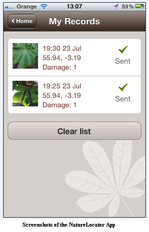
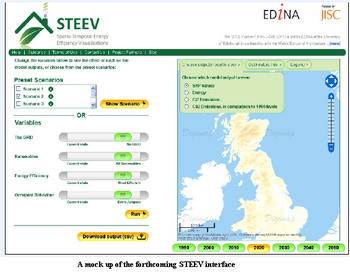
We are also working with the NatureLocator project who have created a curiously addictive phone app that lets you record the location and level of damage to horse chestnut trees which will help track the spread of the leaf minor moth; xEvents, who are creating a tool to build, share and map academic events; STEEV, a project to enable you to time travel through of historical energy efficiency data right through to future predictions. And, last but by no means least, the GEMMA project (which has a particularly fetching gerbil logo) is building a series of mapping applications and tools that can be combined and adapted so that any web user can make a map no matter how much or little that individual knows about mapping.

Steev.bmp

Most of these projects are reaching out far beyond traditional academic communities and all reach beyond traditional geo communities. Communicating with these audiences can be challenging, particularly for those used to working mainly with other specialists in their field. We are helping the projects find each other and related projects both within and outside of academia, and we are helping them to reach out with the broader community around their work. My main responsibility has been to help the project teams communicate what they are doing through their blogs. Some of the project teams include experienced bloggers but some of our researchers and developers are entirely new to sharing their work in such an informal and public space and we’ve been delighted to support them to become confident and talented bloggers.

In addition to the project blog we directly communicate key developments and announcements about these projects through a central JISC GECO blog and on Twitter as @jiscGECO. We are trying to highlight the connections between all manner of geo ideas, projects, concepts, tools and sites so we tend to share rather quirky finds in these spaces and always welcome comments, suggestions and guest posts. We will be running a number of events over the coming months and we will be amplifying these through liveblogging, tweeting and, where possible, videoing key content. We also have a mailing list to encourage broad discussion around geo – we do a lot of matchmaking between different people and communities and we want to help raise awareness of the ubiquity and importance that geo plays in everyday work and lives.

Our main focus at the moment is the organisation of an Open Source Geo and Health event (Twitter hashtag #GECOhealth ) which we will be running in Edinburgh on Tuesday 9th August. We have worked with the ELOGeo project at Nottingham University, the British Computing Society, Edinburgh Napier University and geo enthusiasts at the Edinburgh College of Art to create a fantastic programme exploring the intersections between geo and many aspects of health practice, theory, trends, policy, and we hope this will trigger some really interesting discussions and relationships that will continue long after the project comes to an end.

Belief in Dialogue: Science, Culture and Modernity

fern.JPG Dr Fern Elsdon-Baker is Director of the British Council’s Belief in Dialogue Programme. Belief in Dialogue is a new intercultural programme, which explores how people in the UK and internationally can live peacefully with diversity and difference in an increasingly pluralistic world. Fern currently serves on the UK Arts and Humanities Research Council’s Science in Culture Advisory Group. A passionate believer in the interactive communication of science, history and philosophy, in her spare time she is the recorder for the History of Science section for the British Science Association. She also serves on the programme’s committee for the British Society for the History of Science.
This blog post is coming to you from the United Arab Emirates. I am at a British Council conference organised with the American University of Sharjah, in association with the International Society for Science and Religion. The title of the conference, Belief in Dialogue: Science, Culture and Modernity, may at first seem a little challenging to some regular readers of Nature. How can there possibly be a dialogue of this kind?

One of the key questions we will be asking at the conference is what factors need to be in place in any society or culture for scientific endeavour or inquiry to flourish. At first these might seem like quite simplistic questions – surely it’s just about good science education and funding for scientific research institutions? However, I would argue it takes much more than that to build a thriving scientific economy. There are certain building blocks needed in areas of society that we might not readily recognise.

The role technological and medical advances can play in our daily lives is clear. We are all aware where the ethical boundaries may lie, whether this be around a range of questions from stem cell research, reproductive technologies, climate change through to water security.

However, to get to the root of what makes science flourish we need to make one fundamental observation – what we mean when we use the terms ‘science’, ‘technology’ or ‘medicine’ are all different. Intrinsically intertwined with shared – yet in places divergent – historical contexts, they have different approaches to methodology or their philosophical underpinning.

For technology to flourish you do not necessarily need a flourishing ‘scientific’ culture – significant societal drivers such as industry and entrepreneurship play perhaps a bigger role than a purely ‘scientific’ approach. Scientific inquiry is as much a way of thinking, seeing and asking questions about the world around us, as it is a consensus on a type of agreed methodological approach.

‘Science’ in this way, whether we recognise it or not, is an integral part of our daily lives. It is the very fabric of our cultural context but in different ways. I am far from arguing that there is no hope of an ‘objective science’ in the way that many scientists would argue – I am certainly not suggesting that the very stuff of science is culturally relative. But the cradle of all scientific inquiry is the broader societal and cultural context in which it sits. Not just the cultural perspective of the individual or team of researchers, but the context of the political system which supports or suppresses, the funding stream that can inadvertently create fashions and trends, and those of us in wider society who are ultimately the end users of any research and in turn fuel both political and funding priorities. This rich tapestry of influences ultimately shapes the scientific discourse of the day.

The answer then to my question lies outside of the science faculty or classroom. It is becoming increasingly recognised in developing scientific economies that the humanities play a key part in helping to frame the systems of thinking that are needed to engage both critically and analytically with the world around us. In the UK, we have long recognised the role of strong multidisciplinary discourse and it is to our credit that our research funding councils see the critical value in this interplay between sciences and humanities – even in these difficult economic times.

Another factor that we are growing to value more and more is the open engagement with wider society and cultures in science communication. Gone are the days when we would expect to disseminate ‘knowledge’ to an uninformed and apparently wilfully ignorant public. We are all members of that amorphous mass we like to call public and we cannot assume that we are all uninformed, uninterested or do not have valid questions about the role of science in society today or how it relates to our own individual cultural perspectives.

Freedom of thought and expression play a key role here too. Too often fundamentalists at the extremes of the spectrum close down on other’s perspectives not because of any epistemological impasse, but merely due to an unwillingness to even engage with another’s cultural perspective. Too often when we communicate science we cleave to polarising narratives that create an ‘us’ and ‘them’ approach to science communication – which can exclude a large proportion of the world’s population. There is no ‘them’, there is only an ‘us’.

In an increasingly globalised world where we all have multiple identities it is not possible to delineate between communities or cultures in the simplistic ways of the past. We cannot therefore assume, as has been done in previous years, that it is possible to create divisions between any culture – be that a disciplinary cultural divide between science and humanities or a cultural divide between world views.

In my work I have had the opportunity to meet a number of people from many different cultures, communities and faiths. Sometimes my perspective on how we view the world might differ from those I meet, but I have as yet not had the misfortune to meet someone who is so set in his own world view that we cannot openly engage in a discussion about those differences. In some surprising and heart-warming circumstances I have found considerable common ground with those who initially felt they were in opposition to my work communicating evolutionary science but have since become firm supporters. At other times I have come away with my own prejudices and misconceptions challenged and found a new respect or understanding of another’s world view even if it is one I do not wholly share.

What I hope we will see at the conference at the American University of Sharjah is an opportunity to openly share different perspectives on the issues and challenges at the core of scientific discourse that are fundamental to all societies’ growth. But more importantly I would hope that by bringing people together from different countries with different beliefs and world views, we will each take our part of the jigsaw and place it together – so that in the future we can build a clearer global picture of how to communicate science in a more effective way as we face the many challenges ahead of us all in the 21st century.

To join in the discussion on Twitter, the conference hashtag is #BIDSCM and you can find the official Belief in Dialogue Twitter account here.

Knowledge, networks and nations

james wilsdon.jpg

This week’s guest blogger is James Wilsdon, Director of the Science Policy Centre at the Royal Society since 2008. Prior to this, he was Head of Science and Innovation at the think tank Demos. His publications include ‘See-Through Science’ (Demos, 2004) ‘The Public Value of Science’ (Demos, 2005), ‘The Atlas of Ideas’ (Demos, 2007) and ‘China: the next science superpower?’ (Demos, 2007).

At the 1908 Olympic Games in London, China failed even to field a team. Eighty years later, in Seoul, they finished in 11th place. And in 2008, as Beijing played host to the most spectacular Olympics in history, China topped the table for the first time, with a tally of 51 gold, 21 silver and 28 bronze medals.

If this is what China can achieve in sport, how quickly can it become a leader in science and innovation? This is one of the questions that prompted the Royal Society’s recent report Knowledge, Networks and Nations. The report maps the global landscape for science in 2011 and charts the growing strength of nations such as China, India and Brazil; as well as the emergence of newer players in the Middle East, South-East Asia and North Africa.

In both science and sport, the Chinese government has set ambitious, long-term targets and mobilized vast resources to achieve them. Just as the $40 billion spent on the Beijing Games dwarfed anything that had gone before, so China is now at an early stage in the most ambitious programme of research investment the world has ever seen. Since 1999, China’s spending on R&D has increased by almost 20 per cent each year. It is now spending US$ 100 billion a year on research, and hitting its target of 2.5% of GDP by 2020 will require a further tripling of investment, to around $300 billion a year.

r and d spending.bmp

Quantity of input doesn’t necessarily result in quality of output, but these investments are starting to yield results. Since 1981, the number of peer-reviewed papers produced by China has increased 64-fold, and it is well on target to become the leading producer of scientific publications within this decade, perhaps as soon as 2013. China’s Olympic triumphs flowed in part from its careful targeting of medal-rich sports like gymnastics, shooting and judo. In the same way, it has focused its research investment on disciplines where the opportunities are greatest.

Alongside globalisation, a second theme of the ‘Knowledge, Networks and Nations’ report is collaboration. The scientific world is also becoming more interconnected: over a third of all articles published in international journals are internationally collaborative, up from a quarter 15 years ago. This is happening for a variety of reasons. Advances in communication technology and cheaper travel have played a part, but the primary driver is scientists themselves, seeking to work with the best of their peers and to access complementary resources, equipment and knowledge. So at a time when budgets in many countries are under pressure, our report makes a strong case for continued investment in collaboration, as vital to high-quality research, and to our capacity to address the big social and environmental challenges that we face today.

Science policy at the Royal Society

The ‘Knowledge, Networks and Nations’ report is one recent example of the contribution that the Royal Society makes to public policy. We’ve been doing this for a long time: our earliest report, on the state of Britain’s forests, was delivered to King Charles II back in 1664.

But today, scientific advice to underpin policy is more important than ever before. In 2009, the Royal Society established a Science Policy Centre to strengthen the independent voice of science in UK, European and international policy. Each year we publish half a dozen reports, usually produced by groups of our Fellows and other experts. We also run workshop and seminars, as well as engaging directly with policymakers and with the media.

Above all, we want to make the Royal Society a hub for debate about science, society and public policy; to act as ‘honest brokers’ of the choices that confront scientists and policymakers in the 21st century.

Last year, the Royal Society celebrated its 350th anniversary. As historians such as Steve Shapin have described, in its early years, the Royal Society was a ‘house of experiment’. Hooke, Boyle, and the Society’s other founders – ‘ingenious and curious gentlemen’ as they styled themselves – met regularly to conduct experiments, to peer through newly-invented telescopes and microscopes, and to dissect strange animals.

Today, while the Society funds the work of several hundred research scientists through its grant schemes, no actual experiments take place within its four walls. Science moved out long ago into the universities and corporate R&D labs. But in other ways, the Society remains a house of experiment. Only now, the experiments that take place are in those messy and contested commons and borderlands between science, politics and society.

This, as I see it, is one of the primary responsibilities of a national academy of science in the 21st Century – to be honest and open in our recognition of the shifting politics of knowledge. To ask and to help answer the burning social, ethical and political questions raised by and for science today.

Working collectively to advance UK science and innovation

D.G.bmp

This week’s guest blogger is Diana Garnham, the chief executive of the Science Council, and chair of the Department for Business Innovation and Skills Expert Group on science for careers, and a regular on the FT science podcast. Prior to joining the Science Council, Diana has managed various other organisations, including the Association of Medical Research Charities. Throughout her career she has been involved with many science related engagement initiatives and policy campaigns.

Sir Gareth Roberts, was very clear about his reasons for wanting to set up the Science Council in 2000:

“There are many challenging issues facing the world in the 21st Century and the science community will need to work both collectively and collaboratively to tackle these.”

My principal task as Chief Executive of the Science Council is to establish priorities and ways in which the science community can work collaboratively to tackle the key issues faced by society today.

The Science Council has dual aims of advancing professionalism in science and increasing the application of science for social benefit. There are now more than 30 member organisations from across the spectrum of science – learned societies including chemistry, biology, physics, mathematics, psychology, as well as professional bodies from nuclear to soil science. It is funded collectively by these organisations and by individual professional scientists through the Chartered Scientist scheme.

What is science?

The Science Council’s embraces science and scientists from basic research through to development and application, as well as across disciplines and professions: it is both inter-disciplinarity and multi-disciplinarity. One of our early tasks was to establish a definition of science that worked across this breadth and in 2008 we published a definition that seems to be passing the test of time. It took us 18 months to agree science is the pursuit of knowledge and understanding of the natural and social world following a systematic methodology based on evidence. Science is a methodology rather than a discipline, and scientists are those who create knowledge and understanding and/or use and apply it.

Working in collaboration

As a seasoned chief executive of umbrella bodies I was under no illusions that getting more than 30 organisations to work together to make a difference was going to be an easy task, and there have certainly been ups and downs in the early years. There is now stronger ‘Science Council-ness’ and a coming together that has enabled us to set out overarching policy on science and innovation investment. This includes establishing some key collaborative projects on outreach, careers and skills, science policy, and advice to Government. Most importantly we help to raise the standards of professionalism in the practice of science, at all levels.

Developing and supporting the science workforce

The term scientist has come to be associated largely with research and development and there is a tendency – particularly in academia – to consider only those with PhDs as real scientists. Apart from this clearly not being true – many more scientists are employed outside academia than within it, with the majority or practicing scientists neither working in the public sector nor education. I personally don’t find this at all surprising – that the more science we discover and develop, the more scientists we need to translate and apply it in society and the economy. A narrow view of the role of the scientist is not only inhibiting young people from entering science, but inhibits the mobility of those who want to move on academia.

If the UK economy is going to compete globally then it will need to attract young people into science and to raise awareness of the career opportunities arising from the study of science and maths. The forecasts suggest demand is between 640,000 to 750,000 more people in the workforce with these skills by 2017-2024. UKCES suggests 58% of all new jobs will require science and technology skills. These numbers are staggering, therefore providing better careers information for school students, science teachers, careers advisers and parents has to be a high priority. There are well documented skills shortages and skills gaps: current shortage areas include food science and medical physics, for example, both sectors where we need to have strong skills to maintain public confidence.

The Science Council is leading work to increase the take up of science and maths post 16 in order to meet these skills demands. We have much deepened understanding of the many different roles that those with science backgrounds undertake in the economy and the mix of skills and competencies that employers will need, as well as seeking to understand transferability and generic knowledge and skills. We know that 58% of STEM graduates work for small and medium sized businesses and not the large, high profile employers that most can name. Central to all of this is the need to promote the profession of scientist – without improved awareness of what scientists do and what sort of people they are, we have no hope of inspiring more young people to aim for science careers. Our Hidden Science Map aiming to get all types of scientists, technologists, engineers and mathematicians to come out and show just how much science and technology is going on everywhere in the UK – sign up on the map – it’s and easy way to ‘do your bit’ on careers and skills.

In 2004 the Science Council launched the Register of Chartered Scientist and since then more than 15,000 practicing scientists have been registered. Last year we fulfilled our commitment to high standards of current competence for registrants by implementing annual revalidation through CPD, one of the first technical based registers to do so. Later this year we will launch a Science Technician Register and next an Intermediate ‘graduate’ register. All the registers encapsulate the multi-disciplinary nature of 21st Century science in which individuals will often practice or specialise in different areas of science and technology during their careers. But they will also, for the first time, recognise the different types and levels of skills that a science and innovation based economy will need.

For more information about the Science Council, its projects and the work of its member bodies click here.