The Daily Dose – Importation hesitation

capitol.jpg

— The French drug giant Sanofi Pasteur recalled 800,000 shots of H1N1 vaccine sent to the US in November. The doses, designed for children age 6 to 35 months, were 12% less potent than required, according to a company spokesman. (CNN)

— Levels of the hormone leptin — which can quell appetite — may be a marker for the onset of Alzheimer’s, according to a 12-year study of nearly 200 participants. Individuals with the lowest levels of leptin were three times more likely to develop Alzheimer’s than those with the highest levels. (BBC)

— People in the US looking across the border for savings on medications will have to wait. Two amendments that would have allowed for the importation of potentially cheaper prescription drugs from Canada and other countries both failed to garner the 60 votes needed to pass in the US Senate last night. (WSJ)

— Patients with certain surgical infections caused by methicillin-resistant Staphylococcus aureus (MRSA) can rack up charges of more than $60,000 on average, according to a study of seven US hospitals. Along with finding a seven-fold increase in risk of death and 35-fold increase in readmission, the study (based on data prior to 2003) suggests that the costs of preventing MRSA infection greatly outweigh the risks. (Reuters)

Image by Matti Mattila via Flickr Creative Commons

The Daily Dose – Gut reactions to BPA

BPA.jpg

— The UK Department for Business Innovation and Skills released formal guidelines for relations with scientific advisers, allowing for advisers’ free engagement with the public. The statement follows the controversial firing of drugs adviser David Nutt in October, after he publicly criticized government classification of cannabis. (BBC)

— Out of the 108 countries fighting rampant malaria, 38 witnessed a 50% or greater reduction in cases of the disease between 2000 and 2008, according to a new report by the World Health Organization. An increase in funding – from $300 million in 2003 to $1.7 billion in 2009 – has helped the effort. (Reuters)

— A rat study suggests that Bisphenol A, a chemical commonly found in plastics, may harm the intestinal tract. The chemical decreased intestinal permeability and lessened the immune system response to digestive inflammation in the rodents and in human tissue samples. The news might add to support for the BPA-Free Kids Act making its way to the US legislature. (AFP)

— The ten most expensive hospital procedures have grown significantly in cost compared with average yearly spending at US hospitals. While total care costs rose about 6% between 2004 and 2007 to $344 billion, bone marrow transplants, for example, rose nearly 85% to $1.3 billion, according to a US Agency for Healthcare Research and Quality report. (AMNews)

Image by thesoftlanding via Flickr Creative Commons

The Daily Dose – Not forever young, but longer

hourglass.jpg

— Last February, the vaginal microbicide gel PRO 2000 showed promise when a trial suggested it reduced the risk of HIV infection by 30% — although the number was not statistically significant. However, in a larger study of more than 9,000 African women, the gel failed to significantly decrease the rate of HIV infection. (BBC)

— Looking young for your age might boost more than just your ego, findings suggest. Among twins whose age was judged by strangers, the individual with a lower perceived age was more likely to live longer. (BBC)

— Children on the US Medicaid health program are four times as likely to receive atypical antipsychotics compared to children on private insurance, according to a new study. While medication may be a cheaper alternative to therapy, the seeming over-reliance on it is a cause for concern among many. (NYTimes)

— A mutation leading to anemia and jaundice among Southeast-Asian populations has the benefit of protecting against malaria, according to new research. Individuals with one copy of the G6PD mutation had about a third fewer Plasmodium vivax parasites in their blood stream than those without the mutation. (Scientific American)

Image by John-Morgan via Flickr Creative Commons

The Daily Dose – Outfoxed ovaries

MouseEggs.JPG— According to the Wall Street Journal, the US Securities and Exchange Commission is looking at possible insider trading related to recent drug company deals. Subpoenas were reportedly sent to hedge funds and brokerages regarding information shared about buyouts and acquisitions by four pharmaceutical giants, Pfizer, Merck, Abbott Laboratories and Eli Lilly. (FiercePharma)

— Knocking out a single gene can cause a partial sex switch in female mice, according to a new study. Silencing the FoxL2 gene in adulthood caused the animals’ ovaries to transform into testes. (Nature News)

— The Medical Group Management Association sent a letter to David Blumenthal, chair of the US Health Information Technology Policy Committee, recommending changes to ‘meaningful use’ guidelines for electronic medical records. It criticized targets set out for 2011, 2012 and 2013 – incentivized by US stimulus legislation – as inflexible and potentially disruptive to health care. (AMNews)

— Construction of Harvard’s $1 billion life-sciences complex in Allston, Massachusetts will be indefinitely put on hold this March. The poor economy and Harvard’s dropping endowment precipitated the decision, with President Drew Gilpin Faust noting the university might look at leasing some of the space. (ScienceInsider)

Image: Istock Photo

The Daily Dose – Breathing easy in North Dakota

NorthDakota.JPG

— A report out today finds that US states overall have cut 15.4% in funding for anti-tobacco programs during the past year. Only one state currently meets the US Centers for Disease Control and Prevention’s funding guidelines: North Dakota. In the words of the movie, Fargo: Ya, you betcha! (U.S. News & World Report)

— The California Institute for Regenerative Medicine (CIRM) is looking to exceed its 50-person cap on staff. The staff limit was set by state Proposition 71, which approved the agency’s creation in 2004. With $1 billion in grants already distributed, and around $2 billion on the table these next few years, CIRM may be looking at administrative hurdles ahead. (California Stem Cell Report)

— Safety data relating to the use of US Food and Drug Administration-approved medications might not be reaching doctors treating children, according to a new study. Although many drug-makers have followed recommendations from the FDA Modernization Act of 1997 and studied side effects among children, a majority of the results haven’t been published or placed on labels. (Reuters)

— An economic study suggests that scientific creativity might be best stimulated when funding isn’t tightly bound to a precise project. A comparison of researchers given broad grants and those who received project-specific grants found that the former group produced more highly cited papers. (Science Insider)

Image: Istock Photo

The Daily Dose – Problems radiate for scanners

MRI.jpg

— The US Food and Drug Administration (FDA) voiced concerns Tuesday about two drugs, Omniscan and Optimark, used to improve the contrast of images from MRI scans. The agency pointed to evidence that these drugs carry a risk of causing serious skin disease among patients with kidney problems. Adding on to fears of enclosed spaces, patients seem to have been overexposed to radiation from CT scanners at three hospitals in the Los Angeles area; the FDA is now investigating. (Reuters, LA Times)

— A study suggests that money in the fight against AIDS might be better spent on more patients receiving antiretroviral therapy, rather than monitoring side effects for those already receiving it. The use of routine lab tests for toxicity showed no difference in survival rates among treated populations in Uganda and Zimbabwe. (BBC)

— The National Institutes of Health could see a 2010 budget of $31 billion, according to developing bills in Congress; the number is a full $250 million more than President Obama’s original proposal, and $692 million more than current spending. See this previous Nature story for more on how the money from Obama’s proposal would potentially be distributed. (Politico)

— The US Government Accountability Office released a report noting that the FDA has yet to reform its safety monitoring after the Vioxx scandal of 2004. Three years after suggestions to improve drug monitoring after market introduction, the FDA says it still lacks the staff to give its surveillance system greater responsibility. (AP)

Image by Muffet via Flickr Creative Commons

Researchers sneeze at Tamiflu effectiveness

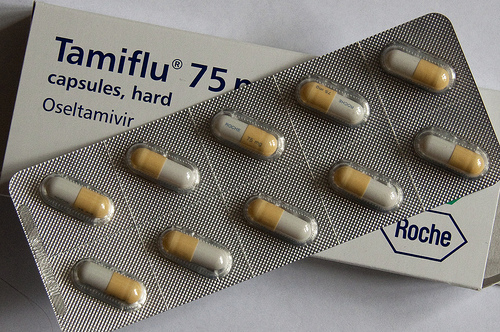
3641376785_fb7681de67.jpgAs countries around the world continue to stockpile Roche’s widely used Tamiflu, the effectiveness of the anti-flu drug is being called into question.

A review of past clinical trials out today found no clear evidence that the antiviral med can protect against flu-related complications, such as pneumonia, among otherwise-healthy adults. The BMJ report concluded that Tamiflu, also known by its generic name oseltamivir, reduces the duration of symptoms by 24 hours among otherwise-healthy individuals, but does not cut the risk of complications.

A piece in The Atlantic last month also raised red flags about Tamiflu’s effectiveness and side effects. Some studies have suggested that the antiviral induces nausea and vomiting among about 20% of adults and causes adverse psychiatric symptoms among about 20% of children — although Roche, which markets the drug, says there is no causal link. In Japan, where Tamiflu is frequently prescribed, the drug is also potentially linked to 50 deaths from cardiac arrest between 2001 and 2007, according to the head of medicines watchdog quoted in The Atlantic.

With Tamiflu-resistant swine flu strains on the rise, we may need a replacement. Researchers at the University of California, San Diego, modeled the binding between FDA-approved drugs and proteins on the outside of the flu virus. Their computer program identified 15 compounds, all with a greater affinity than any existing anti-flu meds, including Tamiflu. Six of these drugs are already being tested against H1N1, they reported Sunday at the American Society for Cell Biology meeting in San Diego.

Image by ahisgett via Flickr Creative Commons

Swine flu denialism

Flu fear TV.JPG

A deadly strain of distrust has infected leaders in Poland this flu season.

The country’s prime minister and the health minister have said that the government will not import swine flu vaccine. “If I had a 100 percent certainty that the vaccine was a panacea for the swine flu, I would certainly buy it," said health minister Ewa Kopacz, in an interview, according to this report. She added that she felt drug companies were “covering up” some information about the vaccines. Prime Minister Donald Tusk, meanwhile, has said that he will not buy from producers that will not take responsibility for possible side effects.

Apparently these politicians have not been reading this blog—as we noted last week, the World Health Organization and US Centers for Disease Control and Prevention have not seen consistent serious adverse effects.

As you might imagine, some people in Poland want a swine flu shot. Janusz Kochanowski, for instance, heads Poland’s human rights office, and is threatening the health minister with prosecution.

The uproar reminds me of the AIDS-denialism of the Thabo Mbeki, who if he lived down the street would be a relatively harmless adherent of errant web sites. But he happened to be the president of South Africa, and his lax policies on HIV drugs led to hundreds of thousands of deaths.

Fortunately, this a relatively mild pandemic, as a report today details. Nonetheless, Poland is a country of about 40 million people and the swine flu kills about 1 in 2000 people who get sick, according to recent US data, many of them children, pregnant women and people in other high risk groups.

Vaccine campaigns in the rest of Europe are well underway. But, according to this report from Bloomberg, a good proportion of the population has skipped a shot because they are worried about safety. It’s clear that public health offices could do a better job of explaining the safety of the vaccine—but what do you do when it’s the health officials who are afraid?

Image by Mike Licht, NotionsCapital via Flickr Creative Commons

The Daily Dose – Is one drug enough?

shot.jpg

— The cocktail of three drugs used in US lethal injection practices is being replaced by just one compound – the anesthetic thiopental sodium – in the execution of Kenneth Biros, planned for later today. It is hoped that a large dose of the anesthetic will present fewer complications than the previous mixture. Needless to say, lethal injection methods have been on trial for years, with many questioning the ethics of doctor involvement, if not the practice itself. (BBC)

— A protein-heavy regime, reminiscent of the Atkins diet, seems to help speed up brain healing in mice. A study found that among rodents with brain injuries, those fed branched amino acids performed better on a learning task than their control counterparts. (New Scientist)

— Plans were announced for the UK Centre for Medical Research and Innovation, a £520-million ($850-million) research facility in London. If construction costs go sky-high, however, there might be fewer scientists based there at the start. (Nature)

— Grain farmer and Republican Senator Charles Grassley has set his sights on a crop of 33 medical-related organizations, including the American Cancer Society and American Medical Association, asking them to divulge money received from drug and device makers. For more about Grassley and his crackdowns on research misconduct, read our interview with him from last fall. (NYTimes)

Image: Istock Photo

Tobacco trends suggest challenges ahead

Smoking.jpg

A lung conference on Friday put a spotlight on trends in tobacco around the world. Health experts estimate, for example, that smoking-related deaths in China will climb to two million each year by 2020 unless the country does more to curb tobacco use. Stamping out cigarettes might be a real drag on the country’s budget, though, as tobacco taxes generate a reported 7.6 % of Chinese central government revenues.

In Africa, the World Health Organization has stepped in to reduce smoking-related deaths, announcing the launch of a new campaign last week with $10 million in funding from the Gates Foundation. But even if the battle against smoking is won, there are other challenges ahead. In the US, the number of smokers has dropped 20% in the past 15 years, but a 48% rise in obesity over the same period may have offset the health benefits across the population.

Posted on behalf of Christian Torres, Nature Medicine news intern

Image by Abdullah AL-Naser via Flickr Creative Commons