New vaccines set for upcoming flu season

sneezehanky.jpgSummer’s still in full swing, but the US Food and Drug Administration (FDA) is already thinking about flu season. The regulatory agency just announced that it has approved the flu vaccine for 2010-2011, and it includes protection against the 2009 pandemic H1N1 ‘swine flu’ strain as well as regular seasonal influenza.

Nearly 20% of the population in the US suffers some form of influenza each year, leading to more than 200,000 hospitalizations and 36,000 deaths, according to estimates from the US Centers for Disease Control (CDC).

This year’s crop of flu vaccines includes: Afluria by CSL Limited; Agriflu and Fluvirin from Novartis; GlaxoSmithKline’s Fluarix; FluLaval, manufactured by the ID Biomedical Corporation; FluMist, from MedImmune; and Fluzone and Fluzone High-Dose from Sanofi-Pasteur. The vaccines contain two strains of influenza A virus&mdash H3N2 and the “swine flu” strain of H1N1&mdash as well as influenza B virus.

For this flu season, the FDA recommends that all people six months or older get vaccinated. Previous guidelines focused on vaccinating the subset of the population most at risk for serious complications resulting from influenza: children, the elderly, people with existing health issues and those likely to come into contact with these high-risk groups.

Image by mcfarlandmo via Flickr Creative Commons

You’re on Geron, says FDA

It’s a go: US federal officials have cleared the way for Geron’s first-of-a-kind clinical trial involving cells derived from human embryonic stem (ES) cells, the Menlo Park, California-based biotech company announced today.

The approval ends a nearly year-long hold on the company’s phase 1 study to treat people with mid-spine injuries with ES cells differentiated to form neural precursors called oligodendrocytes. The trial was given the go-ahead by the US Food and Drug Administration in January 2009, but halted seven months later after researchers discovered microscopic cysts at the injury site in the spinal cords of animals given the treatment. Geron says it has now completed further mouse studies and developed new assays to ensure the safety of the cellular therapy.

Geron’s shares shot up more than 10% today on the news.

Geron’s green light could be good news for Advanced Cell Technology, a stem cell company out of Santa Monica, California that hopes to be next in line to launch an ES cell-based therapeutic trial. The company announced this week that it submitted additional material in support of to its application — first filed in November — for a cell therapy to treat an inherited form of juvenile blindness called Stargardt’s Macular Dystrophy.

Open science summit unlocks research access

openlock.jpgScientists, hackers, and patients are congregating in Berkeley, California today to hear the latest on how open-source platforms are impacting scientific research at the 2010 Open Science Summit.

Talks slated for today include: a retrospective look on the Human Genome Project and its future implications for synthetic biology, genetic patents, and collaborative research; a panel discussion on the state of open access scientific journals with PLoS co-founder Michael Eisen; and an exploration of the rise of ‘do it yourself’ research practiced by citizens outside the academic and industrial science complexes.

If you can’t make it out to California, you can catch the webcast here. The event resumes today at 9:30 am Pacific time, and continues throughout today and tomorrow.

Image by sooperkuh via Flickr Creative Commons.

Viral ‘fossils’ turn back the clock

Marburg_virus.jpgResearchers have known for some time that mammalian genomes contain DNA copies of retroviral sequences, known as endogenous retroviruses (ERVs). These sequences are passed down through generation after generation&mdash 8% of the human genome is known to consist of these retroviral elements. Their presence is somewhat logical, since an important step in retroviral replication is making a DNA copy of the virus’ RNA genome. But it seems that our genomes might have even more viral baggage than previously thought possible.

Earlier this year, researchers found the first instances of non-retroviral RNA virus sequences integrated into a mammalian genome. Now, a new paper in PLoS Pathogens takes a more expansive look at the phenomenon. Scientists examined over 5,000 genes from all known single-stranded RNA viruses that are not retroviruses and compared these to the genomes of 48 vertebrate species, including humans. They found sequences from RNA viruses in the Filovirus (Marburgvirus and Ebolavirus), and Bornavirus families in about half of these animals.

An obvious question is raised here: how did the sequences end up in the animal genome? Since these are not retroviruses, they don’t make DNA copies of themselves in order to reproduce. One plausible explanation is that host cells might have accidentally used a reverse transcriptase, such as telomerase, to generate DNA copies of the RNA viruses’ genomes at some point.

Continue reading

Tracking mutations in real time (video)

A new article in Current Biology highlights a method for tracking DNA mutations in real time. The key to this approach is using a fluorescent-labeled derivative of MutL, a protein involved in DNA mismatch repair. The accumulation of this fluorescent protein signals the occurrence of a mutation in a population of replicating E. coli bacteria. Even more significantly, this method allows the visualization of mutations that do not result in recognizable phenotypes. That means that it could be used to alert researchers to DNA errors they are not even looking for.

The video below shows 180 minutes of E.coli growth compressed to 12 seconds:

Group hug for Sanofi-Aventis and Genzyme?

The rumor mill is ablaze with reports that the French drug maker Sanofi-Aventis will send a so-called “bear hug” letter before the week is through to Cambridge, Massachusetts-based Genzyme with a takeover bid offering close to $19 billion, or $70 per share. Bear hugs are generally friendly in tone (think Care Bears), but they often signal that a company is moving toward a more hostile conquest (think non-fictional bear contacts).

Buying up Genzyme, the world’s third-largest biotechnology company, should help Sanofi-Aventis with its impending patent cliff and associated losses in revenue, Forbes reports. According to Sanford Bernstein analyst Timothy Anderson, the Paris-based pharma giant’s sales will fall from $41.2 billion in 2010 to $34.7 billion in 2014. In contrast, Mark Schoenebaum, a biotech analyst with International Stock Research, projects that Genzyme’s sales will nearly double between 2010 and 2014, approaching $6.8 billion.

New dimensions in molecular modeling

molecule3d.bmp

This week PLoS Biology, in collaboration with the Structural Genomics Consortium, rolled out “enhanced versions” of two of its articles. Once a browser plug-in is installed, readers see a 3-D molecular model alongside the article. As they progress through the text, the structure spins and zooms in or out to focus on the relevant molecular feature.

One of the enhanced PLoS Biology articles details the structure of CaMKIIδ, which senses and transmits calcium signals to aid in cellular signaling. The other is a structural and functional analysis of the human peptidyl-prolyl isomerase family of proteins, which are targeted by the immunosuppressive drug cyclosporin, which helps counteract organ rejection in transplant recipients.

We can foresee this becoming the tool of choice at conferences and meetings in the near future. And, who knows? Perhaps an all 3-D issue of Nature Medicine is in order &mdash but we wouldn’t be the first publication to jump on that train.

Drumming up an unusual anthrax case

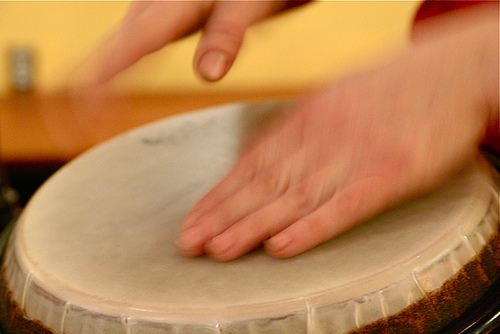
drumming.jpgJam-band concertgoers and neo-Pagans, take care &mdash your next drum-circle could sicken you.

Last week, the US Centers for Disease Control reported an instance where a 24-year-old woman fell severely ill after participating in a community drumming event in the US state of New Hampshire. Investigators found anthrax spores on two drums used at the event that matched spores isolated from the patient.

What is most unusual about this case is that the patient contracted the gastrointestinal form of anthrax. There’s a history of animal-hide products acting as vectors for anthrax spores (the US federal government prohibits importing goatskin products from Haiti for this very reason), but these usually result in the respiratory form of the disease. Instances of gastrointestinal anthrax are incredibly rare in the US, usually resulting when people eat tainted beef, as in the 2000 case of a farmer’s family in Minnesota. It’s possible that in the course of the drum-circle event, spores from the drums found their way into food or water that the patient ingested, or that she was particularly susceptible due to her immune system being compromised. At the time, the woman was also suffering from an infection of pinworms in her small intestine and appendix.

Anthrax popped up earlier this year in the UK when a rash of cases arose among heroin addicts. Over 50 people, mostly in Scotland, were sickened, and 13 died after injecting anthrax-contaminated heroin. It’s thought that the drug may have become tainted at its source in Afghanistan, either from coming into contact with contaminated soil or animal skins, or possibly because the drug was “cut” with ground bone meal containing anthrax spores.

Image by stevendepolo via Flickr Creative Commons

Quango cull triggers research regulator rationalisation

Cross posted from Nature’s The Great Beyond blog.

The UK’s bonfire of the quangos continued today, as the coalition government lined up a selection of health-related agencies for termination. Rising from the ashes may be a new super-regulator for research as the government has pledged a “radical simplification” of medical research.

Overall, the Department of Health is to reduce the number of its so-called arm’s length bodies from the current 18 down to around nine as part of the government’s aim is to shave over 45% from the administrative cost of the National Health Service.

Among the casualties is the Health Protection Agency, which provides scientific advice to government, doctors and the public about infectious diseases. Its work will be transferred to the Secretary of State for Health.

Read the rest of the post on The Great Beyond.

“Made In India” preview: East meets West in the womb

madeinindia.bmpInfertile couples from the US and Europe, frustrated by high costs and legal hurdles, are increasingly turning to India for surrogate mothers. News coverage of the trend has often had an alarmist tone, suggesting that the practice of making “wombs for rent” will inevitably exploit the surrogate mother. And then there are more semantic issues of citizenship and parenthood: if a child’s DNA is American, but is carried and born in India, what passport will he or she receive? Such is parenting in the twenty-first century.

A new feature-length documentary, “Made in India”, explores the touchy issues of family, technology, and poverty by following a Texas couple, Lisa and Brian Switzer, and their Indian surrogate, a Mumbai woman named Aasia Khan.

The two New York-based filmmakers, Vaishali Sinha and Rebecca Haimowitz, began hashing out their film over a cup of coffee in 2006, after one of the earlier articles on Indian surrogacy appeared in the LA Times. Both women were passionate about women’s rights, but initially had different reactions to the surrogacy issue.

Continue reading