Immunologist effort aims to improve hyperlinking of research papers to raw data

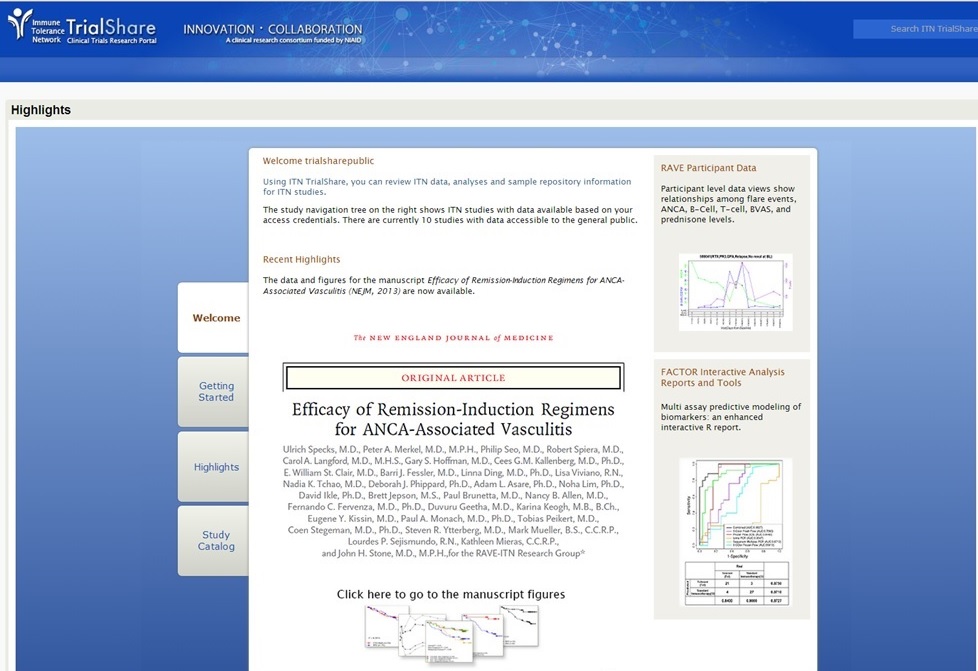
TrialShareA study published today in the New England Journal of Medicine reports that people suffering from ANCA-associated vasculitis, a disease in which the body attacks its own defense system, can now be effectively treated with one month of weekly infusions of rituximab, instead of the standard 18-month regimen with daily pills of cyclophosphamide, which has strong side effects. But that is not the only thing that makes the report noteworthy. According to its authors, the study is the first to contain hyperlinked charts or graphs that redirect users to an information-sharing system called TrialShare, where they can instantly access data amassed during this clinical trial and others.

The interactive platform was developed by the Immune Tolerance Network (ITN), a consortium of clinical researchers who study everything from allergies to organ transplants. The ITN is headquartered in Seattle, Washington, and funded by the US National Institute of Allergy and Infectious Disease, in Bethesda, Maryland.

Even without an online version of the article, anyone can sign on to the website, at www.itnTrialShare.org. However, the site is geared toward researchers who want access to information acquired during a study—for example, the twice daily blood pressure readings of patients that a researcher might have reported as an average instead of logging every measurement—which may not have made it into the published paper or supplementary material. Creators of the website emphasize that the information about the patients is anonymized.

This isn’t the first effort to put more information about clinical trials in the hands—and minds—of more people, with the hope of improving the design of future studies and avoiding redundant work. There are some groups, such as the Biomarkers Consortium, based in Bethesda, Maryland, and founded by a combination of private and public agencies that include the US National Institutes of Health (NIH), focused on specific collaborations that only share research data only among their partnership members. TrialShare, by comparison, is now open-access.

Other databases, such as the Gene Expression Omnibus (GEO) run by the NIH’s National Center for Biotechnology Information, act as repositories for data, but they lack the clinical data seen in the TrialShare site.

Continue reading

Mouse study shows heat shock protein protects against hearing damage caused by common antibiotic

Every drug has the potential to cause side effects. With aminoglycosides, a group of antibiotics that includes those used to treat tuberculosis and other serious infections, hearing loss can affect as many as 20% of people taking the drug. Despite a spate of efforts, there is currently no treatment or prevention for the damage to sensory cells caused by these drugs.

Ear photo

However, in a paper published today, in the Journal of Clinical Investigation, Lisa Cunningham and her colleagues at the US National Institute on Deafness and Other Communication Disorders in Bethesda, Maryland, show that the protective effect of a heat shock protein, HSP70, may provide a new therapeutic option to prevent inner ear cells injury by these antibiotics.

Heat shock proteins (HSPs) are produced by cells in response to stress, such as a sudden spike in temperature. Dubbed ‘molecular chaperones’, HSPs may be best known for their stabilizing role inside cells where they help sort, separate and fold other proteins. But scientists continue to discover the protective role that heat shock proteins can play outside of cells—from activating the body’s defense system to helping repair injured muscle. With a lengthening research record of showing up when cells get injured, HSP70 may be a good therapeutic focus to avert aminoglycoside-induced hair cell death.

“We know diseases can be caused where there is deficient or inadequate chaperone function,” says Rona Giffard, a neuroscientist at Stanford Medical School, in Palo Alto, California. If researchers find a way to increase HSP70 in areas where cells could be harmed, that ability to create a ‘super-response’ may give us ways to support cells that are stressed and unlikely to survive, Giffard says. “We might be able to push cells over the edge, to survival.”

Continue reading

Toddler’s death prompts reflection on bioengineered tissue transplants

Tissue engineering

{credit}Robert A. Lisak{/credit}

There was sad news over the weekend that the youngest patient to ever receive a bioengineered trachea seeded with her own bone marrow–derived stem cells had died. Hannah Warren, who was born without a windpipe, received the artificial trachea at Children’s Hospital of Illinois in Peoria in April. It was only the sixth procedure of its kind and the first to be performed in the US. She would have turned three next month.

Doctors involved in the girl’s treatment told the New York Times that her death was not related to the bioengineered organ. Rather, her native tissue around the esophagus didn’t heal properly, necessitating another operation. She ultimately died from complications of that second operation. “The trachea was never a problem,” said Paolo Macchiarini, a surgeon at the Karolinska Institute in Stockholm, who led the girl’s tracheal implant and has spearheaded the protocol around the world.

The news got me thinking about a feature article I wrote two years ago about a similar procedure in which a toddler, about the same age as Hannah Warren, received a tissue-engineered blood vessel to correct a congenital heart defect known as a ‘single-ventricle anomaly’. The problem is fatal without surgical correction.

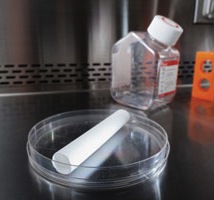
The bioengineered blood vessel, like the artificial trachea, starts out as a tube of plastic fibers. Doctors then add a patient’s own cells, taken from the bone marrow, and implant the construct after just a few hours of incubation. Twenty-five people received this treatment in Japan throughout the late 1990s and early 2000s, but this was the first such procedure in the US.

So how is that child doing today? “I am happy to report our first patient is still doing well nearly two years after her surgery,” Christopher Breuer told me in an email this week.

Breuer and his colleague Toshiharu Shinoka completed the operation in August 2011 at the Yale-New Haven Hospital in Connecticut. The two pediatric surgeons have since moved to Columbus, Ohio, where they codirect the Tissue Engineering Program at Nationwide Children’s Hospital. They continue to see their one patient from the blood vessel trial every six months and talk to her parents on the phone about once a month. But the move to Ohio has temporarily delayed further study enrollment.

They should be recruiting participants again soon, though. “We have recently completed construction of our new facilities,” says Breuer, “and will hopefully be enrolling more patients later this year.”

As for the bioengineered tracheas, Macchiarini told the Times that he would continue with similar operations, including one scheduled for Stockholm this week. It’s clear that with Hannah Warren’s death, the risks of the procedure will be foremost in researchers’ thoughts.

Gilead under pressure to produce stand-alone version of new HIV drug

TAF_TDF

{credit}National AIDS Treatment Advocacy Project{/credit}

In 2001, the US Food and Drug Administration approved a new HIV medication called tenofovir disoproxil fumarate (TDF). Patient advocates hailed the decision, noting that it represented the first novel antiviral agent to get the green light after the FDA turned down a similar drug  two years earlier. But a lot changes in a decade. For one thing, the maker of TDF, Gilead Sciences of Foster City, California, has a newer, better formulation of tenofovir, called tenofovir alafenamide (TAF). Meanwhile, patient advocates at the International AIDS Society Conference in Kuala Lumpur this week are crying foul that the company isn’t working on a stand-alone version of TAF and plans to sell it only in expensive combination pills.

Currently, TDF is available from Gilead as a solo formulation (sold as Viread). It’s also available as part of Stribild, a fixed-drug combination ‘quad’ pill that also includes the drugs elvitegravir, cobicistat and emtricitabine—the four drugs designated for first-line treatment by the World Health Organization. TAF is currently in development as part of three different combination pills: as a dual-drug tablet with emtricitabine; and in two different combination pills, one of which uses TAF as a substitute for TDF in the currently available ‘quad’ pill, and then in another new single-pill treatment which contains darunavir, cobicistat, and emtricitabine.

Without a stand-alone version of TAF, health programs in poorer parts of the world cannot combine it with cheaper alternatives, such as lamivudine, which works like emtricitabine but, at $37 for a year of treatment, costs about half as much.

Continue reading

Rwandan model proposed as solution to deadly scourge of counterfeit drugs

The problem of counterfeit drugs has made headlines in recent years with, for example, the discovery of fake versions of the cancer drug Avastin showing up in US hospitals. But the problem is worst in developing countries, where up to 25% of drugs in developing countries are falsified or substandard, according to the World Health organization (WHO).

Some global health advocates say that international players such as the WHO have not outlined sufficiently effective plans to deal with the problem of counterfeit drugs. In an essay published online today in PLOS Medicine, health policy specialists, including the Rwandan Minister of Health, Agnes Binagwaho, review data from 17 countries and suggest that Rwanda, a country once engulfed in conflict, serves as an example of how a committed approach can safeguard drug supplies.

The essay highlights the safety of Rwanda’s tuberculosis drugs, as reported in a March 2013 study published in The International Journal of Tuberculosis and Lung Disease. In that earlier study, researchers posing as local customers visited 19 cities to obtain 713 samples of tuberculosis treatment medications. No active ingredient was found in almost 10% of all the samples. The proportion of counterfeit drugs rose to 17% among medications taken from the 11 African nations in the study. However, no falsified medications came from Rwanda.

The East African nation’s success is founded on the government’s integrated approach, linking health and enforcement agencies to regulatory control, says Amir Attaran, a senior author on the new essay and a health law expert at the University of Ottawa. Some of the stringent steps the Rwandan government takes include giving drug contracts only to manufacturers with current WHO-approved certificates of good manufacturing practices, mandatory inspections of incoming drug shipments and routine sampling of medications. The country’s Ministry of Health drafted guidelines  in 2011 detailing measures to ensure drug quality, such as setting up agency outposts at 469 health centers to the rollout of patient forms for reporting adverse drug events. Rwanda also banned the majority of private pharmacies in the nation from selling tuberculosis drugs, making it easier to control the drug supply chain.

Continue reading