US appeals court overthrows stem cell injunction

Cross posted from Nature’s The Great Beyond blog.

The US Court of Appeals for the District of Columbia Circuit minutes ago vacated a lower court’s preliminary injunction blocking the National Institutes of Health (NIH) from funding human embryonic stem cell research.

In this 2-1 decision in Sherley et al v. Sebelius, the majority wrote that the judge Royce Lamberth of the US District Court for the District of Colmbia “abused [the court’s] discretion” when he issued this preliminary injunction that shut down NIH funding of stem cell research for 17 days last summer.

Read the rest of the post on The Great Beyond.

Major clinical study could be the nail in the coffin for Genentech’s expensive eye drug

LucentisAvastin.jpgThere’s more bad news out today for Genentech’s eye drug Lucentis. In the largest clinical trial to date, Avastin (bevacizumab), an inexpensive version of the same compound, worked just as well as the pricier Lucentis (ranibizumab) at preventing vision loss in people with age-related macular degeneration.

“There was no significant treatment difference between Lucentis and Avastin as measured by visual acuity outcomes,” Paul Sieving, director of the US National Eye Institute (NEI), which sponsored the trial, said at a teleconference earlier today. In a series of standard vision tests, “the two drugs were virtually identical,” added Daniel Martin, chairman of the Cole Eye Institute at the Cleveland Clinic in Ohio, and lead investigator of the 1,185-person, 43-center trial.

The comparison is a hot button issue because Avastin, a monoclonal antibody used to treat cancer, isn’t currently licensed for people with age-related macular degeneration. Yet despite its lack of approval for the blindness-associated disorder, many physicians commonly prescribe the drug off-label at just $50 per dose in place of Lucentis, which costs around $2,000 per treatment. Both drugs are marketed by South San Francisco’s Genentech.

Continue reading

Armadillos likely spread leprosy to people

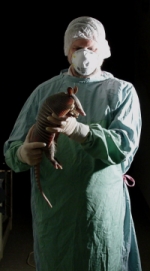
Truman.jpgWith their sharp claws and leathery body armor, it’s no surprise that armadillos are not found in petting zoos. But it’s not just their bites and scratches that pose a health risk to people. Researchers have found that the armored animals can spread leprosy to humans, too.

Using genetic sequence analyses, US government scientists discovered the same strain of the leprosy pathogen in 28 of 33 wild armadillos and 25 of 39 human skin samples, suggesting that up to a third of the 150 to 250 leprosy cases that arise each year in the southern US result from contact with infected armadillos.

“We’ve been able to demonstrate for the first time that environmental reservoirs are important for leprosy,” says Richard Truman, a scientist with the US Health Resources and Services Administration’s National Hansen’s Disease Program in Baton Rouge, Louisiana who led the study published today in the New England Journal of Medicine.

“Many people from the south really have no idea what their source of infection is for the disease, and that can be very anxiety provoking," Truman adds. "Here, we show a good biological source for the disease, and that may provide some relief for some individuals when they’re diagnosed with this infection.”

Armadillo.jpg

Images courtesy of The National Hansen’s Disease Program

European ban on stem cell patents could hit researchers hard, experts warn

Posted on behalf of Meera Swami

LONDON — A group of leading stem cell biologists is raising alarm bells about how a landmark intellectual property decision that would make it illegal for European researchers to patent procedures involving human embryonic stem (ES) cell lines could do irreparable damage to European stem cell research.

The proposed prohibition “represents a blow to years of effort to derive biomedical applications from embryonic stem cells in areas such as drug development and cell-replacement therapy,” the 13 scientists write in today’s issue of Nature.

On 10 March, the court’s advocate-general concluded that “inventions relating to pluripotent stem cells can be patentable only if they are not obtained to the detriment of an embryo.” The opinion is not legally binding. But the European Court follows the Advocate General’s advice in approximately 80% of cases, which has led the stem cell community to worry about the continent’s future competitive edge in regenerative biomedicine. Some scientists also fear that the opinion could prompt EU nations to tighten legislation on research involving embryos, or ban such work altogether.

Speaking yesterday at the Science Media Centre in London, Austin Smith, director of the Wellcome Trust Centre for Stem Cell Research at the University of Cambridge, UK, who spearheaded today’s letter, echoed many of the concerns raised in the correspondence. He challenged the advocate-general’s argument that patenting ES cell lines represents immoral commercialization of the human embryo. He noted that ES cell lines derived from surplus in vitro fertilized eggs can be maintained and proliferated indefinitely without the deliberate creation or destruction of embryos. What’s more, he argued that when scientists seek patents surrounding ES cells, they generally wish to protect the technology and methods used to manipulate the cells — not the cells themselves or any form of human life.

Smith and his colleagues also highlighted the need to preserve patent protection as an incentive for the drug industry to invest in stem-cell medicine. If all intellectual property relating to ES cells is fair game in Europe, they warned, multinational pharmaceutical companies might simply move their operations to another continent where they can patent their discoveries, all to the detriment of European biomedical innovation and the economy. “The real price will be paid in the future,” Smith said.

If the ban goes ahead, there could also be far-reaching consequences for patient care in Europe. Without patents, companies might be reluctant to carry out clinical trials using ES cells in Europe, and, further down the line, there may be difficulties licensing ES cell-based therapies in the continent, the scientists cautioned. This is especially pertinent as the first ES cell therapies are now entering clinical trials. For example, a team led by Pete Coffey at University College London is currently testing ES cell derivatives to treat age-related macular degeneration. According to Coffey, who also signed the letter, something that has been lost in advocate-general’s advisory is “the ethical need to treat disease.”

Prescription drug use on the rise among moms-to-be

PregWomen.jpgIt’s Alcohol Awareness Month this month. So, many organizations are again reminding the public about the dangers of binge drinking, particularly for women who are pregnant or planning to become pregnant. And the messaging seems to be paying off. According to the latest US National Survey on Drug Use and Health, an estimated 10% of pregnant women between the ages of 15 and 44 report using alcohol, which is far less than the 54% of all nonpregnant women in the same age group who drink.

But even though the vast majority of expectant mothers choose to steer clear of alcohol, the same is not true when it comes to prescription medications. According to a study published yesterday in the American Journal of Obstetrics & Gynecology, around half of all moms-to-be now take at least one medication.

The study, led by the director of Boston University’s Slone Epidemiology Center Allen Mitchell, looked at antenatal medication use among more than 30,000 women between 1976 and 2008. The authors found that first trimester drug use had increased by around 60% over the past three decades, with antidepressants accounting for the bulk of this rise and multi-drug use increasing even more dramatically.

The findings “reinforce the need for ongoing surveillance regarding medication use in pregnancy and its consequences,” Mitchell said in a press release.

Drug use among pregnant women is not just a concern in the US either. For example, a study published last month found that maternal medication use is widespread in Norway, and a recent West Indian study found that pregnant women in Trinidad take more than one prescription drug on average during the first and second trimesters.

Image by Arenamontanus via Flickr Creative Commons

Social networking provides accelerated platform for testing controversial clinical findings

In 2008, Italian researchers reported the results of a small unblinded human clinical trial suggesting that daily doses of lithium could slow the progression of the neurodegenerative disease amyotrophic lateral sclerosis (ALS), also known as Lou Gehrig’s disease. Two years later, however, the finding was refuted by larger, carefully controlled, double-blind, randomized trials in North America and again in Italy. One could argue that that’s simply how science works and correcting the academic record sometimes takes a couple years. But according to a study out yesterday in Nature Biotechnology, scientists could have gleaned those counter-results much earlier had they turned to social networking instead of relying on traditional trial design.

After the original 2008 report came out, some members of the online forum PatientsLikeMe decided to share their experiences with the drug. The website created a platform for data collection, and around 150 people with ALS who experimented with lithium self-reported their disease progression. PatientsLikeMe researchers then developed an algorithm to match the study subjects to around 450 controls who didn’t take the drug. After a year of treatment, the internet-gathered data showed no benefit of lithium on disease symptoms including swallowing, walking and breathing.

“While not a replacement for the gold standard double blind clinical trial, our platform can provide supplementary data to support effective decision-making in medicine and discovery,” PatientsLikeMe co-founder and study author ”https://www.patientslikeme.com/members/view/71">Jamie Heywood said in a press release. “Patients win when reliable data is made available, sooner."

But that’s not the only advantage of self-reported patient data. Earlier this year, researchers used information gathered from five PatientsLikeMe disease communities to document the widespread off-label drug use for two mood-altering medicines, demonstrating how portals like these can be used to better track and understand drug usage in real-time. And last year, scientists from 23andMe, the California genetic testing company, showed that DNA data could be combined with online surveys to identify new genetic association for common traits and, ultimately, perhaps medically conditions.

Self-reported medical data “has tremendous potential,’’ 2001 Nobel prize winner Lee Hartwell, president and director emeritus of the Fred Hutchinson Cancer Research Center in Seattle and chief scientist of the Biodesign Institute’s Center for Sustainable Health at Arizona State University in Tempe, ”https://online.wsj.com/article/SB10001424052748704489604576283010994997034.html">told the Wall Street Journal.

For more on how people can be empowered to contribute to the research enterprise without signing up for clinical trials, check out our 2010 news feature on one company’s plans to make medical genetics more participatory, as well as our video from February on the world’s first participatory laboratory.

VIDEO: New gene linked to ADHD

Korean scientists have identified a connection between attention deficit hyperactivity disorder (ADHD) and a small error in a specific gene. The discovery, published online this week in Nature Medicine, could pave the way for new drugs to treat ADHD, a condition that affects an estimated 5% of school-aged children, making it hard for them to learn.

“This could become a springboard now to study the molecular pathways that cause ADHD in humans,” Huda Zoghbi, a neuroscientist at Baylor College of Medicine in Houston who was not involved in the study, told Nature Medicine.

Several genome-wide scans had recently pointed to chromosome 17 as a hotspot for candidate genes linked to ADHD, but none of these studies had zeroed in on any specific gene targets in this region. So Eunjoon Kim and his colleagues from the Korea Advanced Institute of Science and Technology in Daejeon, South Korea, turned their sights to one such a gene on the short arm of the chromosome encoding the G protein–coupled receptor kinase–interacting protein-1 (GIT1). Researchers had previously linked GIT1 to many cellular functions, including receptor internalization, focal adhesion and cell signaling, but had never implicated the protein in ADHD.

Kim’s team knocked out the GIT1 gene in mice and saw that the animals were more active and displayed impaired learning and memory in a series of behavioral tests. They then validated the findings in people by examining the gene’s sequence in close to 400 Korean children, half of whom were diagnosed with ADHD. They found that a single nucleotide difference was nearly three times as common among youngsters affected by the condition.

“The human results will be useful in the diagnosis of ADHD, and GIT1 knockout mice may be used in exploring the underlying mechanisms and developing novel ADHD medications,” Kim wrote in an email.

In the following video, you can watch as a GIT1 knockout mouse feverishly paces around its cage, with a normal mouse displayed in the cage below for comparison. Also, be sure to check out our video of a mouse model of obsessive compulsive disorder.

New best practice guide protects people seeking fertility treatments

FileTr icsi 03.jpgFrustrated by the high costs and long waiting lists associated with in vitro fertilization treatments, more and more infertile couples in the developed world are seeking assisted reproduction services abroad. Such ‘procreative tourism’ might save time and money, but, with only around one in three countries regulating their fertility clinics, crossing national borders to conceive can result in inadequate treatment and increased health risks. Aiming to protect couples and would-be donors of sperm and eggs, the European Society of Human Reproduction and Embryology (ESHRE) yesterday outlined the first-ever international guidelines for cross-border reproductive care.

The ESHRE recommendations “will provide guidance for clinics treating foreign patients and it will help regulators and policy makers to create a framework to enable centers to abide by these rules,” Françoise Shenfield, a medical ethicist at University College London and the coordinator of the ESHRE task force on the issue, said in a statement.

In Europe, tens of thousands of infertile couples cross the border each year to receive reproductive care, often to dodge legal restrictions in their home countries on gamete donation or the number of permitted attempts at IVF. Individuals willing to go to such extremes to conceive can be vulnerable to coercion and manipulation, so the ESHRE task force recommends that people are told upfront about the costs and risk of fertility treatments in different countries. The new guidelines also call for the implementation of national donor registries to ensure that those who provide eggs or sperm are protected.

Across the Atlantic, meanwhile, fertility clinics are under attack for short-changing egg donors. As The Economist reports this week, an egg donor in the US has filed an antitrust lawsuit against the American Society for Reproductive Medicine and the Society for Assisted Reproductive Technology alleging that these organization’s pricing guidelines keep reimbursement rates for eggs artificially low.

With so many young women undergoing the lengthy and often painful procedure of egg donation for extra pocket change and an increasing number of couples traveling for the privilege of IVF services, the new best practice guide is a step in the right direction toward better care for all women.

Image: Wikipedia

Q&A: HIV prevention pill still holds promise, despite trial failure

The news out this week that women taking the HIV prevention pill Truvada were no more likely to evade infection than those on placebo was a huge disappointment for infectious disease researchers and the AIDS community alike. Trial investigators had hoped to enroll 3,000 HIV-negative women in Kenya, Tanzania and South Africa. But a preliminary analysis of the nearly 2,000 study participants registered to date showed that 56 new HIV infections had occurred, with an equal number coming from those taking the drug and those assigned to the dummy pill. As a result, organizers announced on Monday that they had halted the trial prematurely.

Scientists are at a loss to explain the data. Yet despite the negative results, they are not giving up on the preventative strategy, known as pre-exposure prophylaxis, or PrEP. Buoyed by last year’s findings that Truvada dramatically reduced the rate of HIV infection in gay and bisexual men, researchers are forging ahead with large-scale PrEP trials in intravenous drug users in India, heterosexual couples in which one partner is HIV-positive in East Africa and high-risk women across Africa.

Grant.jpgTo put the most recent findings in perspective, Nature Medicine spoke with Robert Grant, an HIV researcher at the University of California–San Francisco’s Gladstone Institute of Virology and Immunology who led the successful PrEP study in men who have sex with men.

What has the scientific community learned from these latest results?

One thing we learned in the last week is how important it is to study interventions in different populations and not to make assumptions that what works in one setting will automatically work in another setting. A study like this gives us the opportunity to think through under what circumstances PrEP might not be as effective as it was in men who have sex with men. It’s critically important that we learn everything that we can, and apply what we learn to guide implementation of PrEP as we move forward.

Does this trial failure take the wind out of PrEP’s sails?

This new information doesn’t really diminish our enthusiasm for the use [of PrEP] in gay and bisexual men. However, we are disappointed that this approach did not show protection for heterosexual women in this particular study, and we look forward to more analysis of the most recent study to really learn what happened there. Was it a problem with adherence? Did people just stop taking the pill? Were there issues with women also taking contraception? Was there something about this particular group of people that led to them not being protected in this particular study? But this is just one of several studies in heterosexual populations in Africa, and something like oral PrEP or an effective topical gel could be very important for other groups.

Continue reading

Disappointment and surprise as promising HIV drug falters

Cross posted from Nature’s The Great Beyond blog.

A major clinical trial on promising anti-HIV drug Truvada has been ended early after it became clear it would be “highly unlikely” to prove effective in preventing new infections.

Family Health International (FHI), the non-profit overseers of the phase III trial, described the development as “surprising and disappointing”. Many AIDS researchers had high hopes for Truvada, not least because it was recently proven to be effective in preventing infection in gay men.

After reviewing interim data on the FEM-PrEP study an independent monitoring committee concluded the study would be “highly unlikely to be able to demonstrate the effectiveness of Truvada in preventing HIV infection in the study population, even if it continued to its originally planned conclusion”, says FHI (press release).

Read the rest of the post on The Great Beyond.