Slippery on stem cells

John McCain is not talking straight about stem cells in these last days of the campaign. In the last presidential debate he emphatically voiced his support for “stem cell research.” Given that he conveniently left off the word “embryonic” that’s kind of like emphatically supporting the right of Joe the Plumber to hire a publicist.

McCain seems to have studiously avoided that distasteful word for the last few months. So have his emissaries, such as health care advisor Jay Khosla. Here is a video of Khosla at a debate with Obama’s advisor Dora Hughes at Georgetown University last month, which I attended. In response to a direct question, Khosla ties himself in knots and fails to define McCain’s position.

A McCain stem cell ad also avoids the word, and this week his campaign did not clarify its position to the Wisconsin State Journal, which tracks issue because James Thomson, the first researcher to isolate human embryonic stem cells, is at the University of Wisconsin.

There’s nothing controversial about supporting stem cell research. What is controversial is research on stem cells derived from human embryos. Currently, federal funding is banned for embryonic stem cell lines derived after August 9, 2001.

McCain voted twice to reverse the ban. And in September, he told ScienceDebate2008 that he supported federal funding for embryonic stem cell research—although he did not clarify whether he supported expanding funding beyond the few tired and increasingly useless stem cell lines allowed under current policy.

More recently, he’s chosen a running-mate opposed to such research. And he didn’t stop the Republican party from calling, in its new platform, for a “”https://www.medicalnewstoday.com/articles/121088.php">ban on all embryonic stem-cell research, public or private.”

McCain seems to want it both ways. He wants to reassure supporters of embryonic stem cell research, which happen to be the majority of US citizens, that he supports science—while at the same time sending signals to the anti-abortion right wing that he’s on their side.

That strategy seems to have worked. Few scientists or journalists seem to have called McCain on his slippery position, although there are some exceptions. And, judging from a few websites, it looks like the anti-abortion advocates may be feeling more comfortable with McCain’s stem cell positions these days.

Embryonic stem cells offer a more promising source of potential therapies than adult stem cells, which McCain and his advisors prefer to talk about. Obama, in constrast, has been clear on his support for expanding federal funding for embryonic stem cell research.

McCain is counting on the fact that most people don’t really even know what a stem cell is. What he’s probably not counting on is that people don’t like being condescended to.
Shoo fly

Fruit fly researchers hold on tight to your charges: Sarah Palin has it out for your favorite organism.

In a recent policy speech on special needs children the vice-presidential candidate disparaged a congressional earmark for “Fruit fly research in Paris, France,” adding incredulously, “I kid you not!”

It seems she was talking about a US government facility in France that studies fruit flies pestering the California olive crop—a decidedly more refined diet than the pungent goo consumed by Drosophila melanogaster, the famous lab workhorse.

I guess no one bothered to tell her that fruit fly research has led to numerous basic science discoveries, such as—oh yeah, the basis for heredity. Not to mention a potential treatment for fragile X syndrome, a major cause of autism, and insight into the brains of people with Down’s syndrome.

It may be easy for Palin to dismiss the insect—after all, it’s not too esthetically appealing. (Unless of course, you happen to work on it.)

At least one renowned fruit fly researcher isn’t impressed. Eric Wieschaus, a winner of the 1995 Nobel Prize in medicine, endorsed Obama in an open letter signed by other Nobel prize winners. Maybe he wasn’t too keen on McCain’s similarly off-target remarks disparaging Grizzly Bear DNA research.

Election 2008

Some of you may have already seen it, but I would encourage to have a look at the excellent special news section on the 2008 US election that my colleagues Roxanne Khamsi, Coco Ballantyne and Charlotte Schubert put together for our October issue. It’s great stuff and a perfect complement to the related special that Nature published several weeks ago.

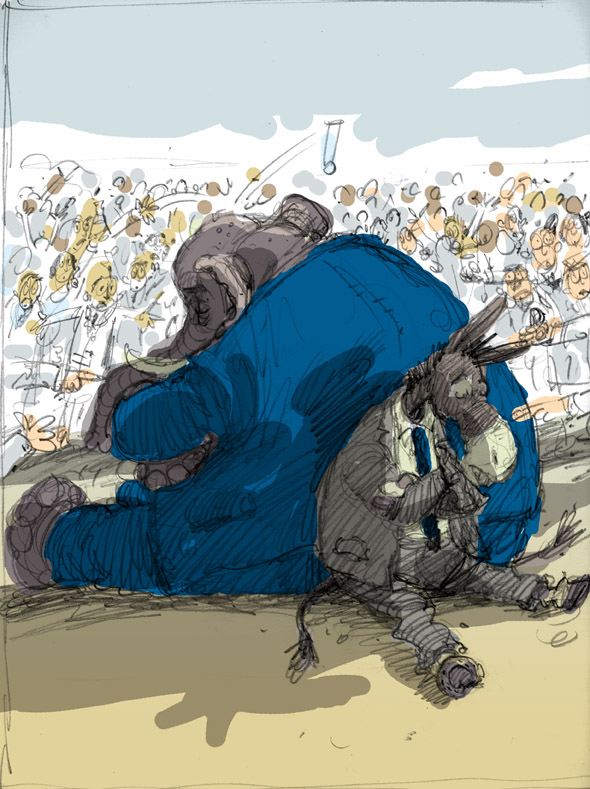
Also, thanks to those of you who have made positive remarks on the cover of the issue. For our readers beyond the US who may not care about US politics, the elephant and the donkey are the symbols of the Republican and the Democratic parties, respectively.

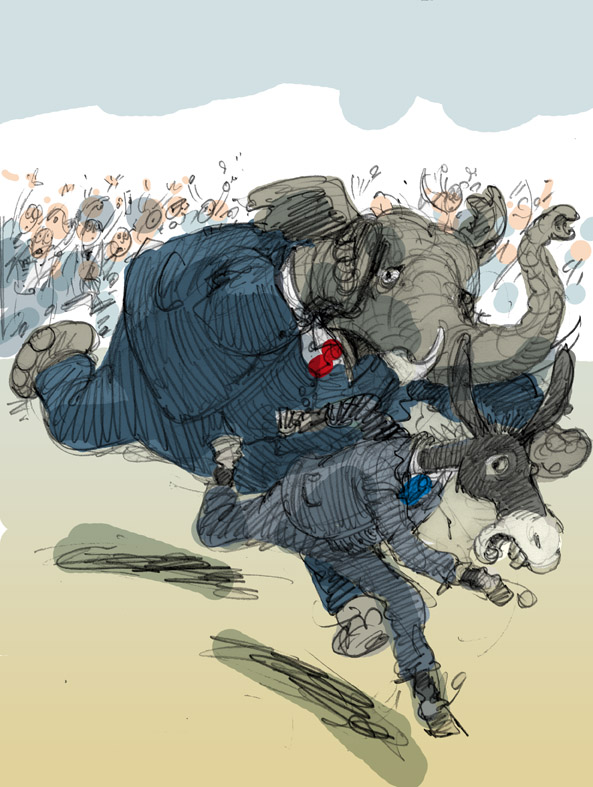
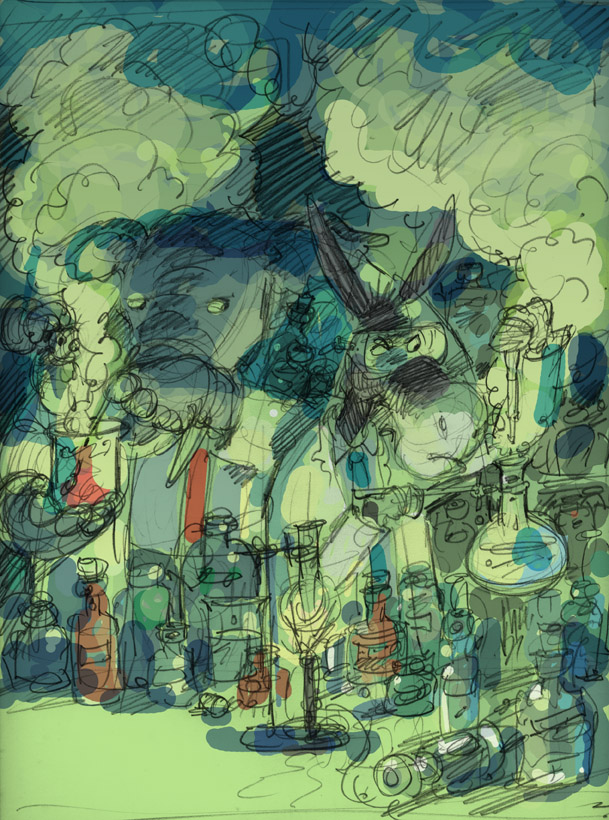
The cover was created by David Parkins, an excellent cartoonist who impressed me not only because of the quality of his work, but also because of his creativity and speed. To give you an idea, below are a couple of additional ideas we entertained for the cover. He mocked up this drafts incredibly quickly and, for those ideas we put forward to him, he was able to understand them immediately and put it down on paper. Enjoy!

fleeing.jpg

Republicans and Democrats running away from an angry mob of scientists.

formula.jpg

Republicans and Democrats searching the right formula to support science.

sleeping.jpg

Republicans and Democrats sleeping, oblivious to the scientists’ demands.

Non-sequitur of the day

From a press release I just got:


From: alyson

Sent: Monday, October 06, 2008 3:00 PM

To: Lopez, Juan Carlos

Subject: EVOLUTIONARY DIET BREAK THROUGH

The discovery of fire was a

brilliant moment for the caveman.

Now the creation of a supplement that

breaks through the body’s evolutionary propensity to

store fat could be the

next best thing since sliced bread.

Anyone who has been on a diet knows that it’s relatively easy to lose weight, but it always comes right back.

We are fighting the equivalent of an Evolutionary Mexican Standoff.

A new study shows that a proprietary combo of cayenne, amino acids, caffeine and green tea keeps the body’s metabolism humming along so diets actually work and stay working.

Metabolife’s Break Through is the long distance Olympian of diet supplements.


It almost makes me want to buy this thing to see if there are any more analogies on the label!

Off the record

As Sarah Palin and Joe Biden face off tonight in the vice presidential debates many voters will be assessing whether they can trust either one to step into the oval office should the president become incapacitated or die.

So, it’s no surprise that some people have been asking for John McCain to release his complete medical records, especially given his history of melanoma. One activist group has been pushing this agenda in television ads and in a video on YouTube.

The group’s popular YouTube video says that people with stage II melanoma, a type of tumor McCain had removed in 2000, have an approximately 60 percent chance of living for ten years after treatment. That statement is accurate. But the video ignores some subtleties. The New York Times reports that, since he’s already survived more than seven years cancer-free, he has a lower risk (I conferred with an oncologist who also said that for stage II melanoma, most instances of recurrence occur within the first few years). But McCain probably shouldn’t give up his skin checkups just yet, since older people have higher risk.

It’s disconcerting that the McCain campaign chose to release the candidate’s more than 1000 pages of records for only 3 hours to a group of reporters it selected—without allowing them access to recording devices, email or outside consultation. How many blebs, polyps, skin dots and detailed pathological reports did they miss? Either his records contain grist for an outside expert to cast doubt on his fitness, or they would put even the most politically partisan MD to sleep. We may never really know.

What about Obama? It seems his campaign also did not fully release his records either, instead providing a summary from his primary physician saying he was in excellent health.

Is the public entitled to know more? I’m sure most people would not welcome the public airing of their medical history, but it seems that a more open standard should apply to presidential candidates. Have the candidates done enough, or should they both release their complete records?

Word Watch

When I turn on the TV to election events, I’m sensitized to the term ‘Science’. Bill Clinton said ‘Science’ in his speech at the Democratic national convention, referring to an ‘assault on science’ by the Bush administration (hey! Cool! He said ‘Science’!). Obama said it, once, in his acceptance speech.

So when I watched the recent presidential debates, I noticed it again: Obama said it: “Science”. Three times! The context, however, was not quite so thrilling. The candidates were asked how the current financial crisis would affect their campaign proposals—some of them rather ambitious, such as Obama’s to reform health care and double spending on basic research. Both candidates evaded the question, but Obama did seem to be laying out some of his priorities. Although just about everything seemed to remain a priority, at least ‘Science’ was up there.

Not to get too concerned about the numbers, but McCain is laggin’ [Palin speak] in the ‘Science’ word watch, not mentioning it in either the debate or his acceptance speech. (In his acceptance speech McCain did say ‘autism’ , which seems to get more attention from the candidates than other medical conditions, for reasons I have yet to understand).

McCain, however, is leading in another word watch catagory. His acceptance speech contained the word ‘God’ seven times, while Obama’s contained ‘God’ twice.

God bless science.

Living with a bad gene

All of us have some bad genes—variants for knock-knees, bad teeth, cardiovascular disease, diabetes.

Most of us don’t know what these variants are, and there’s probably not much to be done about most of them anyway. So we are spared the type of dilemma facing women who carry a timebomb—mutations in BRCA1 or BRCA2.

The choices are fairly stark for women with mutations in these genes—undergo surgery for a prophylactic mastectomy and ovary removal or face a high probability of breast and ovarian cancer.

Joanna Rudnick explores this dilemma in her documentary “In the Family” which airs tonight on PBS. She is also interviewed for today’s segment of “Talk of the Nation” on NPR.

I went to a preview of the film in Washington, DC this July—at en event also attended by local science celebrity Francis Collins (who also liked this film). Rudnick tested positive for a BRCA1 mutation at age 27 and turns the camera on herself, examining how women with the mutations weigh their choices. It’s a gut-wrenching and honest exploration.

Rudnick, who has not had children, decided to hold off on making a decision about surgery, but shows us women who made similar decisions, and came to regret them as cancer took hold. By portraying other women and their families—as they go with their sisters to get tested, and as they hold back the disease or succumb to it—she uses herself as a subject without being overbearing.

She also explores some of the political issues surrounding genetic testing, including an illuminating interview with Mark Skolnick, a proponent of gene patents, who proudly proclaims he ‘won’ the race to find the

BRCA1 gene after Mary Claire King showed the path to it. Skolnick went on to found Myriad Genetics, the company that has the rights to genetic testing of BRCA1 and BRCA2 in the US—a system with downsides, such as high pricing.

My only quibble with the film—and a lot of the press around this issue— is that it may dramatize the risk of the mutations, showcasing genetic counselors citing numbers as high as 90 percent for the risk of breast cancer in women with BRCA1 mutations. In reality, geneticists have argued about the degree of risk for years—with some studies showing risk closer to 50 percent or below.

I cannot imagine making life-changing decisions based on probabilities that even the experts can’t agree on. But whatever the exact numbers, as Rudnick shows, testing positive for a BRCA1 mutation changes life dramatically.

Voting on science

It’s been online a week—and many of you may have already seen it—but here’s a shout-out to check out Nature’s Election Special. The reporters here in the Washington, DC Nature offices dug deep to bring you the candidates’ views on science, ferreting out the advisors to each campaign and examining how our favorite agencies—such as the NIH—might fare under each candidate.

It’s clear there are some welcome similarities between the candidates—both, for instance, take climate change seriously. But there are also some prominent differences.

Although both candidates say they support increases in funding for research, Obama specifically pledges a doubling of support for basic research. And while Obama is unequivocal about his support for embryonic stem cell research, some researchers are legitimately concerned that McCain is backing off of his previous support ( I will blog about that later this week).

Obama seems to have a deeper network of science advisors. And, unlike McCain, Obama has chosen actual scientists for his science advisors. That might have something to do with the fact that Obama’s campaign bothered to answer a series of questions posed by Nature, although McCain did respond, along with Obama, to a series of science questions posed by ScienceDebate2008, the group that pushed for a science debate among the candidates last April.

To learn more, check out the special!