Science on the mall

It was truly stirring to be in Washington DC on the national mall during the inauguration. No matter what your politics, it’s difficult to not be moved by the presence of so many people who want the best for their country.

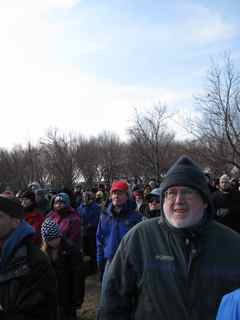
I slipped in the back, near the Lincoln memorial, where the crowd was happy but low-key. No huge “Obama” chants, like the hard-core fans pressed in closer to the capitol, but a lot of rapt listeners, cheering at lines like Obama’s pledge to uphold the bill of rights.

I had my own cheers. Funny, nobody joined me in the chant for Steve Chu, our new energy secretary, when he appeared in the lineup before the speech. Then he said it: “Science!”

Obama said the word right up front, when he laid the groundwork of what his new administration would be about:

We will restore science to its rightful place and wield technology’s wonders to raise health care’s quality and lower its costs.

I started the science-O-meter during the presidential debates. Obama handily beat McCain, using the word “Science” at least twice as often. But while the inauguration was historical in many respects, it was not as measured by the Science-O-meter. The word has been used in inauguration speeches before, for instance by Woodrow Wilson and John F. Kennedy, who wielded it with more sinister undertones:

Finally, to those nations who would make themselves our adversary, we offer not a pledge but a request: that both sides begin anew the quest for peace, before the dark powers of destruction unleashed by science engulf all humanity in planned or accidental self-destruction.

Let both sides seek to invoke the wonders of science instead of its terrors.

I like to think by using the word Obama also meant something broader, that his policies will be driven more by facts than ideology. That seems evident in the phrasing he used to convey his core governing philosophy:

The question we ask today is not whether our government is too big or too small, but whether it works, whether it helps families find jobs at a decent wage, care they can afford, a retirement that is dignified.

After the inauguration I walked along the river towards Georgetown. Waved goodbye to Bush’s helicopter and went and ate lunch at Clyde’s restaurant. I drank and talked late into the night with my friends, wondering how anyone could manage to go to one ball, much less ten.

Now the work begins—and the science-O-meter keeps on ticking.

inauguration.jpg

What were they thinking?

There were lots of ways to make it to the inauguration festivities. You could brave the crowds on the metro. You could take one of the eerily empty buses heading downtown. It took ten minutes to drive across town, since cars were scared from the roads. Entire families bundled up to cycle on the trails to the national mall.

Or, you could try and kayak. Oops. Oh yes, except the weather was below freezing.

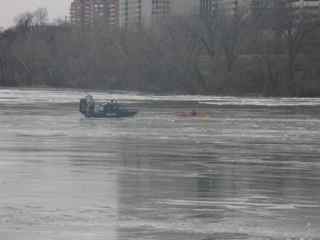
But that didn’t seem to stop these two idiots who thought that they could paddle down a treacherous river of ice. I passed by them-and their massive rescue operation-when I was cycling down by the Potomac River on the day of the inauguration concert.

Fortunately the city was ready for any disaster. At least six fire engines screamed down to the shore, two police boats cleaved through the mush ice at top speed and helicopter zoomed to the scene. Thankfully Obamania didn’t make most people this stupid.

kayak.jpg

kayak2.jpg

Day of service—for Science

President Kennedy once famously declared Washington, DC a city of “Southern efficiency and Northern charm.” Something happened the last few days. Despite the crowds, people have not only been amazingly civil, but outright friendly—strangers strike up conversations, locals take the time to point out-of-towners in the right direction. I’d be happy if this relaxed courtesy courteous lingered but I suspect it might be due to the influx of people from more polite locations—not to mention what I’ve observed to be the euphoria-inducing effects of Obama-mania.

That mania translated on Monday into a mass of people across the country taking part in community service—in response to a call from Obama to observe the intent, declared by Congress, of Martin Luther King Day. In Philadelphia alone 60,000 people volunteered, and in Washington DC thousands wanting to help were turned away from food banks and schools. On the subway I met a family from New York city carrying plastic bags so they could pick up random litter they found on their trek through the city.

I was less imaginative with 21-month old in tow. So my biggest contribution to the collective good was to direct a woman from Illinois to a decent place for lunch (Ben’s Chili Bowl, of course). She pinned an inauguration button onto my daughter, who was spinnning around happily to a rendition of “This little light of mine” as part of a concert at the Smithsonian of American spirituals.

So, what’s all that have to do with science? It seems someone with an eye on science has been shining their light for the larger community in the last few weeks. That’s evident in the boon for science in the economic stimulus plan crafted by Obama’s transition team and Democratic congressional leaders.

Along with money for other agencies, the plan calls for $3.5 billion for NIH and $3 billion for NSF—half of its annual budget. That’s pleased science advocacy groups who, along with us at Nature Medicine, have argued that investing in science not only lays the groundwork for future prosperity it also creates jobs in the short-term (message to John Boehner, minority leader of the House—scientists have to eat too). It also helps, of course, that the new administration is receptive to such ideas.

We’ll see if the plan survives the congressional gamut. Keep shining that light.

Obama-mania and the science appointments

The masses have converged here in DC for the inauguration—and for many partygoers it kicked off on U street on Saturday night.

Vendors, two to every block, plied their Obama T-shirts and blinking fluorescent Obama buttons. In front of Ben’s Chili Bowl—almost as much of a DC icon as the Jefferson Memorial—a crowd of hungry onlookers gathered. Business must be booming since Mayor Adrian Fenty took Obama there last week for a half-smoke. At 3 a.m. people were still straining to take pictures.

At “Town” a giant club on 9th street, hundreds—maybe thousands—of sweaty dancers celebrated “DC’s Official Gay Inauguration Dance Party.” There was no sign of Rick Warren—the controversial evangelist chosen to give the invocation at the inauguration. But Barack Obama was omnipresent. Dancers scoped each other out underneath giant images of the president-elect, projected on every video screen. Tinsel and red white and blue bunting were everywhere. “He’s the best we have,” said one club-goer of the surreal mix of earsplitting techno, bare chests and political fervor.

At the 7-Eleven someone was selling “Obama water.” Said one woman in purple, “It’s better than Kool-Aid!”

That was just the beginning of inauguration frenzy. We’ll see how much more of the frenzy, and the freezing weather I can take, but I will probably be threading my bike through the crowds on the way to the national mall on Tuesday to check out the scene.

Meanwhile, here is my personal lowdown on the science- and health-related Obama nominees and appointments. What is yours?

Steven Chu—a scientist to head the Department of Energy? Wow. Chu seems to round out a line-up that takes the science on global warming seriously, including John Holdren, his pick for science advisor, Lisa Jackon, his nominee to head the Environmental Protection Agency and Carol Browner, who will act as White House czar on climate and energy. You can complain about some of Obama’s appointments being more of the same, or more of the Clinton era, but when it comes to global warming issues it looks like change to me.

John Holdren, science advisor (Holdren will be a co-chair of PCAST, the President’s Council of Advisors on Science and Technology, Director of the White House Office of Science and Technology Policy and—the Assistant to the President for Science and Technology, a position restored to its former glamour, before Bush eliminated it). As former head of the Woods Hole Research Center, Holdren is known to have a grasp of issues that concern biologists. I also hope he has had the opportunity to look at a few marine embryos under the microscope—super cool.

Harold Varmus, co-chair of PCAST. The coolest thing about Varmus is that as NIH Director he declared “to support and defend the Constitution against anyone who says I can’t bring my bicycle into the building.” I am not sure exactly what PCAST does, but surely that depends on whether Obama takes his science advisors seriously—and according to his address in December, he plans to. Advocates of open-access publishing will surely get some extra clout from the appointment of Varmus, a co-founder of the Public Library of Science. The third co-chair, Eric Lander must know everyone in the business and he does think big.

Tom Daschle—head of the Department of Health and Human Services. Healthcare reform is more politics than policy—and surely Daschle knows the lay of the land. As I crushed out my (rare but savored) cigarette before getting into a cab Saturday night, I thought of the scolding I would get from Obama’s probable pick for Deputy Secretary of HHS, William Corr, currently the executive director of the Campaign for Tobacco-Free Kids. Given that tobacco remains our nations number one killer—and kids the front-line consumers—the possibility of Corr’s nomination has deservedly resulted in cheers from the public health sector. Maybe he can also help Obama stay away from the evil drug.

Sanjay Gupta: Seems like nobody has listened to surgeon general since the bearded Reagan-era Dr. Koop (I don’t think he even has a first name). But if Obama wants to give the office a voice again, it makes sense to choose someone people know—such as this CNN commentator, rumored to be Obama’s top pick.

Tom Vilsack, to head the Department of Agriculture. I am waiting for politicians to show some spine and eliminate the incredible waste of taxpayer money that goes to prop up wealthy industrial farmers. Writers such as Michael Pollan convincingly argue that billions spent on crops like corn help keep our diet rich in high fructose corn syrup and low in actual fruit—and contribute to our epidemic of obesity. Meanwhile, most small farmers, like the one who delivers fresh organic vegetables to my neighborhood each week, get nothing. It’s unclear whether this former governer of Iowa has the will, desire, or mandate to put our agricultural system back on course.

Jane Lubchenco, head of NOAA (National Oceanographic and Atmospheric Association). A bone fide fish-hugger.

I know there is someone I’m forgetting. But I have to go sleep off that Obama cocktail…

To find out more about these nominees and for actually astute commentary, read Nature’s coverage.

Missing hope

The New York Times, which has the kind of web tools that some of us can only dream about, published a couple of days ago an interactive feature called “”https://www.nytimes.com/interactive/2009/01/15/us/politics/20090115_HOPE.html?partner=permalink&exprod=permalink">I hope so, too". The newspaper asked 200 people to state their greatest hopes for what Barack Obama might accomplish during his presidency, and then invited readers to choose the hopes they agree with.

I was surprised to see that science was nowhere to be found among the 29 “hopes” catalogued by the Times. The closest it got was “Education” and “Environment”. Is it the case that science is so far below the radar of the average person on the street to not be mentioned by 200 random people sufficiently enough to become category # 30? Fortunately, the Times also invited readers to comment in case their hope was not represented, and a fair number of people who took the time to add their two cents called for increased respect for and support of science.

Although the indications so far are that Obama will take science and technology seriously, it’s a bit disappointing that science didn’t rank particularly high in people’s priorities. Having said that, and considering the tough times that the US and the whole world are going through, many people could be excused for having other things in their minds, asthere was no shortage of things to hope for. That’s the only bonanza we can expect to see in the immediate future.

Save us Rick Warren

So, what is up with Obama choosing Rick Warren to give the invocation at the inauguration?

Despite my three years of junior-high protestant education, complete with training in creationism, I had to look it up. Invocation—sort of like a prayer. I guess every secular country needs its own charismatic megapreacher!

Gay rights groups are livid, understandably—Warren came out strongly for Proposition 8, the ban on gay mairrage in California.

But Warren’s also known for turning evangelism away from its obsession with issues like abortion and turning attention more to problems like global warming and HIV/AIDS.

I saw the guy at a forum on malaria a couple years ago, which I blogged about. He talks about mobilizing christian churches around the world to combat poverty and AIDS—and it’s a good talk. Despite myself I was practically swaying and beating my chest. Just think of churches distributing drugs and bed nets! Pastors trained in basic logistics of drug delivery! It could change the world! When he talks about program his church initiated to involve churches throughout the world in such efforts, it’s truly inspirational. But does it work?

Time magazine took a close look. They examine international programs initiated by his church and conclude that the outcome is not nearly so rosy. Apparently most aid workers interviewed by Time could not point to tangible projects by his organization. Either Warren and his acolytes need to put in more effort, more time, or more praying!

Maybe Warren is serious about his efforts to get churches more involved in public health, in a systematic, global kind of way. Let’s hope he’ll use his temporarily expanded flock to make it work.

Gearing up after the election

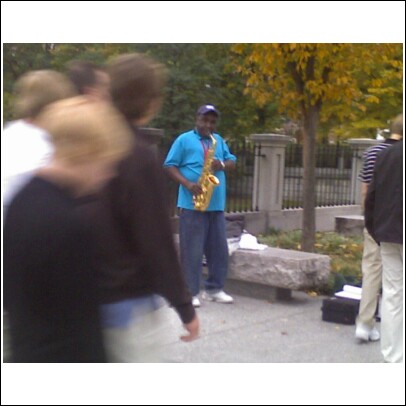
Here in Washington DC, a heavily Democratic city, there was undeniably a sense of jubilation on the streets after the election, such as this spontaneous celebration at 14th and U. And yesterday while I cycled home I saw something rare in front of the white house: a street musician.

While Obama supporters partied, the incoming administration has lost no time in lining people up for key positions. Already, rumors are flying about who will take over the beleaguered FDA and the agency that oversees the NIH, the Department of Health and Human Services (HHS).

The Wall Street Journal’s Health Blog mentions Obma science advisor Harold Varmus as a candidate to head HHS, along with Howard Dean and former senator Tom Daschle. Cleveland Clinic cardiologist Steve Nissen, a prominent agency critic, may be in the mix for FDA head, according to the Wall Street Journal and the blog Pharmalot.

For rundowns of how science fared during the elections, including a win for stem cell research in Michigan, check out the entries from Nature here and here.

2.jpg

Shoo fly

Fruit fly researchers hold on tight to your charges: Sarah Palin has it out for your favorite organism.

In a recent policy speech on special needs children the vice-presidential candidate disparaged a congressional earmark for “Fruit fly research in Paris, France,” adding incredulously, “I kid you not!”

It seems she was talking about a US government facility in France that studies fruit flies pestering the California olive crop—a decidedly more refined diet than the pungent goo consumed by Drosophila melanogaster, the famous lab workhorse.

I guess no one bothered to tell her that fruit fly research has led to numerous basic science discoveries, such as—oh yeah, the basis for heredity. Not to mention a potential treatment for fragile X syndrome, a major cause of autism, and insight into the brains of people with Down’s syndrome.

It may be easy for Palin to dismiss the insect—after all, it’s not too esthetically appealing. (Unless of course, you happen to work on it.)

At least one renowned fruit fly researcher isn’t impressed. Eric Wieschaus, a winner of the 1995 Nobel Prize in medicine, endorsed Obama in an open letter signed by other Nobel prize winners. Maybe he wasn’t too keen on McCain’s similarly off-target remarks disparaging Grizzly Bear DNA research.

Election 2008

Some of you may have already seen it, but I would encourage to have a look at the excellent special news section on the 2008 US election that my colleagues Roxanne Khamsi, Coco Ballantyne and Charlotte Schubert put together for our October issue. It’s great stuff and a perfect complement to the related special that Nature published several weeks ago.

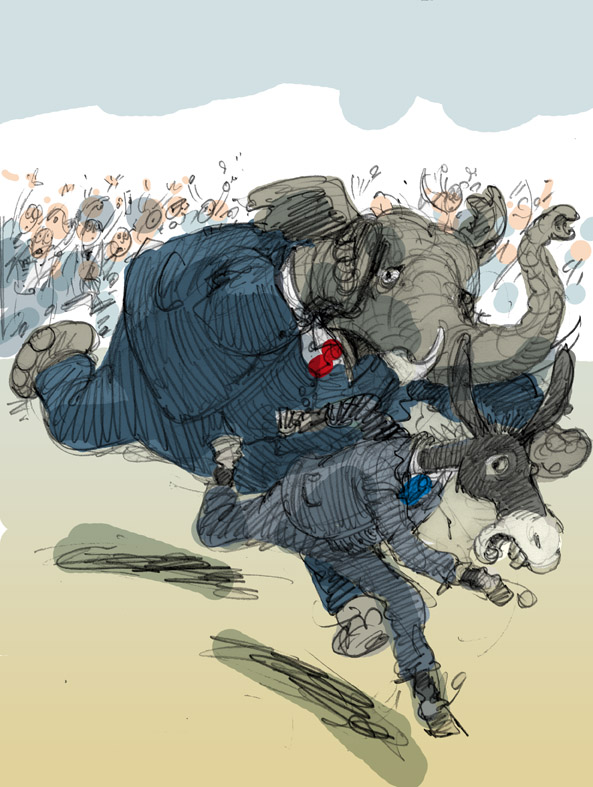
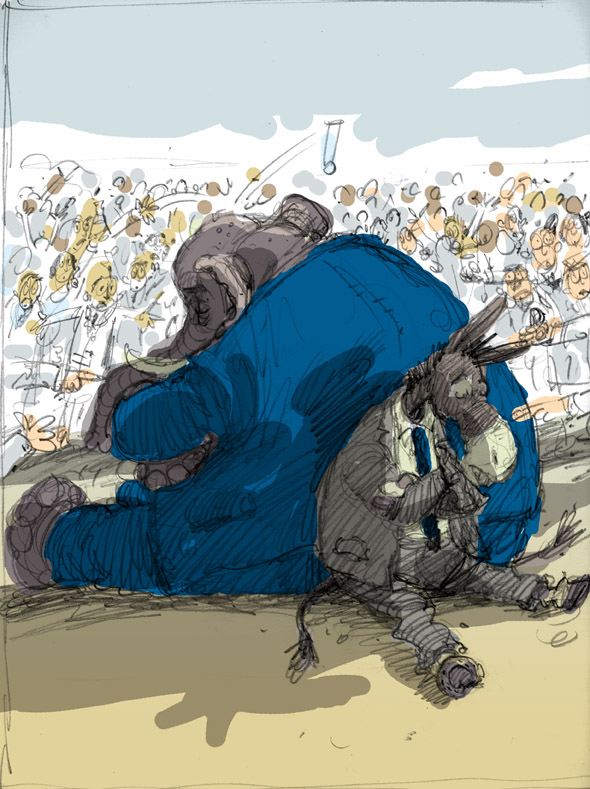
Also, thanks to those of you who have made positive remarks on the cover of the issue. For our readers beyond the US who may not care about US politics, the elephant and the donkey are the symbols of the Republican and the Democratic parties, respectively.

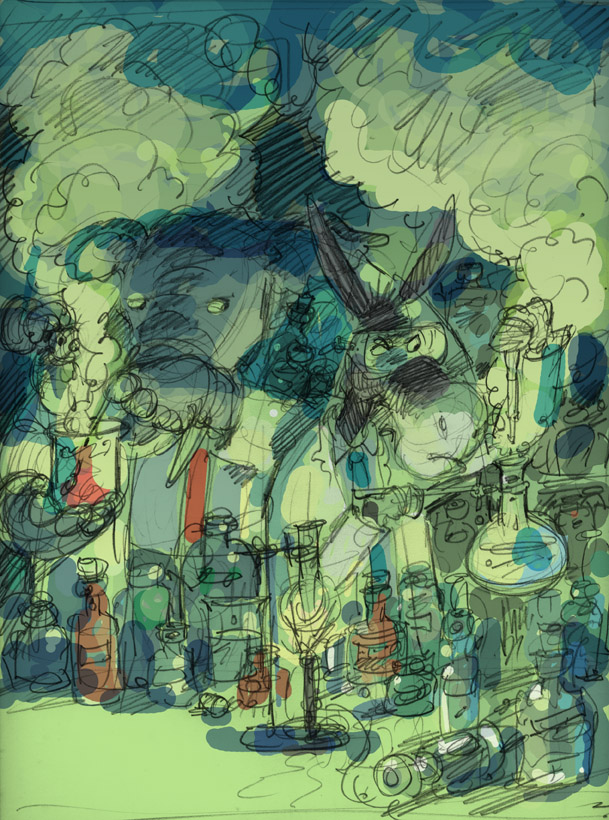
The cover was created by David Parkins, an excellent cartoonist who impressed me not only because of the quality of his work, but also because of his creativity and speed. To give you an idea, below are a couple of additional ideas we entertained for the cover. He mocked up this drafts incredibly quickly and, for those ideas we put forward to him, he was able to understand them immediately and put it down on paper. Enjoy!

fleeing.jpg

Republicans and Democrats running away from an angry mob of scientists.

formula.jpg

Republicans and Democrats searching the right formula to support science.

sleeping.jpg

Republicans and Democrats sleeping, oblivious to the scientists’ demands.

Off the record

As Sarah Palin and Joe Biden face off tonight in the vice presidential debates many voters will be assessing whether they can trust either one to step into the oval office should the president become incapacitated or die.

So, it’s no surprise that some people have been asking for John McCain to release his complete medical records, especially given his history of melanoma. One activist group has been pushing this agenda in television ads and in a video on YouTube.

The group’s popular YouTube video says that people with stage II melanoma, a type of tumor McCain had removed in 2000, have an approximately 60 percent chance of living for ten years after treatment. That statement is accurate. But the video ignores some subtleties. The New York Times reports that, since he’s already survived more than seven years cancer-free, he has a lower risk (I conferred with an oncologist who also said that for stage II melanoma, most instances of recurrence occur within the first few years). But McCain probably shouldn’t give up his skin checkups just yet, since older people have higher risk.

It’s disconcerting that the McCain campaign chose to release the candidate’s more than 1000 pages of records for only 3 hours to a group of reporters it selected—without allowing them access to recording devices, email or outside consultation. How many blebs, polyps, skin dots and detailed pathological reports did they miss? Either his records contain grist for an outside expert to cast doubt on his fitness, or they would put even the most politically partisan MD to sleep. We may never really know.

What about Obama? It seems his campaign also did not fully release his records either, instead providing a summary from his primary physician saying he was in excellent health.

Is the public entitled to know more? I’m sure most people would not welcome the public airing of their medical history, but it seems that a more open standard should apply to presidential candidates. Have the candidates done enough, or should they both release their complete records?