Q&A: Scotland gets new stem cell chieftain

Charles ffrench-Constant by Matt Davis 002 300.jpg

Scotland first grabbed headlines in the stem cell world fifteen years ago with the cloning of Dolly the sheep. But Scotland’s stem cell successes didn’t end there. In 2003, scientific highlanders at the University of Edinburgh discovered Nanog, a critical pluripotency gene expressed in embryonic stem cells. And last year, doctors at Glasgow’s Southern General Hospital treated a patient in the first-ever regulated human trial for a stem cell stroke treatment.

Yet stem cell medicine in Scotland has also faced some quagmires in the moors. Five years ago, for example, embryonic stem cell pioneer Austin Smith moved to the University of Cambridge; then, the biotech company Stem Cell Sciences followed suit. But with the development of potential new stem cell therapies for multiple sclerosis and the prospect of a stem cell-based approach to make blood for transfusions, scientists in Scotland are starting to turn things around. And those efforts will be emboldened by the Scottish Centre for Regenerative Medicine, a new ₤59 million ($97 million) research and commercialization facility in Edinburgh slated to open this summer.

Earlier this year, organizers announced that Charles ffrench-Constant, a multiple sclerosis researcher at the University of Edinburgh, would replace Dolly cloner Sir Ian Wilmut as the center’s director. Ahead of the building’s launch, Nature Medicine spoke to ffrench-Constant to learn how he plans to advance stem cell medicine in the land of lochs and glens.

What milestones do you hope to meet at the new center over the next five to ten years?

I would like us to have dramatically improved our understanding of basic stem cell science, and use this knowledge to be able to take human embryonic stem cells or human induced pluripotent stem cells and convert them into very large numbers of specific cell types in the brain, liver or in the blood. We would also like to be able to do the same in skin and heart and then use those [cells] either for disease modeling purposes, drug discovery programs or put them directly into the patient. I would like to be able to tell you that these goals weren’t just feasible but also something that is practical.

Continue reading

Bug and weed killers kick Parkinson’s disease in gear

4518790585_7c71144f5b_m.jpgSince the early-1990s, scientists have known that farmers and other field workers are more likely to succumb to Parkinson’s disease because of their exposure to pesticides and other agricultural chemicals. But these studies fell short on showing a causal relationship between pesticides and the debilitating neurodegenerative disorder.

So, researchers turned to rodent models to prove the link. In the last decade, researchers found that three bug and weed killers promoted neurodegeneration in mice. And now, an independent team has validated those findings in a large epidemiological survey in humans.

The team led by Beate Ritz, an epidemiologist at the University of California–Los Angeles, estimated the average 25-year pesticide exposure for around 700 Californians, about half of whom developed Parkinson’s. Reporting in the European Journal of Epidemiology, the researchers found that people who lived or worked near farmlands treated with two commonly used agricultural fungicides — ziram and maneb — as well as the herbicide paraquat were three times more likely to develop Parkinson’s disease than those Parkinson’s disease than those were not exposed to these agricultural chemicals.

The results follow a previous study of residents from California’s Central Valley showing that people who lived near fields treated by two of these chemicals were 75% more likely to get Parkinson’s.

The findings “suggest that the critical window of exposure of toxicants may have occurred years before the onset of motor symptoms when the diagnosis of Parkinson’s disease is made,” Ritz said in a statement.

Looking ahead, Ritz and her colleagues urge lawmakers to establish monitoring programs to estimate pesticide exposure in rural communities in hopes of limiting people’s exposure to these agricultural chemicals and, ultimately, of getting Parkinson’s disease.

Image: Santiago Nicolau, Flickr Creative Commons

Study to examine use of chimpanzees in US research

Crossposted from Nature’s news blog on behalf of Meredith Wadman.

Schimpanse_zoo-leipig.jpgAn Institute of Medicine (IOM) committee that will recommend whether the US government should continue to support chimpanzee research opened its inaugural meeting yesterday in Washington, D.C. and began wrestling with the thorny questions it has been set.

The Committee on the Use of Chimpanzees in Biomedical and Behavioral Research is charged with determining “if chimpanzees are or will be necessary for research discoveries” to improve public health and for determining the safety and effectiveness of new drugs and vaccines. Its task also includes looking at whether the animals, humans’ closest living relatives, are necessary for progress in behavioral research.

Sally Rockey, NIH’s Deputy Director for Extramural Research, told the committee: “We are expecting a highly objective study, one that is going to consider the scientific ramifications of the use of chimpanzees….If they are needed, why are they needed? You need to describe that to us.”

The National Institutes of Health (NIH), the agency that supports chimpanzee research, asked the IOM to undertake the study in January, after three senators wrote this letter to NIH director Francis Collins. They were reacting to a controversial NIH proposal to move 176 government-owned chimpanzees out of semi-retirement and back into active research.

Yesterday, in a public session in a small, crowded room at the National Academies’ Keck Center in downtown Washington, the committee members asked pointed questions of invited guests that included officials from the NIH.

Continue reading on Nature’s news blog.

Image via Wikimedia

Heart disease test goes green

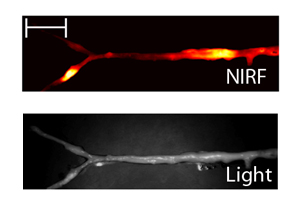
ICG.jpgHeart disease is the leading cause of death in the United States, and costs the country upwards of $316 billion in terms of healthcare costs, drugs and lost productivity. Yet the methods currently used to identify those at highest risk of heart attack leave much to be desired. A team of researchers hopes to change that by introducing a new type of catheterization procedure that produces detailed images of the fatty buildup inside blood vessel walls in the heart.

“This may be a new way to identify high risk plaques in coronary arteries— the ones responsible for heart attacks,” says Farouc Jaffer of Massachusetts General Hospital in Boston, lead author of a paper describing the technology that appears in Science Translational Medicine today.

The approach uses an imaging agent known as near-infrared lipid-binding dye indocyanine green (ICG)—which is already approved by the US Food and Drug Administration (FDA)—to detect the fatty buildups likely to burst in the heart.

In this proof of principle study, the team fed one group of rabbits cholesterol-heavy foods for eight weeks, while keeping their control counterparts on a healthy diet. They then injected the dye, and 20 minutes later inserted a catheter, which as expected picked up more infrared signals in the rabbits on the cholesterol-rich diet.

In future, the Massachusetts General Hospital team plans to test this procedure in heart disease patients to determine its ability to identify those at highest risk of heart attack.

Image: Aorta after injection of ICG in an atherosclerotic rabbit. Courtesy of Science Translational Medicine/AAAS

California’s stem cell agency to choose between investment banker and cardiologist — UPDATED

Thomas&Litvack
CIRM nominees: Jonathan Thomas (left) and Frank Litvack (right)
 

Six months after a bungled attempt to find a new leader, the California Institute for Regenerative Medicine (CIRM) yesterday announced two candidates to succeed Bob Klein, the architect and founding chairman of the $3 billion state stem cell agency. And with the option of electing either a bond financier or a cardiologist, the CIRM board now faces a stark choice over who will lead the San Francisco-based institute as it enters into its next phase.

Klein, a real estate magnate and lawyer who led the charge to put CIRM on the ballot in 2004, announced plans earlier this month to step down as CIRM’s chairman on 23 June. He had previously intended to do so when his term ended in December 2010. But after citizenship concerns scuttled the candidacy of his likely successor — the Canadian molecular biologist Alan Bernstein — Klein agreed to stay on for six months until a suitable replacement could be found.

At the time, Klein told Nature that he wanted “another scientist or clinician-scientist” to lead CIRM’s governing board. In line with those wishes, California State Controller John Chiang yesterday nominated Frank Litvack, a Los Angeles cardiologist who has held academic appointments at Cedars-Sinai Medical Center and the University of California–Los Angeles, to replace Klein. Litvack has also founded and led several medical technology start-ups, and currently sits on the boards of several biopharmaceutical companies.

“I have a background in clinical medicine, I have a background in research, and I have a background in business — and all of that is tied in to what people today call translational medicine,” Litvack told Nature Medicine. “It’s unusual for somebody to have done all three of those things, and I think I bring that to the table for the organization.”

However, the other three executive officers charged with choosing Klein’s successor all rallied around an attorney with financial acumen, rather than someone with extensive biopharma experience. In separate letters sent to Klein over the past week, California Governor Jerry Brown, Lieutenant Governor Gavin Newson and State Treasurer Bill Lockyer each nominated Jonathan Thomas, a founding partner in the bond investment group Saybrook Capital in Santa Monica, to takeover the chairmanship. According to letter of interest sent to the CIRM board yesterday, Thomas studied the history of medicine, served on the board of several governmental agencies as well as the Crippled Children’s Society of Southern California (now known as AbilityFirst), and has been an investor in the Santa Monica-based stem cell company Advanced Cell Technology.

Continue reading

A drug with 70 side effects? That’s just par for the course

4882443448_ab47e2f22b_m(3)Mobile phone users who balked at the idea that their telephone providers can track their every move have recently learned the hard way that reading the fine print is important. But while it’s custom practice to blindly accept usage agreements for telephones and computer programs, it’s tougher to operate with the same nonchalance when it comes to reading the side effects listed on the side of drug boxes. To make matters worse, a study published yesterday in the Archives of Internal Medicine estimates that the average drug has about 70 side effects.

The study, led by Jon Duke of the Indiana University School of Medicine in Indianapolis, analyzed the labels of nearly 5,600 medicines approved by the US Food and Drug Administration and currently on the market. The team found that the top 200 prescribed medications in the US in 2008 had 100 side effects on average.

Antidepressants, antiviral drugs and Parkinson’s medications were among the therapies with the longest list of side effects, according to the new research.

Duke warns that this information overload can confuse physicians and dissuade patients from taking their medications. “We need to wake up and make these labels more usable,” he says. “We need labels that communicate real risks.” He adds, however, that the vast majority of side effects recorded on drug labels are minor.

In future, the team urges manufacturers to develop smart labels that can communicate personalized safety information relevant to patients. “Manufacturers really need to try to avoid the instinct of putting everything on the label,” Duke told Nature Medicine.

WHO defers decision on smallpox stocks

Crossposted from Nature’s newsblog.

The World Health Organization’s top-decision making body, the World Health Assembly, said today it would defer until 2014 any decision on the destruction of the two last known remaining stocks of the virus that causes smallpox. A US-resolution calling for the stocks to be maintained for at least another five years ran into opposition led by Iran, resulting in deadlock last night after a day of negotiations.

A consensus to defer the decision was only reached after further negotiations this morning (today is the last day of the World Health Assembly). Shortly after the assembly decided to not decide, I spoke with Nils Daulaire, director of the Office of Global Health Affairs at the US Department of Health and Human Services, and head of the US delegation to the Geneva meeting. He says that Iran opposed in particular a clause in the US resolution that would have demanded that all countries affirm to WHO that they do not currently hold undeclared stocks of the virus.

Continue reading on Nature’s newsblog.

Crowd control keeps cancer in check

A stress landscape_300.jpg Scientists are one step closer to understanding how cancer spreads thanks to a new technology based on real-time fluorescent imaging.

Reporting in Nature Materials yesterday, researchers describe how mechanical forces help coordinate cell movement and influence normal tissue growth. Their approach also sheds light on how cancerous cells break loose.

“What we think is happening in metastasis is that you lose this steering control and the cells break away and escape,” says co-leader of the study Jeffrey Fredberg of the Harvard School of Public Health in Boston.

Using a new technique dubbed ‘monolayer stress microscopy’, the team measured the forces between hundreds of cells in sheets of cultured healthy and cancerous breast tissue. The team found that cells form packs, which keep them in order. But the forces holding these cells together eroded in the tissue culture when scientists flooded it with proteins that promote growth*; ultimately this perturbation caused cells to break from the ranks and scatter in all directions. The scientists speculate that these rogue cells can then seed cancer in other organs in the body.

“We knew that these intercellular forces had to be important,” says Fredberg, “but we could never measure these forces until now.”

He hopes to use this method in the future to uncover how wounds heal.

To learn more about the emerging role of force in cancer metastasis, read our recent feature or check out our interactive slide show.

Image: A stress landscape. A map of the forces between cells in sheets of cultured rat lung endothelial tissue. Adapted from yesterday’s paper in Nature Materials.

*Updated 5/24/11: An earlier version of this sentence erroneously implied that the experiment observed the activation of oncogenes.

FDA pulls Avandia off retail pharmacy shelves

It’s official: Avandia will no longer be found on most US pharmacy shelves starting 18 November. After deciding last autumn to severely limit the use of GlaxoSmithKline’s beleaguered type 2 diabetes drug, the US Food and Drug Administration outlined new restrictions this week that will make the drug available only through a special mail-order program to diabetics whose blood sugar levels are not controlled by other drugs.

This decision follows a number of studies showing that Avandia (rosiglitazone) triggers more heart attacks than its competitor, Takeda’s Actos (pioglitazone). The European Medicines Agency suspended Avandia last year, forcing diabetics to find other medications to control their blood sugar levels.

“It’s like a decade-long nightmare coming to an end,” Steven Nissen, chief of cardiovascular medicine at the Cleveland Clinic, told USA Today. “Eleven years after this drug was introduced, it will be so restricted in access that virtually no one will be able to get it.”

Some people might be reluctant to give up Avandia, but, fortunately, alternative options abound. According to a meta-analysis out this week in the Annals of Internal Medicine, all other available diabetes drugs are just as effective when used to control blood sugar levels with two other conventional medicines. In the review of 18 clinical trials totaling around 4,500 participants, researchers from the Federal University of Rio Grande do Sul in Portugal found little difference in benefit between the thiazolidinediones (which include Avandia and Actos), alpha-glucosidase inhibitors (such as Bayer’s Precose), glucagon-like peptide-1 agonists (including Byetta’s Exenatide and Novo Nordisk’s Victoza) and dipeptidyl peptidase-4 inhibitors (which include Merck’s Januvia and Bristol-Myers Squibb’s Onglyza).

Ribosome freeze frame offers new perspective on microbial defenses

ribosome250.jpgWith an estimated 175,000 deaths attributed to hospital-acquired infections each year in Europe alone and a dwindling arsenal of effective antibiotics to combat these superbugs, researchers have been striving to develop new antibacterial medicines. But these efforts have been hampered by scientists’ limited understanding of the basic molecular machinery that microbes use to thwart medicine’s best weapons.

To gain a better picture of how pesky pathogens such as Escherichia coli generate defensive proteins, a team led by structural biologist Jamie Doudna Cate at the University of California-Berkeley turned to X-ray crystallography to obtain molecular snapshots of E. coli’s protein-producing ribosomes in action. Using these pictures, reported today in Science, Doudna Cate says researchers may be able to develop new antibiotics that stick a wrench in the ribosome’s works.

”There are a lot of great drugs out there but there are also bacteria becoming resistant to all of them,” Doudna Cate told Nature Medicine. “We need more targets.”

Image courtesy of Science/AAAS