Course correction

The following editorial appears in the November issue of Nature Medicine.

The international response to the ongoing Ebola epidemic has in many respects been more reactive than proactive. But there are changes that, if made, may shift the balance toward future readiness. 

The projections are appalling. At the time of this writing, the World Health Organization (WHO) stated that the number of new Ebola virus disease cases could reach 10,000 per week before the end of the year. The three most heavily afflicted nations—Guinea, Liberia and Sierra Leone—remain woefully underequipped to stem the tide of infection. Severe shortages in medical personnel, protective gear, treatment beds and burial teams hinder almost every aspect of the effort. Cases of transmission were also reported in the US and Spain.

One thing is clear: the international community was not prepared to respond to this outbreak. Less clear is how, with limited resources, to stop the current epidemic. But several broad areas stand out as particularly important for efforts to stem Ebola’s spread and improve preparedness for future outbreaks. Continue reading

One in six clinical trials might fall outside federal oversight, study estimates

Bioethicists have long known about a potential regulatory loophole that excludes certain types of clinical trials from federal regulations designed to protect the safety of human research subjects in the US. However, the number of clinical trials that fell into this gap remained unknown. Now, a letter published online today in the Journal of the American Medical Association reveals just how many trials may fall outside federal government supervision at present.

In the US, two federal policies provide oversight for research involving people. One is the so-called Common Rule, which applies to the majority of human studies that are performed or funded by the federal government. The other is the set of regulations issued by the US Food and Drug Administration (FDA) that apply to human tests of drugs, devices and biological products such as vaccines regardless of funding source. Some clinical trials are subject to only one of these regulations; others are governed by both. However, some privately funded trials are neither subject to oversight by the FDA nor the Common Rule.

A team led by Deborah Zarin, director of the site ClinicalTrials.gov—a federal registry of publicly and privately funded human trials—decided to find out just how many active trials fall into each of the various categories of oversight. The researchers compiled a list of some 24,000 US-based clinical trials that were listed as active in that database as of 13 September 2013, and estimated that at least 19% of the sampled trials were covered by both policies. Furthermore, between 1,285 and 3,696 trials, or approximately 5%–16%, were not subject to the Common Rule or the FDA, because they weren’t federally funded and didn’t involve drugs, devices or biologics. “That might include things like surgical interventions,” Zarin says.

The unregulated trials raise concerns for human safety, says Robert Califf, vice chancellor for clinical research at Duke University in Durham, North Carolina. “Put yourself in the shoes of a person that volunteers for a study,” he says. “I think most people would agree it would be good to make sure that there’s an encompassing system so you can be assured that the institution that’s conducting the trial has agreed to a common set of rules about how human studies should be done.”

At the same time that Zarin voices concern about studies falling outside the regulatory domain of both the FDA and Common Rule, she says it’s not ideal for trials to be subject to oversight by both rules. This double oversight, according to Zarin, could create a potential burden to researchers due to differences in reporting requirements and extra paperwork: “When people consider possible changes to the regulatory framework, these are the kinds of things that should be thought about.”

Seeing through the smoke with the help of research: a conversation with Helen Meissner

{credit}NIH{/credit}

Most people stopped doubting the dangers of tobacco long ago. And yet, tobacco products continue to adorn the checkout kiosks of convenience stores and appear in the pages of magazines. The question is: which of these products should be allowed and which should not? It’s no longer a theoretical question: the US Food and Drug Administration (FDA) was granted the power to regulate these products four years ago.

More research will help the FDA make tough decisions in this area, says Helen Meissner, the director of the Tobacco Regulatory Science Program at the US National Institutes of Health (NIH). Meissner is leading a joint effort with the FDA to study how to bring science-based regulation to the manufacturing, marketing and distribution of products such as cigarettes. On 19 September, the two agencies announced that they would grant a total of $53 million to 14 research teams working on tobacco-related projects across the US. Nature Medicine asked Meissner about the newly formed Tobacco Centers of Regulatory Science (TCORS) and the challenges of government-funded research in this space.

What are the biggest research goals of this new funding effort, broadly speaking?

The FDA [needs] to understand tobacco products in order to review tobacco products. They need product standards. They need to know how best to monitor compliance and enforcement, say with advertising or youth access. And they also need information on the best ways to communicate about tobacco products through media and education campaigns.

And how will the 14 centers come together and communicate?

They will be coming together through grantee meetings, so there will be collaborative activities across the centers. Although each is independent and they have different seams—as I mentioned they cover different areas—there is synergy as well across the centers. So that is the role of NIH: to convene the groups.

Continue reading

Voting commences on research prize determined by public poll

It’s an off year in the US election cycle, which means that neither the President nor most members of Congress will face the voters come November. But that doesn’t mean you can’t still cast a ballot this fall. Today, the Brigham and Women’s Hospital (BWH) in Boston announced the finalists for the second annual BRIght Futures Prize, a $100,000 research contest in which the winner is decided by a public poll. Voting is now open through 21 November.

The BWH launched the prize last year in an effort to engage the public-at-large. First, the hospital’s Biomedical Research Institute (BRI) solicited grant proposals from BWH staff on various overarching themes: last year, those were personalized medicine and systems immunology; this year, the topics span the nine featured at the hospital’s ‘research day‘ in November (where the BRIght Futures Prize winner will be announced). Then, the BRI convened peer-review panels to winnow the applicants down to three finalists, each of whom made a short video to pitch their ideas to the public. (See my coverage of last year’s prize: ‘Biomedical grant awarded by ‘American Idol’-style public vote’.)

Last year’s winner was Robert Green, a clinical geneticist at BWH who proposed to sequence the genomes of 480 newborns, half from healthy babies and half from sick babies, in an effort to study how to use that information in routine medical care. Off the back of his BRIght Futures Prize, which served as a sort of pilot grant, earlier this month Green won a $6 million grant from the US National Human Genome Research Institute to roll out his plan in full. (See ‘Scientists to sequence genomes of hundreds of newborns’ from the Nature News blog.)

This year’s finalists include: Utkan Demirci*, a biomedical engineer who aims to advance a point-of-care microfluidic device for detecting levels blood levels of antiepileptic drugs; pharmacoepidemiologist Daniel Solomon and healthcare researcher Joel Weissman, who hope to create an online patient portal to streamline clinical trial enrollment and boost participation; and plastic surgeon Bohdan Pomahač and bioengineer Jeffrey Karp, who propose to develop a new generation of adhesive medical tapes based on biologically-inspired designs. (See my February 2013 news feature about Karp’s investigations of ‘biomimetic’ adhesives: ‘The sticking point’.)

You can watch all the finalists’ videos and read short descriptions of their research proposals here. Check them out, and then exercise your voting right!

*Update: Demirci was named the winner at the BWH Research Day on 21 November.

Melanoma drug joins ‘breakthrough’ club

Earlier this year, the US Food and Drug Administration (FDA) granted its first ‘breakthrough therapy designations’ to a pair of cystic fibrosis drugs (see Nat. Med. 19, 116–117, 2013). But since then, it’s been all about the cancer agents.

The New Jersey drug giant Merck announced this morning that its investigational cancer drug lambrolizumab (MK-3475) had received the breakthrough blessing in recognition of the dramatic clinical benefits observed in an open-label, phase 1 trial involving people with advanced melanoma. The FDA’s new development path is specifically designed for experimental agents that produce large and unprecedented treatment effects in early clinical trials.

According to preliminary data presented at an international melanoma meeting last year, 43 of 85 patients with inoperable and metastatic melanoma who received lambrolizumab showed an objective anti-tumor response after 12 weeks, including eight who experienced a complete response. The average duration of response was 7.6 months, and most of the reported side events were minor, although seven people experienced potentially dangerous immune-related complications.

“It’s never a good time to be a patient. But at this point, if you are, it’s the dawning of a new day where we have the return of hope of having a significant therapy,” says trial investigator Omid Hamid, director of the Melanoma Center at the Angeles Clinic and Research Institute in Los Angeles.

“One of the best things about getting this breakthrough designation is that it drives patients to clinical trials, and it drives patients to the understanding that there is continued work being done,” he adds.
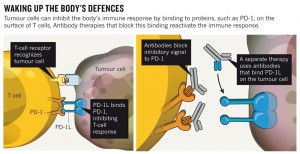
How anti-PD-1 therapy such as lambrolizumab works

How anti-PD-1 therapy works{credit}Nature{/credit}

Like Yervoy (ipilimumab), an FDA-approved melanoma therapy that promotes T cell function by blocking a surface protein called cytotoxic T lymphocyte antigen 4 (CTLA-4), lambrolizumab is an immunotherapy drug. It works by inhibiting another surface protein called programmed death-1 (PD-1). PD-1 is an inhibitory signaling receptor expressed on activated T cells. By targeting PD-1, lambrolizumab stimulates the immune system, enhancing the ability of T cells to kill tumor cells (see Nat. Med. 18, 993, 2012).

Bristol-Myers Squibb, Genentech, Amplimmune and CureTech all similarly have drugs directed at either PD-1 or its ligand. But, according to Hamid, lambrolizumab is the only drug to have been shown publicly to work in people for whom Yervoy has failed. In the trial data presented last year, 11 of 27 participants who had previously tried Yervoy showed an objective anti-tumor response to the new experimental Merck antibody.

Additional phase 1 data will be presented in June at the American Society of Clinical Oncology’s annual meeting in Chicago. Merck is currently recruiting participants for a 510-person, phase 2 follow-up.

Wendy Selig, president and chief executive of the Melanoma Research Alliance, an advocacy organization based in Washington, DC, welcomes the new designation for lambrolizumab. “We view it as a really important step in the process of creating this ‘all hands on deck’ mentality, where you have a serious unmet medical need and where there are big gaps in terms of what’s available,” she says.

Lambrolizumab is the fourth experimental cancer drug to be labeled a breakthrough. The others are: Pfizer’s palbociclib (PD-0332991) for metastatic breast cancer; Novartis’s LDK378 for ALK-positive lung cancer; and Johnson & Johnson’s ibrutinib (PCI-32765) for various types of leukemia and lymphoma.

“It’s great to see that the FDA has embraced this,” says Jeff Allen, executive director of Friends of Cancer Research, a Washington, DC–based think tank and advocacy organization that first proposed the breakthrough designation. “I think what’s most promising is that there are drugs that are having this magnitude of effects in disease settings where there are so few options.”

Hopkins scientist to lead the NIH’s basic science branch

Photo credit: Mike Ciesielski

NIGMS’s new director Jon Lorsch {credit}Mike Ciesielski{/credit}

The US National Institute of General Medical Sciences (NIGMS)—the $2.4 billion branch of the National Institutes of Health (NIH) tasked with laying the foundation for research into disease diagnosis, treatment and prevention—has a new leader. Earlier today, the agency announced that Jon Lorsch, a biophysical chemist at the Johns Hopkins University School of Medicine in Baltimore, would become the new director, starting this summer.

“They could not have done better at the NIH,” says Lorsch’s colleague Mario Amzel, director of the Biophysics and Physical Chemistry department at Hopkins. “He’s one of the best teachers at the medical school and has a strong interest in education, which seems to be one of the directions in which the NIH wants to go now.”

In 2011, for example, Lorsch proposed a new integrated model for graduate education in the life sciences that addressed a number of challenges, including the increased information burden and the need to train researchers who can work across traditional disciplinary boundaries.

In the lab, Lorsch’s work focuses on understanding the mechanisms of translational initiation in yeast cells. Last month, for instance, his group published two papers characterizing the molecular events through which messenger RNA is recognized by and recruited to the ribosome.

Jon has exploited the tools available in yeast and combined them with powerful kinetic analyses to molecularly dissect the process of translation initiation,” says Thomas Dever, a biochemist at the US Eunice Kennedy Shriver National Institute of Child Health and Human Development in Bethesda, Maryland, who has worked with Lorsch on similar projects. “As a long-time collaborator, I am particularly excited to have him as a colleague at the NIH.”

The news of Lorsch’s appointment was equally well received by his former mentor and PhD advisor Jack Szostak, a geneticist at the Massachusetts General Hospital in Boston. “It’s great to have another outstanding scientist as NIGMS Director,” he told Nature Medicine. “Jon is also a very funny person, and no doubt his sense of humor will help him in trying to get people with diverse interests to work together and support the best science in the most efficient manner.”

Lorsch will replace acting director Judith Greenberg, who stepped into the post two years ago after Jeremy Berg, who had served as NIGMS director from 2003 to 2011, left to lead science strategy and planning at the University of Pittsburgh Schools of the Health Sciences in Pennsylvania. (Nature Medicine conducted an interview with Berg in 2011 regarding his contributions to NIGMS and his decision to leave.) Under Greenberg, the NIGMS underwent a series of reorganizations, with the creation of two new divisions that combined existing NIGMS programs with those transferred from the former National Center for Research Resources (NCRR). The NCRR was folded in 2011 to make room for the National Center for Advancing Translational Sciences.

Rallying for the future of medical research: Q&A with Jon Retzlaff

shutterstock_44616835Less than a month from now, science advocates hope to bring thousands of people together on the Carnegie Library Grounds at Mt. Vernon Square in Washington, DC,  to stand together in the Rally for Medical Research. The move is, in large part, a response to the latest development in the US budget battle, in which the government has implemented massive cuts, known as sequestration, to most federal programs starting 1 March. The sequestration’s $1.6 billion cut to the US National Institutes of Health (NIH) translates to over 5 % spending cut to federally-funded medical research. These cuts come at a time when the NIH’s budget has been steadily declining for the past ten years.

The American Association for Cancer Research (AACR) is one of nearly 100 partnering organizations behind the 8 April rally. Jon Retzlaff, a managing director for Science Policy and Regulatory Affairs at AACR who is also involved in coordinating and organizing the rally, told Nature Medicine how AACR conceived the idea for the rally and how it plans to call on our nation’s policymakers to make life-saving medical research funding a national priority:

How did the idea for a rally come about?

We have an annual meeting in Washington, DC, between April 6 and 10, where around 18,000 people come to town for this meeting. Our chief executive officer, Margaret Foti, proposed that because we are at a crisis moment in regards to the medical research, specifically the funding for the NIH, we need to do something at the annual meeting to make the NIH a national priority and generate awareness among the general public to take action to inform the members of Congress that there are key areas of government that need to be supported and the NIH is one of them.

How many people are they expecting to come?

Nearly 100 partnering organization have already signed up. The American Heart Association is coming to the rally on behalf of the NIH and it’s going to be a major event. When we just started, we hoped for 10,000 people. Now I’m optimistic that we underestimated the numbers.

Continue reading

Q&A: How the Brain Activity Map came together—and what its proponents hope to achieve

{credit}Laura Luongo{/credit}

It was a single tweet. On 12 February, after US President Barack Obama made a subtle nod to a new neuroscience project in his annual State of the Union address, Francis Collins, director of the country’s National Institutes of Health (NIH), posted on the @NIHDirector Twitter feed: “Obama mentions the #NIH Brain Activity Map in #SOTU.” Instantly, scientists were buzzing with rumors that the Brain Activity Map could be the next moon shot, with a budget and timeline similar to the Human Genome Project.

The brain map began as a brief white paper and has grown into a large—and still largely undefined—collaboration of several government agencies, nonprofit foundations and private companies. As the stakeholders describe in a commentary slated to be published later this month, the goal of the initiative is to understand how thousands of neurons work in concert to control behavior and trigger disease. Miyoung Chun, vice president for science programs at The Kavli Foundation in Oxnard, California, has been developing the project since the beginning and is the self-described “glue” between its many diverse stakeholders. Chun (pictured) spoke with Virginia Hughes about the evolution of the project and what it might mean for biomedicine.

Were you surprised that President Obama mentioned the Brain Activity Map during his speech?

Absolutely. I had no idea that he was going to mention the project. All of us scientists who have been working so hard and talking about this issue for the past 18 months, we were writing emails to each other, we were calling each other, shouting, jumping. We were like, “Wow, he knows about this project? That’s amazing!”

Continue reading

US budget cuts imperil domestic and global biomedical research

{credit}Shutterstock{/credit}

In the medical world, the term ‘sequestration’ is usually preceded by the word ‘pulmonary’ or ‘splenic’ and is used to describe rare diseases that are the focus of research grants funded by the US National Institutes of Health (NIH). But sequestration has now taken on a new meaning.

On Friday (1 March), a series of sweeping federal budget cuts totaling more than a trillion dollars over the next ten years are scheduled to automatically go into effect unless a legislative bargain is reached—and their impact on biomedical research could be dire, with consequences felt both in the US and abroad.

“We are going to maim our innovation capabilities if you do these abrupt deep cuts at NIH,” former agency director Elias Zerhouni, now head of global R&D at the French drug company Sanofi, told the Washington Post. “It will impact science for generations to come.”

The NIH, already suffering through half-a-decade of stagnant funding, will receive a 5.1% cut across the board—a reduction of $1.5 billion from a total budget of $31 billion. Should this happen, the agency’s operation plan is straightforward: fewer projects will get new funding and existing ones will be supported at lower levels. “Cuts will result in slower progress against our most common diseases, such as Alzheimer’s, cancer, AIDS, diabetes and heart disease,” Francis Collins, the NIH’s current director, said at a press conference addressing sequestration last week.

United for Medical Research, a coalition of universities, biotech companies and research associations, estimates that cuts to the NIH budget could lead to 20,000 fewer jobs and a $3 billion economic impact this fiscal year. Potentially more troubling is the effect of sequestration on new researchers. Lower success rates for NIH grants, which have steadily declined since their peak in the early 2000’s, could stall the careers of young investigators. Even training grants, which fund graduate students at universities, are at risk of being cut, said Collins. “This is not a spigot you turn off and turn back on later. If we lose the talents of this up and coming generation, they’re not coming back,” he said.

Although the NIH is the single largest funding source for biomedical research, other agencies—including the Food and Drug Administration, the Agency for Healthcare Research and Quality, the Department of Defense, the Centers for Disease Control and Prevention, the National Science Foundation, and the Agency for International Development—would all receive sequestration cuts.

Combined, the US agencies are the largest funder of research in the world. Their significant contributions to global health and the potential harm sequestration could cause are highlighted in a report released today by the Global Health Technologies Coalition, a group of nonprofit organizations.

With the development of potential HIV preventatives, improved malaria drugs and other global health products, US government research funding has already saved millions of lives and provided economic benefits around the world. If the research pipeline were to be interrupted now, scientific regression, increased long-term costs and needless deaths would result, the report argues. “There is much to lose by pulling back now,” the authors write.

Under scrutiny, India’s premier medical research council faces review

BANGALORE — A high-powered panel set up at the request of India’s Ministry of Finance is reviewing the work of the Indian Council of Medical Research (ICMR), the country’s primary funding and coordinating body for biomedical research, based in New Delhi.

The ICMR has faced criticism that the medical research it supports does not adequately address public health problems. Such critiques, it seems, have prompted the ministry to seek an external audit of the ICMR’s research programs before the government releases the 85 billion rupees ($1.6 billion) that the council has asked for over the next five years—twice as much as it got for the previous five years—including 31.5 billion rupees for new scientific institutes and an upgrade of existing ones.

Prakash Tandon, a neurosurgeon at the government-funded National Brain Research Centre in New Delhi who heads the 11 member committee, told Nature Medicine that a new direction for medical research will be formulated after critical evaluation of the usefulness and public health relevance of programs in each of the ICMR’s 27 institutes. It’s likely that a number of duplicated programs across different ICMR institutes will be recommended for closure, added pathologist Indira Nath, an emeritus professor at the National Institute of Pathology in New Delhi and a committee member. The review of the ICMR began two weeks ago and a report will be submitted within the next two months, according to Tandon.

Continue reading