Researchers question ‘read-through’ mechanism of muscular dystrophy drug ataluren

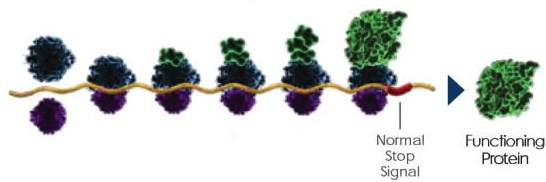
Ataluren's proposed mechanism of action

Ataluren’s proposed mechanism of action {credit}PTC Therapeutics{/credit}

A drug in clinical trials for muscular dystrophy and cystic fibrosis might not work through the molecular mechanism that scientists think it does. Although the new findings do not cast doubt on the clinical efficacy of the medication, the new experiments suggest that researchers might need to double-check that therapeutics believed to rescue normal protein production by helping parts of the cell ‘read through’ the genetic sequences actually do just that.

The drug in question, ataluren, was developed by New Jersey’s PTC Therapeutics to treat illnesses caused by nonsense mutations such as Duchenne muscular dystrophy, a disease in which disrupted production of dystrophin, a protein critical to muscle structure and stability, leads to progressive muscle deterioration. The drug has also shown clinical benefit in the 10% of cystic fibrosis patients with a mutation in the CFTR gene that causes truncated proteins and has potential for treating other ailments, including hemophilia.

Overall, about 11% of genetic mutations found in inherited diseases involve changes in the code of messenger RNA that prematurely stop protein translation to produce a dysfunctional or nonexistent protein product. But ataluren, formerly known as PTC124, was thought to work by cozying up to parts of the cell known as ribosomes and allowing them to ‘read through’ these errors and continue to make a normal protein.

The developers of ataluren had conducted experiments in human embryonic kidney cells in which the drug succeeded in reading over a mutation and restoring normal production of the enzyme firefly luciferase (FLuc), which causes cells to glow. However, two subsequent reports found evidence that ataluren boosted production of FLuc without assisting the read-through of the code for the enzyme.

In a new study published today in PLoS Biology, researchers ran additional experiments and came across more data placing the read-through mechanism in doubt. Stuart McElroy, a molecular biologist at the Drug Discovery Unit at the University of Dundee, UK, and his team tested ataluren against G418 activity, a well-documented antibiotic read-through agent, in four non-luciferase assays and found in each case that G418 rescued production of proteins but ataluren did not. Researchers also manipulated the sequence of nonsense mutations in another 12 assays and, again, found no measureable effect of read-through activity with ataluren.

Continue reading

A victory for genes

A version of this editorial appears in the forthcoming July issue of Nature Medicine.

The ability to patent human genes has been costly to researchers and patients, and has restricted competition in the biotech marketplace. The recent US Supreme Court decision making isolated human genes unpatentable will bring freedom of choice to the patient, and level the playing field for research and development.

***

On 13 June, in a landmark decision, the US Supreme Court ruled that human genes cannot be patented. The unani- mous decision by the Court concludes a lawsuit against the molecular diagnostics company Myriad Genetics that was seeking to invalidate certain claims in three of the company’s US patents on the BRCA1 and BRCA2 genes, which were originally granted in the 1990s. This welcome ruling marks the first time that the US Supreme Court has invalidated a human gene patent.

The decision has been a long time in coming—so long that Myriad’s patents were due to expire in less than three years. And the 15-year delay has surely not aided patients who frequently benefit from healthy competition in the biotech sector or from research on BRCA genes. Yet the decision brings relief to those of us who reject the idea that an individual or corporation can own—even for a limited time—human genes and thereby control their use.

In 1994, Mark Skolnick, a future founder of Myriad Genetics, along with several other research groups, cloned BRCA1, followed swiftly by BRCA2. Myriad Genetics was founded that same year, and the company filed patents for the two genes in 1994 and 1995. Mutations in the genes are associated with increased susceptibility to breast and ovarian cancers, and Myriad has successfully translated this infor- mation into genetic testing kits. Moreover, by claiming intellectual property rights on these genes, they have precluded other companies and university-based diagnostic labs from commercializing compet- ing tests, effectively establishing a monopoly on BRCA testing.

But in 2009, the American Civil Liberties Union and the Public Patent Foundation filed a lawsuit against Myriad Genetics, the US Patent and Trademark Office and others, stating that patenting BRCA1 and BRCA2 was unconstitutional. After several rounds in lower courts, with alternating decisions in favor of and against the motion, the Supreme Court agreed in November 2012 to hear the case (Association for Molecular Pathology et al. v. Myriad Genetics, Inc., et al.).

In siding with the plaintiffs in this case, the Court’s decision rests on the interpretation of a section of the US Code governing patent law that has remained virtually unchanged since 1793. According to the Code, “any new or useful process, machine, manufacture or composition of matter, or any new and useful improvement thereof ” can be patented. Although not explicitly stated, the wording has been interpreted to mean that naturally occurring phenomena are not new or invented and therefore are not inherently patentable. In writing the Court’s opinion, Justice Clarence Thomas stated, “Myriad did not create or alter any of the genetic information encoded in the BRCA1 and BRCA2 genes. The location and order of the nucleotides existed in nature before Myriad found them. Nor did Myriad create or alter the genetic structure of DNA . . . . We . . . hold that genes and the informa- tion they encode are not patent eligible . . . simply because they have been isolated from the surrounding genetic material.”

Continue reading

UPDATED: GSK inquiry reports signs of possible data fabrication in multiple sclerosis paper

An inquiry by the British pharmaceutical company GlaxoSmithKline (GSK) into allegations of possible data fabrication in a 2010 Nature Medicine paper regarding the role of specialized T cells in autoimmune disease has found what it sees as evidence of misconduct. Concerns regarding the paper surfaced last week, when news sources reported that the company had begun investigating the research conducted for the study at a GSK lab in Shanghai.

The paper, led by Jingwu Zhang at the GlaxoSmithKline Research and Development Center’s department of neuroimmunology in Shanghai, originally claimed to have found data suggesting that the signaling molecule interleukin-7 caused a subset of T cells known as T helper 17 (TH17) cells taken from people with multiple sclerosis to multiply. The finding complemented other research in the field suggesting that genetic differences in the cell receptor for interleukin-7 might put some individuals at risk for developing multiple sclerosis—an autoimmune disease thought to involve helper T cells.

Continue reading

Yale immunologist wins new €4 million award

Ruslan Medzhitov

{credit}Brian Ach/HHMI{/credit}

Most scientists will say that they go to the lab every day out of a pure love of science, not to make buckets of money. But for researchers at the pinnacle of their fields, science can be a lucrative trade. Win a Nobel Prize, and you could take home more than $1.2 million. Bag a Templeton Prize, and you could be depositing a $1.7 million check. Net a Breakthrough Prize in Life Sciences, first awarded earlier this year, and you’d walk away with a cool $3 million.

But that’s nothing compared to the €4 million ($5.1 million) purse attached to the Else Kröner-Fresenius Award, a new prize handed out today by the German non-profit Else Kröner-Fresenius-Stiftung (EKFS). Although €3.5 million of the prize money is intended for future research (leaving only €500,000 for the recipient to use as he or she pleases) the total value of new award makes it the most valuable single accolade in all of science, monetarily at least.

That accolade was given to immunologist Ruslan Medzhitov, a Russian-born scientist at Yale University in New Haven, Connecticut, who co-discovered and characterized mammalian Toll-like receptors (TLRs) in the 1990s. These pattern recognition molecules are now recognized as integral parts of the innate immune system that fight off microbial infections and detect associated damage. Many drug companies are actively targeting these receptors in the hopes of treating cancer, sepsis and inflammatory disease.

Two years ago, Medzhitov (pictured) was controversially overlooked for the 2011 Nobel Prize in Physiology or Medicine, which went to the discoverer of dendritic cells (Ralph Steinman) and two other immunologists who elucidated key aspects of innate immunity (Bruce Beutler and Jules Hoffmann, with whom Medzhitov shared the 2011 Shaw Prize in Life Science and Medicine, the $1 million ‘Nobel Prize of the East’). At the time, 24 scientists wrote an open letter in Nature arguing that Medzhitov and his mentor Charles Janeway, who died in 2003, should have been recognized by the Nobel Committee for their seminal contribution of cloning a human TLR and showing that it activated signaling pathways that induce adaptive immunity.

However, according to Stefan Kaufmann, director at the Max Planck Institute for Infection Biology in Berlin, the Nobel snub had no effect on Medzhitov’s selection for the new award. Medzhitov “was clearly one of more innovative researchers,” says Kaufmann, who, as president of the International Union of Immunological Societies, served as chair of the award’s executive committee. Plus, he notes, the Else Kröner-Fresenius Award recognizes both past achievements and ongoing research activity, and Medzhitov has an active research program that could aid in the development of new vaccines and anti-inflammatory medicines. (See this commentary that Kaufmann cowrote last year in Nature Immunology for more background on the award.)

The inaugural immunology-themed award was timed to commemorate the 25th anniversary of the death of EKFS founder Else Kröner. Going forward, the foundation expects to grant the award every four years to a different discipline of medical research.