More than a Spoonful

Back in December 2006, readers got their first dose of the Spoonful of Medicine blog. Over the last eight years, there’s been a lot of news to dispense—from our look at the ongoing problem of drug shortages and the movement to pressure companies to make cheaper therapies available to our reporting in April about experimental Ebola drugs (when much of the world was ignoring the rising outbreak in West Africa). We’ve highlighted many of the biggest breakthroughs in biomedical research, and also detailed a few of the ones that went under the radar. Take, for example, our reporting on insights into the tapeworm genome last year, or a study indicating that a diabetes drug could potentially work to treat emphysema. In every instance we went beyond simply reporting the results and tried to give our readers a better understanding of the biological mechanisms underpinning new findings, as well as a level-headed take on what the real implications were for any future medical applications. We put all claims—big and small—under the microscope.

Every drug needs an antidote, and so the Spoonful of Medicine blog has also given readers some light-hearted posts about the research enterprise. We’ve taken on the amusing and bizarre acronyms for clinical trials, such as the ‘AWESOME’ trial, in a story that became a reader favorite. Another popular post detailed the findings of an ancient shipwreck that contained tablets with ingredients similar to what might find in today’s over-the-counter medicine Cold-EEZE.

We are now committing more time than ever before to bring you investigative news features (our piece on missing follow-up clinical trial data is one example) and although that means this blog will be put on pause for the foreseeable future, we will continue to publish news on the Nature Medicine homepage, which underwent a redesign earlier this year. Our first ‘advance online publication’ news story, about how universities are banning medical staff from helping with the Ebola outbreak in West Africa, went live online just recently. There will be more of those to come, and we hope you will subscribe—via TwitterFacebook or the journal’s table of contents RSS feed—to keep up to date about all the news that we offer. Our news reporting goes far beyond the Spoonful site, and we hope you’ll seek us out at www.nature.com/naturemedicine where the news will keep rolling out.
We’re seeking an assistant news editor

Nature Medicine (that’s us!) seeks an assistant news editor to report and edit must-read stories about the fast-changing field of drug development. We are looking for a person with a passion for understanding and communicating biomedical research, who is eager to break new ground with insightful investigative journalism in this area. The responsibilities of the position include writing and editing news content, as well as helping to manage the journal’s robust online presence.

The job requires an individual who can work with minimal guidance, finding and developing exclusive stories. The ideal candidate will have a degree in biology or a related science and at least two years of experience as a working journalist. S/he should be able to commission and guide freelancers and work with production staff to conceptualize artwork for print layout. The assistant news editor will be based in our Cambridge, Massachusetts, offices and work closely with our team in New York.

The job offers opportunity for travel and attendance at leading scientific meetings, as well as excellent benefits. Nature Publishing Group is an Equal Opportunity Employer.

Please submit a resume, cover letter and any relevant published writing samples to r.khamsi@us.nature.com and https://home.eease.adp.com/recruit/?id=10018071 by 30 July 2014.


Intern at Nature Medicine

Have a passion for reporting on biomedical news? We’re currently accepting applications for our science writing internship. The intern will be closely involved in the editorial process and write news articles and briefs. This is not a paper-pushing internship! The person selected for the position will be reporting stories and working on editorial content, including the blog (https://blogs.nature.com/spoonful/).

Applicants should have completed one year in a graduate program in journalism or have equivalent work experience in journalism. Additionally, a strong understanding of biology and current issues in medicine is required.

This four-month, paid internship and will start in May or early June and be based in our New York offices.

The deadline for applications is March 31st. To apply please send 1) a cover letter, 2) your resume and 3) three published writing clips to r.khamsi@us.nature.com.

UPDATED: GSK inquiry reports signs of possible data fabrication in multiple sclerosis paper

An inquiry by the British pharmaceutical company GlaxoSmithKline (GSK) into allegations of possible data fabrication in a 2010 Nature Medicine paper regarding the role of specialized T cells in autoimmune disease has found what it sees as evidence of misconduct. Concerns regarding the paper surfaced last week, when news sources reported that the company had begun investigating the research conducted for the study at a GSK lab in Shanghai.

The paper, led by Jingwu Zhang at the GlaxoSmithKline Research and Development Center’s department of neuroimmunology in Shanghai, originally claimed to have found data suggesting that the signaling molecule interleukin-7 caused a subset of T cells known as T helper 17 (TH17) cells taken from people with multiple sclerosis to multiply. The finding complemented other research in the field suggesting that genetic differences in the cell receptor for interleukin-7 might put some individuals at risk for developing multiple sclerosis—an autoimmune disease thought to involve helper T cells.

Continue reading

Paid news internship at Nature Medicine

Are you comfortable with the concepts of both gene editing and story editing? If so, we want to let you know that we’re currently accepting applications for our science writing internship.

The intern will be closely involved in the editorial process and write news articles and briefs. This is not a paper-pushing internship! The person selected for the position will be reporting stories and working on editorial content full-time, including this very blog.

Applicants should have completed one year in a graduate program in journalism or have equivalent work experience in journalism. Additionally, a strong understanding of biology and current issues in medicine is required. This four-month, paid internship will start in May or June and be based in New York City or Boston.

The deadline for applications is 10 March 2013.

Please send an email to r.khamsi@us.nature.com with “Nature Medicine news internship” in the subject line and include 1) a cover letter, 2) your resume and 3) three published writing clips.

TB vaccine takes a tumble

Cross-posted from the Nature News Blog

A leading candidate for a sorely needed new vaccine against tuberculosis (TB) has failed to protect children against the disease in a major clinical trial.

Published today in The Lancet, the results of the trial of the MVA85A vaccine show that it seems to have “no significant efficacy” against either TB or infection with Mycobacterium tuberculosis.

The results are a major blow to the TB research community, as MVA85A had seemed highly promising as a solution to the problem of the patchy efficacy of the ‘BCG’ vaccine used worldwide against the disease.

Click here to continue reading.


Paid news internship at Nature Medicine

We’re looking for a person who is passionate about biomedicine and journalism to join our team as a news intern.

The intern will be closely involved in the editorial process and write news articles and briefs. This is not a paper-pushing internship! The person selected for the position will be reporting stories and working on editorial content full-time, including this very blog.

Applicants should have completed one year in a graduate program in journalism or have equivalent work experience in journalism. Additionally, a strong understanding of biology and current issues in medicine is required. This four-month, paid internship will start in October and be based in New York City.

The deadline for applications is 8 October 2012.

Please send an email to r.khamsi@us.nature.com with “Nature Medicine news internship” in the subject line and include 1) a cover letter, 2) your resume and 3) three published writing clips.

Cancer drug in the works might double as reversible male contraceptive

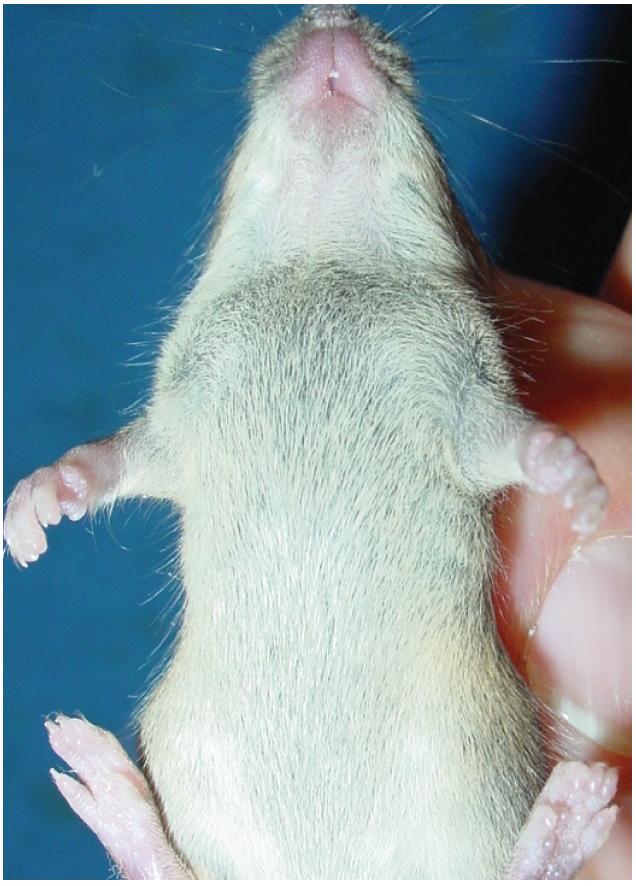
Researchers show off a pup fathered by a mouse that regained its fertility.

The serendipitous finding that a potential cancer-fighting compound temporarily halts sperm production in mice has seeded new hopes for a reversible male contraceptive pill. At a time when the only non-hormonal contraceptive choices for men consist of condoms and vasectomies, the finding, published today in the journal Cell, has stirred the interest of pharmaceutical companies, although it’s quite far from entering clinical trials.

Several new contraceptives that rely on steroid hormones are in the works to reduce sperm production in men. However, most products developed to date seem to carry undesirable side effects, such as acne and perturbations of cholesterol levels. So, scientists have sought to halt sperm production with compounds that do not alter hormones, targeting everything from calcium ion channels on the tails of sperm to the production of retinoic acid, a metabolite of Vitamin A that has a role in their development. A team led by Dolores Mruk at the Population Council’s Center for Biomedical Research in New York has even reported in Nature Medicine on the discovery of a chemical compound known as Adjudin that can stop sperm-forming cells from adhering to the Sertoli cells that nurture them.

The new findings announced today also describe a non-hormonal drug for stopping sperm—but contraception was the furthest thing from the minds of James Bradner and his colleagues at the Dana-Farber Cancer Institute who initially developed the experimental compound.

As we reported last year, Bradner’s team had investigated a small molecule called JQ1 for its ability to thwart cancer by acting on a protein named BRD4. They showed success in mice with multiple myeloma, and other groups soon reported similar findings in animal models of leukemia and lymphoma. Bradner has been downright evangelical about the drug ever since, shipping it to more than 250 labs worldwide, according to a profile of Bradner published last week in Nature.

As part of their homework in understanding the specificity of JQ1, Bradner’s group found that it also targeted a similar protein, called BRDT, which comes from a completely different chromosome than BRD4. In a quick survey of the scientific literature, Bradner noticed a study that linked mutations in BRDT to fertility problems in men, so he reached out to reproductive biologist Marty Matzuk of the Baylor College of Medicine in Houston to study its contraceptive effects in mice.

“This project for us started very much as a side project,” says Bradner. “We planned together to do a critical first experiment to explore the effects of JQ1 on sperm count and motility. We went right in vivo. And we were shocked at how well the drug worked.”

Continue reading

Court ruling: FDA can regulate stem cell clinics

Cross posted from the Nature News blog on behalf of Monya Baker.

The FDA can block U.S. clinics that offer cultured cell products, according to a ruling of a U.S. district court this week.

Though championed by politicians like Governor of Texas Rick Perry, clinics marketing stem-cell procedures worry many healthcare advocates because these procedures are often heavily marketed but not thoroughly tested in clinical trials. (See Stem cell therapy takes off in Texas from nature.com and warnings compiled by the International Society for Stem Cell Research)

If cells are harvested and returned to a patient with “minimal manipulation”, the procedures are not regulated, but further processing classifies cell treatments as a drug, which requires FDA approval.

Read more on the Nature News blog.

Combination drug ‘sprinkles’ in the works for infants with HIV

WASHINGTON, DC — Last year, 330,000 infants were born infected with HIV, many of whom will succumb to the disease unless more baby-friendly formulations of antiretrovirals become available, AIDS advocates warned here yesterday at the International AIDS Society conference. “We know that existing treatments are very often difficult to administer,” Bernard Pécoul, executive director of the Drugs for Neglected Diseases initiative (DNDi), a Geneva-based non-profit that works to foster new treatments, told meeting attendees.

Newborns cannot swallow large pills, for example, and caregivers cannot crush tablets because this destroys their efficacy. Syrup-based formulations can be easier to administer, but bottles of these liquid drugs can be difficult to transport given their weight—a real issue in rural regions where this is done on foot—and families struggle with refrigerating and measuring the syrup, according to Adeodata Kekitiinwa-Rukyalekere, a pediatrician at Mulago National Hospital in Kampala, Uganda. What’s more, the suspension also contains alcohol, making the bitter taste of the medicine even more unpalatable than it already is.

In an effort to develop an effective and baby-proof option, last week DNDi announced a partnership with the Indian drug giant Cipla to develop the first four-in-one HIV drug combination in sprinkle form to address the unmet need of medicines for the very young. The sprinkles, which they aim to ultimately package in small, easy-to-transport packets, will contain the protease inhibitors lopinavir and ritonavir as well as the therapeutic agents abacavir and lamivudine.

In January, Gilead Sciences of Foster City, California, received approval from the US Food and Drug Administration for an oral powder version of the antiretroviral tenofivir (sold under the brand name Viread) for youngsters ages two to five. But “tenofivir is not indicated for very young children, and it’s just one drug” as opposed to a combination, says Jaideep Gogtay, head of the Medical Services division at Cipla, which is headquartered in Mumbai. Cipla already has a sprinkle version of lopinavir and ritonavir (which are sold together in high-income countries under the brand name Kaletra by Chicago’s Abbott Laboratories), and recent results from the CHAPAS-2 trial comparing these sprinkes against a syrup version revealed that 71% of families of children under the age of 1 in the trial chose to continue the sprinkles over the syrup after the study concluded.

The challenge now will be to create a granulized version that also contains abacavir and lamivudine (drugs currently marketed together by the UK’s GlaxoSmithKline as Epzicom or Kivexa) to enable the infants to receive all of the drugs in sprinkles, which could be given orally or mixed with food. Researchers in Cipla’s Mumbai labs will work to find a way to create granules that are coated to protect the drugs from the stomach’s acid environment, which can degrade the active ingredients.

If the creation of the four-in-one sprinkles goes according to plan, the partnership aims to begin clinical trials in 2015, according to Shing Chang, scientific advisor to DNDi.