Doubts about usefulness of gene testing for antiplatelet drug prompt video rebuttal

A textbook example of pharmacogenomics is the testing of the CYP2C19 liver enzyme gene to predict how well people will metabolize the antiplatelet drug Plavix (clopidogrel). Many cardiologists have such confidence in the link that they preemptively genotype people before administering the drug. Last year, US regulators even added a ‘black box’ warning to clopidogrel’s prescribing information noting the the link between certain genotypes and reduced drug efficacy. But a new meta-analysis published in the Journal of the American Medical Association (JAMA) this week reports that such preemptive moves might be premature.

“The totality of evidence suggests that there’s no association between genotype and clinical outcomes,” says Michael Holmes, a clinical pharmacologist at University College London (UCL) who led the study.

Holmes and his colleagues cast a wide net in the literature and found 32 studies involving more than 42,000 participants that evaluated whether the CYP2C19  genotype affected the risk of cardiovascular complications for clopidogrel. The researchers found that small studies typically reported the strongest gene link to these adverse events — suggesting that the link between CYP2C19  and the antiplatelet drug might be based on a publication bias. When they restricted their analysis to studies reporting at least 200 such adverse events, they found no overall association between CYP2C19 genotype and health outcomes. In light of the new analysis, “physicians should use CYP2C19 or platelet reactivity testing rarely, if ever,” Steven Nissen, chief of cardiovascular medicine of the Cleveland Clinic in Ohio, wrote in an accompanying editorial.

Many experts took exception with this conclusion. One fundamental problem with the analysis, notes Dan Roden, assistant vice-chancellor for personalized medicine at the Vanderbilt University Medical Center in Nashville, Tennessee, is that the authors problematically included people with conditions such as stable coronary heart disease or atrial fibrillation, for whom clopidogrel hasn’t shown any clinical benefit. “If you throw a bunch of those patients in, then, well, jeez, you’re going to get that kind of result,” he says.

According to Roden, people undergoing stenting for the treatment of acute coronary artery disease stand to benefit the most from CYP2C19 genotyping before taking clopidogrel. Of the groups analyzed in the meta-analysis, those whose DNA predicted that they would be poor clopidogrel metabolizers suffered disproportionately more from stent thrombosis.

“With the goal of trying to include every possible study, I think [the authors] did a disservice by including studies where one wouldn’t even expect to see a benefit of pharmacogenetics for clopidogrel.” says Marc Sabatine, a cardiologist at the Brigham and Women’s Hospital in Boston, who published his own meta-analysis last year in JAMA demonstrating the benefit of genotyping among people receiving stents and antiplatelet therapy. And yet, at the same time, the authors chose to exclude any studies that only looked at rates of stent thrombosis but didn’t include other endpoints directly related to heart problems in their analysis, he notes.

“Unfortunately,” Sabatine says, “this study will set the field potentially back a bit.”

Continue reading

American scientist arrested in stem-cell clinic sting

Cross-posted from the Nature News Blog

An American university scientist was arrested on 27 December, accused of supplying stem cells for use in unapproved therapies.

The US Department of Justice says Vincent Dammai, a researcher at the Medical University of South Carolina (MUSC) in Charleston, supplied the stem cells without the approval of his university or of the US Food and Drug Administration. Two other men, Francisco Morales of Brownsville, Texas, and Alberto Ramon, of Del Rio, Texas, were also arrested this week as part of the case. A fourth man, Lawrence Stowe of Dallas, Texas, has been charged and a warrant is out for his arrest, according to an FBI press release.

Click here to continue reading.

Causes are hard. Explaining pharma’s problems is harder

We all know the pharmaceutical industry is in trouble — what, with the precipitous patent cliff, soaring price of drug development and the death of the megablockbuster. And much ink has been spilled about the potential solutions to pharma’s problems, from mergers to academic partnerships to new research units. But what if the entire R&D enterprise is fundamentally flawed?

That’s the hypothesis of a new article in Wired magazine by science writer Jonah Lehrer postulating that the reductionist dogma of modern biomedicine has prompted scientists to desperately seek causal narratives where there are only statistical correlations to be found. In turn, Lehrer’s theory goes, such causal stories that scientists tell themselves have led drug developers on expensive and ultimately futile pharmaceutical goose chases.

It’s a provocative idea. The only problem is that Lehrer himself seems to be creating a causal explanation of his own for the industry’s woes on the basis of a reductionist extrapolation from a few flawed examples of pharma failures.

Lehrer’s primary example is torcetrapib, a much-touted experimental cholesterol drug from New York-based Pfizer that flopped in phase 3 trials. Torcetrapib works to raise levels of high density lipoprotein (HDL), a.k.a. ‘good’ cholesterol. And since preclinical and observational data had shown that higher HDL counts translate into better cardiovascular health, torcetrapib was expected to “redefine cardiovascular treatment,” according to former Pfizer CEO Jeff Kindler. That didn’t pan out. Pfizer pulled the plug on the drug’s pivotal trial after the compound was linked to higher rates of chest pain, heart failure and death than placebo.

“The story of torcetrapib is a tale of mistaken causation,” Lehrer writes. “Pfizer was operating on the assumption that raising levels of HDL cholesterol and lowering LDL would lead to a predictable outcome: Improved cardiovascular health. Less arterial plaque. Cleaner pipes. But that didn’t happen.”

He’s right that it didn’t happen for torcetrapib. But it could happen for torcetrapib’s drug class.

Continue reading

HPV vaccination for boys called into question

Texas Governor Rick Perry has taken a lot of flak for mandating that adolescent girls in the Lone Star State should be vaccinated against the human pappilomavirus (HPV). But Perry’s policy might have a strong scientific grounding. According to a report published today in PLoS Medicine, blanket vaccinating young girls might be the most effective way of curbing the cancer-causing virus.

A team led by Johannes Bogaards, a biostatistician at the VU University Medical Centre in the Netherlands, devised a mathematical model of sexually transmitted infections to investigate whether vaccinating males only, females only or both sexes was the best way to reduce the prevalence of such diseases. The researchers found that single-sex vaccination was most effective, and that the sex vaccinated should be the one with the highest prevalence of the disease.

Since HPV is more common among girls than boys, “vaccinating additional females is more effective in blocking transmission and reducing the population prevalence of infection than it is to start vaccinating males,” Bogaards says.

That conclusion runs counter to recent policy recommendations made by the US Centers for Disease Control and Prevention (CDC). In October, the agency recommended that young boys should be vaccinated alongside their female schoolmates to help stem the transmission of the virus.

Despite the Dutch team’s analysis, however, Joseph Bocchini, chairman of the CDC advisory committee on HPV, stands by his agency’s recommendations. He notes that sociopolitical stigma and misinformation have led to low vaccination rates in the US that upset many of the assumptions of the Dutch model. As such, he explains, “the fewer women who are immunized the more we stand to gain from vaccinating boys.”

The mathematical model also assumes only heterosexual disease transmission, notes pediatrician Luis Barroso of Wake Forest University in North Carolina. The analysis “doesn’t take into account men having sex with men,” who would get “no protection at all from vaccinating women,” he says. That’s why, in addition to adolescent boys, the CDC’s October report recommended vaccination for men up to age 26 if they have sex with other men.

Such disagreements within the scientific community reflect the difficulty of creating an epidemiological model that can be widely applied. One thing epidemiologists, biostaticians and policymakers all agree on is that the HPV vaccine is safe, effective and should be widely implemented. Convincing parents of that fact is proving to be the most difficult obstacle to overcome.

Our Spoonful gets a more polished look

You probably notice today that the Spoonful of Medicine blog has had some “work done”. But unlike many celebrities of our day, we’re not ashamed to dish on the details of our cosmetic surgery. Thanks to the hard work of our web developers, the blog should be easier to read and navigate. The revamp has also made our blog archive more readily available, so if you’re feeling nostalgic, click on the right to rekindle memories of days when Bush’s stem cell ban reigned supreme (which you’re likely not) or the retreat of swine flu. There’s a spiffy new commenting tool as well, so let us know what you think.

We launched this blog almost five years ago to the date as a place to expand on the news and commentary that you find in Nature Medicine. The journal comes out each month, but here in the Spoonful blog you can get your daily serving of information about drug development and policy changes affecting biomedical research.

From here forward, the Spoonful of Medicine will continue to bring you interviews with leading thinkers in global health and the pharmaceutical industry, such as Seth Berkley (formerly of IAVI, now with GAVI) and the new head of the US National Institutes of Health’s stem cell center, Mahendra Rao. We’ll also continue to dish on business news, in the tradition of earlier stories about the most expensive drug in the world, leadership woes at the California Institute for Regenerative Medicine and how companies are coping with the so-called ‘patent cliff’.

You’ll also find pharmaceutical news off the beaten path on the Spoonful blog, comic-book-style drug reports, reviews of pharmaceutical-themed art exhibits and medicine-inspired musical apps. And, further off the path: movie reviews of films such as Contagion, Extraordinary Measures and We Were Here, a documentary of the AIDS epidemic. You can also find our in-house videos, including a short one about DIY-labs, medical apps for the iPhone, and innovative diagnostic tools for developing-world settings.

If you’re more inclined to teaspoons of news than tablespoons, you can get your fix via Twitter. We’re also on Facebook and Google+. If RSS is more your style, you can subscribe to our feed here. And if you’d rather listen than read, you can subscribe to our monthly podcast via iTunes.

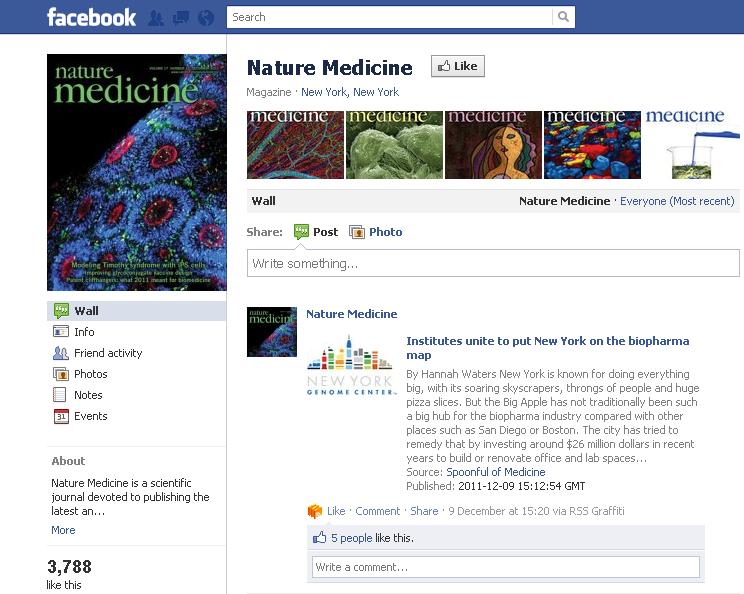
Screenshot of Nature Medicine’s Facebook Page

Many of you reading this blog are scientists, or have some sort of scientific inclination, so don’t be afraid to experiment with how you get your Spoonful of Medicine. Please note, however, that side effects may include an uncontrollable urge to discuss the forecasted market share of biologic drugs at your office holiday party or singing a song about DNA that you can’t get out of your head. Should either of these adverse reactions occur, please consult your doctor.

Welcome to the morbidostat: Researchers watch deadly drug resistance in action

The word ‘morbidostat’ sounds like a death-metric — and in a way it is.

The Morbidostat, photo courtesy of Len Rubenstein

Reporting online yesterday in Nature Genetics, researchers describe a new high-tech tool termed the morbidostat that can trace the evolution of drug resistance by continuously adjusting the conditions under which bacteria grow.

The device — a web of white tubes running in and out of an incubator filled with glass vials — contains hundreds of different strains of Escherichia coli, each fed by a bundle of tubes. One tube supplies growth medium and a second delivers varying amounts of deadly antibiotic. “The device is looking all the time at how well E. coli are growing, adjusting how much antibiotic it gives,” explains study author Roy Kishony, a biophysicist at Harvard Medical School in Boston.

The machine measures the optical density of the culture — which correlates with bacterial growth — to ensure that the microbes are not completely killed by the antibiotics, but, at the same time, still facing an adaptive challenge in the face of the drugs. “The morbidostat keeps the bacteria on the edge, just suffering, but not wiped out,” says Kishony.

Challenging conditions like these promote many adaptations in succession, which could help geneticists watch evolution in action. For instance, in Kishony’s proof-of-concept study, his team conducted a 25-day continuous experiment testing resistance to one of several antibiotics in 15 parallel bacterial cultures. The researchers sequenced the E. coli populations over the course of the experiment and found far more mutations than documented previously in standard chemostat experiments, thereby opening the door to further studies about how many of these hitherto unknown mutations are involved in drug resistance.

Researchers find a new way to take the Myc-key out of cancer

Myc mac, cancer whack. Researchers have discovered a new way to defeat one of the most sinister genes in cancer biology.  Reporting today in Science, a US team showed that hitting one of the molecular helpers of the Myc oncogene, rather than going directly after the elusive cancer target itself, offers a promising new therapeutic strategy for stopping aggressive tumors.

In its mutated form, Myc drives cells to frenzied, uncontrollable growth, leading to aggressive tumor formation. Cancer biologists have long searched for drugs that can silence the transcription factor encoded by Myc, but the cancer-causing protein has proven to be a slippery foe. “There is a striking lack of Myc-directed therapeutics despite 30 years of data pointing to Myc as a target for therapy,” says James Bradner, a medical oncologist at the Dana-Farber Cancer Institute in Boston who was not involved in the latest study.

Because Myc itself is so difficult to target, cancer researchers have begun to consider indirect tactics. Bradner last year developed a small molecule targeting the ‘bromodomain’ protein BRD4, which interacts alongside Myc. Widespread investigation of Bradner’s BRD4 inhibitor over the last ten months has shown it to be successful in halting Myc-dependent cancers in the blood.  However, bromodomain inhibitors do not show as much promise when applied to Myc-dependent cancers in solid organs. Meanwhile, other groups have taken a different tack, trying to identify Myc coactivator proteins.

Most recently, Stephen Elledge, a geneticist at the Harvard Medical School in Boston, and his former postdoc Thomas Westbrook, now at the Baylor College of Medicine in Houston, identified the SUMO-activating-enzyme 2 (SAE2) as a protein to which Myc is hopelessly addicted. Using an shRNA screen, they identified SAE2 and subsequently knocked the gene out in breast cancer cells, showing that Myc-dependent cancer cells also depend on SAE2.

“We found right off the bat that if you inhibit SAE2 is cancer cells that depend on Myc, the cells die,” Elledge explains. The researchers further investigated SAE2  by stratifying gene expression data from around 1,300 women with breast cancer, and showed the people with high Myc activity had a lower instances of metastatic cancer and death if they had naturally low SAE2 levels. (SAE2 levels didn’t matter for those with low Myc activity.)

“Inhibiting Myc coactivator proteins is a very fruitful path to take to attack cancers with high Myc activity,” says Bradner.

Although the researchers have not yet found a drug that can target SAE2, Elledge expects that wiping out SAE2 could cause tumor cells to fall flat on their faces, so to speak. “Everyone thinks cancer cells are super cells, but they’re really very sick cells, limping forward on crutches,” he says. “SAE2 is one of those crutches.”

NEWS FEATURE: Breaking the silence

Scientists had long assumed that any genetic mutation that does not alter a protein sequence should have no impact on human health. But recent research has shown that such synonymous DNA changes can trigger disease in a number of ways. Alla Katsnelson talks to scientists and biotech companies who are speaking up about ‘silent’ mutations.

nm1211-1536-I1.jpgIt all started with an expression problem. Michael Gottesman and his lab members at the US National Cancer Institute in Bethesda, Maryland were studying a membrane protein involved in drug metabolism called P-glycoprotein to understand why some people develop resistance to chemotherapy during cancer treatment. But when the scientists tried to express large quantities of the protein in bacterial cells, they hit a wall.

“It was a real mess,” Gottesman recalls. “We couldn’t do it.”

The genetic code is read in triplets called codons, 64 of them representing just 20 amino acids. That means there is more than one codon for each amino acid, and different organisms preferentially use certain codons to make translation faster. One standard trick for boosting the expression of human genes in other organisms is to swap around nucleotides to get the DNA triplets most often used by the host’s cellular machinery. But a colleague of Gottesman’s suggested a different tack: as proteins elongate, the translation process needs to slow down and speed up to achieve proper folding, and perhaps the distribution of frequent and rare codons might control that rhythm.

The idea got Gottesman thinking about a niggling problem. The gene that encodes P-glycoprotein, called multidrug resistance 1 (MDR1), has about 50 single nucleotide polymorphisms, a handful of which are located in the coding region but at a position where they don’t affect the protein’s amino acid sequence. One, for example, in exon 26 of this 209-kilobase-long gene switches an ATC codon to ATT, both of which encode the amino acid isoleucine. Scientists routinely assume that such ‘silent’ or ‘synonymous’ mutations don’t affect the protein’s function, but clinical data clearly showed that people carrying these mutations metabolize drugs differently. “We were trying to think of how it could be that these synonymous mutations caused these changes,” Gottesman says. Maybe, he thought, they were meddling with the rhythm, thereby changing the protein produced.

The researchers then expressed the ATT codon along with two other naturally occurring polymorphisms and saw that the expression levels of messenger RNA (mRNA) and protein remained the same, but the protein’s activity was altered. Just as Gottesman had hypothesized, the evidence pointed to a shape shift in the resultant P-glycoprotein, caused by altered timing of translation.

The findings, published online in Science in late 2006, weren’t the only report of this type of mutation at work. A paper published at the same time in the same journal reported that synonymous polymorphisms in a gene encoding a protein called catechol-O-methyltransferase, which modulates responsiveness to pain, affected the loops and turns that make up the structure of the gene’s corresponding mRNA, and, with it, the level of protein expression. The two studies were the first published examples of human genes in which naturally occurring mutations produced proteins with an unchanged amino acid sequence but clearly different functional effects on disease. And, in the five years since, the idea that such mutations can have dramatic and far-reaching effects is beginning to take off.

(Click here to continue reading.)

Q&A: A healthy chat with the Center for Global Development’s health policy leader

nm1211-1534-I1.jpgSince its launch in 2001, the Center for Global Development (CGD) has been instrumental in convening working groups and issuing reports that shape the agenda for a range of topics that affect global poverty and people of the developing world. At the helm of its global health effort is Amanda Glassman. As the daughter of US Foreign Service diplomats, Glassman was exposed to disparities in public health in developing countries from a very young age. So it was a no-brainer for Glassman that she would devote her career to tackling those inequalities. She has spent the last two decades at places like the US Agency for International Development, the Inter-American Development Bank and the Brookings Institution. Last year, she joined CGD as the director of its global health policy division.

One idea that the $10-million-a-year, Washington, DC–based think tank has championed with some success is what’s known as an advance market commitment (AMC), a financial instrument that incentivizes vaccine development for diseases primarily affecting low-income countries. It’s for this influence that the center, which is mainly funded by governments and philanthropic entities, was ranked the fifteenth most important US think tank by Foreign Policy magazine in 2008. In recognition of CGD’s ten-year anniversary last month, Elie Dolgin spoke to Glassman about how the think tank turns its words into actions.

(Click here to continue reading.)

Four-in-one HIV pill may be exception among combination drugs

By Hannah Waters

jetsons-peek-a-boo-prober.jpgThe 1960s cartoon The Jetsons envisioned a future where single pills provided the same nutrition, taste and satiation as food that required chewing. That time-saving tablet remains a pipe dream, but the drugmaker Gilead is trying to deliver a similarly inspired pill for HIV medicines. On 27 October, the California company submitted an application to the US Food and Drug Administration (FDA) for its four-in-one HIV pill, which, if approved, would contain more medicines than any pill currently on the US market. The so-called ‘Quad’ pill promises the same virus-controlling ability as the four drugs separately but should be easier to use for people with the infection.

The idea of combining multiple medicines is seen by some as an easy shortcut to reinvigorating old products. Drugmakers can often simply repackage what’s already on the market, and, because the individual components have already been approved, the hassle of large clinical trials is off the table. The FDA generally requires only simple bioequivalence tests to ensure that drug dosing is consistent with the individual medicines, and, at most, a small human trial to prove similar efficacy.

(Click here to continue reading.)