The 2010 Roche – Nature Medicine Translational Neuroscience Symposium

This past April, we were supposed to hold the 2010 Roche – Nature Medicine Translational Neuroscience Symposium “”https://www.nature.com/natureconferences/tns2010/index.html">Innovative Translational Approaches to Brain Disorders" in Buonas, Switzerland.

Unfortunately, we had to cancel the event because of the Eyjafjallajoekull volcano, the eruption of which made it impossible for many speakers and delegates to attend.

Last week, however, we got together at the Roche offices in Basel for a mini-symposium on the same topic, the goals of which were to reinforce our committment to this meeting series and to honor the recipients of the Roche – Nature Medicine Awards for Translational Neuroscience 2010, which we were supposed to present to the winners back in April.

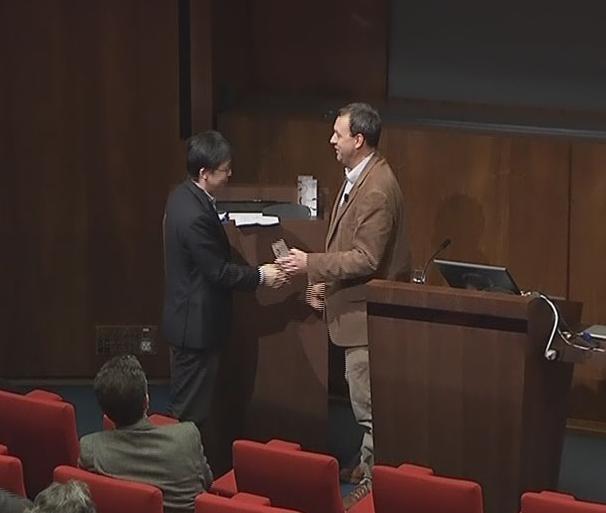
The Junior Award recognizes a researcher at the doctoral, post-doctoral level or who has been an independent investigator for a maximum of seven years. This year, the recipient was Dr. Feng Zhang, from Harvard University, in recognition of his pioneering work in the field of optogenetics — a powerful tool to study the function of neural circuits. He is shown in the picture receiving his Award from Eric Prinssen (from CNS Research at Roche and co-organizer of the meeting).

Feng.JPG

Continue reading

Nature Medicine wants you!

Fancy a career in publishing? This may very well be your chance: Nature Medicine has a vacancy for a News & Views/Reviews Editor.

This position involves identifying papers worthy of coverage in the News & Views section, commissioning and editing News & Views and Reviews, and writing research highlights. Click here for more information.

The harder they fall

Pretty busy week over at the JAMA offices. First came the report that one of its editors had called a whistleblower a “”https://blogs.wsj.com/health/2009/03/13/jama-editor-calls-critic-a-nobody-and-a-nothing/“>nobody and a nothing”, report that was accompanied by a pretty long series of comments from outraged readers.

Then came the journal’s decision to modify its policy on conflicts of interest. Crucially, the new policy states that “The person bringing the allegation will be specifically informed that he/she should not reveal this information to third parties or the media while the investigation is under way, will be informed about progress of the investigation, upon request, as appropriate, and will be notified when the investigation is completed.”

Ha! I’m sure that those New York Times and Wall Street Journal reporters will be delighted to hold on to their stories before breaking the news that a fresh conflict-of-interest case has come to light. I’m also sure that next time you discover an unreported conflict, you will first inform the journal and wait as long as needed for it to take remedial action, instead of bringing the conflict to the attention of the author’s institution or funding body — what authority do these other people have, anyway?

Not surprisingly, several media outlets have already put their own spin on the way they are reporting this policy change, and they don’t seem impressed by it.

No-one would deny that JAMA has been a leader in raising awareness about conflicts of interest, discussing them perhaps to the point of eliciting a certain desensitization — is anyone surprised when the journal expresses, yet again, the view that conflicts of interest should not be tolerated? Alas, despite its track record, the events of the past week undermine the credibility of the journal’s position on this front.

To my mind, the way in which this whole controversy has escalated is related, in no small measure, to the overzealous way in which JAMA has always decried conflicts of interest. In other words, the tough line that JAMA has taken against conflicts of interest makes the journal much more susceptible to embarrassment when one emerges. Or as the saying goes, the higher they climb, the harder they fall. The latest policy change would seem to be saying that it’s always possible to climb a little higher.

Photo by SparkyLeigh via Flickr

Get your house in order

This article in the newspaper El Mundo, which reports on a paper published in 2008 in the American Journal or Psychiatry, definitely caught my imagination.

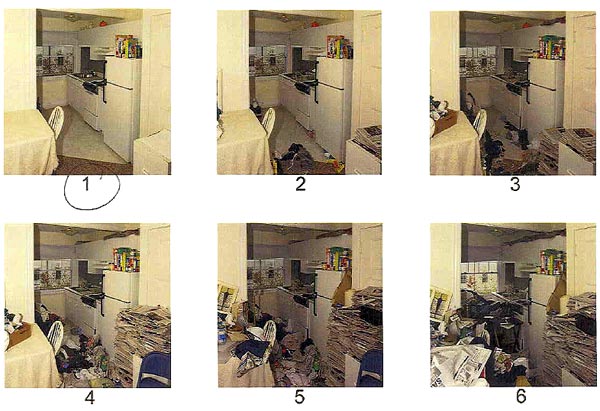
The authors of the paper in question, entitled “Compulsive hoarding: OCD symptom, distinct clinical syndrome, or both?” studied a group of people with the strong drive to gather stuff to the point of making their houses uninhabitable, as exemplified by the picture below, credited to Boston University and published in El Mundo.

1236010715_g_2

Does this look familiar to you?

The question they asked was whether compulsive hoarding is a disease in its own right or a symptom of obsessive-compulsive disorder (OCD). The conclusion was that it is a disease in and of itself, and that “These findings have implications for the classification of OCD and compulsive hoarding in the next edition of DSM”, perhaps getting its own entry in the legendary diagnostic manual.

I don’t mean to criticize these authors’ research, which, in fact, builds on an extensive literature on compulsive hoarding. I nevertheless find it somewhat disappointing that psychiatry carries on having this distinct fascination with taxonomy, which, regardless of its diagnostic use and validity, does very little to help us understand the underlying biology of disease and come up with new therapeutic approaches to treat the disorders of the mind.

In other words, is it realistic to think that we’ll help people who hoard compulsively (assuming that we buy into the idea that this is really a disease, something that I’m not sure everyone will subscribe to) by categorizing their condition separately from OCD? Is it really a big advance to say to a patient “You don’t have OCD; you only have compulsive hoarding”? It may provide comfort to some patients but, at the end of the day, I’d argue that it makes little difference.

What I’m trying to say is that, at a time in which the concept of endophenotypes is beginning to gain traction as a new way to parcel psychiatric diseases, it would be a shame if we don’t seize the opportunity to start thinking about endophenotypes as features of a mental disease that have a specific, experimentally approachable biological foundation, instead of coming up with endophenotypes that are as unapproachable as the original disease or, even worse, coming up with new diseases altogether.

As for the DSM-IV, I get the feeling that it has come to the end of its useful life. Work is underway on the DSM-V, publication of which is scheduled for May 2012. Although it would be nice to think that the new edition will represent a break from the past, pushing the current boundaries of the discipline, I’m not so optimistic about it. Instead, I strongly suspect that we will see a much larger, encyclopedic book, with extensive discussion about many more conditions and diagnoses, many of which would be quite esoteric — a lot of heat, but very little light. So, even though the field of psychiatry is in more dire need to get its house in order than some of those compulsive hoarders, I don’t see it happening between now and 2012.

We want your paper!

This story in The New York Times got me thinking about how similar high-end restaurants and scientific journals have come to be of late.

03note_span.600

Photo Illustration by Tony Cenicola/The New York Times

The article reports that expensive restaurants are no longer playing hard to get and have decided to offer great deals in order to attract costumers. I seem to recall that I read a similar story about British restaurants, but cannot find the link. In any case, the reason why I say that this looks a lot like what’s happening with scientific journals is that it seems that publications are doing everything they can to attract potential authors. For example, according to this blog entry at The Scientist, the Journal of Biology gives authors the option of asking the journal to publish their revised paper without asking the original reviewers to comment on the suitability of the revisions made in response to their critiques.

It seems that the editors of the journal will “carefully scrutinize revised manuscripts,” and if the authors addressed “substantive issues,” the journal will publish the article with an accompanying editorial in which any problems with the paper will be flagged. Sure, authors may be happy with this arrangement, but what about the reviewers? I don’t know about you but, if I were asked to review a paper for this journal, I’m not sure I would be very keen on lending a hand if I won’t have a chance to engage in a dialogue with the authors.

In another example, one of my colleagues at NPG was telling me that a relatively visible cell biology journal has this fast-track system in which members of the editorial board internally referee a paper in less than 2 weeks, only asking for essential controls. Not surprisingly, people in a hurry love this ‘rapid communication’ system. After all, why bother with further experiments to bolster an author’s conclusions?

Then there’s the journal that’s redifining what it means to publish an article — PLoS One. In this case, the only thing that matters is that the paper be technically sound to merit publication. It doesn’t matter if it’s an incremental advance or something not particularly new. As long as the experiments were properly done, the paper will be published. This is actually a very clever model, and I strongly suspect that it will turn on the heat on a lot of specialized journals that publish very thin slices of the scientific salami.

Think about it: if you’re a neuroscientist and your paper didn’t make it in Nature, Science, Nature Neuroscience and Neuron, how much further down the pecking order will you go before you stop caring? The Journal of Neuroscience is a very decent journal, and many of us would still be OK with a paper there. Some of us may go one notch below but, really, very quickly you will want to see the back of that study and just have it published anywhere. PLoS One is therefore an excellent option if your paper didn’t make it into one of the vanity journals, as it will be very visible and freely accessible. My prediction is that very soon this journal will start taking a lot of business from the more specialized journals in every discipline.

There is a problem for the vanity journals, though. If people can publish their work in a decent place like PLoS One, the reputation of which is steadily growing, they will be less inclined to do the hard experiment that will get them a high-profile paper in a vanity journal. This is, of course, bad news for my journal and other highly visible titles. But more worryingly, it might be a bit of a problem for the advancement of science in general, as it isn’t hard to imagine that many scientists may shift into a “complacent mode” in which they cease to ask their staff and themselves to go that extra mile that will turn their study into something really satisfactory. In other words, I can imagine them thinking “why should I do all those experiments that the Nature Medicine referees asked for when I could immediately go to PLoS One and have this part of the story out?”

Don’t get me wrong, though. I don’t mean to insult PLoS One, which strikes me as a legitimate option to disseminate your work. Here I’m trying to make a broader point about the effect that shifting publication standards can have on science at large. In this regard, it may be illustrative to recall the example of PNAS, a journal that, in its heyday, was regarded as a very high-profile publication. I’ve heard many people (including some members of the PNAS editorial board) complain about the fact that members of the National Academy of Science get to publish their work very quickly, after a not-so-stringent peer-review process. I think it’s fair to say that PNAS doesn’t carry any more the weight that it used to carry, but it’s also true that its club-style approach to accepting papers hasn’t been beneficial for the publishing community or for science in general.

The push for attracting papers seems to be so hard that it’s also beginning to affect the vanity journals. Cell, for example, just published this editorial in which Emilie Marcus states that “While some may think the work of an editor is mainly to reject papers, we have found that to achieve our vision for the journal the most important task for an editor is to be an enthusiastic advocate for science and to actively define what is interesting and important to publish—in essence to accept papers.” So, in other words, if you send your paper to Cell you will find an advocate of your science who will try to work with you in order to get the paper where it needs to get.

Emilie is right in that those papers that are potentially interesting but somewhat premature are to be nurtured, and this is something that editors must always try to do — at Nature Medicine we certainly do so. What she fails to mention is that those potentially great papers are so infrequent that, alas, the vanity journals will continue churning out many more rejection letters than letters of encouragement. Be that as it may, as a strategy to get people to submit to their journal, I’m sure the Cell editorial will be very effective.

Even our firm is beginning to experiment with new ways to make a rejection letter from a Nature-branded journal less painful. I don’t think I’m at liberty to discuss the plan in detail, but it is consistent with this global strategy of working in favor of the author, as opposed to asking them to do the hard experiment.

It’s difficult to predict where this whole trend is going to end but, just in case, I’m asking our art editor to print a couple of poster boards like those that top chefs Mario Batali, Sirio Maccioni and Jean-Georges Vongerichten are wearing in the picture above. My plan is to carry the boards with me at every scientific meeting I go to, hoping to attract one or two submissions per trip. You won’t believe our deals — I guarantee it!

Missing hope

The New York Times, which has the kind of web tools that some of us can only dream about, published a couple of days ago an interactive feature called “”https://www.nytimes.com/interactive/2009/01/15/us/politics/20090115_HOPE.html?partner=permalink&exprod=permalink">I hope so, too". The newspaper asked 200 people to state their greatest hopes for what Barack Obama might accomplish during his presidency, and then invited readers to choose the hopes they agree with.

I was surprised to see that science was nowhere to be found among the 29 “hopes” catalogued by the Times. The closest it got was “Education” and “Environment”. Is it the case that science is so far below the radar of the average person on the street to not be mentioned by 200 random people sufficiently enough to become category # 30? Fortunately, the Times also invited readers to comment in case their hope was not represented, and a fair number of people who took the time to add their two cents called for increased respect for and support of science.

Although the indications so far are that Obama will take science and technology seriously, it’s a bit disappointing that science didn’t rank particularly high in people’s priorities. Having said that, and considering the tough times that the US and the whole world are going through, many people could be excused for having other things in their minds, asthere was no shortage of things to hope for. That’s the only bonanza we can expect to see in the immediate future.

In memory of Henry

The legendary amnesiac HM — Henry Molaison — died last month at 82 years of age.

HM

Photo: The New York Times

Together with Leborgne (also known as “Tan”, Broca’s first aphasic patient) and Phineas Gage, HM is surely one of the three most fascinating cases in the history of neuroscience.

I’m sure that a lot has been written on what HM taught us about the organization of human memory – the existence of short and long-term forms, as well as the divide between declarative and procedural memories. I’m not inclined to repeat what others can say about HM with a lot more authority than I could. (Here, for example, is an audio from NPR that tells you everything you may want to know about him.) Instead, I prefer to write about that HM meant to me as a young guy wondering whether to pursue a scientific career and in what discipline.

Just like so many students decided they wanted to become scientists after reading “The Microbe Hunters” or “The Double Helix”, my personal epiphany came when I learned about HM’s inability to form new memories and the fact that he was, as it were, trapped in the present. To discover that there was a patient like him inspired me to believe that there was some logic to the workings of the brain, a logic that could be experimentally deciphered. I decided there and then that understanding this logic is what I wanted to do with my scientific career.

I grew older and began to know better, but my interest in memory and in HM in particular never disappeared. In fact, I always hoped I would have a chance to meet him in person. The closest I ever got was during my tenure at Nature Reviews Neuroscience, while editing this article by Suzanne Corkin on what was new with HM. As part of the article, she sent us the originals of these drawings made by the patient (read the article if you want to know what they mean):

When Eric Kandel, my PhD mentor, got the Nobel Prize, I remember a lab mate saying that it felt as if a distant relative had got the prize. To me, as delighted as I was for Eric, HM’s death evokes more strongly that feeling of familiarity; it really feels like the passing of a distant relative, one that now I can never hope to meet. May these few words serve as my personal tribute in memory of the man with no memory.

Reality check

At the risk of being guilty of a non-sequitur, they froze my salary for 2009. I will therefore write more on this blog than last year. Besides, it’s been a while since we heard about “Biophysical Semeiotics” and “Inherited Real Risk”, don’t you think?

To get things started, a little something that came in the mail the other day, after I rejected a submission:

——-Original Message——-

From:

Sent: Wednesday, December 31, 2008 7:26 AM

To: Medicine

Subject: Re: Decision

Dear Dr. Lopez,

thank you for the fast decision. I agree, we will find another journal for publishing our results.

After all, neither Temin´s reverse transcriptase nor the first PCR description of Mullis found acceptance by a nature journal.

I wish you more luck for your future decisions.

Kind regards

I don’t know if the author is right that those papers were rejectd by the Nature journals, but is it too much to ask for some modesty when talking about one’s own research? Or does the author really think that his/her submission will have the same impact as those studies? Only time will tell, but I’m sure you can bet where I’m putting my money.

Election 2008

Some of you may have already seen it, but I would encourage to have a look at the excellent special news section on the 2008 US election that my colleagues Roxanne Khamsi, Coco Ballantyne and Charlotte Schubert put together for our October issue. It’s great stuff and a perfect complement to the related special that Nature published several weeks ago.

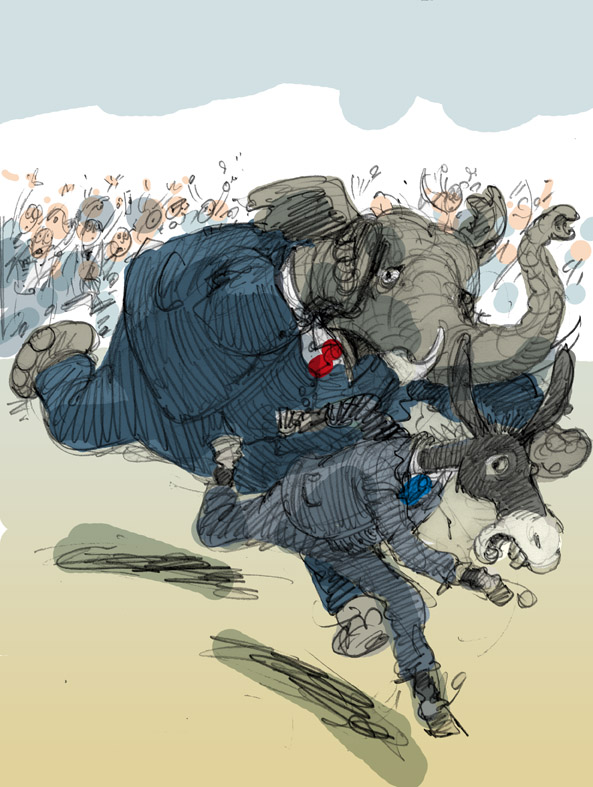
Also, thanks to those of you who have made positive remarks on the cover of the issue. For our readers beyond the US who may not care about US politics, the elephant and the donkey are the symbols of the Republican and the Democratic parties, respectively.

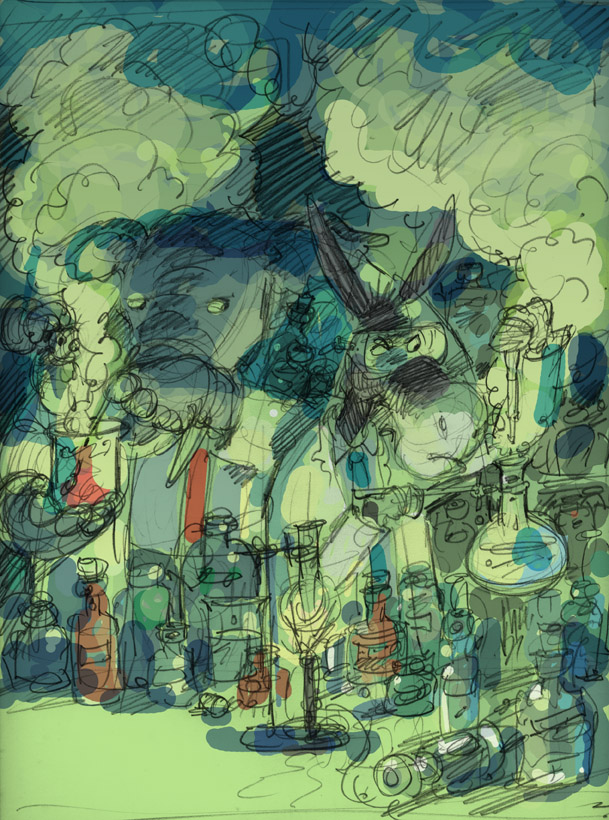
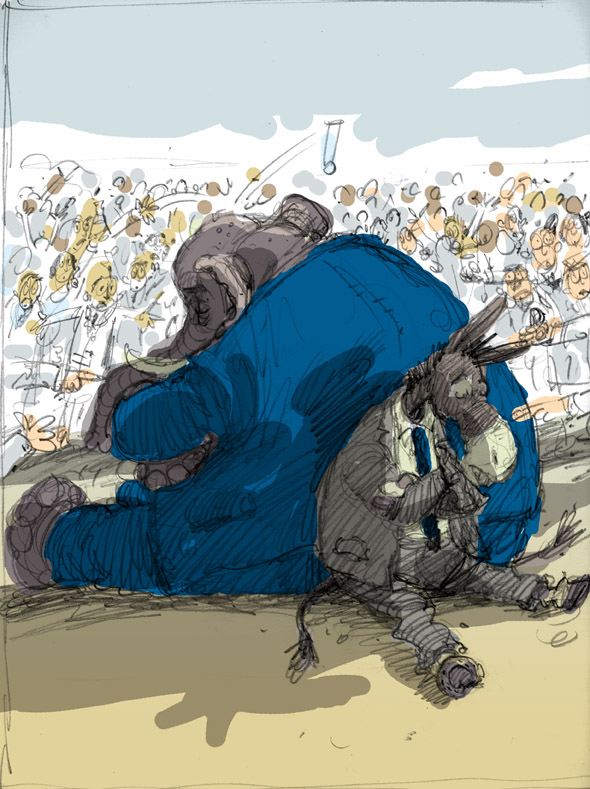
The cover was created by David Parkins, an excellent cartoonist who impressed me not only because of the quality of his work, but also because of his creativity and speed. To give you an idea, below are a couple of additional ideas we entertained for the cover. He mocked up this drafts incredibly quickly and, for those ideas we put forward to him, he was able to understand them immediately and put it down on paper. Enjoy!

fleeing.jpg

Republicans and Democrats running away from an angry mob of scientists.

formula.jpg

Republicans and Democrats searching the right formula to support science.

sleeping.jpg

Republicans and Democrats sleeping, oblivious to the scientists’ demands.