Non-sequitur of the day

From a press release I just got:


From: alyson

Sent: Monday, October 06, 2008 3:00 PM

To: Lopez, Juan Carlos

Subject: EVOLUTIONARY DIET BREAK THROUGH

The discovery of fire was a

brilliant moment for the caveman.

Now the creation of a supplement that

breaks through the body’s evolutionary propensity to

store fat could be the

next best thing since sliced bread.

Anyone who has been on a diet knows that it’s relatively easy to lose weight, but it always comes right back.

We are fighting the equivalent of an Evolutionary Mexican Standoff.

A new study shows that a proprietary combo of cayenne, amino acids, caffeine and green tea keeps the body’s metabolism humming along so diets actually work and stay working.

Metabolife’s Break Through is the long distance Olympian of diet supplements.


It almost makes me want to buy this thing to see if there are any more analogies on the label!

Gone to the dogs

I’ve been neglecting the blog too much recently. Too much work or too many parties, I’m not sure.

Anyway, the latest issue of Nature was enough to prompt me to post this entry. Have you looked at the cover? Nothing unusual, you may say, until you see the back cover. Have a look at this scan and see if it makes you wonder, as it made me, if science has gone to the dogs…

Download file

(N.B. Incidentally, this was not planned in any way. It’s just one of those coincidences that remind you that life is often stranger than fiction.)

The end of the middle class

Another long blogging hiatus. I can offer the same excuses as last time, plus a new one: I was told off after the last entry. Oh well! You live and learn, I guess.

This time, it’s this article in Science that captured my imagination. In it, James Evans analyzed a database of 34 million articles to show that, as more journal issues have gone online, the articles currently cited tend to be more recent, fewer, and come from fewer journals.

Evans argues that print journals forced scientists to do more browsing, perhaps stretching scientists to anchor findings more deeply into past advances. He also argues that, sure, searching online is a more efficient way of putting you in touch with the prevailing views in your field. The price we pay, though, is that such “narrowing of science and scholarship” (borrowing from Evans’ title) may accelerate consensus and impose limits on the range of ideas upon which we build scientific progress.

This is a fascinating contribution that, needless to say, I would find very difficult to formally evaluate. Yet, an intriguing question formed in my mind: is there a strict causal relationship between journals going online and this narrowing of scholarship, or are there other factors that explain that fewer, newer papers that come from fewer journals are being cited? In all fairness to Evans, he didn’t make any claims regarding a strict causal relationship, and he didn’t say that his observations fully accounted for the current citation pattern. Still, a provocative exercise is to think about other factors that may explain the trends he identified.

In terms of citing newer papers, I suspect that technical advances have a lot to do with that. For example, the advent of transgenic and knockout mice represented a turning point for biology. You can now obtain much more definitive answers about the function of a molecule if you have a knockout than before, when all you could hope for was having a more or less specific antagonist. It wouldn’t be surprising if advances of this sort have modified the citing behavior of a scientist writing a paper.

Regarding the citation of fewer papers, some studies have shown that many people tend not to read the references they cite, but simply copy them from other papers that have cited them—a behavior that one could refer to as “meta-referencing”. Also, I have anecdotal evidence of people who don’t cite anything that isn’t in PubMed. For example, when a referee asks an author to cite the classic papers from Dr. Smith from the 1950s, it’s not that uncommon to hear that they “couldn’t cite them because the abstract wasn’t in PubMed”.

So, the whole universe of citable papers does not extend beyond the 1970s, and many of us cite papers even though we haven’t read them, just because someone else did. And we haven’t even talked about the proliferation of review articles, in which you often find the authors citing other reviews on the same topic—a behavior one could refer to as “meta-reviewing”. No wonder few papers get the benefit of a citation.

The last point has to do with the observation that we now tend to cite papers from fewer journals. A first corollary of this fact is that the journals that publish the papers that garner those highly coveted citations will have the highest impact factors. A second corollary is that, if fewer journals have most of the citations, this would predict that we will see an ever increasing gap between the impact factors of the high-profile and the more specialized journals. In socioeconomic terms, we will see a widening gap between the wealthy and the poor at the expense of the middle class.

From where I sit, this prediction seems to be proving right. Back in the 1980s, when I started in research, publishing your work in any international journal truly represented the crystallization of a lot of work. So, even though you didn’t get your paper in Science or Nature, it didn’t matter so much because your small contribution, however humble, still counted for something to those working in the same field as you. These days, some journals in which I published my work are largely ignored by the community, which tends to think about them as “places in which you publish your work after everything else fails”. In fact, some people prefer to store the paper in the filing cabinet before publishing in some journals that have come to be too specialized for their taste.

As for the current middle class, the journals that aren’t regarded as high profile but are very solid publications that demand a lot from authors — those journals where you immediately send your paper after the “vanity” journals turned you down — are constantly trying to improve their image and position themselves in such a way that they are also perceived as high profile, quite often with great success. This is, of course, a very smart thing to be doing because, as the gap between rich and poor widens, you don’t want to be caught on the wrong side of the divide.

To end, I thought I’d paste Evans’ last paragraph, which also fed my imagination, triggering associations that I may share in a future post:

“The move to online science appears to represent one more step on the path initiated by the much earlier shift from the contextualized monograph, like Newton’s Principia or Darwin’s Origin of Species, to the modern research article. The Principia and Origin, each produced over the course of more than a decade, not only were engaged in current debates, but wove their propositions into conversation with astronomers, geometers, and naturalists from centuries past. As 21st-century scientists and scholars use online searching and hyperlinking to frame and publish their arguments more efficiently, they weave them into a more focused—and more narrow—past and present.”

newtondarwin.JPG

Photo of Newton @ Madame Tussauds by Colaco. Scan of Darwin portrait by cpurrin1.

Ignorance is bold

Hi.

I haven’t been blogging for quite a while now. A combination of factors got on the way: I’ve been traveling, I’ve been covering at the journal for some of my colleagues who have been traveling, Coco and Roxanne have been doing a great job blogging about much more interesting stuff than I had, and, to be perfectly honest, I lost a lot of the motivation I need in order to sit down in front of the computer and type.

But the reaction elicited by last Friday’s report about the PLoS journals published in Nature was of sufficient importance to help me muster the energy to say one or two things about the many writings that have appeared in relation to that piece.

First, having previously commented on open-access publishing in this forum, I explicitly want to distance my journal and myself from any pejorative descriptors that might have been applied to the science published by the PLoS journals. I’m not an advocate of open access, but the quality of what open-access journals publish has never been an issue I have cared to discuss in public.

Second, I want to commend my colleague Maxine Clarke for being one of our few senior members of staff to face the backlash elicited by the Nature report, exposing herself to more vitriol in the process. Bravo, Maxine!

Third, to say that the Nature Publishing Group decided to publish Declan Butler’s report to intentionally damage the reputation of the PLoS journals shows a profound degree of ignorance about how editorial decisions are made in our journals. The business side of our trade never has any input on the editorial decisions to run whichever piece we care to publish, and the editors take a lot of pride in this fact.

To say that Nature ran the story because our firm is afraid of the open-access publishing model (another reaction to the news piece that I’ve encountered far too frequently) is also absurd. It’s like saying that we are afraid of Science, Cell or any other of our competitors. Our firm is not afraid of competition; we respect our competitors and observe what they do, the same way that our rivals are surely familiar with our strengths and weaknesses.

Furthermore, although I’m not free to discuss figures, our business model continues to be very successful, thankyouverymuch. Last, our firm has always been proactive in taking part in the open-access debate, and our directors have always engaged in productive discussions with some of the most influential advocates of open access (e.g. the NIH). So, to say that we are afraid of the open-access movement is also a very ignorant comment to make.

Fourth, I take strong exception to the comment I’ve seen in several blogs regarding the qualifications of journal editors to do their job, referring to them as failed postdocs who couldn’t cut it in academia. The job of editor is not fundamentally different from any other profession, scientists included — it pays the rent and puts bread on the table. To argue that someone who decided to pursue a career in academia is, almost by definition, more successful than an editor is not only absurd, but extremely arrogant.

In fact, I’d argue that many more practicing scientists than editors are frustrated with their careers; I know many mediocre scientists, but couldn’t think of a single mediocre research editor, not only at the Nature Publishing Group, but also among my many colleagues from journals that also employ professional editors. At a personal level, I’m convinced that to have the opportunity to work surrounded by so many intellectually sharp and well informed colleagues as there are at our journals is a privilege that many people who stay in academia don’t ever get to experience.

These comments should not be construed as an attempt to defend Butler’s article. As I implied above, I prefer to distance myself from some of his comments. Instead, I’m simply trying to defend the integrity of my profession and the integrity of those of us in the publishing world who care about the advancement of science and are proud of what we do.

“La ignorancia es atrevida” goes a saying in Spanish that, roughly translated, means “Ignorance is bold”. Judging from some of the comments I’ve read in response to the Nature article, it seems that the anonymity cloak provided by the blogosphere is very conducive to this purposeless kind of boldness. And speaking of Spanish sayings, this recent cartoon by (in my opinion) Spain’s best cartoonist — Forges — that appeared in the newspaper El Pais perfectly summarizes this point.

forges.jpg

“The blogosphere is a blessing. Thanks to it, he doesn’t bray at home any more.”

“Congratulations!”

Mine is larger than yours

A dear friend of mine sent me a link to this page, which shows the “h indices” of what the author of the page refers to the “best Spanish scientists”. The page is a bit difficult to navigate if you don’t know Spanish, but it doesn’t matter; I’m sure that if you have the time and inclination, you will find a similar page in your language and for the nationality of your choice.

The reason for bringing it up has to do with the raison d’etre of the h index — to quantify an individual’s scientific research output. The h index was originally introduced by J. E. Hirsch, from UCSD, in this paper and, briefly, his proposal was that a scientist has an index of h if h of his/her papers have at least h citations each, and the rest of his/her papers have no more than h citations each. In his paper, Hirsch argues why this measure is preferable to other criteria, and ends up suggesting that “this index may provide a useful yardstick to compare different individuals competing for the same resource when an important evaluation criterion is scientific achievement, in an unbiased way”.

I don’t know how many people have bought into this index, but needless to say, as any of these metrics, it has limitations. For example, if you’re the technician of a lab that has a bunch of highly cited papers and you’re always including in the middle of a long list of authors, does your massive h index turn you into one of those “best scientists”?

In any case, its limitations notwithstanding, I thought I would share it in order to stimulate our unsatiable appetite for ways to measure the quality of what we publish. Ready to go check if yours is larger than your neighbor’s?

Image by Brett L.

No such thing as a free yogurt

You might have noted that the previous entry on this blog was written by Coco Ballantyne, who recently joined the journal as our News intern. I’m confident she will blog about far less frivolous things than the one I’m going to write about today, so please join me in giving her a warm welcome.

Now, check out this entry from The Wall Street Journal‘s Health Blog. In a nutshell, companies are beginning to restrict the freebies they give away at meetings, keeping them from doctors who work in specific parts of this country. For example, Lilly won’t give you a cup of frozen yogurt if you have prescribing authority in Minnesota or if you are a government employee in New York.

This priceless initiative, of course, finds its origins in the criticisms that pharma companies have received for giving doctors expensive gifts, which have been regarded as an attempt to bias the choice of drugs that physicians prescribe. As the pharma industry seems to want to comply with state regulations that limit the gifts that they can give to doctors in some places, it seems that companies are pulling all the stops (no matter how silly) to make sure they remain on the safe side. I’m sure that some pundits who are obsessed with transparency in biomedicine are celebrating this victory of what I call “CFI fundamentalism”.

Anyway, Minnesota docs, don’t worry. Our marketing department just created some very neat Rubik cube-like toys to advertise the different journals that NPG publishes on cancer. They may not be as tasty as that frozen yogurt but, if you come to come by our booth at a future meetings, you’ll be very welcome to take one of them home with you.

The jury’s (way) out

When it’s not a trip, my day job gets in the way of my posting something to Spoonful. This week we closed the June issue of Nature Medicine, and right now I’m at the airport, about to start another ‘tour’. So, while I wait for the PA system to herd us to the plane, I thought I would blog about my day as a juror.

For the second year running, a very dear friend of mine invited me to be part of the jury for an award that her organization gives to young scientists. And for the second year running, it turned out to be a fun day out.

The award recognizes young scientists in all disciplines. As a result, the jury (composed of nearly 40 people) was a very eclectic mix of basic scientists, engineers, physicists, matemathicians, you name it. There were even editors like me, whose only expertise lies on the inexact science of rejecting papers.

The discussion, which took the best part of the day to go over something like 40 finalists, was free-form. One of us would go over the candidate, and the rest would ask questions or bring up caveats about each of them, trying to understand the importance of their contributions.

I must confess that, halfway through the session, I started feeling sorry for those scholars who have to decide on, say, people’s grants.

In the case of our jury, we found it was pretty tricky to decide how much weight to give to the candidates’ letters of recommendation, to their number of papers and the journals in which they were published (someone referred to the high-profile journals as ‘vanity journals’, which struck a chord with me), to the number of citations, and to a plethora of factors that, one way or another, represent the blood, sweat and tears of a scientist.

Does a scientist who has three patents in the past five years, but only three papers, each of which had been cited just three times deserve more recognition than the scientist with five Nature papers and 1000 citations? Does a scientist who works in a hot field and has made nice contributions deserve more credit than another one who works in a less glamorous, lonelier field and has made equally profound contributions?

These questions aren’t always easy to answer, but my friend got it right because she quickly realized that there’s strength in numbers. So, if you have 40 judges from different fields and with different ways of evaluating science, chances are that the truly outstanding pieces of work will triumph over the rest. I’m therefore confident that our eclectic group made the right choices.

But returning to those grant evaluators, I was saying that I felt sorry for them because, if we managed to screw up and made a mistake yesterday, it won’t make much of a difference for the scientists who should have won and didn’t despite our best efforts. They’ll carry on and will still be great scientists. In the case of grant decisions, though, getting them wrong can lead to a lab’s shutdown, to fired postdocs and to truncated careers, which, alas, are becoming more and more common.

jury.jpg

Photo by JasonUnbound

Barking at the wrong tree

Time to return to the issue I brought up the other day regarding the open-access debate. Some people think that publishing firms rip people off by taking scientific information from the community and selling it back to the very providers of this information. This ignores, of course, that some journals such as the Nature titles, Science and the Cell Press stable add value to the content they publish by filtering scientific information in such a way that their imprimatur is (in most cases) guarantee of quality. Ironically, as these journals have professional editors, who are the public face of the titles, they tend to receive most of the negative feedback regarding our business model.

But, fine, let’s play along and ignore the fact that we at the Nature journals add value to what we publish. The purpose of this post is to illustrate that, even though we charge for our content, our publications are very cost-effective for our readers.

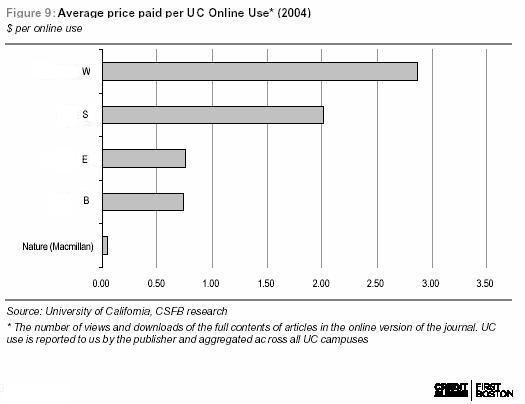
Take a look at this figure from an independent study by Credit Suisse/First Boston. It shows how much the University of California system (a very important user in terms of sheer volume) had to pay every time a member of their community used our journals online, and it compares this cost across different publishing companies.

costs-w.JPG

As you can see, whereas the cost of using our journals is approximately one nickel per use, other publisher’s products cost well over an order of magnitude more (almost two orders of magnitude in one case).

I’m sorry that I had to blank out the name of the other publishers; I didn’t feel comfortable fully disclosing them. In any case, I’m sure you suspect who they might be.

So, next time you think that the Nature journals rip you off, think about this graph. Do the Nature journals really deserve all the flak they receive, or do we actually give people their money’s worth?