Bangladesh eyes the generic pharma pie

By T V Padmabangladesh300.jpg

China and India, in 2001 and 2005, respectively, amended their patent laws to comply with the World Trade Organization’s Trade Related Intellectual Property Rights (TRIPS) agreement, which bans making generic copies of drugs still under patent protection. The move sparked concerns about the affordability of medicines in poor countries. But Bangladesh, categorized among the world’s least developed countries (LDCs) according to the UN, hopes to fill the void—at least for the next five years.

Under the TRIPS agreement, LDCs can make generic versions of patented drugs until 2016. Bangladesh already has an estimated 350 drug companies, from small domestics to large multinationals, which produce 97% of its domestic demand for medicines. However, to make these medicines for domestic use and export, Bangladesh imports 80% of the active pharmaceutical ingredients (APIs), the chemicals responsible for a drug’s action. “That is a weakness, as the imports do not make our pharma industry a fully integrated one,” Abdul Muktadir, secretary general of the Dhaka-based Bangladesh Association of Pharmaceutical Industries, told Nature Medicine.

(Click here to continue reading.)

Image: Masud Ananda, Flickr

Gloomy pharma forecast in Japan downgraded after quake

By Branwen Morgan

japan250.jpgJapan is the world’s second largest pharmaceutical market after the US on the basis of total revenue. But according to Business Monitor International (BMI), a London-based analyst firm, Japan’s overall pharmaceutical market is stagnating, and the devastating 9.0-magnitude earthquake that struck in March has introduced new uncertainties. In its initial review, published in early March, BMI stated that factors such as the government’s cuts to subsidies for prescription medicines and its pro-generics stance will conspire to lower annual growth rates going forward. Presently, pharmaceutical expenditure is 1.8% of the country’s gross domestic product and BMI predicted that through to 2015 the five-year compound annual growth rate will be 0.7%. However, soon after BMI published these gloomy estimates, they revised them down further. The 11 March earthquake and tsunami that devastated a large part of northeastern Japan led the firm to downgrade its pharmaceutical market forecast to take into account the impending economic slowdown.

“The majority of the report’s content is still applicable, but we have lowered our 2020 sales predictions by 1.5% (from $91.7 billion to $90.3 billion), which reflects a change in the country’s overall macroeconomics now that the full extent of the recent disaster is known,” says Jamie Davies, BMI analyst and report author. “To improve their overall outlook for growth, the country’s pharmaceutical companies need to look more to emerging markets, such as China.”

(Click here to continue reading.)

Image: VectorPortal

Russia pledges $4 billion for Pharma-2020 plan

By Gary Peach

putin300.jpgRussia’s biomedical industry is woefully underdeveloped, accounting for only 0.2% of the world market. But plans are afoot to change that. Speaking at the opening of a new birth center in Ryazan on 11 March, for example, Prime Minister Vladimir Putin stated that the government wants to boost Russia’s presence on the world biopharma stage to 3–5% in the next decade. And he emphasized that the country already possesses the necessary academic and research institutions to achieve that. “We need to come up with measures to stimulate demand for Russia-made biotechnological products and remove barriers that often prevent businesses from working,” he said.

To that end, Russian leaders announced in March that they have approved 120 billion rubles ($4 billion) for a strategic investment program aimed at developing the country’s massively import-dependent pharmaceutical and medical supplies industries.

Dubbed Pharma-2020, the program—which was adopted two years ago although financing was only approved by the government last month—will attempt to boost output of local medicines, in gross sales terms, from nearly 25% last year to 50% by 2020. In addition, the program calls for ensuring that 90% of vital medicines are domestically produced, retooling some 160 companies to good manufacturing practice standards, establishing ten research and development centers that will focus on creating innovative products and boosting exports to $100 million.

(Click here to continue reading.)

Image: Astapkovich Vladimir, Newscom

Experts emphasize need for speed in launch of Australian trials

By Branwen Morgan

australia.jpgSYDNEY — This past December, Oprah Winfrey took 300 of her audience members on a much-publicized trip to Australia to celebrate the twenty-fifth anniversary of her US talk show. But it’s going to take more than an Oprah endorsement or a catchy advertising campaign for the land Down Under to remain a preferred destination for the conduct of clinical trials.

As recently as 2005, the Economist Intelligence Unit conducted a benchmarking study that ranked Australia as the number one location for conducting clinical trials. It was placed ahead of countries such as the US, Japan and India on the basis of its high number of trial sites per capita, high percentage of on-time trial completions and low average trial costs.

(Click here to continue reading.)

Image: Ed Uthman, Flickr

Despite Canadian government woes, neuroscience should win out

By Hannah Hoag

braincanada_crop.jpgMONTREAL — When Canada’s Conservative government presented its 2011 budget in late March, the fiscal plan didn’t contain too many surprises for science funding. Like previous budgets, the proposal offered modest increases to the country’s national research agencies and replenished the coffers of Genome Canada, its genomics and proteomics outfit. But the budget also contained a flashy and unprecedented new move: a multimillion-dollar earmark for neuroscience research.

Under the Conservatives’ proposed scheme, the government would contribute up to C$100 million ($105 million) over several years to the Canada Brain Research Fund, a public-private partnership led by the Brain Canada Foundation in collaboration with the Canadian Association for Neuroscience and Neurological Health Charities Canada (NHCC). The government money would then be matched by funds raised from private sources by Brain Canada to support large, multidisciplinary neuroscience grants, postdoctoral fellowships and training programs.

(Click here to continue reading.)

Companies ponder how truly ‘personal’ medicines can get

By Monya Baker

personalized.jpgCancer drugs such as Herceptin are known as ‘personalized medicines’ because they are prescribed for subgroups of patients who share specific genetic traits. But truly individualized therapies are represented by treatments such as Provenge, which consists of patients’ own cells that have been extracted, exposed to an antigen that trains them to go after prostate cancer and re-infused.

The latter category is a tougher nut to crack, yet, ever since the US Food and Drug Administration (FDA) approved Provenge a year ago, cell-based personalized medicine has continued to garner interest. A course of three infusions of the treatment costs $93,000, but demand is still high. Earlier this year, Dendreon, the Seattle-based company that makes Provenge, announced it had received FDA approval to expand the number of production facilities for the product from 12 to 48.

Optimists are quick to cite Provenge as the crest of a wave of new therapies. “It has huge implications,” says Ronald Levy, a co-founder of Idec Pharmaceuticals (which merged to form Biogen Idec in 2003). “There may be 50 other therapies who hope to follow in the Provenge example.”

Although Levy, who is now at the Stanford University School of Medicine in California, is buoyant about the future of personalized cell-based therapies, he learned the hard way that some forms of personalized medicine prove too cumbersome to scale up. In the 1980s, he began creating antibodies designed for individual patients with lymphoma. Levy and his colleagues would identify telltale receptors on the wayward lymphocytes for each patient and then produce personalized antibodies designed to attack only his or her cancerous cells. Some 50 patients were treated with antibodies made this way, says Levy. “It worked most of the time, but it became economically unfeasible.” So he and his Idec colleagues instead developed the blockbuster rituximab, an antibody that targets a protein found on all B cells, allowing many patients with lymphoma to receive the same drug.

Bill Rastetter, a former chief executive at Idec and now a partner at Venrock, a venture-capital firm in Palo Alto, California, says efficacy as well as economics led him to decide against making individualized antibodies. Idec’s projected selling price for the personalized antibody approach was $50,000 per course of therapy, with about one in five patients showing remissions longer than those projected from chemotherapy alone. In contrast, about six out of ten patients benefitted from rituximab, he says, at a cost of about $10,000 per treatment course. (Levy notes that the approaches were never tested side by side, so efficacy is hard to compare.)

(Click here to continue reading.)

Image: Jim Dowdalls/Photo Researchers, Inc.

NIH faces marching orders on orphan drug shortage

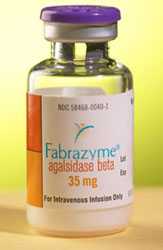
fabcrop.jpgBy Elie Dolgin

Ever since a virus contaminated Genzyme’s production plant in Allston, Massachusetts close to two years ago, people with Fabry’s disease have faced severe shortages of the medicine they need, Fabrazyme (see editorial on page 515). In August 2010, three people with Fabry’s petitioned the US National Institutes of Health (NIH) to step in and demand that Genzyme allow other companies to make the enzyme replacement therapy on the basis of the government’s so-called ‘march-in’ rights. The provision of the Bayh-Dole Act allows funding agencies to override exclusivity rights to intellectual property arising from government-funded research when people’s lives are at risk.

The NIH denied the request late last year. But, given Genzyme’s continuous production delays—the company now says it won’t be manufacturing Fabrazyme again until closer to the end of the year—on 5 April the petitioners appealed the original decision.

Such requests have historically failed. But this time could be different.

(Click here to continue reading.)

EDITORIAL: March on, not in

The production setbacks for Genzyme’s rare-disease drug Fabrazyme are tragic for the people who need the medicine. But a petition to break the company’s patent exclusivity could do far more harm than good.

On 23 March, Genzyme announced that yet another batch of its Fabrazyme drug, an enzyme replacement therapy used to treat Fabry’s disease, had failed to meet industry standards for manufacturing procedures. For Genzyme, it was just the latest in a long string of production setbacks since the Cambridge, Massachusetts–based biotech firm discovered a virus contaminating its manufacturing plant two years ago. For Genzyme investors, it could mean less money under the Sanofi-aventis buyout plan if the company fails to meet specified production levels in time. And for Fabry’s disease sufferers—many of whom are already taking only a fraction of their usual drug regimen while supplies are low—the delay could trigger more rationing and induce more suffering.

(Click here to continue reading.)

Jackson Laboratory’s foray into Florida faces murky future

By Christopher Mims

JacksonLogo300.jpgLately, it seems as if the Bar Harbor, Maine–based Jackson Laboratory, famous for its research on mammalian genetics, cannot catch a break in its efforts to build a satellite research facility in Florida. Since 2003, the state has heavily recruited biomedical institutions including Scripps, Max Planck, Torrey Pines, Sanford-Burnham and the Vaccine and Gene Therapy Institute (Nat. Med. 16, 1066–1069, 2010). But its attempts to engage Jackson Labs have been fraught with delays and setbacks.

As recently as the spring of 2010, Jackson Labs was in talks to locate its new branch in Naples, Florida. However, according to Tammie Nemecek, president of the Economic Development Council of Collier County, which includes Naples, that effort fell through when the state failed to fully finance its innovation fund, which would have provided Jackson Labs with $100 million to construct its facility, for two years in a row. Nemecek says that under then-governor Charlie Crist, “you didn’t have that leadership at state level where you got the strategy and funding to do it.”

(Click here to continue reading.)