
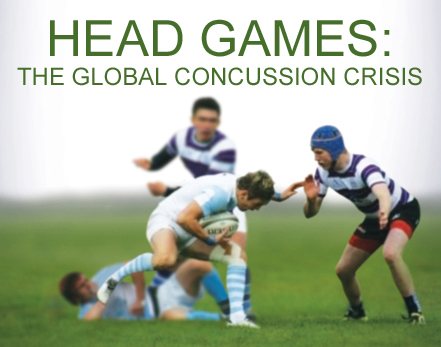
 Although it wasn’t a contender for last night’s Academy Awards, there’s a powerful new film out this week that you may want to see. It’s the sports documentary, Head Games: The Global Concussion Crisis, and it provides a human face to the seemingly endless stream of high-profile reports linking repetitive head trauma to degenerative brain disease.
Early in the film, we meet Christopher Nowinski, who confesses that he once “loved the violence” of football. “It’s the closest thing to being a warrior without actually having to go to war,” says Nowinski, a former Harvard football defensive lineman turned pro-wrestler. But not long after that, we see him lying on a cold concrete floor, clutching his head after what would turn out to be a career-ending concussion he sustained during a wrestling match in 2003.
As Nowinski continued to experience headaches, memory problems and sleepwalking for the next year, he decided to see Boston University School of Medicine concussion expert Robert Cantu, who asked Nowinski how often he saw stars or felt woozy after being hit in the wrestling ring or on the football field. “All the time,” Nowinski recalls sheepishly, dumbfounded that he had likely been experiencing regular concussions but had never before given much thought to the potential long-term consequences of such injuries.
That experience led Nowinski on a crusade to better understand his condition, and in 2006 he published the book, “Head Games: Football’s Concussion Crisis,” which inspired the documentary from director Steve James (who also gave us the 1994 Oscar-nominated documentary, Hoop Dreams). But whereas Nowinski’s book largely focused on the brain hazards associated with professional and amateur football, the new film makes painfully clear that all athletes who engage in contact sports—be it hockey, rugby, soccer or any of a variety of games—are potentially at risk.