
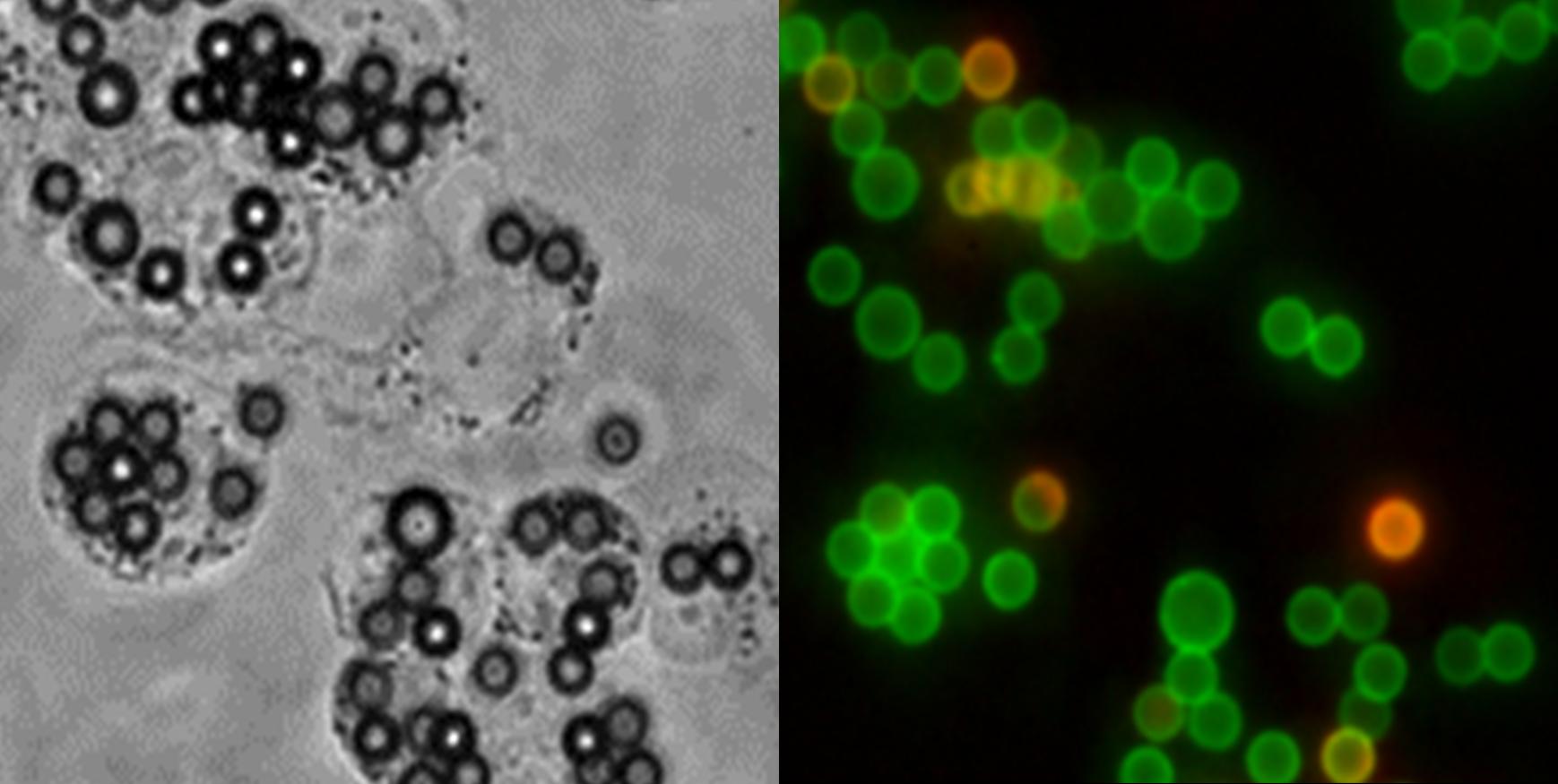
Protein-bound nanoparticle beads are ingested by macrophages, as seen in the phase contrast (left) and fluorescent microscopy (right) images. Beads in green are ingested, whereas red-yellow beads are still outside.{credit}Richard Tsai, University of Pennsylvania. {/credit}
The body’s first line of defense, known as the innate immune system, protects against foreign invaders, including tiny microbes, bacteria or viruses. Yet it also poses a major challenge for therapeutic applications that rely on microscopic drug-delivering vehicles, or nanoparticles. These nanoparticles are in the same size range as many pathogens and are quickly detected and destroyed by macrophages, the innate immune system’s sentinel cells.
Macrophages rely on proteins in blood serum that stick to foreign objects in the bloodstream; these biological ‘red flags’ attract macrophages to engulf the intruders. In the past, scientists working on nanoparticles have attempted to circumvent this process by, for example, masking the engineered particles with a compound called polyethylene glycol, or PEG, to create a “stealth” coat that blocks these blood proteins from sticking to the nanoparticle surface.
A new approach exploits an Achilles’ heel of the innate immune system. Despite their veracious appetite, macrophages are discriminate consumers because they recognize a specific “don’t eat me” signal on the surface of our own cells, represented by a protein called ‘cluster of differentiation 47’, or CD47. On the basis of this insight, Dennis Discher, a biochemist at the University of Pennsylvania School of Engineering and Applied Science in Philadelphia, and his team devised a new way to get these nanoparticles past the body’s immune defenses. The scientists designed a short peptide sequence derived from CD47 and attached it to nanoparticles to fool macrophages into accepting them as ‘self’ rather than foreign. The details of the technique appear in today’s issue of Science.
“It opens the door for better therapeutic targeting because you suppress clearance by macrophages first and foremost,” says Discher.