The harder they fall

Pretty busy week over at the JAMA offices. First came the report that one of its editors had called a whistleblower a “”https://blogs.wsj.com/health/2009/03/13/jama-editor-calls-critic-a-nobody-and-a-nothing/“>nobody and a nothing”, report that was accompanied by a pretty long series of comments from outraged readers.

Then came the journal’s decision to modify its policy on conflicts of interest. Crucially, the new policy states that “The person bringing the allegation will be specifically informed that he/she should not reveal this information to third parties or the media while the investigation is under way, will be informed about progress of the investigation, upon request, as appropriate, and will be notified when the investigation is completed.”

Ha! I’m sure that those New York Times and Wall Street Journal reporters will be delighted to hold on to their stories before breaking the news that a fresh conflict-of-interest case has come to light. I’m also sure that next time you discover an unreported conflict, you will first inform the journal and wait as long as needed for it to take remedial action, instead of bringing the conflict to the attention of the author’s institution or funding body — what authority do these other people have, anyway?

Not surprisingly, several media outlets have already put their own spin on the way they are reporting this policy change, and they don’t seem impressed by it.

No-one would deny that JAMA has been a leader in raising awareness about conflicts of interest, discussing them perhaps to the point of eliciting a certain desensitization — is anyone surprised when the journal expresses, yet again, the view that conflicts of interest should not be tolerated? Alas, despite its track record, the events of the past week undermine the credibility of the journal’s position on this front.

To my mind, the way in which this whole controversy has escalated is related, in no small measure, to the overzealous way in which JAMA has always decried conflicts of interest. In other words, the tough line that JAMA has taken against conflicts of interest makes the journal much more susceptible to embarrassment when one emerges. Or as the saying goes, the higher they climb, the harder they fall. The latest policy change would seem to be saying that it’s always possible to climb a little higher.

Photo by SparkyLeigh via Flickr

We want your paper!

This story in The New York Times got me thinking about how similar high-end restaurants and scientific journals have come to be of late.

03note_span.600

Photo Illustration by Tony Cenicola/The New York Times

The article reports that expensive restaurants are no longer playing hard to get and have decided to offer great deals in order to attract costumers. I seem to recall that I read a similar story about British restaurants, but cannot find the link. In any case, the reason why I say that this looks a lot like what’s happening with scientific journals is that it seems that publications are doing everything they can to attract potential authors. For example, according to this blog entry at The Scientist, the Journal of Biology gives authors the option of asking the journal to publish their revised paper without asking the original reviewers to comment on the suitability of the revisions made in response to their critiques.

It seems that the editors of the journal will “carefully scrutinize revised manuscripts,” and if the authors addressed “substantive issues,” the journal will publish the article with an accompanying editorial in which any problems with the paper will be flagged. Sure, authors may be happy with this arrangement, but what about the reviewers? I don’t know about you but, if I were asked to review a paper for this journal, I’m not sure I would be very keen on lending a hand if I won’t have a chance to engage in a dialogue with the authors.

In another example, one of my colleagues at NPG was telling me that a relatively visible cell biology journal has this fast-track system in which members of the editorial board internally referee a paper in less than 2 weeks, only asking for essential controls. Not surprisingly, people in a hurry love this ‘rapid communication’ system. After all, why bother with further experiments to bolster an author’s conclusions?

Then there’s the journal that’s redifining what it means to publish an article — PLoS One. In this case, the only thing that matters is that the paper be technically sound to merit publication. It doesn’t matter if it’s an incremental advance or something not particularly new. As long as the experiments were properly done, the paper will be published. This is actually a very clever model, and I strongly suspect that it will turn on the heat on a lot of specialized journals that publish very thin slices of the scientific salami.

Think about it: if you’re a neuroscientist and your paper didn’t make it in Nature, Science, Nature Neuroscience and Neuron, how much further down the pecking order will you go before you stop caring? The Journal of Neuroscience is a very decent journal, and many of us would still be OK with a paper there. Some of us may go one notch below but, really, very quickly you will want to see the back of that study and just have it published anywhere. PLoS One is therefore an excellent option if your paper didn’t make it into one of the vanity journals, as it will be very visible and freely accessible. My prediction is that very soon this journal will start taking a lot of business from the more specialized journals in every discipline.

There is a problem for the vanity journals, though. If people can publish their work in a decent place like PLoS One, the reputation of which is steadily growing, they will be less inclined to do the hard experiment that will get them a high-profile paper in a vanity journal. This is, of course, bad news for my journal and other highly visible titles. But more worryingly, it might be a bit of a problem for the advancement of science in general, as it isn’t hard to imagine that many scientists may shift into a “complacent mode” in which they cease to ask their staff and themselves to go that extra mile that will turn their study into something really satisfactory. In other words, I can imagine them thinking “why should I do all those experiments that the Nature Medicine referees asked for when I could immediately go to PLoS One and have this part of the story out?”

Don’t get me wrong, though. I don’t mean to insult PLoS One, which strikes me as a legitimate option to disseminate your work. Here I’m trying to make a broader point about the effect that shifting publication standards can have on science at large. In this regard, it may be illustrative to recall the example of PNAS, a journal that, in its heyday, was regarded as a very high-profile publication. I’ve heard many people (including some members of the PNAS editorial board) complain about the fact that members of the National Academy of Science get to publish their work very quickly, after a not-so-stringent peer-review process. I think it’s fair to say that PNAS doesn’t carry any more the weight that it used to carry, but it’s also true that its club-style approach to accepting papers hasn’t been beneficial for the publishing community or for science in general.

The push for attracting papers seems to be so hard that it’s also beginning to affect the vanity journals. Cell, for example, just published this editorial in which Emilie Marcus states that “While some may think the work of an editor is mainly to reject papers, we have found that to achieve our vision for the journal the most important task for an editor is to be an enthusiastic advocate for science and to actively define what is interesting and important to publish—in essence to accept papers.” So, in other words, if you send your paper to Cell you will find an advocate of your science who will try to work with you in order to get the paper where it needs to get.

Emilie is right in that those papers that are potentially interesting but somewhat premature are to be nurtured, and this is something that editors must always try to do — at Nature Medicine we certainly do so. What she fails to mention is that those potentially great papers are so infrequent that, alas, the vanity journals will continue churning out many more rejection letters than letters of encouragement. Be that as it may, as a strategy to get people to submit to their journal, I’m sure the Cell editorial will be very effective.

Even our firm is beginning to experiment with new ways to make a rejection letter from a Nature-branded journal less painful. I don’t think I’m at liberty to discuss the plan in detail, but it is consistent with this global strategy of working in favor of the author, as opposed to asking them to do the hard experiment.

It’s difficult to predict where this whole trend is going to end but, just in case, I’m asking our art editor to print a couple of poster boards like those that top chefs Mario Batali, Sirio Maccioni and Jean-Georges Vongerichten are wearing in the picture above. My plan is to carry the boards with me at every scientific meeting I go to, hoping to attract one or two submissions per trip. You won’t believe our deals — I guarantee it!

The end of the middle class

Another long blogging hiatus. I can offer the same excuses as last time, plus a new one: I was told off after the last entry. Oh well! You live and learn, I guess.

This time, it’s this article in Science that captured my imagination. In it, James Evans analyzed a database of 34 million articles to show that, as more journal issues have gone online, the articles currently cited tend to be more recent, fewer, and come from fewer journals.

Evans argues that print journals forced scientists to do more browsing, perhaps stretching scientists to anchor findings more deeply into past advances. He also argues that, sure, searching online is a more efficient way of putting you in touch with the prevailing views in your field. The price we pay, though, is that such “narrowing of science and scholarship” (borrowing from Evans’ title) may accelerate consensus and impose limits on the range of ideas upon which we build scientific progress.

This is a fascinating contribution that, needless to say, I would find very difficult to formally evaluate. Yet, an intriguing question formed in my mind: is there a strict causal relationship between journals going online and this narrowing of scholarship, or are there other factors that explain that fewer, newer papers that come from fewer journals are being cited? In all fairness to Evans, he didn’t make any claims regarding a strict causal relationship, and he didn’t say that his observations fully accounted for the current citation pattern. Still, a provocative exercise is to think about other factors that may explain the trends he identified.

In terms of citing newer papers, I suspect that technical advances have a lot to do with that. For example, the advent of transgenic and knockout mice represented a turning point for biology. You can now obtain much more definitive answers about the function of a molecule if you have a knockout than before, when all you could hope for was having a more or less specific antagonist. It wouldn’t be surprising if advances of this sort have modified the citing behavior of a scientist writing a paper.

Regarding the citation of fewer papers, some studies have shown that many people tend not to read the references they cite, but simply copy them from other papers that have cited them—a behavior that one could refer to as “meta-referencing”. Also, I have anecdotal evidence of people who don’t cite anything that isn’t in PubMed. For example, when a referee asks an author to cite the classic papers from Dr. Smith from the 1950s, it’s not that uncommon to hear that they “couldn’t cite them because the abstract wasn’t in PubMed”.

So, the whole universe of citable papers does not extend beyond the 1970s, and many of us cite papers even though we haven’t read them, just because someone else did. And we haven’t even talked about the proliferation of review articles, in which you often find the authors citing other reviews on the same topic—a behavior one could refer to as “meta-reviewing”. No wonder few papers get the benefit of a citation.

The last point has to do with the observation that we now tend to cite papers from fewer journals. A first corollary of this fact is that the journals that publish the papers that garner those highly coveted citations will have the highest impact factors. A second corollary is that, if fewer journals have most of the citations, this would predict that we will see an ever increasing gap between the impact factors of the high-profile and the more specialized journals. In socioeconomic terms, we will see a widening gap between the wealthy and the poor at the expense of the middle class.

From where I sit, this prediction seems to be proving right. Back in the 1980s, when I started in research, publishing your work in any international journal truly represented the crystallization of a lot of work. So, even though you didn’t get your paper in Science or Nature, it didn’t matter so much because your small contribution, however humble, still counted for something to those working in the same field as you. These days, some journals in which I published my work are largely ignored by the community, which tends to think about them as “places in which you publish your work after everything else fails”. In fact, some people prefer to store the paper in the filing cabinet before publishing in some journals that have come to be too specialized for their taste.

As for the current middle class, the journals that aren’t regarded as high profile but are very solid publications that demand a lot from authors — those journals where you immediately send your paper after the “vanity” journals turned you down — are constantly trying to improve their image and position themselves in such a way that they are also perceived as high profile, quite often with great success. This is, of course, a very smart thing to be doing because, as the gap between rich and poor widens, you don’t want to be caught on the wrong side of the divide.

To end, I thought I’d paste Evans’ last paragraph, which also fed my imagination, triggering associations that I may share in a future post:

The move to online science appears to represent one more step on the path initiated by the much earlier shift from the contextualized monograph, like Newton’s Principia or Darwin’s Origin of Species, to the modern research article. The Principia and Origin, each produced over the course of more than a decade, not only were engaged in current debates, but wove their propositions into conversation with astronomers, geometers, and naturalists from centuries past. As 21st-century scientists and scholars use online searching and hyperlinking to frame and publish their arguments more efficiently, they weave them into a more focused—and more narrow—past and present.

newtondarwin.JPG

Photo of Newton @ Madame Tussauds by Colaco. Scan of Darwin portrait by cpurrin1.

Ignorance is bold

Hi.

I haven’t been blogging for quite a while now. A combination of factors got on the way: I’ve been traveling, I’ve been covering at the journal for some of my colleagues who have been traveling, Coco and Roxanne have been doing a great job blogging about much more interesting stuff than I had, and, to be perfectly honest, I lost a lot of the motivation I need in order to sit down in front of the computer and type.

But the reaction elicited by last Friday’s report about the PLoS journals published in Nature was of sufficient importance to help me muster the energy to say one or two things about the many writings that have appeared in relation to that piece.

First, having previously commented on open-access publishing in this forum, I explicitly want to distance my journal and myself from any pejorative descriptors that might have been applied to the science published by the PLoS journals. I’m not an advocate of open access, but the quality of what open-access journals publish has never been an issue I have cared to discuss in public.

Second, I want to commend my colleague Maxine Clarke for being one of our few senior members of staff to face the backlash elicited by the Nature report, exposing herself to more vitriol in the process. Bravo, Maxine!

Third, to say that the Nature Publishing Group decided to publish Declan Butler’s report to intentionally damage the reputation of the PLoS journals shows a profound degree of ignorance about how editorial decisions are made in our journals. The business side of our trade never has any input on the editorial decisions to run whichever piece we care to publish, and the editors take a lot of pride in this fact.

To say that Nature ran the story because our firm is afraid of the open-access publishing model (another reaction to the news piece that I’ve encountered far too frequently) is also absurd. It’s like saying that we are afraid of Science, Cell or any other of our competitors. Our firm is not afraid of competition; we respect our competitors and observe what they do, the same way that our rivals are surely familiar with our strengths and weaknesses.

Furthermore, although I’m not free to discuss figures, our business model continues to be very successful, thankyouverymuch. Last, our firm has always been proactive in taking part in the open-access debate, and our directors have always engaged in productive discussions with some of the most influential advocates of open access (e.g. the NIH). So, to say that we are afraid of the open-access movement is also a very ignorant comment to make.

Fourth, I take strong exception to the comment I’ve seen in several blogs regarding the qualifications of journal editors to do their job, referring to them as failed postdocs who couldn’t cut it in academia. The job of editor is not fundamentally different from any other profession, scientists included — it pays the rent and puts bread on the table. To argue that someone who decided to pursue a career in academia is, almost by definition, more successful than an editor is not only absurd, but extremely arrogant.

In fact, I’d argue that many more practicing scientists than editors are frustrated with their careers; I know many mediocre scientists, but couldn’t think of a single mediocre research editor, not only at the Nature Publishing Group, but also among my many colleagues from journals that also employ professional editors. At a personal level, I’m convinced that to have the opportunity to work surrounded by so many intellectually sharp and well informed colleagues as there are at our journals is a privilege that many people who stay in academia don’t ever get to experience.

These comments should not be construed as an attempt to defend Butler’s article. As I implied above, I prefer to distance myself from some of his comments. Instead, I’m simply trying to defend the integrity of my profession and the integrity of those of us in the publishing world who care about the advancement of science and are proud of what we do.

La ignorancia es atrevida” goes a saying in Spanish that, roughly translated, means “Ignorance is bold”. Judging from some of the comments I’ve read in response to the Nature article, it seems that the anonymity cloak provided by the blogosphere is very conducive to this purposeless kind of boldness. And speaking of Spanish sayings, this recent cartoon by (in my opinion) Spain’s best cartoonist — Forges — that appeared in the newspaper El Pais perfectly summarizes this point.

forges.jpg

“The blogosphere is a blessing. Thanks to it, he doesn’t bray at home any more.”

“Congratulations!”

Mine is larger than yours

A dear friend of mine sent me a link to this page, which shows the “h indices” of what the author of the page refers to the “best Spanish scientists”. The page is a bit difficult to navigate if you don’t know Spanish, but it doesn’t matter; I’m sure that if you have the time and inclination, you will find a similar page in your language and for the nationality of your choice.

The reason for bringing it up has to do with the raison d’etre of the h index — to quantify an individual’s scientific research output. The h index was originally introduced by J. E. Hirsch, from UCSD, in this paper and, briefly, his proposal was that a scientist has an index of h if h of his/her papers have at least h citations each, and the rest of his/her papers have no more than h citations each. In his paper, Hirsch argues why this measure is preferable to other criteria, and ends up suggesting that “this index may provide a useful yardstick to compare different individuals competing for the same resource when an important evaluation criterion is scientific achievement, in an unbiased way”.

I don’t know how many people have bought into this index, but needless to say, as any of these metrics, it has limitations. For example, if you’re the technician of a lab that has a bunch of highly cited papers and you’re always including in the middle of a long list of authors, does your massive h index turn you into one of those “best scientists”?

In any case, its limitations notwithstanding, I thought I would share it in order to stimulate our unsatiable appetite for ways to measure the quality of what we publish. Ready to go check if yours is larger than your neighbor’s?

Image by Brett L.

Barking at the wrong tree

Time to return to the issue I brought up the other day regarding the open-access debate. Some people think that publishing firms rip people off by taking scientific information from the community and selling it back to the very providers of this information. This ignores, of course, that some journals such as the Nature titles, Science and the Cell Press stable add value to the content they publish by filtering scientific information in such a way that their imprimatur is (in most cases) guarantee of quality. Ironically, as these journals have professional editors, who are the public face of the titles, they tend to receive most of the negative feedback regarding our business model.

But, fine, let’s play along and ignore the fact that we at the Nature journals add value to what we publish. The purpose of this post is to illustrate that, even though we charge for our content, our publications are very cost-effective for our readers.

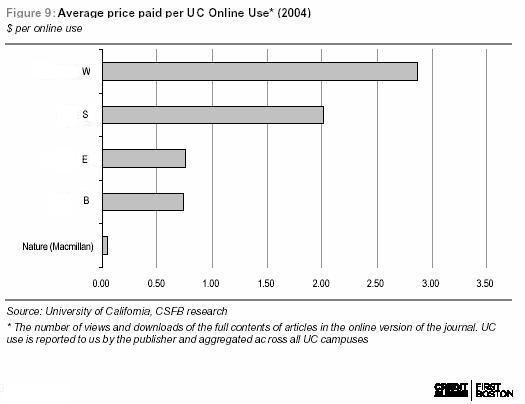
Take a look at this figure from an independent study by Credit Suisse/First Boston. It shows how much the University of California system (a very important user in terms of sheer volume) had to pay every time a member of their community used our journals online, and it compares this cost across different publishing companies.

costs-w.JPG

As you can see, whereas the cost of using our journals is approximately one nickel per use, other publisher’s products cost well over an order of magnitude more (almost two orders of magnitude in one case).

I’m sorry that I had to blank out the name of the other publishers; I didn’t feel comfortable fully disclosing them. In any case, I’m sure you suspect who they might be.

So, next time you think that the Nature journals rip you off, think about this graph. Do the Nature journals really deserve all the flak they receive, or do we actually give people their money’s worth?

Our new columns: Narrowing the distance between bench and bedside

The ‘News and Views’ section of Nature Medicine has a new look!

This month you’ll see we’ve introduced three new columns: Bedside to Bench, Bench to Bedside, and Community Corner. These columns are available this month without a subscription.

Cancer researchers Daniele Krause and Richard Van Etten anchor the new section with a ‘Bedside to Bench’ column examining how recent clinical trials hint at how to kill the cancer stem cell in certain blood disorders; eliminating this source of tumor cells has the potential to lead to improved cancer treatment. Their analysis exemplifies the goal of the new column: to examine the basic research implications of a recent clinical finding.

So far the response from the community has been positive about the ‘Bedside to Bench’ column. One of our readers, Evan Snyder, a physician-scientist at the Burnham Institute in La Jolla, California, said he has initiated a seminar series with this same intent, examining how to develop testable hypotheses about basic science from clinical observations. We’d love to hear if others in the community have similar programs, or how they feel about this approach to asking the right scientific questions.

The other new column, ‘Bench to Bedside’ takes the more familiar route of examining the clinical implications of a basic research study. This month, Neil Shah complements Van Etten and Krause’s column by highlighting how resistance to chemotherapy develops in tumors deficient in the well-known cancer genes, BRCA1 and BRCA2. Shah takes the assignment to heart, examining in depth how patient treatment might change given this greater mechanistic understanding.

Our third column, ‘Community Corner’, scans a small segment of the research community for their response to a recent biomedical study—in this case two reports suggesting how environmental toxins might affect the development of autoimmunity. Experts with three different backgrounds each found something unique about the study.

To make room for the changes we have largely discontinued news and views on papers published outside of Nature Medicine. I’ve been wondering what to do with this format ever since, to my dismay, finding that Nature Medicine, Nature Immunology and Nature had all published a news and views on the same paper. A speaker at a conference—rightly, to my mind—mocked such excess. Since the launch of Nature Medicine more than ten years ago many other journals have begun to present commentaries on their strongest papers, particularly those with a biomedical slant. Although I like to think I provide superior editorial and screening functions as an editor, that is mostly vanity—-basically, with a click on a web browser you can find the commentary you need. In my mind, too much duplication risks redundancy and stretches the editorial resources of the scientific community.

Although we’ve dropped some news and views, we still have a duty to our readers to alert them to the hottest biomedical research in the previous month. So we’ve expanded our research highlights section to two pages, and added a short column highlighting papers within the Nature Publishing Group. One drawback to our process is that we rarely highlight papers that we have rejected, in order to avoid sending mixed signals to researchers who submit their papers. I must admit though, we do sometimes reject some interesting papers—often for reasons unrelated to their overall coolness, but for reasons nonetheless appropriate for our journal, such as a lack of mechanistic insight or poor in vivo data. So, these papers aside, I like to think we provide a quick snapshot in the research highlights section of the papers most relevant to that elusive beast dubbed ‘Translational Research.’

Our aim with the research highlights is to provide breadth in our coverage.

Our aim with the three new columns is to provide the depth—exploring the biomedical literature with quality synthesis.

We’d like your help in this venture. If you are a researcher who has formulated a testable, reasonable—and compelling—hypothesis about the mechanistic basis of disease, based on recent clinical findings, consider submitting a proposal for a ‘Bedside to Bench’ column. And if you get a chance to read the new columns, send us your feedback. This is a work in progress and we hope it develops in a way to best serve the biomedical community.

No such thing as a free lunch

As I was saying yesterday, several people have made comments on the talk I gave in Madrid last month, as well as on the related blog post. Considering that we don’t really censor people who write to us and that we are very receptive of feedback, I find it amusing that few of these comments have been posted on our blog, and that people prefer to cut and paste from what I wrote on their own blogs, but so be it.

Most of the comments have centered on what I wrote about the fact that open-access publishing is not the only alternative to scientific publishing, but just one of several models. Some people take strong exception to this idea to the point of feeling violated by the fact that we “sell back” the science they produce. Others acknowledge that we provide a filtering service, but point to the fact that the peer-review process is free. And a third group of critics argue that the problem with scientific publishing can be summarized in three words: Nature, Science and Cell. Each of these criticisms deserve some comment, and I’ll start with the concept that peer-review is free.

Last August we published an editorial and a blog post called “Why review?”. In them, we went over some of the reasons why people choose to review articles for scientific journals despite the myriad of other things they could do with their time. Particularly relevant to our current discussion is the fact that, although it is true that scientists don’t get any money in exchange for their effort, they get enough compensation from the access they gain to privileged information about what their colleagues and their competitors are doing. For many scientists, to exert influence on the direction and standards of their field not only through their own work, but also through the comments they give their colleagues on their research is enough reward to make reviewing papers worth their while.

Now, there is information and there is information. If scientists choose to review papers for a given journal, it is because, a priori, they think that what they’re gonna read will be of legitimate interest to them. So, many scientists have different thresholds to agree to review for certain journals. Indeed, I’ve met scientists who may agree to review for Nature, but nor for Nature Medicine, and others who agree to review for Nature Medicine, but not for more specialized journals. Why? Because, when they receive an invitation to review from us, their initial expectation is that they are likely to read something of broad interest or “otherwise, Nature Medicine would not be considering this paper for possible publication”.

A corollary of this is that, if we send too many papers out for review, including some that may not be particularly interesting from the start, then we’ll start finding that more and more people turn down our invitations to review manuscripts. In other words, being less selective on what we send out for review will quickly erode the expectation of quality that our reviewers have developed. They’ll start feeling that the compensation they get from reviewing for Nature Medicine is not enough, and will find something else to do with their time.

A second corollary is that, in the absence of a certain guarantee that the paper will be of interest to a reviewer, the reviewer will almost certainly not touch it. This, in fact, is one of the reasons why those initiatives to publish papers online to let the community read them and evaluate them have not been successful so far — many of the most thoughtful reviewers will choose to not spend time on those manuscripts in the absence of some initial screening that separates the wheat from the chaff.

In summary, the peer-review process is free, but only in a most superficial way. Reviewers get compensation from evaluating manuscripts for high-profile journals, provided that an initial screening of manuscripts takes place and truly identifies the contributions that will be of interest to the reviewers. The golden rule that there is no such thing as a free lunch also applies to our trade.

lunch.jpg

Definitely not Nature Medicine’s idea of lunch. (Image by malias.)

15 seconds of fame

You may or may not have noticed that I haven’t been blogging for over a week; I was in Madrid giving a talk in which I tried to make the point that we don’t discriminate against authors on the basis of nationality, language or any other non-scientific aspect. In a previous entry, I had already shared some data to back this statement up, and I used the same and additional data during the talk to drive the point home. It was quite amusing to see that some people still didn’t believe me: “sure, I can see that your graphs show that you don’t discriminate, but I still don’t believe you”. What is there left to say?

In any case, I must confess that the talk got a little boring when people started asking me questions about open-access publishing. It was fascinating to see how difficult it was for some people to understand that scientfic publishing costs money, and that there are different models to recover your costs — the author-pays model, the subscription model, and everything in between. The talk got boring (at least to me) because I have very little patience with this discussion when people stop putting forward compelling arguments in support of their ideas or, as in this case, when people just don’t seem to want to get the simple point I was trying to make: as there are different models, publishing groups ought to choose the model that works best for each of them. In our case, the subscription-based model is the only one that seems viable for the time being. How difficult is it to get this point?

Anyway, a funny thing was that there was a lot of press covering the talk, which was part of a larger event organized by our Madrid office to present a new “How to publish in the Nature journals” guide in Spanish (I’ll write an entry about the guide some other day). As a result, a couple of newspapers ran stories and interviews with yours truly, and there’s even this video I found. Enjoy!

More on discrimination

One of my colleagues was telling me the other day that we at the journal have a bias in favor of the USA. She was specifically making this comment with regard to our reviewer pool, which is indeed dominated by US-based scientists. But then again, there are many more scientists here than in any other country in the world.

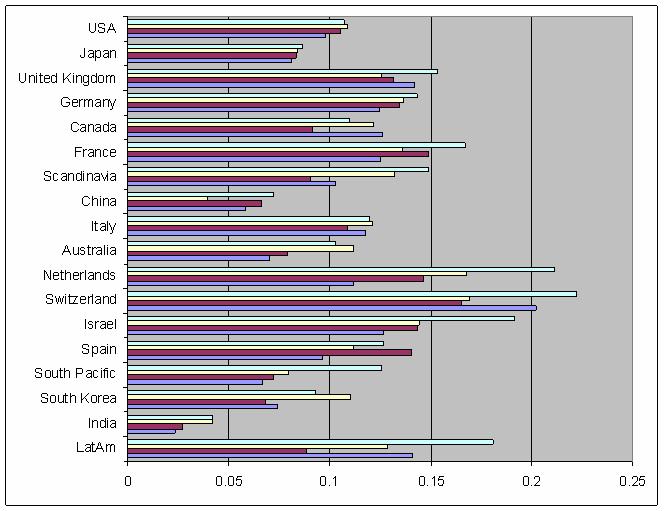
In terms of authors, though, there doesn’t seem to be such bias in favor of the US or against any country in particular. Have a look at this graph, which shows the ratio of published to submitted papers as a function of country.

ratios.JPG

Each color represents a year — from 2007 to 2004, top to bottom. Note that this plot includes papers submitted not only to Nat Med, but it’s pooled data from NMed, NNeuro, NGenet, NSMB, NCellBio, NImmunol and NBT. I didn’t plot the actual number of submitted papers because, of course, we get our largest number of submissions from the US. But this graph clearly shows that we don’t favor the US over, say, Italy or Spain. The graph also shows that countries that have invested heavily in science over the past few years, like Australia, show a steady increase in their ratio of successes over failures. Sure, countries like China and India still have some catching up to do, but they’ll get there, trust me.

LatAm stands for Latin America. South Pacific includes Singapore, Hong Kong and Taiwan. Scandinavia includes Sweden, Norway, Denmark and Finland.