
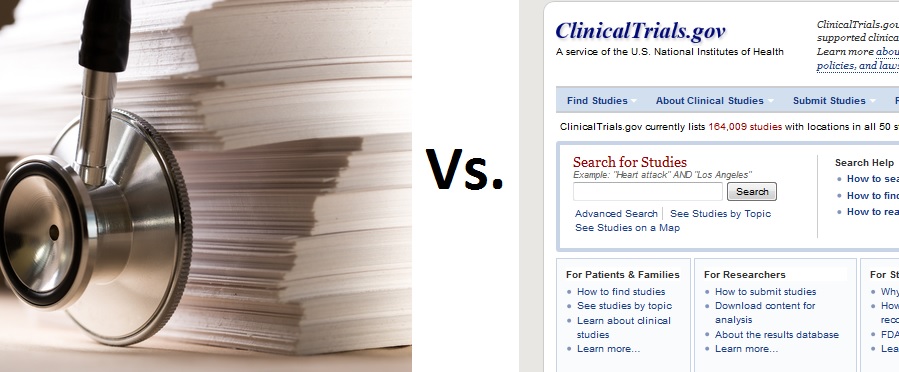
The worst thing that can happen to a person participating in a clinical trial is what’s known as a ‘serious adverse event’, which can describe anything from permanent kidney damage or liver failure to hospitalization or even death. Federal law in the US mandates that researchers conducting trials of drugs or other products regulated by the country’s Food and Drug Administration (FDA) report adverse events on ClinicalTrials.gov, a data repository open to the public. But a new study shows that many of these serious adverse events don’t appear in medical journals, making some interventions seem more favorable than they may actually be.
Reporting online today in the Archives of Internal Medicine, a group of researchers led by Daniel Hartung, a drug safety and policy analyst at Oregon Health & Science University in Portland, looked at how the data reported on ClincialTrials.gov stack up against the results published in the medical literature. The team limited their focus to phase 3 or 4 trials with results reported on ClinicalTrials.gov and completed prior to 2009, to allow sufficient time for the trials’ results to be published in medical journals. Hartung’s group then randomly selected 10% of those trials that had matching publications, yielding a total of 110 trials.
Hartung’s team found that 33 of the trials reported a greater number of serious adverse events on ClinicalTrials.gov than in the medical literature. For example, a 13,608-person study comparing the blood-thinning drugs Effient (prasugrel) and Plavix (clopidogrel) reported in the online database a total of 3,406 serious adverse events among all participants in the trial, and 3,082 in a related publication. (The patients in the trial were at high risk of heart attack, and were undergoing angioplasty, so it’s important to note that these adverse events were not necessarily linked to the drugs.)
Of the 84 trials that reported the occurrence of serious adverse events in the public database, 16 of the matching publications either failed to mention them or incorrectly reported that they did not occur. (Notably, 5 trials actually reported more serious adverse events in related medical papers than they did in the public database.)