 This week’s guest blogger is Shreena Patel, Scientific Projects Manager for Exscitec. In partnership with Imperial College Outreach,
they provide hands-on practical activities for students to raise aspirations in Science, Technology, Engineering and Maths (STEM).
Science is cool. Science is fun. If you’re anything like me, you love keeping up to date with the latest technologies and discoveries that emanate from the scientific world. However, trying to convince a less than enthusiastic 14 year old that a peak in the data from the Large Hadron Collider could possibly change Physics as we know it…well that’s slightly more challenging! The reality is that for a large number of students, science is simply not seen as fun or cool.
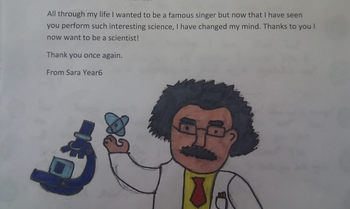
Recently I asked a group of year 6 students (10-11 year olds) “What is a scientist?” What appeared on the whiteboard was a disturbing cross between Doc Brown and Einstein. I was told by the students that the image depicted in the picture was concentrating hard on NOT blowing up the ‘potions’ in his lab and was about to invent something spectacular (hence the light bulb hovering over his head). The excitement in the room was so infectious that even I wanted to meet this amazing scientist drawn on my whiteboard.
Ask this same question of year 10 (14-15 year olds) and the image on the whiteboard becomes the stereotype of a boring, geeky individual stuck in a dingy lab all day. Despite some very hard working teachers, a lot of students at this age just don’t realise how vast the reach of STEM is in the real world.
As outreach providers for Imperial College, over the past 12 years, Exscitec has provided bespoke courses for school students of all ages and abilities. Whether it’s building robots, synthesizing compounds or discovering who committed murder most foul through forensic testing, we try to take STEM off the textbook page and into the real world. In a nutshell, we try give students that ‘wow’ factor that will change the way they look at STEM.

With the new Reach Out Lab (ROL) at Imperial College, we are now able to connect with even more students throughout the year. Opened in 2010 and championed by Professor Lord Winston, Chair of Science and Society, this multi-purpose laboratory provides a year round teaching facility for young people and teachers. Exscitec’s CEO, Alan West, who is also the Director of the ROL, was recently awarded an MBE for services to STEM education. Speaking about his work, he says, “In recent years, my work, and that of the Exscitec team, has focused very much on the development of STEM enrichment activity connected with Imperial’s Reach Out Lab, the success of which is enabling us to develop more exciting initiatives in support of STEM education”.
One of these new initiatives is called Reaching Further, which is a program which allows school students the opportunity to work with PhD, MRes and Masters students from the Imperial College research community. The premise is simple: students get to speak to a “real scientist”, and in return, researchers are able to share their work and strengthen their public engagement portfolio.
By giving students the opportunity to work with these researchers, we are able to tackle one of the main issues facing young students studying science: the time it takes for scientific breakthroughs to make it into students’ textbooks. This disconnect is one of the major issues we are trying to overcome here at the ROL. So far we have worked with researchers from the National Heart and Lung Institute, the Energy Futures Lab, the Grantham Institute for Climate Change, UK Energy Research Centre (UKERC) to name but a few.
Sarah Lester, Energy and Mitigation researcher at the Gratham Institute for Climate Change, along with Dr Jeff Hardy and other colleagues from UKERC, recently led Energy Islands – a role play workshop where year 12 students (16-17 years old) negotiated a reduction in carbon emissions for their world. Talking about her work with outreach so far, Sarah says, “I think the outreach work has been going really well and has helped the students get involved with academics and research on climate change. The Energy Islands game has also given us great motivation and an excellent tool to work with under 18s and the public as part of our education and information sharing work. One of the best things was being reminded how passionate people can be about this area once they feel they can make a difference.”
I couldn’t have put it better myself. When it boils down to it, students want to be spoken to, not at. Once they feel that someone is listening, you find that they have an awful lot to say. Whether it’s stem cells or solar cells, who better to talk to than those who are at the forefront of the field? As Claire Doyle, PhD student in Organic Chemistry put it, “It definitely added variety to my doctorate and has given me some great experience for the future. Plus it was very rewarding to see students so excited about what I did.”
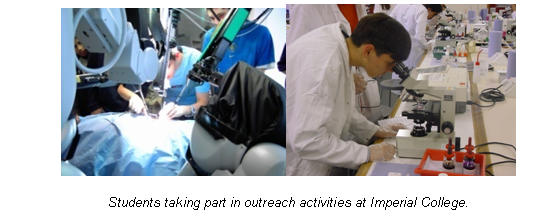
So to all those hard working researchers sitting reading this during a break from their next round of tests, I urge you to get involved in outreach in whatever way you can. One interaction can literally change a student’s whole outlook on a subject. Science becomes cool, science becomes fun and as a consequence back at school the attitude towards science learning changes too.
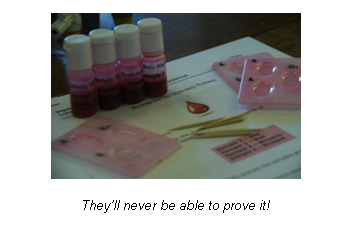
With that, it’s time I return to my lab, where a group of year 9 students (13-14 year olds) from Watford are eagerly waiting to accuse me of murder based on some smudged fingerprints and some suspicious stains on my clothing… which may have tested positive for blood (rookie mistake!) I have been informed that I am going to be thoroughly interrogated after lunch…!
If you’re interested in reading more about mentoring in science, the nature.com Communities team ran a recent Science Online NYC (#sonyc) discussion about “Reaching the Niches”. Links to our coverage, including a series of guest posts on other mentoring initiatives can be found here.