Define ironic…

Ahead of a meeting with a representative from the recently-formed UK Research Integrity Office, I sorted through my file of papers on research misconduct. Amongst them I found a ‘News in Brief’ page from Nature Medicine, 2005 . On it, I found the headline that had caused me to photocopy the page – “Many scientists admit to misconduct”, drawing attention to a paper in its sister publication Nature published a month earlier. The paper described a survey in which it was revealed that one in three scientists has committed some type of scientific misconduct.

The irony was that at the bottom of the same page was a short piece (from the same correspondent, Emily Singer) announcing “South Korean chalks up another stem cell victory”. The article highlighted the work of Woo-Suk Hwang in which he claimed to have cloned human embryonic stem cells in a paper published two months earlier in Science. The disgraced Professor, formerly of Seoul National University, is now used as a case-study for fraud in research (for example, Fraud Advisory Panel Occasional paper 01/07 Fraud in Research: Is it new or just not true?).

Was this incredible prescience on the part of the author, or just a strange coincidence of publishing?

Posted on behalf of Dr. Dave Wilson, Cardiff School of Biosciences, Cardiff University, Wales, UK

Hwang.jpg

Placental HSCs

A recent paper in Cell Stem Cell provides some interesting new information about the origin of hematopoietic stem cells (HSCs), arguably the best characterized population of stem cells in the organism, and the one population that has been successfully used in regenerative medicine for some time.

We already knew that, in the mouse, the placenta acts as a very early reservoir for HSCs. But do they come from the circulation or are they born there? In the new study, Katrin Rhodes and her colleagues looked in mouse embryos that lack a functional heart and have therefore no circulation, and found that bona fide, multipotential HSCs develop in the placental vasculature in the absence of blood flow.

The authors admit that there were fewer HSCs in the placentas of mutant mice than in the placentas of wild-type controls, indicating that blood circulation may after all make a contribution to the total number of HSCs, but these observations do provide good evidence that the placenta is more than a mere reservoir of stem cells, simply waiting for the liver to become the first true hematopoietic organ.

Point of no return?

Modeling Parkinson disease in animals has been very hard. The chemical models (6-OHDA and MPTP) are good to study cell replacement therapies, but not so great for pathogenesis. And the genetic models have failed to give the mouse something like true Parkinson disease — there may be alpha-synuclein aggregates or structures akin to Lewy bodies, but no cell death, or vice versa. To add to the debate, Silke Nuber and her colleagues just published in J. Neurosci. a conditional model of Parkinson in which alpha-synuclein expression can be switched off by feeding the animals doxycyclin. This is an image from the paper, showing the expression of the transgene in the two divisions of the substantia nigra of the mice.

nigra.JPG

Their key finding was that turning alpha-synuclein expression off in mice that started to show neurodegeneration and behavioral symptoms halted disease progression but did not reverse it. This is quite different to what Jose Lucas and his colleagues showed years ago in Huntington disease. In that case, turning the expression of huntingtin off did reverse the motor symptoms in mice.

Albeit interesting, one wonders about the relevance of the findings of Nuber and colleagues to true Parkinson disease. Similar to previous attempts to reproduce the disease in mice, their model was not perfect — there was neurodegeneration, but no Lewy bodies.

Sinners, repent!

About 1,400 years ago, Pope Gregory the Great (image below) enumerated the Seven Deadly Sins — sins that cut the sinner off from God. Now, Archbishop Gianfranco Girotti has drawn up a new list of Seven Deadly Sins for modern times.

“To sin is to violate the relationship of man with God”, stated Archbishop Girotti. So, his new list has paid special attention to what one could call “social sins” that are linked to “the phenomenon of globalization”. This is how the ”https://news.bbc.co.uk/1/hi/world/europe/7287071.stm">BBC listed the new deadly sins:

Environmental pollution

Genetic manipulation

Accumulating excessive wealth

Inflicting poverty

Drug trafficking and consumption

Morally debatable experiments

Violation of fundamental rights of human nature

Wait a minute, though. Genetic manipulation? Surely not! So, does this mean that, if someone successfully cures a congenital disease using gene therapy, this person will go to Hell? I hope not. Otherwise, the Italian authors of a paper we published over a year ago may be a bit too close to the Vatican for comfort.

And morally debatable experiments? Aren’t all experiments morally debatable? I admit that I don’t know all the details of what the ‘Osservatore Romano’, the official newspaper of the Vatican, published, but hopefully there is some clarification for the benefit of those of us Catholics who had to learn to live by the law of the original deadly sins. Do morally debatable experiments refer only to experiments in embryonic stem cells, or are there other experiments one needs to be worried about?

Sure, one can see where the Catholic church is coming from with their proclamations of the new sins. But to place a good number of fine scientists twice in such an eclectic list and in the company of drug traffickers strikes me as somewhat disturbing. Good thing I’m no longer a practicing scientist. Otherwise, I would need to do a lot of explaining next time I visit my mom.

gregory.jpg

Heal my pain with lavender

I always thought the ‘therapy’ in ‘aromatherapy’ was something nobody took seriously, sort of like ‘low-fat’ in ‘low-fat potato chip’ or ‘recycle’ in the Microsoft desktop’s ‘recycle bin’ (only in my nicey-nice hometown of Seattle would anyone get away with coining such a platitude).

But apparently the ‘therapy’ part of aromatherapy is real enough for the US National Center for Complementary and Alternative Medicine at the National Institutes of Health. The institute, which we have covered before, has sponsored a trial of aromatherapy—and the results are out!

Big news: aromatherapy doesn’t work. The best thing lemon did was lift the mood and lavender didn’t even do that. Surely there are other, more interesting and potentially effective alternative therapies to study. I’m not sure what. But at least they are not studying that substance of apparently limited effectiveness, prozac.

Gout gene

Gout is an inflammatory disease that results from the deposition of uric acid crystals in the joints. It tends to be somewhat common in people with high levels of uric acid in the blood, which is, in turn, often the result of reduced renal excretion of the acid. How does this chain of events come about? Two papers in Nature Genetics give us a clue: Veronique Vitart and her colleagues and Angela Doring and her colleagues independently identified variants in the gene SLC2A9 that are linked to variability in uric acid concentrations.

SLC2A9 encodes a fructose transporter, but Vitart and colleagues found that the protein can also transport uric acid when expressed in Xenopus oocytes. Moreover, the transporter was already known to be expressed in the kidney. So, this molecule could very well turn out to be a therapeutic target for gout. The image below, from Ed Euthman, shows uric acid crystals in a human joint.

uratecrystal.jpg

Autism express II

There’s a saying in Spanish that roughly translated says “Calamities never arrive alone”. Following John McCain’s statement on the “strong” evidence for a link between vaccines and autism, which Charlotte Schubert blogged about, the ruling in the case of Hannah Poling is a second calamity that is bound to add more fuel to a debate that hasn’t been particularly productive.

The US government’s decision to settle and agree to pay Hannah, who has autistic symptoms, for her care has been immediately heralded as a victory for supporters of the vaccine-autism link, even though officials have been careful to clarify that they didn’t concede that vaccines cause autism.

The government can continue to clarify their position until they go blue in the face but, unfortunately, this ruling is bad news for the science that has debunked the autism-vaccines link, for the cost of health care in the US (which is bound to feel the effect of more settlements of this sort, if this case is accepted as precedent), and for herd immunity (the effectiveness of which may decrease if too many kids in a given pupulation stop being vaccinated).

vaccine.jpg

Madame Secretary

I was listening yesterday to an interview with Madeleine Albright, former secretary of state, on KGNU, an online radio station based in Colorado.

While plugging her new book, she said that the job of secretary of state is more complex than when she had it. The reason? The position now requires more science savvy: the next secretary of state, she said is going to have to know about climate change, energy and public health.

So it’s not just a bunch of geeks thinking all this science stuff is getting more important. So-and yes I keep bringing this up-Madame Secretary, are you prepared to add your name to a call for a Science Debate?

Top models

Speaking of mammals (see the end of my previous entry), not even rats and mice always cut it when it comes to providing good models of human disease. Take, for example, cystic fibrosis. There are a couple of mouse models of the disease (we have published at least one of them), but the community does not seem to be satisfied with them. It is therefore great to see a pair of papers in the JCI reporting on two new attempts at generating the ideal model of cystic fibrosis.

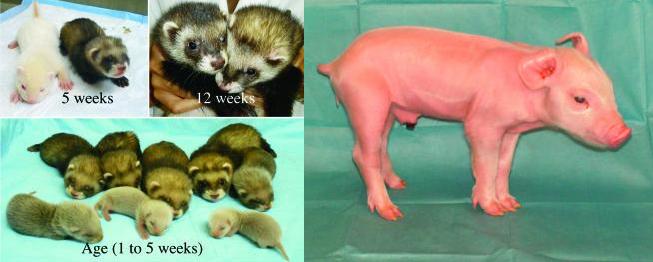
The two of studies are very similar. In the first one, Xingshen Sun and colleagues report the first description of genetically engineered ferrets. They started by targetting the CFTR gene (the gene affected in the disease) in fibroblasts using an adeno-associated viral (AAV) construct, and then used a nuclear transfer protocol to obtain cloned ferrets heterozygous for the CFTR mutation. In the second one, Christopher Rogers and colleagues employed a similar strategy in pigs to obtain heterozygous piglets carrying the CFTR mutation.

The next steps will be to establish how much these models truly recapitulate human disease, and then use them to learn new biology about the disease and/or for preclinical drug-discovery work.

The figures, taken from the papers, show the cloned CFTR ferrets and a non-cloned albino at different ages, and the first CFTR heterozygous pig at one day of age.

ferrets.JPG

Retinoids, skincare and Matthew Wood

People with acne will find this JCI paper of interest. 13-cis retinoic acid can be used to treat acne, as it can kill human sebaceous-gland cells by apoptosis. The molecule is teratogenic, though, making it necessary to look for alternatives. As the mechanism of action of 13-cis retinoic acid is unknown, Amanda Nelson and her colleagues tried to elucidate it, hoping to identify new targets for the treatment of the bothersome skin condition. Using transcriptional profiling of skin cells from people with acne and cultured sebaceous glands, they found that lipocalin-2 was distinctively upregulated by treatment with 13-cis retinoic acid. They also found that the apoptotic effect of 13-cis retinoic acid indeed depended on the expression of neutrophil gelatinase–associated lipocalin (NGAL), the protein encoded by lipocalin-2; by using siRNA to lipocalin-2, they blocked the apoptotic effect, and by adding recombinant NGAL, they promoted it. It is therefore conceivable that manipulating NGAL expression could lead to a new way to fight acne.

acne.jpg

A more serious pathology with a connection to retinoids is Matthew-Wood syndrome, a fatal disease characterized by multisystem developmental malformations that has been linked to mutations in STRA6. STRA6 interacts with retinol-binding protein 4 (RBP4), which is, in turn, a carrier of retinoids (vitamin A and its derivatives). A paper published in Cell Metabolism establishes that the biochemical interaction between STRA6 and RBP4 is indeed functionally relevant. Studying zebrafish embryos, Andrea Isken and colleagues found that Stra6 deficiency allows more Rbp4 to remain free and to carry an excess amount of retinoids to several embryonic tissues, including bone, heart and eye. In fact, reducing the levels of Rbp4 prevented these effects. The findings provide a nice molecular account of Matthew-Wood syndrome, although I cannot help but wish that the authors had done the in vivo experiments in a mammal. I must confess that, when we evaluate papers at Nature Medicine, we’re seldom enthused by data from zebrafish, Drosophila or C. elegans, as the relevance of these models to human physiology tends to be harder to ascertain. Nothing personal against the fish or the invertebrates, though.

zebrafish.jpg