Tales of Brown Fat

Three new studies published in the April 9, 2009 issue of The New England Journal of Medicine show conclusive proof that adult humans do indeed have appreciable amounts of brown adipose tissue. Why is this important? For at least two reasons: 1) it puts to rest the issue that adult humans have this cell type (more on this below), and 2) if the numbers or the activity of these cells could be increased it could help in the fight against obesity.

So what exactly is brown adipose tissue? Well, when most people think of adipose tissue they think of white fat – the cell type that stores fat for future energy needs of the body (though experts think it is also useful for keeping fats away from other critical organs, like the liver and muscle, and preventing the excess fat from inhibiting their function). But brown fat has another purpose entirely – it burns fats and carbs to release heat, which in turn keeps the body warm. For animals that can shiver, like adult humans, it was believed that brown fat wasn’t needed or if it was present it was a vestigial organ that wasn’t important for normal physiology. These three studies show that cold temperatures induce the occurrence of this tissue and that it is indeed likely important for normal physiology. More importantly, though, the findings also suggest that because these cells are present they could be targeted to fight obesity, as mentioned above. Indeed, as one of the papers points out, if as little as 0.1% of a person’s body weight is converted to brown adipose tissue it could account for ~20% of the adult body’s daily energy expenditure.

But there is also an interesting background to these three studies, which all three papers cite and two explain a bit, but it might be interesting to spell out a little further here. The technique the three papers used to identify the brown fat is to give volunteers radiolabeled glucose (18F-fluorodeoxyglucose) followed by PET-CT scans. But this technique has been around for awhile. It was originally devised because it was noticed that tumors are quite energy intensive and thus more likely to take up this radiolabel more quickly than normal, healthy cells. Thus it was hoped the technique would allow advanced tumors and their metastases to be visualized. But around 2002-2004 a number of reports started to appear in the radiological literature pointing out that patients tested in this way showed several ‘blobs’ of staining in the supraclavicular area. Given what we know about the energy expenditure of brown fat, the authors of those earlier studies suggested that adult humans do indeed have appreciable levels of brown fat. But it wasn’t until the new studies published this month that this staining was shown conclusively to be cold-inducible and, more importantly, upon biopsy that the cells are indeed brown adipose tissue, as characterized by histology and molecular marker analysis.

Time will only tell now if this cell type in adult humans can indeed be manipulated to keep us trim.


Stress as a therapy?

There’s a new report in Molecular Cell (29, 541-551) from Gokhan Hotamisligil’s group suggesting that cellular stress might actually be helpful in certain contexts.

The Hotamisligil lab has published numerous reports on the importance of endoplasmic reticulum (ER) stress in metabolic dysfunction. Their previous data have suggested that insulin resistance (pre-diabetes, if you will) leads to a greater demand for insulin from the pancreatic beta cells. But this increased demand means more protein production, which can stress the ER and result in apoptosis. If this occurs in the islets overt diabetes can result.

In addition to his basic science experience, Gokhan also has a clinical background and he mentioned to me once that he used to see tuberous sclerosis complex (TSC) patients and was struck by the numerous benign tumors that form throughout their bodies. Now his interests are coming full circle as his group is reporting on ER stress in TSC and a potential therapy angle that could result from this insight.

The normal versions of the disease genes of TSC, TSC1 and TSC2, encode for proteins that form a complex that inhibits mTOR, the mammalian target of rapamycin. mTOR is a critical protein that integrates the nutritional state of the cell and cell growth by activating nuclear factors that control protein translation in response to increased amino acid levels. So TSC deficiency results in hyperactivation of mTOR, which leads to increased cell growth and is probably an explanation for the high number of benign tumors in these patients. While rapamycin, an inhibitor of mTOR, is a possible therapeutic treatment for TSC sufferers, it also has many nasty side-effects, especially over the long-term, so its potential in this regard is rather limited.

Given the increased protein production that results when mTOR is hyperactivated, it is possible that ER stress could occur in TSC-deficient cells. In this new report, Umut Ozcan et al. now show that lack of TSC does result in ER stress, including in the tumors that form in the Tsc2 KO mouse, as well as in a resected human TSC-derived tumor. They also show that this ER stress results in insulin resistance, tying in these results with the lab’s previous studies.

Clearly the level of ER stress caused by the defect in TSC, however, is not sufficient to cause apoptosis given the high number of benign tumors that form in this disease. But the team reasoned that if TSC1- or TSC2-deficient cells were treated with thapsigargin, a chemical inducer of ER stress, then perhaps they could tip the balance towards cell death. They were able to show this and, importantly, at the dosage of thapsigargin used normal cells were not killed. This result indicates the absence of TSC makes cells more vulnerable to ER-stress-induced apoptosis, which the group then used to their advantage in vivo. They injected Tsc2+/- mice, which develop kidney adenomas after 1 year, with thapsigargin once a day for a week and that resulted in apoptosis in the tumor cells but not in nearby healthy tissue. It wasn’t reported, however, if this treatment was sufficient to shrink the tumor or return normal kidney function.

These findings are summarized in this schematic from the paper:

TSC-Mol Cell Summary schematic.bmp

These results suggest a possible way to treat TSC. Unfortunately thapsigargin is too toxic and too blunt a tool to be used in the clinic. For example, pancreatic beta cells, even healthy ones, are quite vulnerable to ER stress-induced apoptosis. But nonetheless this study does point in a new direction for the development of a future therapeutic option in treating cancers that involve hyperactivation of mTOR.

Strong Nature

I found the past two online installments of Nature to be particularly strong.

Sunday’s issue had two papers showing that activation of the aryl hydrocarbon receptor (AHR) — a ligand-dependent transcription factor that mediates the action of environmental toxins such as dioxin — plays a role in the pathophysiology of EAE, the commonly used animal model of multiple sclerosis.

Marc Veldhoen et al. and Francisco Quintana et al. found that AHR exacerbated EAE by promoting the differentiation of Th17 cells and the production of IL-22. Remarkably, Quintana and his colleagues went on to show that the effect of AHR depended on the agonist they used; whereas one agonist promoted EAE, a different agonist suppressed the pathology by inducing regulatory T cells. The authors don’t go too far downstream to nail down the transcriptional pathways that are responsible and account for the dual effect of AHR (which is in and of itself not unprecedented), but the possibility that environmental toxins might use this receptor to modify the course of multiple sclerosis in people is very interesting.

Then, on today’s edition of the journal, there are two RNA-related papers that are also very interesting. The first one is a proof-of-principle study by Joacim Elmén et al., showing that it is possible to silence microRNAs in non-human primates. Although therapeutic effects of blocking microRNAs in rodents have been published, there has been scepticism about translating the approach to the clinic. Elmén and his colleagues now show that it is possible to silence a liver microRNA in the green monkey by delivering a locked-nucleic-acid-modified “antimiR”. Moreover, this silencing approach had a functional readout — decreased plasma cholesterol — and no obvious toxicity. This is a reassuring finding for those interested in targeting microRNAs in humans with therapeutic purposes.

The second RNA-related paper reports a somewhat unexpected finding. There are reports that you can use siRNA to target proangiogenic molecules like VEGF or its receptor, and block pathological angiogenesis in patients with neovascularization linked to age-related macular degeneration. Now, Mark Kleinman and his colleagues show that it doesn’t quite matter what molecule you target because a large number of siRNAs (even if some that target non-genomic sequences or antiangiogenic genes) have the same antiangiogenic effect. As long as the siRNA is 21-nucleotides or longer, it will exert an anti-angiogenic effect mediated by the TLR3 signaling cascade. This “class effect” implies that generic siRNAs might be therapeutic agents, and that siRNAs might have unanticipated actions on the vascular and immune systems.

Thin and happy

A lot has been said about the link between calorie restriction and aging — eat less, live longer. But if that wasn’t enough, there seems to be a new reason to do away with snacking: calorie restriction has an anti-depressant effect in mice, which depends on orexin-mediated signaling.

Michael Lutter and his colleagues tested mice in two animal models of depression — forced swim (a “depressed” animal will stop trying to escape from the water and will therefore cease to swim) and social defeat (a mouse that has been bullied will express its “depression” by reduced social interactions with other mice). The authors found that, if the mice were on calorie restriction, both their latency to stop swimming and their likelihood to engage in social interactions increased. In other words, the restricted mice did not show signs of depression.

But if the mice lacked orexin, calorie restriction had no effect. Orexin’s claim to fame is its relationship to narcolepsy — people (and some dog breeds) without orexin fall asleep without warning. But orexin has also been linked to the regulation of food and drug reward, pointing to a role for orexin in emotional processes. Lutter et al. further strengthen the link of orexin with depression by showing that mice in the social-defeat model have epigenetic modifications in the orexin promoter, which lead to decreased expression of the orexin gene in the “depressed” mice.

Clearly, the mechanistic link between depression, orexin and calorie restriction could do with some additional tightening. Similarly, the existing animal models of depression and their relevance to human depression are consistently criticized by the community. One also wonders about the behavioral (or “psychological”, if you will) effects of calorie restriction per se on an animal that is undergoing a stressful situation like the one the mice experience in the forced-swim and social-defeat tests. In other words, is the increased latency to show depression a true anti-depressant effect, or is it that the mouse’s hunger causes it to be more anxious in the context of the behavioural testing it is exposed to?

All of that said, other effects of calorie restriction that were originally met with scepticism now enjoy widespread acceptance. Maybe the same will turn out to occur in this fascinating case.

cupcakes.jpg

The wrong target

There’s a remarkable number of drugs that people use for which the mechanism of action is unknown, and two papers in the Journal of Neuroscience illustrate this point from two different perspectives.

Methylprednisolone is an anti-inflammatory drug that is often used — with modest success — in multiple sclerosis and (off label) after spinal cord injury. People think that its effect depends on its ability to dampen inflammation but, as Jin-Moo Lee and colleagues show, the drug seems to act in vitro and in vivo (at least in rats) by preventing oligodendrocyte apoptosis through the indirect activation of glucocorticoid receptors. By contrast, the drug has no such protective effect on neurons, which may start to account for its limited therapeutic effect.

The second paper has to do with a drug that people use with recreational, as opposed to therapeutic, purposes — ecstasy. Carla Busceti and her colleagues report that giving ecstasy to mice results in a transient increase in the phosphorylation of tau — the same molecule that is phosphorylated in Alzheimer disease and in a series of conditions known as tauopathies. They further show that the increased phosphorylation, which is primarily seen in the hippocampus, depends on both GSK3β and cdk5, a pair of kinases known to phosphorylate tau. So, ecstasy induces the expression of Dickkopf-1, which inhibits Wnt signalling, thereby increasing GSK3β activity, and it also induces the expression of p25, a known activator of cdk5. It’s very hard to know if there is any relationship between these biochemical changes and neurological diseases, but it would be very interesting to see if there is an increased incidence of any tauopathy in frequent users of ecstasy. I guess we’ll have to wait for epidemiological studies to know the answer.

drugs.jpg

Gene associations galore

This week’s issue of JAMA struck me as pretty interesting. They normally publish stuff that’s too clinical or epidemiological for my taste and in comparison to what we publish, but this time they had a themed issue on genomics with four articles reporting associations between gene variants and diseases of different systems.

Two of the articles are relevant to the cardiovascular system. First, Tamali Bhattacharyya and colleagues established a link between polymorphisms that affect the function of paraoxonase 1 (an HDL-bound enzyme with cardioprotective properties), oxidative stress and cardiovascular disease. As might be expected, forms of the enzyme with higher activity were associated with less oxidative stress and a reduced risk of cardiac events.

The second paper, by Irene Bezemer and her colleagues, disclosed gene polymorphisms linked to deep vein thrombosis. These variants affected several genes (CYP4V2, SERPINC1, GP6, KLKB1 and F11), and some of these were also linked to higher levels of coagulation factor XI, hinting at a possible molecular mechanism.

Next, a study by Joyce van Meurs and colleagues reports polymorphisms in the low-density lipoprotein receptor-related protein LRP5 that are associated with osteoporosis. As mutations in LRP5 had already been linked to bone disorders, it is not entirely surprising that variants of this gene would lead to reduced bone density and increased fracture risk.

Last, but not least, there’s a very intriguing contribution by Elisabeth Binder and her colleagues, who found that variants in the FKBP5 gene (which encodes a protein that interacts with the glucocorticoid receptor to modulate its cortisol-binding affinity and has therefore been linked to physiological responses to stress) interact with the occurrence of abuse during childhood, predicting the severity of posttraumatic stress disorder (PTSD) in adulthood. The gene variants themselves were not good predictors of PTSD. So, this is a fine example of gene-environment interactions in the context of mental disease.

Very interesting associations indeed. Hopefully they’ll lead to some hardcore molecular work that results in some mechanistic insight into the biological meaning of this gene polymorphisms that goes above and beyond the correlations found in these studies.

DNA.jpg

Two on cancer

Two papers in Nature these past few days reported on some very intriguing biology of cancer cells.

Some tumor cells have the peculiar property of acting like anaerobic cells, producing lactate even in the presence of oxygen — a property known as aerobic glycolysis or the Warburg phenomenon. The molecular mechanisms behind this phenotype are not clear, but the first of these two papers provides a very solid clue to account for it. Heather Christofk and her colleagues show that a switch between isoforms of the glycolytic enzyme pyruvate kinase is crucial for aerobic glycolysis and tumorigenesis. Tumor cells express the embryonic M2 isoform of pyruvate kinase, but by knocking it down and replacing it with the M1 (adult) isoform, the authors reversed aerobic glycolysis and reduced tumor growth in mice.

The second paper takes a look at the hardcore signaling that takes place inside tumor cells. We know very well that the Ras-PI3K-AKT pathway is crucial for tumor maintenance. The new study, by Kian-Huat Lim and colleagues, shows that blocking the AKT-mediated phosphorylation of endothelial nitric oxide synthase (eNOS) also inhibits tumor maintenance. As eNOS enhances the nitrosylation and activity of Ras proteins, which are required for tumorigenesis, the authors come full circle by proposing a (mutated) Ras-PI3K-AKT-eNOS-(wild-type) Ras pathway for tumor growth.

Placental HSCs

A recent paper in Cell Stem Cell provides some interesting new information about the origin of hematopoietic stem cells (HSCs), arguably the best characterized population of stem cells in the organism, and the one population that has been successfully used in regenerative medicine for some time.

We already knew that, in the mouse, the placenta acts as a very early reservoir for HSCs. But do they come from the circulation or are they born there? In the new study, Katrin Rhodes and her colleagues looked in mouse embryos that lack a functional heart and have therefore no circulation, and found that bona fide, multipotential HSCs develop in the placental vasculature in the absence of blood flow.

The authors admit that there were fewer HSCs in the placentas of mutant mice than in the placentas of wild-type controls, indicating that blood circulation may after all make a contribution to the total number of HSCs, but these observations do provide good evidence that the placenta is more than a mere reservoir of stem cells, simply waiting for the liver to become the first true hematopoietic organ.

Point of no return?

Modeling Parkinson disease in animals has been very hard. The chemical models (6-OHDA and MPTP) are good to study cell replacement therapies, but not so great for pathogenesis. And the genetic models have failed to give the mouse something like true Parkinson disease — there may be alpha-synuclein aggregates or structures akin to Lewy bodies, but no cell death, or vice versa. To add to the debate, Silke Nuber and her colleagues just published in J. Neurosci. a conditional model of Parkinson in which alpha-synuclein expression can be switched off by feeding the animals doxycyclin. This is an image from the paper, showing the expression of the transgene in the two divisions of the substantia nigra of the mice.

nigra.JPG

Their key finding was that turning alpha-synuclein expression off in mice that started to show neurodegeneration and behavioral symptoms halted disease progression but did not reverse it. This is quite different to what Jose Lucas and his colleagues showed years ago in Huntington disease. In that case, turning the expression of huntingtin off did reverse the motor symptoms in mice.

Albeit interesting, one wonders about the relevance of the findings of Nuber and colleagues to true Parkinson disease. Similar to previous attempts to reproduce the disease in mice, their model was not perfect — there was neurodegeneration, but no Lewy bodies.

Gout gene

Gout is an inflammatory disease that results from the deposition of uric acid crystals in the joints. It tends to be somewhat common in people with high levels of uric acid in the blood, which is, in turn, often the result of reduced renal excretion of the acid. How does this chain of events come about? Two papers in Nature Genetics give us a clue: Veronique Vitart and her colleagues and Angela Doring and her colleagues independently identified variants in the gene SLC2A9 that are linked to variability in uric acid concentrations.

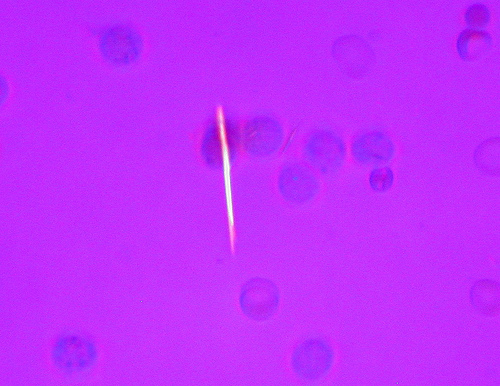
SLC2A9 encodes a fructose transporter, but Vitart and colleagues found that the protein can also transport uric acid when expressed in Xenopus oocytes. Moreover, the transporter was already known to be expressed in the kidney. So, this molecule could very well turn out to be a therapeutic target for gout. The image below, from Ed Euthman, shows uric acid crystals in a human joint.

uratecrystal.jpg