Disaster in the time of cholera

haitisupplies.jpgHaiti is back in the news this morning, as its Ministry of Health just announced that lab tests have confirmed that cholera is responsible for an outbreak of diarrhea in rural areas. The epidemic has sickened more than 1,500 and killed at least 150, according to the World Health Organization (WHO). For months, aid organizations have been warning that crowded conditions amongst refugees from January’s devastating earthquake could lead to rapidly spreading illnesses.

“This is the first major epidemic that has taken place since the earthquake as far as I’m aware,” Andrew Marx, spokesman for medical aid group Partners in Health, told the Wall Street Journal.

Access to clean water is of paramount importance to disaster victims, as many aid groups well know. Recent floods in Pakistan have been accompanied by fears of cholera outbreaks; in August, the WHO reported that more than 18,000 people were treated for acute diarrhea in flood-affected areas. After the 2004 Boxing Day tsunami in southeastern Asia, officials feared that cholera could double the more than 230,000-person death toll, but major outbreaks failed to materialize.

Image by the US Navy via Wikimedia Commons

Tobacco trends suggest challenges ahead

Smoking.jpg

A lung conference on Friday put a spotlight on trends in tobacco around the world. Health experts estimate, for example, that smoking-related deaths in China will climb to two million each year by 2020 unless the country does more to curb tobacco use. Stamping out cigarettes might be a real drag on the country’s budget, though, as tobacco taxes generate a reported 7.6 % of Chinese central government revenues.

In Africa, the World Health Organization has stepped in to reduce smoking-related deaths, announcing the launch of a new campaign last week with $10 million in funding from the Gates Foundation. But even if the battle against smoking is won, there are other challenges ahead. In the US, the number of smokers has dropped 20% in the past 15 years, but a 48% rise in obesity over the same period may have offset the health benefits across the population.

Posted on behalf of Christian Torres, Nature Medicine news intern

Image by Abdullah AL-Naser via Flickr Creative Commons

The best defense against biowarfare

The recent suicide of vaccine researcher Bruce Ivins, the FBI’s prime suspect in the fatal anthrax mailings following the 9/11 attacks, has brought bioterrorism back to the forefront of the national consciousness. Many people are pondering out loud: Is the US prepared to respond to a bioweapons attack? Probably not, according to recent media reports. The government has invested some $50 billion in biowarfare research since 2001, which has gone into creating new labs, building up stockpiles of antibiotics and smallpox vaccines, and devising strategies for large-scale distribution of these medicines. Yet despite considerable progress, there is still work to be done; we still don’t have a suitable anthrax vaccine, for example.

Congressional investigators have expressed concern that the recent proliferation of biowarfare research facilities might actually increase US vulnerability because more people have access to dangerous materials, which generates more opportunities for accidents and abuse. There are currently some 14,000 people working at about 400 laboratories authorized to study certain ‘select agents’ — dangerous viruses, bacteria and toxins, some of which could be weaponized, The New York Times has reported.

But I think the more people conducting research in this area, the better. Chemical and biowarfare attacks are likely to happen regardless of how hard we try to thwart them. Much of the scientific information required to make bioweapons is freely available on the Internet; synthetic DNA can be mail-ordered with the click of a mouse. Our best defense against biowarfare is to cultivate a vibrant biomedical research community with agile response capabilities. We need biosensing systems that can rapidly detect dangerous particles in the environment, fast tests for identifying pathogens, along with new vaccines, antibiotics and antivirals.

Stockpiling medications is not sufficient; we need better techniques for designing and manufacturing the medicines, as it is impossible to anticipate every potential biowarfare scenario. (To get an idea of the number of potential agents we are dealing with, check out the select agents list compiled by the feds and you find everything from the familiar botulinum neurotoxin to the mysterious “Lumpy skin disease virus.”)

The best step the US government can take to prevent abuses and accidents is to cooperate with its international partners to create an effective oversight framework under which this type of research can flourish safely. This, unfortunately, has not yet happened.

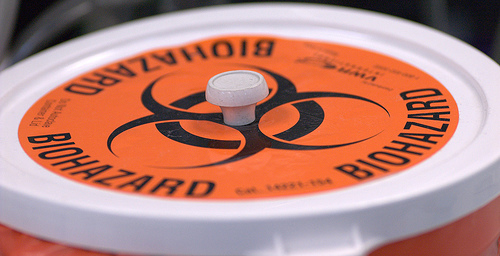
biohazard.jpg

Image by canardo

Smoke and Mirrors

The tobacco industry produces a product that, used as intended, kills millions of people each year. So it seems a lot to ask the industry to assume ethical standards in another of its favorite endeavors—funding scientific research.

The tobacco industry is up to some of its usual antics, as reported by

The New York Times. It seems tobacco money helped fund one of the most controversial studies to recently emerge from The New England Journal of Medicine.

The study concluded that the widespread use of CT scans could prevent 80 percent of lung cancer deaths.

The primary author of the study, Claudia Henschke of Weill Cornell Medical College declared funding through a little-known group, the Foundation for Lung Cancer: Early Detection, Prevention and Treatment. It took an investigative

reporter checking tax records to discover that foundation is actually funded by the parent company of the Liggett group, which manufactures several cigarette brands. Henschke did not reveal the source of the foundation’s money to the journal—what’s more, she helped create the foundation and is its president; the dean of Weill Cornell is a director.

The study’s findings obviously are favorable to the tobacco industry. But they have been controversial in part because early screening can lead to unnecessary procedures for spots on a CT scan that are not an imminent threat to health. A $200 million follow-up trial is now under way at the NCI.

What the tobacco linkage will mean for the validity of the study in the minds of experts remains to be seen—although this quote, from Catherine D. DeAngelis, the editor of The Journal of the American Medical Association, is telling:

I would never publish a paper dealing with lung cancer from a person who had taken money from a tobacco company.

Why so much fuss?

As DeAngelis is undoubtedly aware, the industry’s influence in this study fits into an overall pattern.

Tobacco companies fund research that has the potential to minimize the severe effects of smoking, and they also underwrite unrelated, legitimate, research, to bolster their reputation. It’s also not unusual for tobacco companies to keep their fingerprints away from the research they fund.

Tobacco companies also have a well-documented history of trying to stir up ‘debate’ about the dangers of smoking and second-hand smoke. Their support of research to bolster their arguments helped, for many years,

create public uncertainty about the dangers of tobacco and staved off anti-tobacco legislation. Sowing doubt about generally-accepted science is a tactic that foes of global warming legislation successfully borrowed; indeed, the tobacco industry spawned some of the ‘think tanks’ that now fight against global-warming legislation by supporting industry-friendly scientists.

Manipulating science has been a core tactic of the tobacco industry for years. So it’s not surprising that some schools, such as Harvard’s School of Public Health, have banned tobacco money. The University of California system refused to follow suit, but they have implemented a system of extra scrutiny over research funded by the tobacco industry. Opponents of a ban in California argued that it would constrain ‘academic freedom.’

What do you think? Does the source of funding for the NEJM study throw its findings into doubt? Or is this all a bunch of fuss about nothing?

Finally, is it fair for the editor of the Journal of the American Medical Association to refuse lung cancer papers funded by the tobacco industry?

Jumping through hoops

Similar to what happened in the US after the 9/11 attacks, the UK government has now decided to carry out security checks on foreign students going to Britain. The aim of this plan is to prevent sensitive knowledge from getting into the wrong hands.

Not surprisingly, some people are wary of this scheme, as they feel that it may deny opportunities for genuine students with no aim other than pursuing a scientific career. Others have expressed concerns about the loss of income from students whose countries pick up the tuition tab. And many more are simply concerned about the extra paperwork that both host institutions and prospective students will have to contend with.

I don’t know if the equivalent scheme in the US has been considered a success. I’m not even sure how one would measure its success. Sure, they may have caught a few malicious guys, but how many ‘false positives’ have been the victims of this paranoia? The one thing most people seem to agree on is the observation that, after prospective US students got hit by the extra security checks, many simply chose an alternative destination. As a result, some observers worry that the balance of scientific power will shift away from the US. Will a similar thing happen in Britain?

Reassuringly, the UK authorities have said that their decision-making process will be quick. But how tough will it be? Will there be many ‘false positives’ who will then have to choose a different country to do scientific research? I’m sure that other European countries, Canada, Australia and a few other nations will be very attentive in case there’s a repeat of the bonanza of students they welcomed after the US turned them down. That is, of course, until those countries decide that maybe they also should place more guards at their borders.

New Wrath over ‘Honest’ Jim

The scientific community shunned Nobel laureate James Watson, of double-helix fame, this week after he suggested that Africa’s prospect is “gloomy” because blacks are not as intelligent as other races. Watson was quoted by the UK’s Sunday Times as saying, “All our social policies are based on the fact that their intelligence is the same as ours – whereas all the testing says not really.”

The backlash was swift. On Wednesday, the Science Museum in London cancelled a sold-out talk Watson was scheduled to give this evening. A day later the board of trustees at Cold Spring Harbor Laboratory, where Watson serves as chancellor, suspended Watson’s administrative responsibilities. Watson, who had plans to tour the UK promoting his new book, Avoid Boring People: Lessons from a Life in Science, apologized and came home.

As a scientist, Watson should know better than to make such sweeping generalizations. I can think of a few other reasons to be gloomy about Africa’s prospects: AIDS, a history of intense colonization, and the persistence of corrupt leadership, to name just a few.

James Watson is wrong, but should he be silenced?

Posted on behalf of Cassandra Willyard, Nature Medicine’s news intern.

A European ORI?

Is it just me, or do people in the US pay more attention to scientific misconduct than, say, Europeans? Maybe it’s not just me; a recent editorial by Xavier Bosch in BMJ argues that Europe lags significantly behind the US in monitoring scientific integrity.

In the US, many institutions and have departments in charge of handling allegations of misconduct. And failing this, the Office of Research Integrity (ORI) deals with cases of misconduct and fosters scientific honesty at a national level. Furthermore, the ORI is taken very seriously; if you’re facing the possibility of an ORI investigation, you are very likely to make sure your lab comes clean as soon as possible to try to keep their officers from paying you a visit.

In Europe, monitoring of scientific integrity is fragmented. Each country deals with the problem as they see fit, and the editorial does a good job of telling you what happens in what country. From my own experience, Spain is not an example of good practices. We once had an allegation of misconduct and could never get anybody from the university in question to get involved.

Bosch also puts forward some possible solutions to the problem. He seems to think that tackling it at a pan-European level would be the best way forward. This certainly makes sense if we consider that many European papers report the work of labs from different countries and that European funding promotes the formation of international networks.

The flip side of this is that European bureaucracy has a reputation for slowness and inefficiency. It is therefore easy to imagine an allegation of misconduct getting lost in the Kafkian labyrinths of the European Union’s offices in Brussels, slowly ripening like a good French wine, but turning into vinegar for those who made the accusation and those who are trying to reproduce a piece of work that may be flawed.

In other words, the creation of a “European ORI” would be of value only if its procedures are streamlined and is not hindered by European policy and National laws. If it isn’t given enough authority and autonomy, and is dragged down by bureaucratic procedures, then what sounds like a good idea in principle is also likely to turn into vinegar.

An alternative, also mentioned by Bosch, is the creation of ORIs in those countries in which research integirty is currently not monitored. This may sound less dramatic, but it strikes me as more useful, specifically in the context of the push by some journals (including ours) to encourage authors to disclose the specific contribution of each person in the author list to the work being reported. So, if there are problems with the confocal images, the Western blots or the statistical analysis, one can know without ambiguity who is responsible and who should be investigated by the local authorities.

Regardless of whether one prefers national or pan-European solutions, one thing’s for sure: Europe has a lot of catching up to do on this front.

Science on a shoestring

Speaking of Apoorva, before she left the journal she managed to produce a fitting swan song — a collection of reports called “”https://www.nature.com/nm/journal/v13/n10/index.html#subcatxt">Science on a shoestring". In this collection, we present the stories of some scientists who, using materials as simple as litmus paper, bamboo and blenders, prove that science on a shoestring is possible.

We hope that these stories are inspiring, not only to other people who may not have the resources to do research, but also to those in rich labs, who often complain about their grants being rejected and about equipment being too expensive.

Back in Mexico, when I was starting in research, I do remember having to wash the plastic pipettes, as well as the pipette tips to reuse as many times as possible. We also had to remove the bottom of plastic graduated cylinders and glue a spout to them so that we could quantify the volume of liquid that our animals drank during their behavioral training. And we had these very elaborate contraptions to distill water, which was a precious commodity.

But that’s enough reminiscing for one day. Instead, tell us what’s happening in your neck of the woods. Do you also have to come up with clever inventions to compensate for the paucity of resources?

(Bio)piracy in Brazil and elsewhere

Biopiracy=stealing (indigenous) knowledge without proper compensation or credit in return.

Today’s New York Times carries a fascinating story about Marc van Roosmalen, a primatologist credited with discovering five species of monkeys and a new primate genus, who has been sentenced to nearly 16 years in a Brazilian jail.

van Roosmalen, one of Time magazine’s “Heroes for the Planet” in 2000, is charged with, among other things, taking monkeys from the forest without permits and offering to name new species after wealthy donors — a practice that is historically common in science, as the Times article points out.

Scientists are rallying to his defense, and 287 of them have signed a petition protesting his sentencing and saying it is indicative of the trend of government repression in Brazil. The government is apparently going overboard in its attempts to prevent biopiracy and, some say, making an example out of van Roosmalen.

This is all well and good. But this article is essentially a rehash of one that appeared in Nature three weeks ago. As anyone who works for scientific journals knows, this is par for the course. Articles that appear in Nature and Science routinely come out slightly modified in newspapers like the Times. And I suppose that’s fair enough. But my complaint here is that nowhere in the article is the acknowledgement that Nature first reported the story.

I’ll let the irony wash over you.

P.S. I particularly like the picture that ran with the Times article of this snake. Very eye-catching.

monkeys_snake.190

Science down under

I’ve just returned from a two-week trip to Australia to scout out stories on the state of research in the country. We’re planning to run a special issue about Australia science early next year so you can read about it in detail then, but one thing I can tell you is I have never met a bunch of people who take more pride in their country.

Almost every scientist I spoke to had trained abroad and they all said they couldn’t imagine living anywhere else. They could go on — and do — for hours about the marvelous lifestyle. Despite the lack of jobs for young scientists, postdocs come back to Australia for the 9-to-5 days, the slower pace, the lack of intense competition all around them.

There’s no doubt that despite this lack of intensity, Australia does produce some world-class science. But here’s my question for you: Is it possible for scientists to lead this kind of laidback lifestyle and still stay competitive? Or would Australia be a much bigger contender in science if its researchers burned the midnight oil like their American and European counterparts do?